deel

5.9K posts

deel banner
deel

deel

@deel

The all-in-one payroll & HR platform for global teams

San Francisco, CA Katılım Kasım 2018
238 Takip Edilen30.7K Takipçiler
deel
deel@deel·
🔴 LIVE NOW: The biggest AI policy debate. A US Chief Innovation Officer, the UK AI Minister, former US Secretaries of Labor, senior EU officials. Watch here lnkd.in/e6-t3Abh
deel tweet media
English
3
16
35
3.1K
deel
deel@deel·
Deel AI analytics is live. Ask any workforce question in plain English and get the report back in seconds. Salary ranges by role. Headcount by country. Contractor spend by region. No report builder, no exports. The more of your workforce that runs on Deel, payroll, EOR, contractors, compensation, hiring, the more you can see. One dataset, more questions you can answer. On Deel? Try it now. Not yet? Book a demo.
English
1
12
71
6.2K
deel
deel@deel·
We helped @BVNKFinance hire globally. Today, workers in 100+ countries get paid in stablecoins in minutes, powered by our partnership with BVNK. That's what borderless work meeting borderless payments actually looks like.
English
3
12
60
4.7K
deel
deel@deel·
2 days left. US, UK, EU policy voices debating AI and the future of work. This is the conversation you need to hear. July 9. Register now 👉 tinyurl.com/yx58fekh
English
1
5
20
1.1K
deel
deel@deel·
O-1 visa rejected? We refund you. Our in-house experts guide you through the entire process. That's how we support extraordinary talent globally. 🌎 Ready to make your move? Learn more: rb.gy/i4zsc6
deel tweet media
English
0
2
29
2.4K
deel
deel@deel·
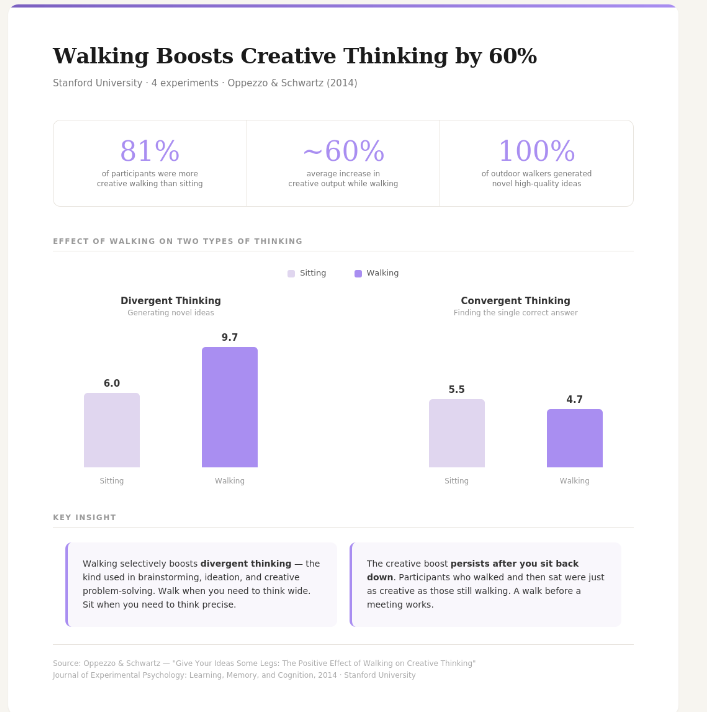
Walking increases creative output by 60%. And the boost doesn't stop when you sit back down. Stanford researchers ran four experiments testing what happens to creative thinking when people walk. They measured it using established creativity tests — tasks where you have to generate novel, useful ideas under time pressure. Here's what they found: 1. 81% of participants produced more creative ideas when walking than sitting. The average increase in creative output was around 60% — and it wasn't just more ideas. A higher proportion of the ideas generated while walking were novel and appropriate. 2. It works on a treadmill facing a blank wall. The creative boost came from the physical act of walking, not the change of scenery. To prove it, they pushed a separate group of participants in wheelchairs through the same outdoor path. Walkers outperformed them. The environment wasn't the driver. Walking was. 3. The effect doesn't stop when you sit down. Participants who walked and then sat were just as creative as those still walking — and far more creative than those who had been sitting the whole time. A short walk before a brainstorm is as effective as walking during one. 4. 100% of outdoor walkers generated at least one novel high-quality analogy, compared with 50% of those who sat indoors. Walking outside produced the most creative output across every measure. 5. Walking helps you brainstorm, not solve equations. It boosted divergent thinking (generating novel ideas) but slightly reduced convergent thinking (finding a single correct answer). The takeaway: walk when you need to think wide, sit when you need to think precise. We sit 9.3 hours a day — more than we sleep. And most of that sitting happens during the hours we're expected to do our most creative work. The next time you're stuck, the answer might not be to think harder. It might be to get up. 📊 Source: Oppezzo & Schwartz, "Give Your Ideas Some Legs: The Positive Effect of Walking on Creative Thinking," Stanford University, Journal of Experimental Psychology (2014)
deel tweet media
English
2
14
72
3.6K
deel
deel@deel·
Think you’ve got the winning picks ? ⚽️🏆 You have until June 10 to prove it for a chance at $150,000. Play now on the Deel platform.
deel tweet media
English
3
7
42
2.3K
deel
deel@deel·
For millions of contractors, a paycheck travels through exchanges they didn't choose, at rates they didn't set. Every stop costs something. That ends today. Introducing the Deel stablecoin wallet — hold earnings in DLUSD, be eligible to earn rewards, spend anywhere. All inside the Deel mobile app. Get paid. Hold. Earn. Spend. Launching today in Latin America, starting with early access in Argentina — APAC, MENA, and Africa to follow. Thanks @Stablecoin, @privy_io, @tempo, @Morpho and @SentoraHQ for making this possible!
English
24
43
549
163K
deel
deel@deel·
The sweepstake, done properly. ⚽ Deel Kick Off is a free global prediction competition for everyone on Deel. $150,000 prize pool. Wherever you work, whoever you support - you're in. 👉 app.deel.com/worldchampions… T&Cs apply. 18+. Participation may be restricted in certain jurisdictions.
English
1
4
380
30.4K
deel
deel@deel·
Here's how @Akai_by_deel works: Walk through a workflow once, and it builds every agent, connects them, and deploys. Each one triggers the next, and your team stays in control throughout.
English
2
7
20
1.8K
deel
deel@deel·
People who procrastinate are 16% more creative than people who start right away. That's from a study by Jihae Shin and Adam Grant, published in the Academy of Management Journal. Participants were asked to generate new business ideas. Some started right away. Others were given five minutes to play Minesweeper first. Independent evaluators rated the procrastinators' ideas as more creative - as long as the task was already in their head before they delayed. We're taught to start fast, move first, and avoid failure. But research on the most original thinkers shows the opposite: 1. Da Vinci spent 16 years of his life on the Mona Lisa. He kept getting sidetracked — studying optics, dissecting human anatomy, experimenting with how light hits curved surfaces. Those detours changed how he painted light, how he blended shadow, how he built depth without a single visible brushstroke. The delay made the Mona Lisa what it is today. Martin Luther King rewrote his biggest speech past 3am the night before the March on Washington. Still scribbling notes as he waited to go onstage. Eleven minutes into the speech, he abandoned his script entirely. "I have a dream", the four words that defined the civil rights movement, were improvised on the spot. 2. The failure rate is 47% for first movers vs 8% for improvisers. Facebook came after Myspace. Google came after Yahoo. Warby Parker launched after other companies were already selling glasses online. They were slow because they were solving the right problem. 3. Firefox and Chrome users stay 15% longer at their jobs. They also outperform IE and Safari users. It's not the browser. IE and Safari come preinstalled. Those users accepted the default. Chrome and Firefox users questioned it and went looking for something better. That instinct carries over into everything. 4. Warby Parker tested 2,000 names before finding the right one. Bach, Beethoven, and Mozart produced hundreds of compositions to get a handful of masterpieces. Elon Musk was sure the first SpaceX launches would fail. He didn't expect Tesla to succeed. But not trying felt worse than failing. The pattern: originals procrastinate, doubt their ideas, and fail constantly. They just refuse to let any of that be the reason they stop. Insights from Adam Grant's TED Talk on the surprising habits of original thinkers.
English
1
1
6
1.6K