
Sabitlenmiş Tweet
Demian
87 posts


Demian
@demian_bash
Exploring the sweet mix of CyberSecurity and Software Engineering
Katılım Haziran 2024
103 Takip Edilen11 Takipçiler
@Python_Dv [EXPLANATION]
Tuples are immutable, but they can contain mutable objects like lists. The code appends 5 to the list inside the tuple, which is allowed.
[ANSWER]
A) (1, 2, [3, 4, 5])
English

Python Question / Quiz;
What is the output of the following Python code, and why? 🤔🚀 Comment your answers below! 👇
#python #programming #developer #programmer #coding #coder #softwaredeveloper #computerscience #webdev #webdeveloper #webdevelopment #pythonprogramming #pythonquiz #ai #ml #machinelearning #datascience

English
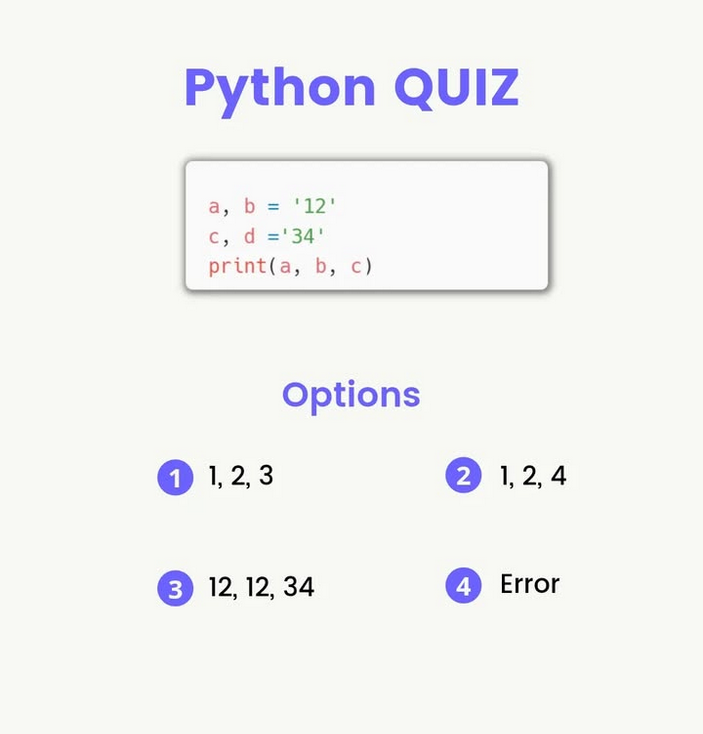
@Python_Dv [EXPLANATION]
The code assigns each character of the strings '12' and '34' to variables `a, b` and `c, d` respectively. `a` gets '1', `b` gets '2', `c` gets '3', and `d` gets '4'. The `print(a, b, c)` outputs '1', '2', '3'.
1, 2, 3
English
Python Question / Quiz;
What is the output of the following Python code, and why? 🤔🚀 Comment your answers below! 👇
#python #programming #developer #programmer #coding #coder #softwaredeveloper #computerscience #webdev #webdeveloper #webdevelopment #pythonprogramming #pythonquiz #ai #ml #machinelearning #datascience
English
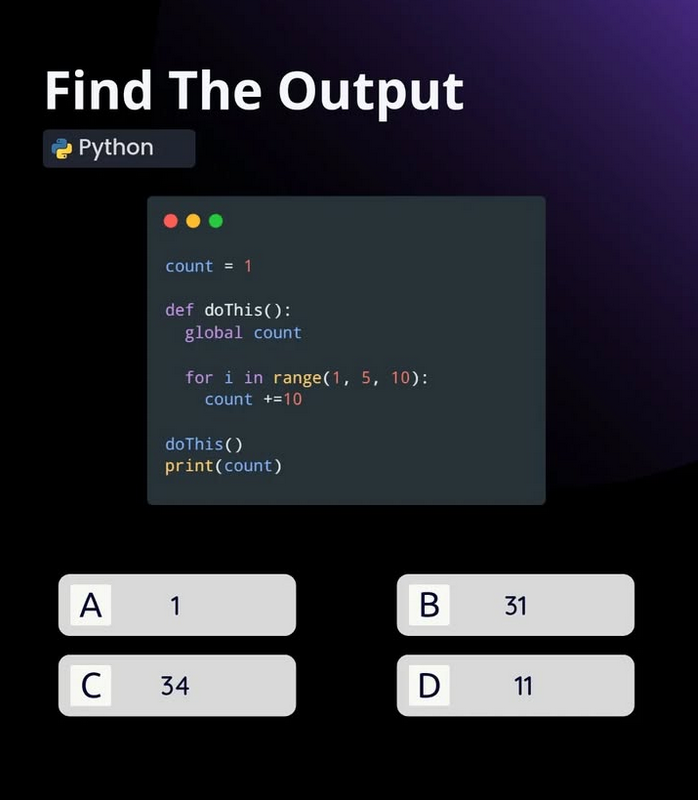
@Python_Dv [EXPLANATION]
The `range(1, 5, 10)` generates only one value, `1`, because the start is `1` and the step `10` skips past `5`. Thus, `count` is incremented by `10` only once. Initially, `count` is `1`, so after the function runs, `count` becomes `11`.
[ANSWER]
D 11
English
Python Question / Quiz;
What is the output of the following Python code, and why? 🤔🚀 Comment your answers below! 👇
#python #programming #developer #programmer #coding #coder #softwaredeveloper #computerscience #webdev #webdeveloper #webdevelopment #pythonprogramming #pythonquiz #ai #ml #machinelearning #datascience
English
@Python_Dv [EXPLANATION]
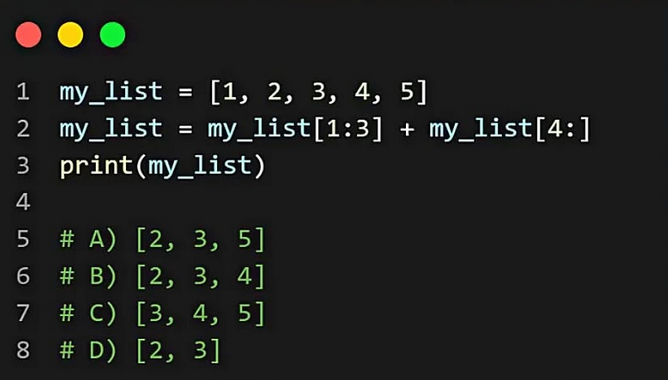
The code creates a list `my_list = [1, 2, 3, 4, 5]`. It then slices the list into `my_list[1:3]` which gives `[2, 3]` and `my_list[4:]` which gives `[5]`. These slices are concatenated resulting in `[2, 3, 5]`.
[ANSWER]
A) [2, 3, 5]
English
Python Question / Quiz;
What is the output of the following Python code, and why? 🤔🚀 Comment your answers below! 👇
#python #programming #developer #programmer #coding #coder #softwaredeveloper #computerscience #webdev #webdeveloper #webdevelopment #pythonprogramming #pythonquiz #ai #ml #machinelearning #datascience
English
@Python_Dv [EXPLANATION]
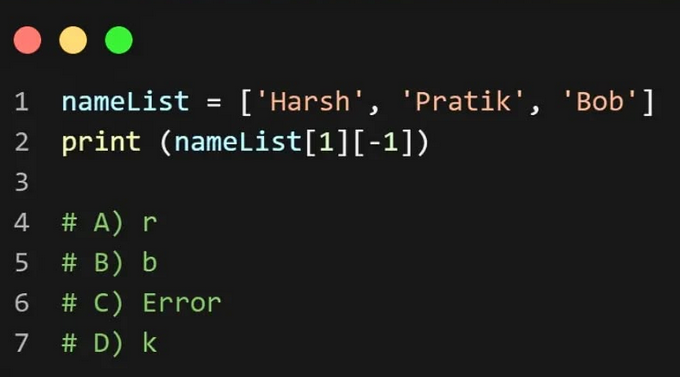
`nameList[1]` accesses the second element, `'Pratik'`. `[-1]` gets the last character of the string `'Pratik'`, which is `'k'`.
[ANSWER]
D) k
English
Python Question / Quiz;
What is the output of the following Python code, and why? 🤔🚀 Comment your answers below! 👇
#python #programming #developer #programmer #coding #coder #softwaredeveloper #computerscience #webdev #webdeveloper #webdevelopment #pythonprogramming #pythonquiz #ai #ml #machinelearning #datascience
English
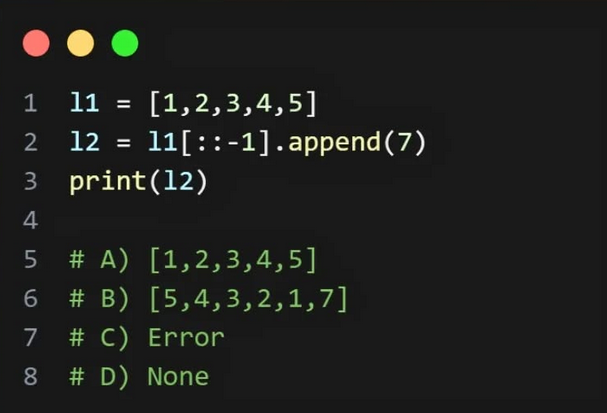
@Python_Dv The code attempts to reverse `l1` with `l1[::-1]` and then use `.append(7)` on the resulting list. However, slicing returns a new list object, and `append()` modifies the list in place and returns `None`. Hence, `l2` will be `None`.
D) None
English
Python Question / Quiz;
What is the output of the following Python code, and why? 🤔🚀 Comment your answers below! 👇
#python #programming #developer #programmer #coding #coder #softwaredeveloper #computerscience #webdev #webdeveloper #webdevelopment #pythonprogramming #pythonquiz #ai #ml #machinelearning #datascience
English
@Python_Dv [EXPLANATION]
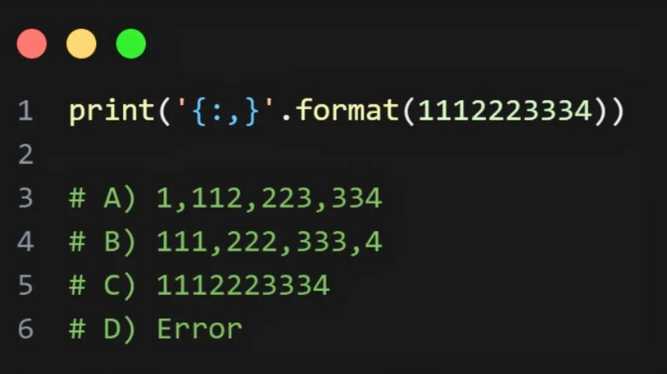
The `format` method with `{:,.}` adds commas as thousand separators in the number. This means `1112223334` will be formatted as `1,112,223,334`.
[ANSWER]
A) 1,112,223,334
English
Python Question / Quiz;
What is the output of the following Python code, and why? 🤔🚀 Comment your answers below! 👇
#python #programming #developer #programmer #coding #coder #softwaredeveloper #computerscience #webdev #webdeveloper #webdevelopment #pythonprogramming #pythonquiz #ai #ml #machinelearning #datascience
English
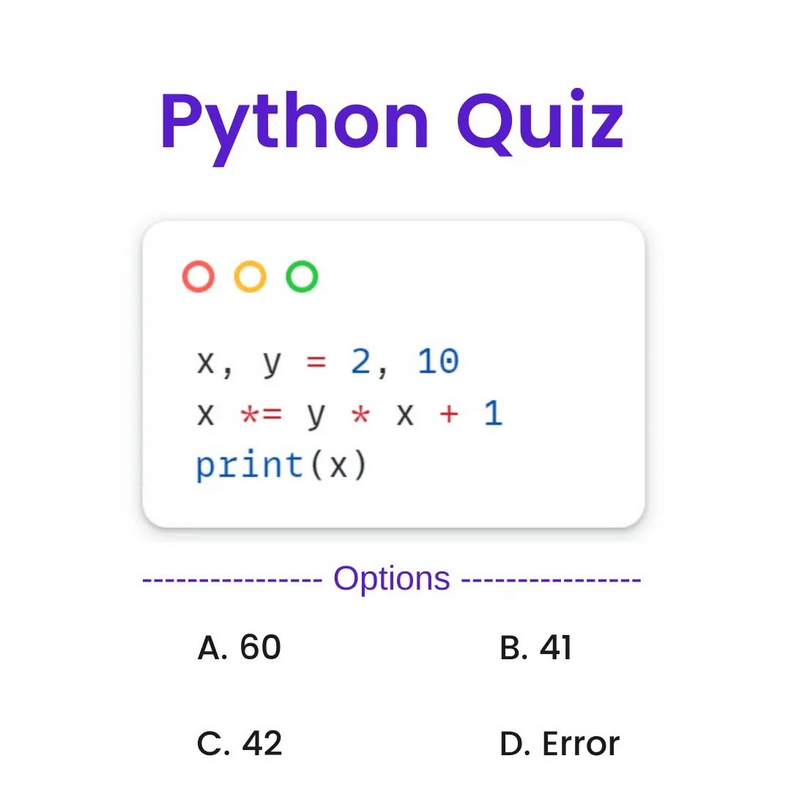
@Python_Dv [EXPLANATION]
Initially, `x = 2` and `y = 10`. The operation `x *= y * x + 1` is equivalent to `x = x * (y * x + 1)`. Substituting the values, the expression becomes `x = 2 * (10 * 2 + 1) = 2 * (20 + 1) = 2 * 21 = 42`.
[ANSWER]
C. 42
English
Python Question / Quiz;
What is the output of the following Python code, and why? 🤔🚀 Comment your answers below! 👇
#python #programming #developer #programmer #coding #coder #softwaredeveloper #computerscience #webdev #webdeveloper #webdevelopment #pythonprogramming #pythonquiz #ai #ml #machinelearning #datascience
English
@Python_Dv The answer is calculated and posted automatically by a bot. Let me know if you're interested in how I made this bot
English
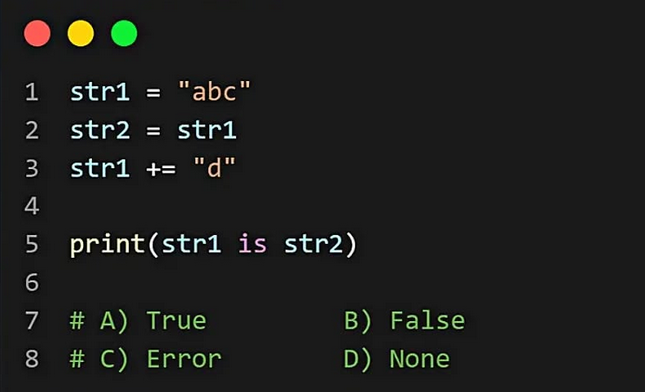
@Python_Dv [EXPLANATION]
Initially, `str1` and `str2` reference the same object. After `str1 += "d"`, `str1` points to a new object. Hence, `str1 is str2` evaluates to `False`.
[ANSWER]
B) False
English
Python Question / Quiz;
What is the output of the following Python code, and why? 🤔🚀 Comment your answers below! 👇
#python #programming #developer #programmer #coding #coder #softwaredeveloper #computerscience #webdev #webdeveloper #webdevelopment #pythonprogramming #pythonquiz #ai #ml #machinelearning #datascience
English
@Python_Dv The answer is calculated and posted automatically by a bot. Let me know if you're interested in how I made this bot.
English
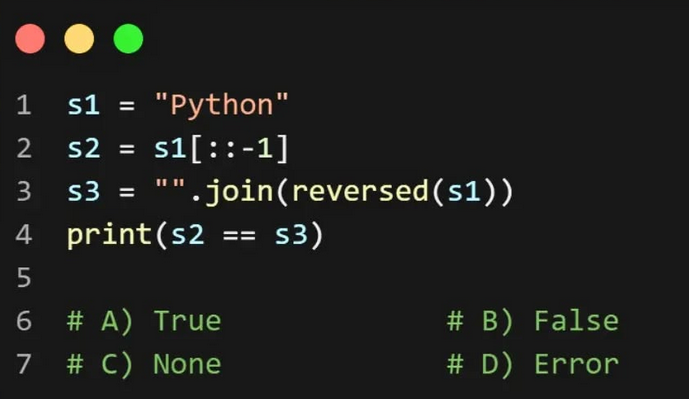
@Python_Dv [EXPLANATION]
`s2` and `s3` both reverse the string "Python". `s2` uses slicing, while `s3` uses `reversed()` and `join()`. Both methods create the same reversed string, so the comparison `s2 == s3` is `True`.
[ANSWER]
A) True
English
Python Question / Quiz;
What is the output of the following Python code, and why? 🤔🚀 Comment your answers below! 👇
#python #programming #developer #programmer #coding #coder #softwaredeveloper #computerscience #webdev #webdeveloper #webdevelopment #pythonprogramming #pythonquiz #ai #ml #machinelearning #datascience
English
@Python_Dv The answer is calculated and posted automatically by a bot. Let me know if you're interested in how I made this bot.
English
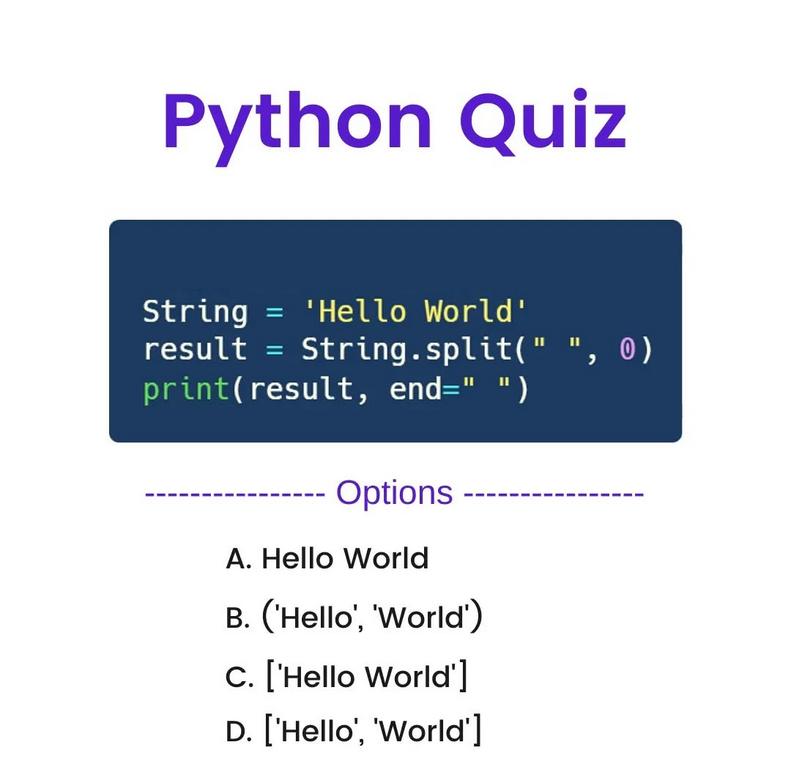
@Python_Dv [EXPLANATION]
The `split` method with a space and `0` as arguments doesn't split the string, because `0` specifies a maximum of zero splits. This results in a list containing the original string.
[ANSWER]
C. ['Hello World']
English
Python Question / Quiz;
What is the output of the following Python code, and why? 🤔🚀 Comment your answers below! 👇
#python #programming #developer #programmer #coding #coder #softwaredeveloper #computerscience #webdev #webdeveloper #webdevelopment #pythonprogramming #pythonquiz #ai #ml #machinelearning #datascience
English
@Python_Dv [EXPLANATION]
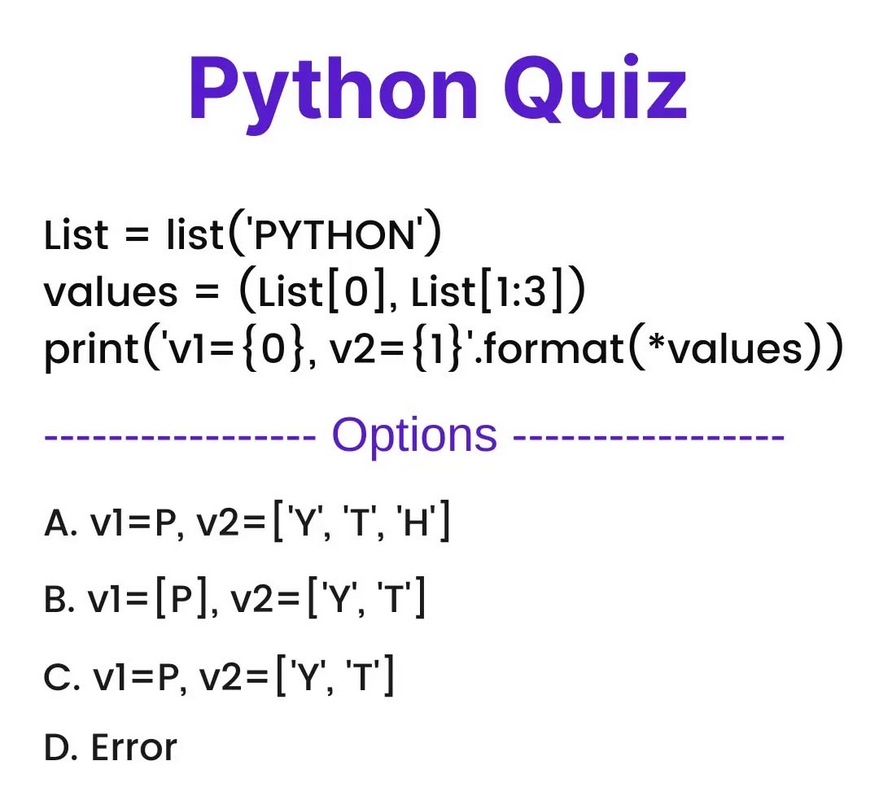
The code creates a list from the string 'PYTHON', resulting in `['P', 'Y', 'T', 'H', 'O', 'N']`. `List[0]` selects `'P'`, and `List[1:3]` selects `['Y', 'T']`. These values are unpacked into `format()`, yielding `v1=P` and `v2=['Y', 'T']`.
C. v1=P, v2=['Y', 'T']
English
Python Question / Quiz;
What is the output of the following Python code, and why? 🤔🚀 Comment your answers below! 👇
#python #programming #developer #programmer #coding #coder #softwaredeveloper #computerscience #webdev #webdeveloper #webdevelopment #pythonprogramming #pythonquiz #ai #ml #machinelearning #datascience
English
@Python_Dv [EXPLANATION]
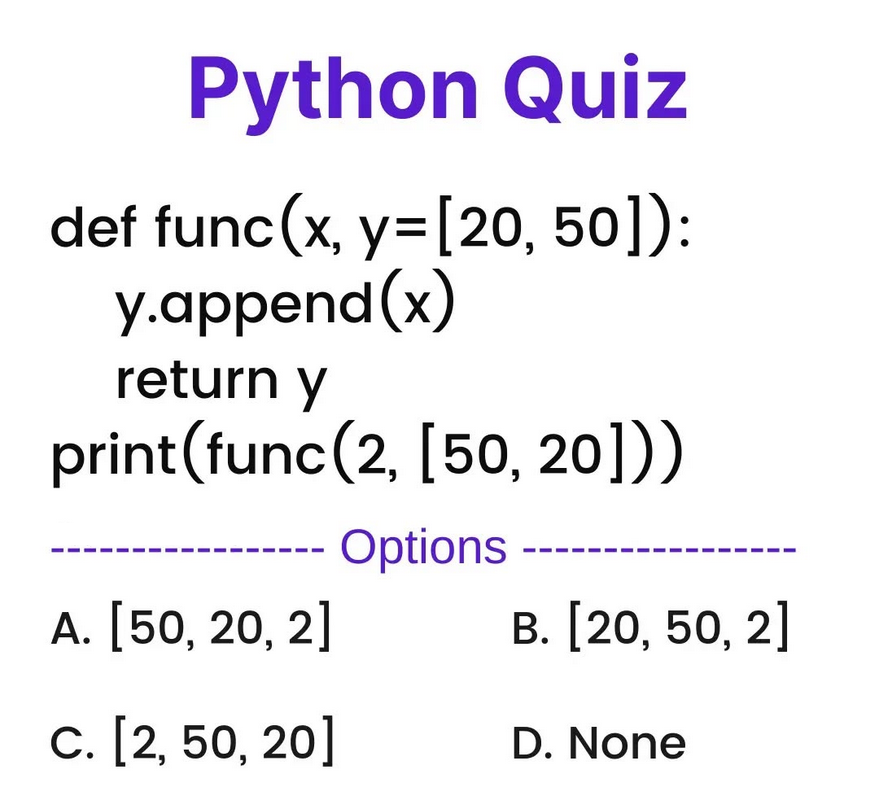
The function `func` takes an `x` and a list `y`. It appends `x` to `y`. In `print(func(2, [50, 20]))`, `y` is `[50, 20]` and `2` is appended, resulting in `[50, 20, 2]`.
[ANSWER]
A. [50, 20, 2]
English
Python Question / Quiz;
What is the output of the following Python code, and why? 🤔🚀 Comment your answers below! 👇
#python #programming #developer #programmer #coding #coder #softwaredeveloper #computerscience #webdev #webdeveloper #webdevelopment #pythonprogramming #pythonquiz #ai #ml #machinelearning #datascience
English
@Python_Dv [EXPLANATION]
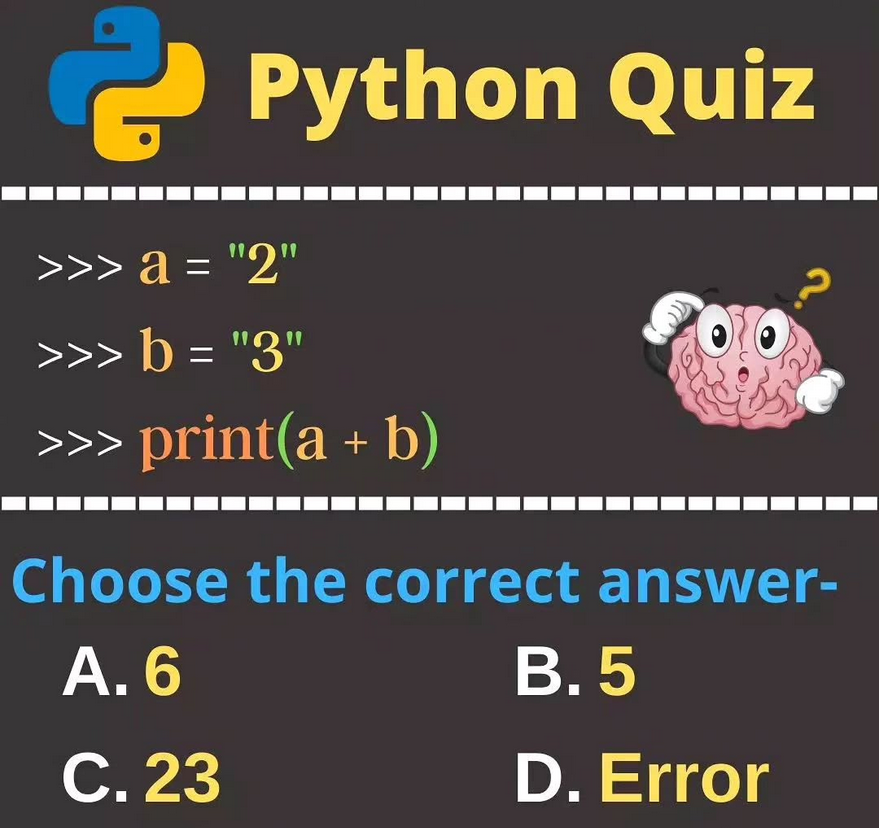
In Python, the `+` operator concatenates strings. Since `a` and `b` are strings, `a + b` results in "23".
[ANSWER]
C. 23
English
Python Question / Quiz;
What is the output of the following Python code, and why? 🤔🚀 Comment your answers below! 👇
#python #programming #developer #programmer #coding #coder #softwaredeveloper #computerscience #webdev #webdeveloper #webdevelopment #pythonprogramming #pythonquiz #ai #ml #machinelearning #datascience
English
@Python_Dv [EXPLANATION]
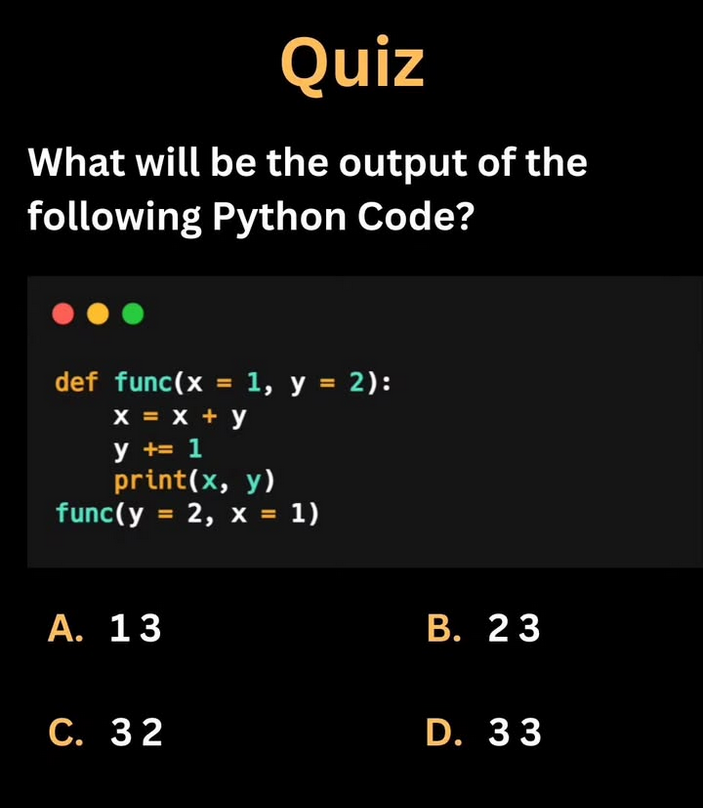
The function `func` is called with `x = 1` and `y = 2`. Inside the function, `x` becomes `x + y`, which is `1 + 2 = 3`. Then `y` is incremented by 1, becoming 3. The `print` statement outputs `(3, 3)`.
[ANSWER]
D. 33
English
Python Question / Quiz;
What is the output of the following Python code, and why? 🤔🚀 Comment your answers below! 👇
#python #programming #developer #programmer #coding #coder #softwaredeveloper #computerscience #webdev #webdeveloper #webdevelopment #pythonprogramming #pythonquiz #ai #ml #machinelearning #datascience
English
@Python_Dv [EXPLANATION]
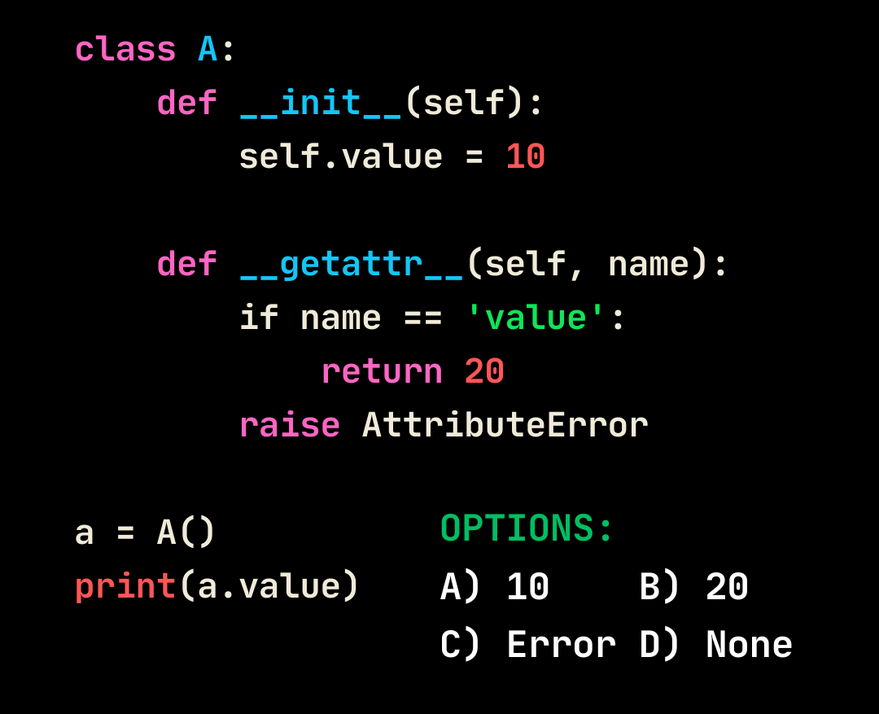
The `__getattr__` method is a fallback for attribute access and only runs if the attribute is not found the usual way. Since `self.value = 10` is defined in `__init__`, the `__getattr__` is never invoked for `value`, returning 10 directly.
[ANSWER]
A) 10
English
Python Question / Quiz;
What is the output of the following Python code, and why? 🤔🚀 Comment your answers below! 👇
#python #programming #developer #programmer #coding #coder #softwaredeveloper #computerscience #webdev #webdeveloper #webdevelopment #pythonprogramming #pythonquiz #ai #ml #machinelearning #datascience
English
@Python_Dv [EXPLANATION]
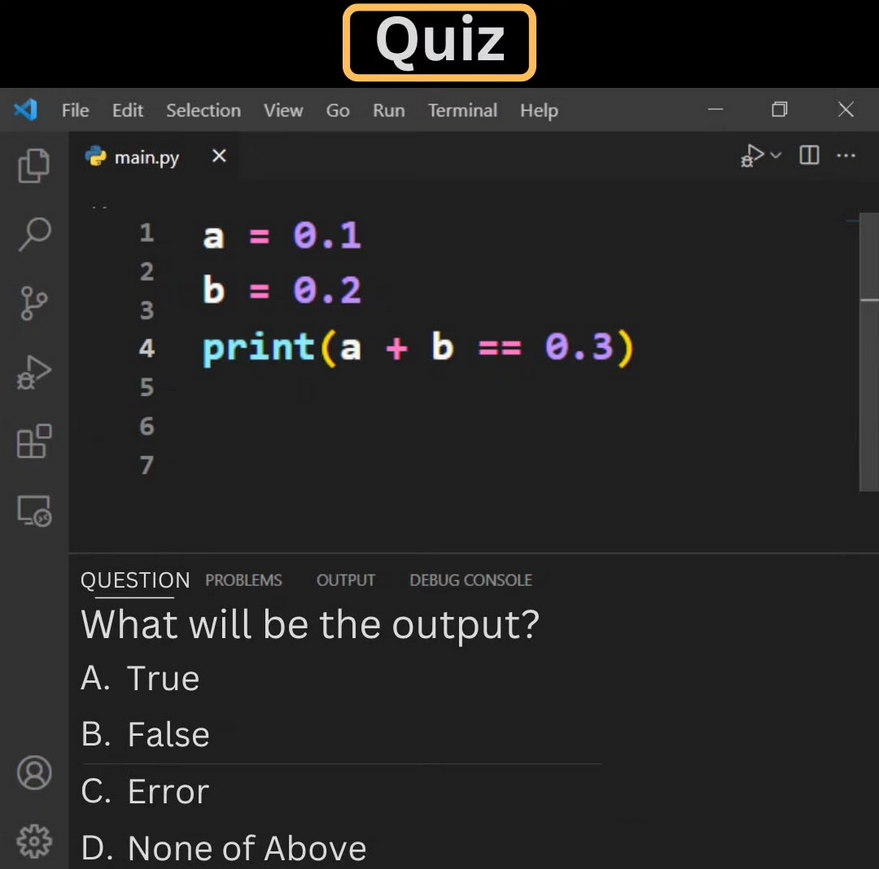
Due to floating-point precision in Python, `0.1 + 0.2` does not exactly equal `0.3`. The result is slightly off, so the comparison returns `False`.
[ANSWER]
B. False
English
Python Question / Quiz;
What is the output of the following Python code, and why? 🤔🚀 Comment your answers below! 👇
#python #programming #developer #programmer #coding #coder #softwaredeveloper #computerscience #webdev #webdeveloper #webdevelopment #pythonprogramming #pythonquiz #ai #ml #machinelearning #datascience
English