

derpilu
1.9K posts


We're not going to travel beyond the solar system, according to Leonard Susskind. And neither are aliens, coming to visit us.
We may not be alone, but we are stuck here for, essentially forever.
1. The nearest star is 4.24 light years away. The fastest spacecraft ever built would require 6,600 years to get there.
2. Surely we can just build faster spacecraft. The problem is to get to anywhere close to the speed of light, we need exponentially more energy.
3. Chemical rockets will just not work. Even fusion rockets won't work. Even 10% of the speed of light is not achievable. The Tsiolkovsky Rocket Equation prevents it.
4. Interstellar dust becomes hand grenades when traveling anywhere close to the speed of light. Ships break.
5. Space radiation will kill us over the time need to travel interstellar distances. Impossible to protect without massive shields, which require massive energy to accelerate and de-accelerate.
English

🚨 THE BIGGEST CRASH IS COMING NEXT
Not Stocks.
Not Bitcoin.
Not Precious metals
But "Bitcoin dominance."

English
@BenWByrne @TaraBull mine is that it's way more than what we think it is
English

@TaraBull My biggest conspiracy theory is the earths population is way less than what we think it is.
English

@cryptaxpt Mas a lei não fala apenas de taxable event apenas quando se passa de Crypto para fiat? Do que me lembro era claro nisso. Agora essa regulação prevalece perante a lei portuguesa?
Tenho dúvidas quanto a isto e continua tudo uma grande confusão.
Português

🚨Important update for crypto users and investors in Portugal: Selling or swapping to stablecoins could trigger taxation as early as 2027 (especially as MiCA fully reshapes the landscape).
Portugal has long been attractive for crypto, but with MiCA (Markets in Crypto-Assets Regulation) implementation advancing and broader EU transparency rules (like DAC8 reporting starting in 2026, with exchanges in 2027), the treatment of stablecoins, particularly Electronic Money Tokens (EMTs), is coming into sharper focus.
✅Not all stablecoins are considered EMTs
Here's what you need to know about Electronic Money tokens(EMTs) under MiCA:
Definition & Purpose:
EMTs are digital representations of a single fiat currency (e.g., € or $), using DLT to store value and enable fast, low-cost payments. They're essentially regulated digital cash.
Stability Mechanism:
Pegged 1:1 to one official legal tender currency, minimizing volatility unlike volatile assets (Bitcoin) or multi-asset referenced tokens.
Key Safeguards (via MiCA):
- Issued only by authorized credit institutions (banks) or electronic money institutions (EMIs).
- Holders enjoy direct redemption rights at par value (full face value) anytime.
- Issuers must maintain 100% reserves, with strict liquidity rules (e.g., at least 30% in segregated accounts).
- Mandatory authorized white papers and strong consumer protections for transparency and financial stability.
EMTs stand apart from other crypto:
They're built for reliability as a medium of exchange in the EEA, not speculation.
Why this matters in Portugal now??
As MiCA aligns national rules (with full effects rolling out), and enhanced reporting/transparency kicks in, transactions involving EMTs/stablecoins may increasingly be treated as taxable events, especially redemptions or fiat off-ramps. Long-term holdings (>365 days) often remain exempt from capital gains tax under current rules, but short-term or frequent use could change the calculus.
⚠️Stay informed, review your holdings, and consider professional advice as the regulatory environment evolves.
Tax guy 🇵🇹@cryptaxpt
🚨Selling for Stablecoin might trigger a taxable event in the near future!🇵🇹 Understanding SEMP and what it means to your taxes! As we hit Q1 2026, the EU's DAC8 (implementing the OECD's Crypto-Asset Reporting Framework - CARF) is fully live, requiring crypto platforms to collect and report user data on transactions. Not all digital assets are treated the same Enter SEMP, Specified Electronic Money Product, a crucial carve-out that's changing how certain stablecoins and digital fiat representations are handled for tax reporting: What qualifies as a SEMP? A digital product representing a single fiat currency (e.g., USD or EUR), issued against received funds, redeemable at any time and at par value (1:1) due to regulatory requirements on the issuer. Think regulated e-money tokens or certain fiat-backed stablecoins that behave like traditional electronic money (with strong redemption rights, no substantive barriers). Why it matters now: True SEMPs are excluded from CARF scope (no mandatory crypto-specific transaction reporting under DAC8). Instead, they fall under the amended CRS (Common Reporting Standard 2.0), treating them more like bank/e-money accounts for automatic exchange of information. Non-SEMP crypto (Bitcoin, most utility tokens, algorithmic stablecoins, etc.) → full CARF reporting kicks in. Mid-year status changes? Recent OECD FAQs clarify: report under CARF until the product qualifies as SEMP, then switch to CRS (jurisdictions may allow full-year treatment for simplicity). For investors in Portugal, this distinction is huge: ✅Holding a qualifying SEMP could align better with traditional financial account treatment → potentially smoother compliance and lower evasion risks. ❌But misclassifying a stablecoin as SEMP when it doesn't meet strict redemption/regulatory criteria? That could trigger unexpected CARF obligations and audits. For tax optimization (especially in favorable jurisdictions), early planning around SEMP vs. Relevant Crypto-Asset makes all the difference. My view: Stablecoins like USDC become less and less riskier from the depeggin point and therefore I see they become more and more of a fiat currency. I still think there is lots of stablecoins that do not fall under SEMP and therefore lots of opportunities to hold you capital gains in crypto. The income tax report (Modelo 3) in Portugal is already prepared for this reporting as it clearly differentiates between crypto assets which are considered securities and crypto assets which are not considered securities. If you have any questions, drop them below⬇️
English
@toutatis16 Isto não faz sentido. Estás a comparar um país que foi atacado e outro que é considerado seguro.
Não existe bolha no imobiliário em Portugal, esquece isso. O que existe é uma procura massiva que só se vai agravar com esta guerra.
Português
O imobiliário em 🇵🇹 em breve....
Quem comprou casa com crédito nos últimos 2 anos em 🇵🇹....
Pior decisão de sempre....
David 🥇🦍🥈the Ape@patato_ass
Dubai real estate bubble 🫧 burst 💥
Português

Just saying… a 69 would be pretty well received right now. 😜🔥
#Bitcoin

Bologna, Emilia Romagna 🇮🇹 English
@klos @CameronSralla Most Devs are actually consultants. If you think you know exactly what you want and the use case is fairly safe with little margin for error, use AI.
English

@CameronSralla I don't know. People goes philosophical, but I don't care if it's "over" - all I know is that in two months I did all I planned for the next 2 years.
English
3 years ago, I hired a programmer to write a feature. He tried for almost 3 months. It cost me ~$10k, and the result was so buggy that I decided to turn it off.
Today, I'm deploying the same feature written by Opus in about 1h.
It's not binary, but many programer s are worse than AI in most tasks.
English
@Skylarjderouen @umzrs For me it's the opposite: Gaining experience and some financial stability first and then take a risk. Could be in their 30s, 40s or even 50s.
English

@umzrs Disagree. They are young enough to take risks. It’s best to do it now instead of when they are in their 40s
English

It’s crazy what Andrew Tate and these course sellers did to some of these kids bro
I’ve seen guys who have nothing going for them drop out of school or college to pursue things like ecom, day trading, etc full time
And these guys have no skills - they’re dumb and don’t have any work ethic
They just heard “you need to break out of the Matrix” and went with it
When in reality they don’t have what it takes to make it in business and should be working a low-level job somewhere, but they can’t get one since they don’t have a degree and spent the last 3 years “grinding on trading” instead of getting actual jobs
Genuinely a lot of guys like this that are never gonna make it
They just got hooked in by hustle culture but were too stupid to realize that they don’t have the skills, smarts or work ethic to make anything happen
English

This will go down as the biggest downgrade in history.
#HenryCavillSuperman
#RestoreTheSnyderVerse
#WeWantZackSnyderBack

English


He's scared. Wait till you see the white of his eyes.
Bro, you just lost $43 a share in a quarter on a company that's only trading at about $100. $MSTR is functionally fucking bankrupt - your liabilities exceed your liquidatable assets. And Bitcoin is now less than 20K away from your entire company's stash being force liquidated and sending the price of the tokens to 4 digits.
HODL isn't going to save you - you've got to find new injections of capital. And your big problem is, anyone not already in crypto no longer trusts it and won't put any money in it (largely because of you). So where's the money coming from, homie? Your little crew is tapped the fuck out.
Michael Saylor@saylor
HODL
English

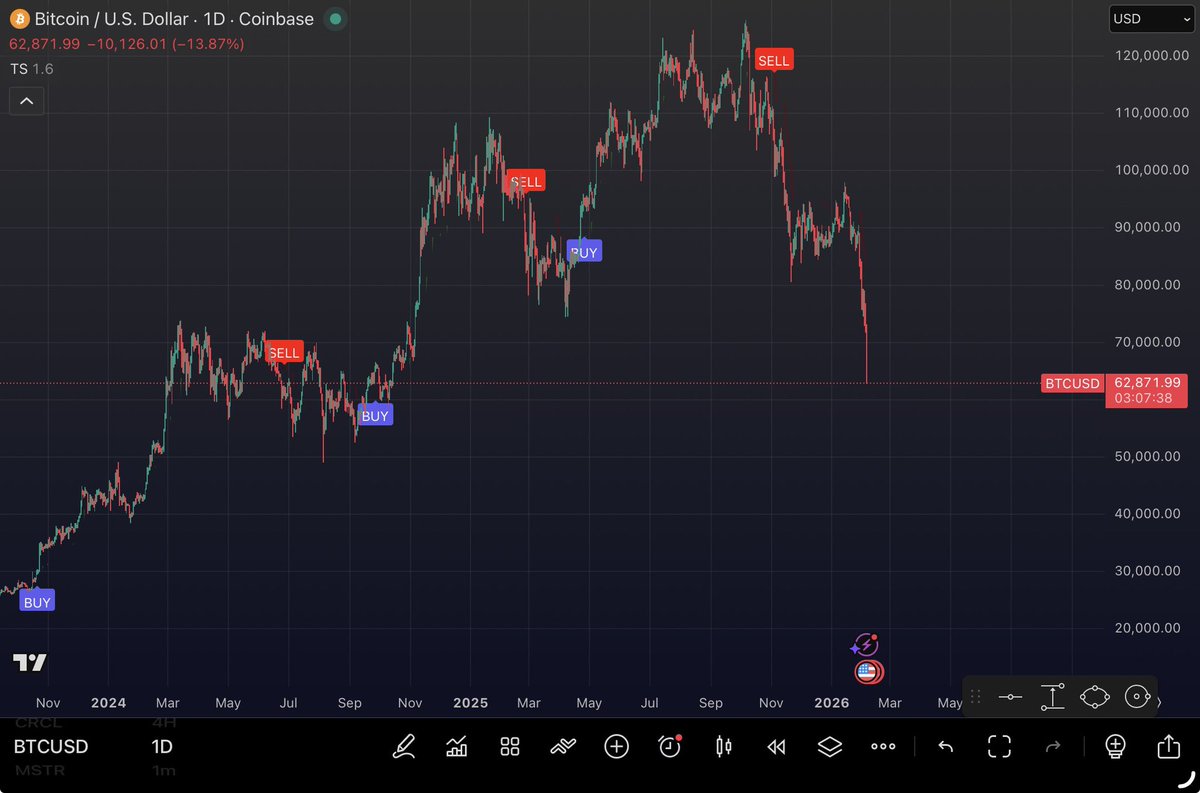
Bitcoin goes to zero scenario🚨
There’s a real chance Jeffrey Epstein knew who Satoshi Nakamoto was
Epstein reportedly claimed he had met Bitcoin’s founders. During a certain period, he was allegedly funding around 60% of Bitcoin Core developers’ salaries. He also invested in Blockstream, a company with massive influence over Bitcoin Core and the Lightning Network.
At the same time, Epstein was closely connected with Brock Pierce, Tether co-founder, later arrested for child abuse charges. Pierce allegedly encouraged Epstein to invest in Tether.
Together, they reportedly labeled Ripple and Stellar as “bad for the ecosystem” and actively tried to push them out of shared funding circles.
This period perfectly aligns with the rise of Bitcoin maximalism.
So here’s the uncomfortable question:
If documents ever surface proving that Bitcoin’s creator(s) were exposed and that Bitcoin was used as part of Epstein’s money-laundering network…
then Bitcoin doesn’t “dip”.
Bitcoin ceases to exist
Think about that
$BTC $MSTR $ETH
English
@LaPetiteADA Good luck solving the trilemma. I'm betting on the Cardano Leios solution but when will it be available? And will retail care about it? I really don't know anymore. I think Cardano needs marketing to attract average Joe's who will be willing to buy cat nfts and pump the price.
English
It seems like Ethereum is adopting Cardano’s approach. 👀🦋🍄
Ethereum's scaling strategy didn’t work out:
• L2s aren’t true ETH
• Most don’t have enough security
• ETH’s L1 has to scale on its own
Cardano was built this way from day one:
• L1 security first
• No bridged assets as a foundation
• Scales without breaking L1 trust with:
✅ Hydra: high-speed, low-cost tx (1M TPS)
✅ Leios: higher L1 throughput, same security
vitalik.eth@VitalikButerin
There have recently been some discussions on the ongoing role of L2s in the Ethereum ecosystem, especially in the face of two facts: * L2s' progress to stage 2 (and, secondarily, on interop) has been far slower and more difficult than originally expected * L1 itself is scaling, fees are very low, and gaslimits are projected to increase greatly in 2026 Both of these facts, for their own separate reasons, mean that the original vision of L2s and their role in Ethereum no longer makes sense, and we need a new path. First, let us recap the original vision. Ethereum needs to scale. The definition of "Ethereum scaling" is the existence of large quantities of block space that is backed by the full faith and credit of Ethereum - that is, block space where, if you do things (including with ETH) inside that block space, your activities are guaranteed to be valid, uncensored, unreverted, untouched, as long as Ethereum itself functions. If you create a 10000 TPS EVM where its connection to L1 is mediated by a multisig bridge, then you are not scaling Ethereum. This vision no longer makes sense. L1 does not need L2s to be "branded shards", because L1 is itself scaling. And L2s are not able or willing to satisfy the properties that a true "branded shard" would require. I've even seen at least one explicitly saying that they may never want to go beyond stage 1, not just for technical reasons around ZK-EVM safety, but also because their customers' regulatory needs require them to have ultimate control. This may be doing the right thing for your customers. But it should be obvious that if you are doing this, then you are not "scaling Ethereum" in the sense meant by the rollup-centric roadmap. But that's fine! it's fine because Ethereum itself is now scaling directly on L1, with large planned increases to its gas limit this year and the years ahead. We should stop thinking about L2s as literally being "branded shards" of Ethereum, with the social status and responsibilities that this entails. Instead, we can think of L2s as being a full spectrum, which includes both chains backed by the full faith and credit of Ethereum with various unique properties (eg. not just EVM), as well as a whole array of options at different levels of connection to Ethereum, that each person (or bot) is free to care about or not care about depending on their needs. What would I do today if I were an L2? * Identify a value add other than "scaling". Examples: (i) non-EVM specialized features/VMs around privacy, (ii) efficiency specialized around a particular application, (iii) truly extreme levels of scaling that even a greatly expanded L1 will not do, (iv) a totally different design for non-financial applications, eg. social, identity, AI, (v) ultra-low-latency and other sequencing properties, (vi) maybe built-in oracles or decentralized dispute resolution or other "non-computationally-verifiable" features * Be stage 1 at the minimum (otherwise you really are just a separate L1 with a bridge, and you should just call yourself that) if you're doing things with ETH or other ethereum-issued assets * Support maximum interoperability with Ethereum, though this will differ for each one (eg. what if you're not EVM, or even not financial?) From Ethereum's side, over the past few months I've become more convinced of the value of the native rollup precompile, particuarly once we have enshrined ZK-EVM proofs that we need anyway to scale L1. This is a precompile that verifies a ZK-EVM proof, and it's "part of Ethereum", so (i) it auto-upgrades along with Ethereum, and (ii) if the precompile has a bug, Ethereum will hard-fork to fix the bug. The native rollup precompile would make full, security-council-free, EVM verification accessible. We should spend much more time working out how to design it in such a way that if your L2 is "EVM plus other stuff", then the native rollup precompile would verify the EVM, and you only have to bring your own prover for the "other stuff" (eg. Stylus). This might involve a canonical way of exposing a lookup table between contract call inputs and outputs, and letting you provide your own values to the lookup table (that you would prove separately). This would make it easy to have safe, strong, trustless interoperability with Ethereum. It also enables synchronous composability (see: ethresear.ch/t/combining-pr… and ethresear.ch/t/synchronous-… ). And from there, it's each L2's choice exactly what they want to build. Don't just "extend L1", figure out something new to add. This of course means that some will add things that are trust-dependent, or backdoored, or otherwise insecure; this is unavoidable in a permissionless ecosystem where developers have freedom. Our job should make to make it clear to users what guarantees they have, and to build up the strongest Ethereum that we can.
English
@UtxoSaint Don't assume there aren't rugs in the CNTs space.
Also, it's probably an architectural problem. They need to implement an interface and there isn't enough liquidity to justify it. That's my guess as to why we don't see CNTs on big exchanges.
English

Now understand why #Cardano native assets were never listed in these big exchanges? Mfrs are all scammers and list only scam tokens involving ponzinomics. And we don’t have ponzinomics built in. We also refuse tomoay the KOL mfrs. So we are useless to scammers . Wish there was a way normie retail can discover this. $ADA is different!
Leonidas 🧡 $DOG@LeonidasNFT
JUSTIN SUN'S GIRLFRIEND IS GOING SCORCHED EARTH ON JUSTIN AND CZ IT'S 10X WORSE THAN WE IMAGINED EXCHANGES LIKE BINANCE HAVE BEEN COLLUDING WITH PROJECTS LIKE TRON TO BUILD MASSIVE PAID KOL NETWORKS IN ORDER TO MANIPULATE MARKETS AND INSIDER TRADE
English

The only people even remotely interested in buying bitcoin are the people that already have it.
Everyone else is not interested and not waiting for an opportunity to buy it.
English

This is, quite honestly, the worst sentiment I have ever experienced in the crypto space. Total psychological capitulation across every class of person. Investors, traders, users, developers, retail. This is absolute rock bottom sentiment (so far!).
Worse than Luna blowup, FTX blowup, 2018 bear market, Covid crash. Only time it may have felt worse was Mt Gox (I wasn't around for that though).
English
@DavidKPiano Services build themselves through magic and an army of unserious software engineers. Got it.
English

Any serious software engineer with experience knows that coding is a very small part of the job
And any dev not influenced by hype knows that AI can only automate *most* of coding well, but not so much the rest
Adriksh@Adriksh
Learning to code is now a hobby, not a career move.
English
