Sabitlenmiş Tweet
Mark Kuatbayev
884 posts

Mark Kuatbayev
@designwithmark
We help SaaS Startups and Agencies position themselves as a 1% authority with strategic design solutions. ✦ +30 Partners served. https://t.co/QWFUYIBCOI
Katılım Haziran 2024
633 Takip Edilen1.4K Takipçiler

We analyzed the last 30 web projects we've done.
The ones needing 5+ revision rounds had one thing in common: we skipped our "internal filter" before moving to development.
Now we run every design through it before executing. Takes 5 minutes to answer, and eliminates 80% of revisions.
Here are the questions:
1. Does this solve the actual problem, or just look good?
Easy to create something beautiful that accomplishes nothing.
We ask: what job does this design need to do? Does it actually do that job?
If it's optimized for aesthetics over outcomes, we start over.
2. Is the most important thing obviously the most important?
If a visitor can't tell what matters most in 3 seconds, the hierarchy failed.
We look at the layout: what do we want them to see first? Does that actually stand out?
If not, we fix it before moving forward.
3. Would this make sense to someone seeing it for the first time?
We've been staring at this for hours. We know the context, the strategy, the backstory.
Clients and their visitors don't.
If someone landed here with zero context, would they immediately understand what this is and why it matters?
If we have to explain it, it's not clear enough yet.
4. Are we following the strategy, or did we drift?
Easy to chase a design direction that looks interesting and forget what we're solving for.
Quick check: does this align with the brief? The goals? The audience we're trying to reach?
If we've wandered into something that's cool but off-strategy, we pull back.
5. What would we change if we had one more day?
There's always something we know could be better.
Sometimes it's minor—tighten spacing, refine a headline. Sometimes it's structural—the flow doesn't quite work.
If there's something we'd fix with more time, we fix it in design, not after development.
The result:
Projects now typically need 1-2 revision rounds instead of 4-5.
That's 10-15 hours saved per project.
Clients can focus feedback on strategic direction instead of catching basic execution problems we should've spotted ourselves.
Not perfectionism. Just catching our own issues before they become someone else's feedback.
What would you add to this filter?

English

@michal_gren yup, expanding our service range and entering this market now
English

@designwithmark Always love when 3d designers works on a tiny details like textures - are going to enter the 3d motion market?
English

@sharpbin_ perfection! who was responsible for the sound design btw?
English

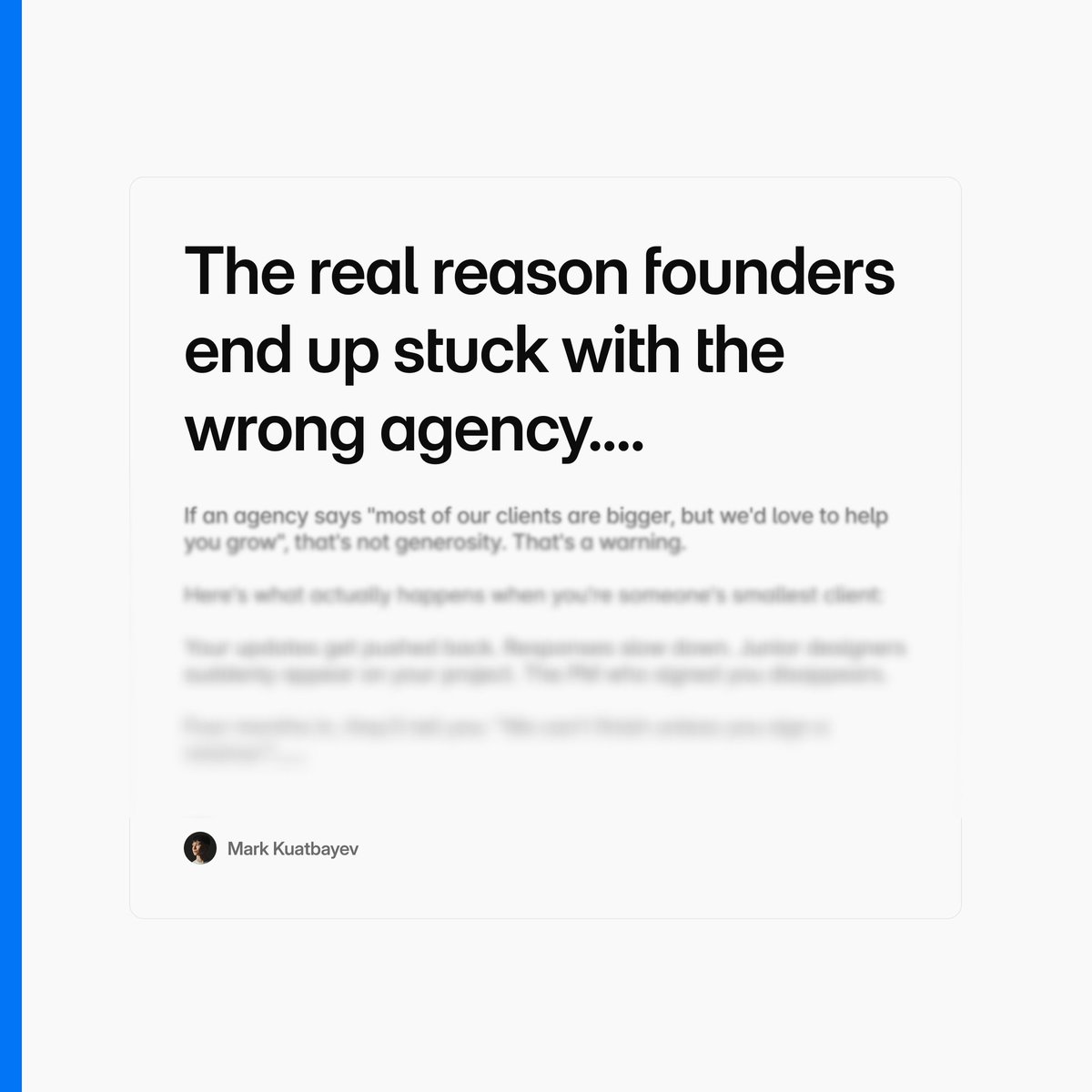
If an agency says "most of our clients are bigger, but we'd love to help you grow", that's not generosity.
That's a warning.
Here's what actually happens when you're someone's smallest client:
Your updates get pushed back.
Responses slow down.
Junior designers suddenly appear on your project.
The PM who signed you disappears.
Four months in, they'll tell you: "We can't finish unless you sign a retainer."
By then, everything's 80% done, but nothing's usable. Switching vendors means starting over.
They know it. You know it. So you sign.
It's not evil. It's resource allocation.
Most agencies optimize for their ideal client size. When you're below it, you're the filler work between retainer commitments.
At Lumibuild Studio, we only work with agencies and SaaS startups doing $10K-100K/month. That's our sweet spot.
We don't take enterprise clients with $40K/month budgets because it would force us to deprioritize you.
When you're in our designed-for range, you get our best resources, fastest timelines, tightest communication.
No bigger fish to bump you.

English

@designwithmark Really amazing illustration man
Are they all made it Figma ?
English

We've got 3 open slots for January 2026. Book your discovery call today:
cal.com/marklumibuilds…
English

We're currently building a website for a SaaS startup with over 12,000 customers.
Early in the project, we shared wireframes, rough structure and messaging direction. Nothing polished yet.
It's the same approach we followed for months:
"Don't wait until something's polished to show."
Early on, we used to think that it's more professional to present finished work, something that looked complete, refined, ready.
But that approach creates problems.
When you wait until work is polished to share it, feedback comes late. And late feedback is expensive.
Not just in time, but in the decisions that get locked in while you're perfecting something that might be going in the wrong direction.
Here's what we've learned after working with 30+ startup and agency founders:
Rough work gets better feedback.
When something's polished, clients hesitate to give real feedback. It looks done.
They don't want to ask you to redo it. So they say it looks good, even if something feels off.
When something's rough, feedback is honest and it's clearly a draft.
Clients feel comfortable saying "this doesn't feel right" or "I think we're solving the wrong problem."
That honesty is what you need early, not politeness.
It also catches misalignment faster.
If we spend two weeks perfecting a design, then show it, and the client says "actually, I was thinking something completely different"—we've wasted two weeks.
If we show rough concepts after three days and hear "that's not the direction," we've saved ourselves weeks of work.
Early feedback isn't a disruption. It's a correction before the cost compounds.
Here's what rough work looks like:
- Wireframes before high-fidelity designs.
- Messaging drafts before final copy.
- Concept sketches before full layouts.
It's not pretty, but it's clear enough to evaluate direction.
And direction is what matters most early on, not polish.
This doesn't mean we show half-baked nonsense.
Rough work is still intentional. It shows our thinking. It has structure.
But it's not final and that's the point.
When we share it, we're saying: "Here's where we're headed. Does this feel right, or should we adjust before we build it out?"
That question, asked early, saves everyone time, money, and frustration.
Because catching a problem at the concept stage takes hours to fix.
Catching it after everything's polished takes weeks.

English

@prachiruns when work doesn't feel like work anymore that's just amazing, haha. I remember having the same feeling before, but recently the work became a bit monotonous. gotta work on my resting rituals, I guess
English

I took an intro call with a founder who’d just raised a Series A on Christmas morning at 9am.
When we both joined the call, we had the same slightly smug expression.
Like neither of us should ideally be here right now.
I thanked him for taking the call on a holiday. He laughed and said he’ll celebrate later, but there’s too much happening in the company to fully switch off. It’s an exciting phase and he genuinely enjoys being in it.
He asked me the same question. And I realised I’m in a similar place.
It’s very common around this time to hear “take a break”, “switch off”, “don’t open Figma or Framer”.
And while I completely believe in rest, I find it hard to make a hard stop, not because I have a toxic relationship with work, but because I genuinely love what I do.
I enjoy opening Figma and experimenting with type.
I enjoy testing things in Framer.
I enjoy thinking about brand systems, flows, and different ways to approach a problem.
At some point, work stopped feeling like work.
My version of rest looks a little different.
Watching cinema.
Reading.
Observing how other people build.
Running.
Sleeping early.
Eating clean.
Taking care of my body.
I’m not actively working on a project, but I’m recharging creatively and physically.
I feel very lucky to be in a place where my work, my curiosity, and my lifestyle overlap enough that most days don’t need an escape from them.
That, to me, feels like a creative vacation in itself.
English
Mark Kuatbayev retweetledi