Dhruba Basu

463 posts

Dhruba Basu banner
Dhruba Basu

Dhruba Basu

@dhrubabasu

Co-founder & CEO @VigilMarkets

NYC Katılım Ocak 2020
256 Takip Edilen1.3K Takipçiler
Sabitlenmiş Tweet
Dhruba Basu
Dhruba Basu@dhrubabasu·
Make Exchanges Boring Again Why do platforms like @binance, @HyperliquidX, and @Lighter_xyz fuel volatility instead of stop it? My new analysis argues their bundled design makes them structurally incapable of providing true market stability
Dhruba Basu tweet media
English
4
4
17
3.8K
Dhruba Basu retweetledi
U.S. Securities and Exchange Commission
TODAY 🚨: The Commission issued an interpretation that clarifies the application of federal securities laws to crypto assets. This is a major step to provide greater clarity regarding the Commission’s treatment of crypto assets. Read the release here: ow.ly/XhhV50YvxvO
U.S. Securities and Exchange Commission tweet media
English
346
1.8K
6.3K
2.4M
Dhruba Basu retweetledi
U.S. Securities and Exchange Commission
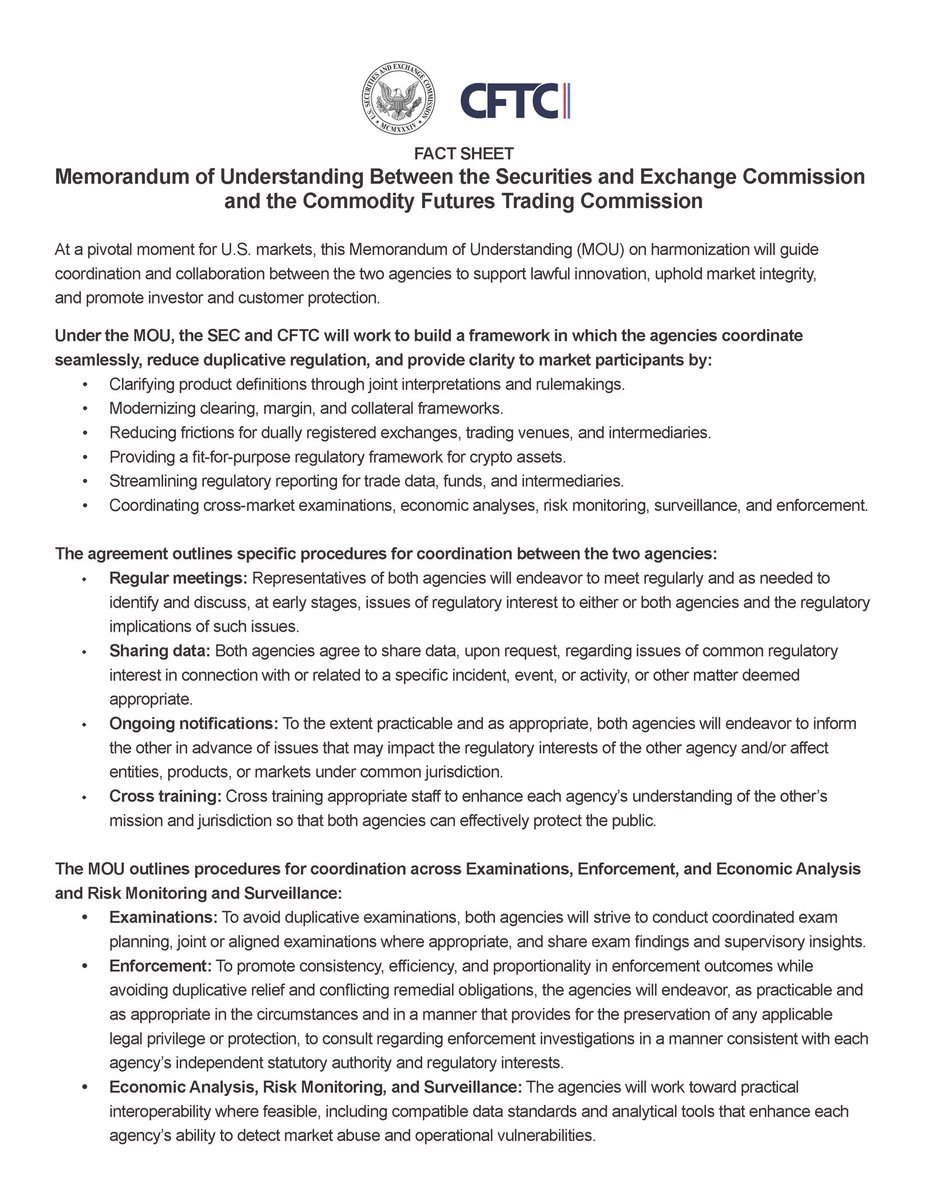
🚨 TODAY: Alongside the @CFTC, we entered into an updated Memorandum of Understanding to guide future coordination between our two agencies.   This MOU will support lawful innovation, uphold market integrity, and promote investor and customer protection.   Link in the comments.
U.S. Securities and Exchange Commission tweet media
English
103
262
1K
264K
Dhruba Basu retweetledi
Cointelegraph
Cointelegraph@Cointelegraph·
🇺🇸 JUST IN: The US Fed, OCC, and FDIC jointly clarify that tokenized securities should receive the same capital treatment as traditional securities. The ruling applies regardless of whether they're issued on permissioned or permissionless blockchains.
Cointelegraph tweet mediaCointelegraph tweet mediaCointelegraph tweet media
English
78
419
2K
112.6K
Dhruba Basu
Dhruba Basu@dhrubabasu·
@dberenzon Isn’t that basically just a tokenized money market fund?
English
0
0
0
61
Dmitriy Berenzon
Dmitriy Berenzon@dberenzon·
Stablecoins are the way you can fuse a currency with an interest rate and have them travel through the financial system together
English
4
2
25
1.9K
Dhruba Basu
Dhruba Basu@dhrubabasu·
@0xLoris No you don't understand, I want to pay for my AWS bill with $AMZN stock
English
1
0
1
179
Loris
Loris@0xLoris·
company equity and protocol tokens are fundamentally incompatible
Loris tweet media
English
11
1
42
3.5K
Dhruba Basu
Dhruba Basu@dhrubabasu·
@kdotcrypto This isn't correct, open source cannot tell you whether there are delays being added on the network
English
0
0
0
51
kdot | bulk
kdot | bulk@kdotcrypto·
If the exchange you are using runs on a PFOF model then it doesn't matter what the UI is showing you the spread is If you can't verify this because the code is not open source, you are trading on a CEX
English
13
3
48
7.1K
Dhruba Basu
Dhruba Basu@dhrubabasu·
We really are speed-running TradFi here Kalshi Inc. just proposed imposing order delays, now under a 10-day CFTC review. Flash Boys are back, baby! (P.S. @Lighter_xyz uses a similar delay for their "zero-fee" trading.)
Dhruba Basu tweet media
English
1
0
3
764
Dhruba Basu retweetledi
wishful_cynic
wishful_cynic@EvgenyGaevoy·
curious how long it will take crypto people to discover that tradfi solved all this stuff long time ago and the real issue is not the perp design but the centralized (and quadi decentralized) exchanges that are prime broker, CLOB and custodian all in one
Arthur@arthur0x

So it's clear from the debates and discussion on this post that crypto derivatives (mainly perps) product design and market structure that surrounding it remain the biggest problem the industry need to tackle before it can grow to the next level in a sustainable manner. The industry simply cannot go through this level of wealth destruction event every once in a while and we pretend things are fine without fixing the structural problems. That said there is a hope that we can hopefully build a better product looking at the history. The March 2020 market meltdown where BTC fall 50% to 70% in hours are very similar to 10th Oct for altcoins where system outage on leading price discovery venue exacerbate the downward movement, however what make things worse were the fact that those perps were quanto perps which means BTC perps are collateralized by BTC not stablecoins thus you get the extreme reflexivity on the downside and there's just very little way you can hedge this quanto perp exposure. Most market participants recognize this product design flaw and combined with the fact that stablecoins been growing in usage, the market share of quanto perps on Bitmex move from >80% to less than 20% in one year and by the mid of 2021, most people are using USDT margined BTC perps and not BTC margined quanto perps anymore. The collective decision for the industry to use USDT margined perps have definitely improve the resilience of market structure significantly and we get less volatility for BTC as time goes by. I am looking forward to a new product design to emerge that is significantly better than the current iteration of crypto perps.

English
64
42
685
175.8K
Dhruba Basu
Dhruba Basu@dhrubabasu·
@DeanEigenmann Been the case for years We treat CEX founders like gods for building entities that are more centralized than the very banks crypto was meant to displace
English
1
0
1
511
Dean Eigenmann
Dean Eigenmann@DeanEigenmann·
lets be perfectly honest, the real-world adoption of crypto we are seeing that self-proclaimed OGs and believers are cheering for is a bastardization of satoshi's vision
English
39
17
177
24.5K
Dhruba Basu
Dhruba Basu@dhrubabasu·
@niteshnath That's a flawed comparison. Binance, or even Coinbase, don't come close to Nasdaq latencies
English
0
0
0
138
Nitesh
Nitesh@niteshnath·
@dhrubabasu FCFS is impossible on any permissionless system but this doesn't hinder MMs from quoting more tightly on Solana spot markets than they do on centralized venues: MMs already quote tighter with equivalent size on spot markets on Solana today than they do on Binance spot.
English
1
0
0
176
Nitesh
Nitesh@niteshnath·
Spending this morning thinking deeply about what price discovery on Solana mainnet looks like. This is a completely different problem from what prop AMMs have solved thus far, which are heavily maker-favored environments that tend to suppress price discovery in favor of deep retail-oriented liquidity. To summarize the core question succinctly: what will it take so that the very first signal that the price is about to move originates on Solana rather than in a centralized exchange's matching engine? The answer to this question is probably the most important question in decentralized trading, because when price discovery begins to happen on Solana, you have the following exchange kingmaker property: All low-latency traders must listen to market data from Solana in order to trade competitively.
English
5
4
66
4K
Dhruba Basu
Dhruba Basu@dhrubabasu·
"react to it" is somewhat simplistic. It's fundamentally different on centralized vs decentralized systems. Take MMs. It doesn't matter what core devs do, a BFT system cannot guarantee FCFS with sub-millisecond latencies. MMs will therefore quote less aggressively on blockchains than they would on a CEX where FCFS is enforced
English
1
0
0
101
Nitesh
Nitesh@niteshnath·
It's just a different math problem, and it's all probabilistic: On Nasdaq, you see a concrete book event or a trade event (probability = 1), construct your forecast (probability < 1), and react to it. On decentralized Nasdaq, you see some event (probability < 1), construct your forecast (probability < 1), and react to it. For the question of "can price discovery happen", it doesn't matter that much that the triggering event is probability < 1 vs exactly 1 imo. I'm certain this difference has implications on how the trader's pricing model is constructed, but it doesn't fundamentally mean that a strong pricing model cannot be constructed. I would argue that as probability approaches 1, the strength of the pricing model increases. It's a market microstructure problem that core devs can work on to make the probability of signal settlement approach 1 as closely as possible. This perspective means that latency of signal propagation or reaction time isn't getting downgraded at all, it's just introducing probabilities on signal settlement.
English
1
0
0
124
Dhruba Basu
Dhruba Basu@dhrubabasu·
I see your point on probabilities, but that's the fundamental disconnect You'd be asking market participants to trade on a probabilistic signal (your 1% revert risk) that takes high tens of milliseconds to finalize in any BFT system They already operate on a deterministic signal (final execution) at sub-50μs on Nasdaq This is the same market where a 350μs deterministic speedbump (IEX) was considered market-breaking. I don't see a good reason why anyone would want to downgrade from 50μs certainty to millisecond-probability
English
1
0
0
99
Nitesh
Nitesh@niteshnath·
Settlement of the signal isn't latency sensitive, creation/reading the signal is. The probability of signal settlement gets priced into how signal receivers handle the signal. Imagine you see a large signal get proposed to the rest of the network. If the probability of that large signal getting reverted is 99% you'd likely mostly toss it as noise. If it's 1% you'd likely update your price based on it. I'm saying probability the signal gets reverted can be low (or at least it is not trivial that it is high).
English
1
0
0
123
Dhruba Basu
Dhruba Basu@dhrubabasu·
Settlement doesn't directly impact price (I was being too general with "finality" earlier) If signal doesn't get incorporated into price, it's noise. I don't think any serious market participant updates their internal pricing of an asset based on an OrderAck (returned in about 5μs on CEXs)
English
1
0
0
151
Nitesh
Nitesh@niteshnath·
> It's an optimistic, revertible guess at the next state since leaders can get voted out So is T+2 settlement though. The protocol is separate from guarantees that can be built on top of it (like a margining system and credit buffers). > A leader's proposal isn't the signal though. A signal is just bits, anything can be a signal, including an optimistic proposal.
English
1
0
1
144
Dhruba Basu
Dhruba Basu@dhrubabasu·
@niteshnath With MCP, it gets a lot more complicated on Solana because you have to do conflict resolution across multiple proposers (adding to execution latency times)
English
0
0
0
59
Dhruba Basu
Dhruba Basu@dhrubabasu·
@niteshnath A leader's proposal isn't the signal though. It's an optimistic, revertable guess at the next state since leaders can get voted out The signal is only truly incorporated into price when all transactions are irreversibly ordered and executed. Until then, it's just noise
English
2
0
0
149
Dhruba Basu
Dhruba Basu@dhrubabasu·
@niteshnath The leader won't know what the actual state transition is until finality. You'd have to finalize within one consensus round (80% stake for Alpenglow) with co-located validators to compete with CEX latency At that point, we've given up on geographic distribution no?
English
1
0
1
150
Nitesh
Nitesh@niteshnath·
Agree on def of price discovery here. The "lowest latency exchange" can just be the Solana leader closest to the signal origination (which doesn't need to happen in a single static location). Execution latency == how fast the Solana leader processes the information and transitions state, which can be as fast as a CEX. In fact, the advantage that a decentralized network has is that stake can permissionlessly accumulate close to signal origination hotspots.
English
1
0
0
187
Jacob
Jacob@jacobeverly·
@ballsyalchemist @ThinkingUSD yes there are holes, but saying you can trade equities for no fees while getting railed by Citadel is a stretch
English
2
0
4
199
Dhruba Basu retweetledi
Austin Campbell
Austin Campbell@austincampbell·
One of the great ironies of crypto is re-learning all the lessons of traditional finance, only... more. Somehow, the CEX is one of the most centralized financial entities ever (custodian, exchange, transfer agent, etc.)! Separate those, and make them compete in an open market.
Open Frontier@Open_Frontier

This pardon now clears Binance, the largest crypto exchange in the world, to buy a US crypto company and any potential regulatory licenses as a way of entering the US market.

English
4
3
27
5.6K