

Diogo de Prince
1K posts
Diogo de Prince
@dioted
Assistant Professor in Economics. PhD in Economics at the Getulio Vargas Foundation (EESP), Brazil. Main interests: Macroeconomics and Econometrics (Time Seri).
Araraquara e São Paulo Katılım Aralık 2010
745 Takip Edilen491 Takipçiler

I am happy that the paper was finally published. It was a long and arduous journey since I first started working on this idea.
Economics is about humans making choices. I want to tell you about the humans that inspired this paper and the humans that wrote it.
The idea came from an odd couple: my friend John and the Brazilian president Dilma Rousseff.
John didn't really like his job. He devised an audacious plan: do poor enough work to get himself fired, collect unemployment insurance, and chill at home playing FIFA.
Sadly for John, he didn't factor in the whims of President Dilma. Elected under the promise of not cutting labor protections, she implemented a plan that reduced unemployment benefits and tightened eligibility requirements. When John finally got fired, he didn't qualify. In our circle of friends, that story never gets old.
That kept me thinking: how should a government choose its unemployment insurance requirements? I reviewed the literature and studied the practice in other countries.
I found two very interesting facts. The US not only has a tenure requirement, like the one that excluded John, but also a monetary requirement that removes eligibility from workers who make too little money.
At first, excluding those who need benefits the most sounded outrageous. I couldn't find any research documenting the harm of such an anti-poor policy. So me and @avdluduvice took it upon ourselves to show it.
We wrote down a model of — well — John's behavior. Agents choose to work or not while facing random income shocks. If someone stops working, the government can't tell if it was a quit or a layoff, kind of like what John was hoping. The government's problem is to design unemployment insurance to maximize agents' welfare. Strict requirements give less protection but make it harder for people to engineer their own firing just to collect benefits and play FIFA. So the government faces a clear trade-off, which force dominates is an empirical question.
So I went to the data. I hand-collected historical unemployment requirement data for the US. There was no AI at the time, so all of it was done by human ctrl+c ctrl+v intelligence buried in old government reports. At @UChicago, that earned me the title of Ghost of the Basement 👻: youtube.com/watch?v=MS-GPz…
Here's what we found. When a state introduces a tenure requirement, workers hop between employers more and are more likely to become part-time, which is consistent with people staying in the job market just long enough to become eligible to UI. The monetary requirement had the opposite effect: workers became less likely to switch jobs or go part-time, consistent with those jobs being less attractive since they no longer come with UI coverage. The data showed that UI requirements matter not only to John.
Using those elasticities to validate the model, we found that the monetary requirement plays an important role, contrary to my initial beliefs. UI increases workers' incentives to accept any job, including ones they'd otherwise turn down. To correct this distortion while still providing insurance, the optimal policy is to exclude low-paying jobs from UI eligibility. This force dominates for two reasons: it reduces the cost of UI, and it creates incentives for workers to search longer for better jobs.

YouTube
Dirk Krueger@IERJournal
The International Economic Review has just published a new exciting paper by Gustavo de Souza and André Victor Luduvice on Optimal Unemployment Insurance Requirements. It is available through @WileyEconomics here: onlinelibrary.wiley.com/doi/full/10.11…
English
Français

Honored to receive the Giorgio Mortara Prize, an economist who paved the way for economics in both Italy and Brazil. Especially meaninful to receive it at @Unibocconi, where he taught before being forced to leave Italy.
We are grateful to @econ_aibe for this recognition!
Associação Ítalo-Brasileira de Economia (AIBE)@econ_aibe
📢Announcing the winners of the Giorgio Mortara Prize 2026 🏆 L Mariani (Bocconi) 🏆 JR Ornelas (BCB) 🏆 B Ricca (Insper) 📄 Banks’ Physical Footprint, Digital Payment Technologies, and Fintech Growth aibe.website/prizes 📍 Award ceremony on July 3 (2nd AIBE Workshop)
English
Diogo de Prince retweetledi

@YunusAksoy_BBK Congratulations to the authors. A very interesting paper!
English

🧵NEW PAPER ALERT. In the presence of state dependencies and nonlinearities, identifying the systematic component of monetary policy is the first step in analysing monetary policy. In a new open-access paper (Oxford Bulletin of Economics and Statistics lnkd.in/eKBY95JX )
English
Diogo de Prince retweetledi
Friendly Remainder Thematic Seminar Friday 22/August - 10:00-11:00 (São Paulo time)
registration x.gd/Sd12g

Română
English

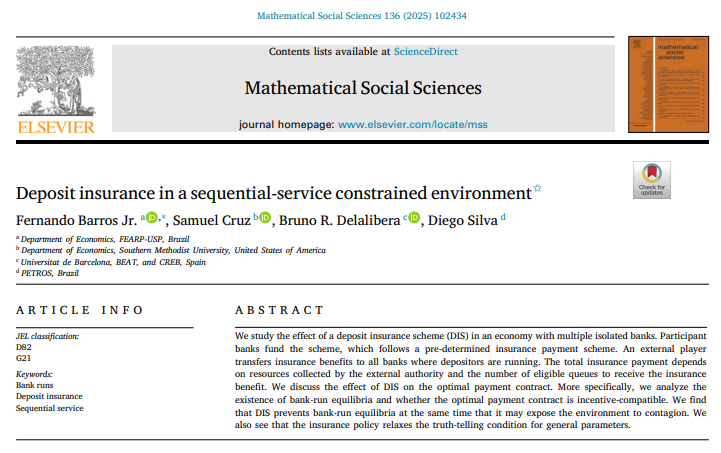
🏦 NEW RESEARCH: How does deposit insurance hold up when banks face sequential-service runs? Our paper models this fragile equilibrium - with surprising insights for financial stability.
Coauthored with @DelaliberaBruno, @savi_cruz & Diego Silva.
🔗 sciencedirect.com/science/articl…
English




@goescarlos @_PublicChoice Congratulations! Very interesting paper and connected to hypothesis r-g!
English

A paper I finished in the beginning of my PhD is out on @_PublicChoice. The paper is simple: it tests Piketty's hypothesis of r-g => inequality for a set of developed countries (that have better data). I find no empirical support for Piketty’s predictions.

English
Diogo de Prince retweetledi

📣 Call for Papers - LACEA 2025 🌍📚
Annual Meeting of the Latin American and Caribbean Economic Association (LACEA) acontecerá em Recife, de 20 a 22 de novembro de 2025! 🎉
🌟 A Universidade Federal de Pernambuco (UFPE) será a anfitriã deste evento, e o Comitê de Programa será presidido por Claudio Ferraz (UBC e PUC-Rio). Os organizadores locais são Breno Sampaio (UFPE) e Rafael Costa Lima (UFPE).
⏳ Prazo para Submissão: 30 de maio de 2025
🚀 Não perca essa oportunidade de compartilhar sua pesquisa com os maiores nomes da economia latino-americana e global!
📍 Link para a submissão de artigos: app.oxfordabstracts.com/stages/78195/s…
Dúvidas envie para o e-mail: lacea2025@gmail.com

Português
@dioted Muito obrigado! Estou sempre tentando fazer os artigos andarem para a publicação 😅
Português
"Our referees have now considered your paper and have recommended publication" what a good way to start this Friday.
English

@dioted Rapaz, se você for o Brad Pitt pode usar boné. O restante de nós devemos evitar....rs
Português
Português

After 10 amazing years at UFRGS (@ufrgsnoticias), it's time for a new chapter! Excited to join USP/ESALQ (@usponline) and continue my journey with fantastic colleagues and students. Grateful for all the experiences, friendships, and lessons learned. Onward to new challenges!
English
Diogo de Prince retweetledi

Edital FEA-RP 004/2025 – processo seletivo para contratação de 01 docente por prazo determinado junto ao Dep. Economia - FEA-RP/USP.
Área: Macroeconomia
Inscrição: 27/01 a 10/02/2025
Mais infos: e.usp.br/rzq
Inscrição exclusivamente no link uspdigital.usp.br/gr/admissao
Português
@dioted Diogo, muito obrigado!!! Desejo o mesmo para você!!! Muito sucesso.
Português
What a year 2024 has been! Time to share some highlights and reflections on my professional and personal journey. 🧵
English
@juninho_barros Congratulations Fernando, well done. Feliz ano novo para vc e família, mta saúde e paz meu caro!
Português
As this year comes to a close, I feel proud, grateful, and eager for what’s ahead. Here’s to 2025 – can’t wait to see what it brings! 🥂
English
Diogo de Prince retweetledi

Calling #finance students working on:
- #forecasting in high-dimensional models
- #assetallocation using #machinelearning
-#climateeconometrics
- #cryptofinance
or related topics to submit their work to the São Paulo School of Advanced Science on High Dimensional Modelling.
English
We have sessions for students and professionals. We have funds for travel and accommodation expenses for master's and doctoral students from Brazil or abroad.
English
The event is about high-dimensional models with a focus on economics and finance, but such models can be applied to other areas. There are 2 mini-courses. Here is the event website: sites.google.com/view/spsahdm/
English
Hi everyone, I am helping to organize the event São Paulo School of Advanced Science on High-Dimensional Models (funded by FAPESP from Brazil) that will be held at the São Paulo School of Economics of the Getulio Vargas Foundation, from April 21 to 30, 2025 in São Paulo, Brazil.
English