dk.extended

72 posts

dk.extended banner
dk.extended

dk.extended

@dk_extended

CTO @extendedapp, formerly @Revolut

Katılım Eylül 2016
63 Takip Edilen969 Takipçiler
dk.extended retweetledi
rf.extended
rf.extended@rf_extended·
What multi-asset collateral unlocks for @extendedapp's roadmap: - Alongside multi-asset collateral, we have built spot trading infrastructure (all non-USDC liquidations already route through the native spot market), leveraged spot and a lending protocol. - As the next step, we will open spot trading to users and expand lending beyond the Extended ecosystem to support broader DeFi use cases. - Reasonably soon, we will multiply the number of crypto and TradFi markets available on Extended, while keeping liquidity and execution quality as top priorities and upgrading spot trading to support leverage. While multi-asset collateral is only one part of the broader vision, it is foundational to Extended’s goal of building one margin account across all markets: hundreds of crypto and TradFi perpetual markets, leveraged spot, an open lending protocol, yield products (XVS), and other trading products.
English
36
34
194
15.4K
dk.extended retweetledi
rf.extended
rf.extended@rf_extended·
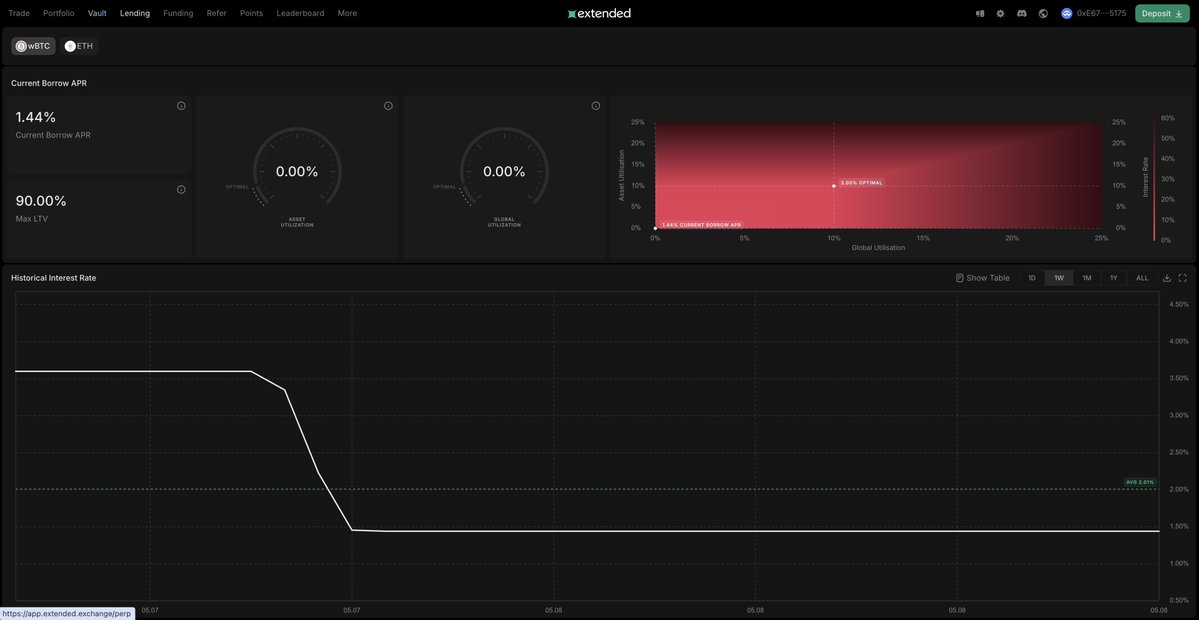
What's unique about Extended’s native money market. With multi-asset collateral now live, @extendedapp users can deposit ETH and wBTC (with USDT and EURC coming shortly) and use them as margin to trade perpetuals. When a user's USDC balance goes negative, borrowing is triggered automatically with the Extended Vault serving as the primary lender. The key difference is how borrowing rates work. Traditional crypto money markets typically operate through isolated lending pools, where interest rates depend only on utilisation of a specific pool. Collateral risk is managed separately through haircuts and borrowing limits. Extended's setup is fundamentally different. The Vault lends against multiple collateral assets simultaneously, while borrowing demand emerges dynamically from unrealised PnL. In this environment static global borrowing caps are not practical. As a result borrowing rates depend on two dimensions: - overall vault utilisation - utilisation against a specific collateral asset. This means borrowing USDC against ETH can be cheaper than borrowing against BTC if system-wide exposure to ETH is lower. The second layer is how borrowing is allocated. When a user has multiple collateral assets, the system automatically routes borrowing through the lowest-rate collateral first, minimising the effective cost of capital. Example: if a user has a negative USDC balance backed by both ETH and wBTC collateral, and ETH borrow rates are lower than BTC, the system will allocate borrowing against ETH first before routing the remainder against BTC, continuously reducing the effective cost of capital. The result is a system where: - users automatically receive the cheapest borrowing allocation across their collateral portfolio - Extended maintains granular risk control over exposure to different collateral assets backing borrowed USDC - vault depositors earn additional yield directly from trading activity.
rf.extended tweet media
English
21
25
159
14.2K
dk.extended retweetledi
Extended
Extended@extendedapp·
Multi-Asset Collateral is now live on Extended From today, wBTC and ETH are accepted as collateral alongside USDC and XVS (Extended yield-bearing collateral). EURC and USDT are coming soon. How it works The system operates on a native money market, with the vault acting as the primary lender. When trading losses push your USDC balance negative and that deficit is covered by non-stablecoin collateral, you are borrowing USDC. Borrowing rates depend on two factors: overall vault utilisation and utilisation against each specific collateral asset. For example, if demand to borrow USDC against ETH is lower than against BTC, borrowing against ETH will be cheaper. When a user holds multiple collateral assets, borrowing is automatically allocated starting with the lowest-rate asset and moving upward, minimising the effective cost with no manual input required. We are not aware of this being implemented anywhere else in DeFi. Example. User is down $175K on a perp and borrowing $175K USDC against a mixed book: $50K USDT @ 1% - $500 $50K ETH @ 5% - $2,500 $75K BTC @ 10% - $7,500 Total annualised interest: $10,500. Effective rate: ~6%. Borrowing the same amount entirely against BTC would cost $17,500 annually, or 67% more. What this means for Extended Vault The vault is the primary lender for the entire system. All interest paid by USDC borrowers flows to vault depositors as Extra Yield, on top of the trading fees already distributed. This creates a second, structurally independent yield stream for XVS holders. The vault earns by serving as the backbone of the margin system.
Extended tweet media
English
51
66
302
59.9K
dk.extended retweetledi
rf.extended
rf.extended@rf_extended·
In light of recent security incidents and the increasingly hostile environment, we have activated a dedicated treasury contract to further strengthen the system’s resilience. This contract is solely responsible for holding the entirety of the protocol’s treasury (TVL) and incorporates a circuit breaker mechanism governing fund outflows. Specifically, if the total value locked (TVL) decreases by more than 3% within any rolling 24-hour period, the treasury contract will automatically halt all USDC outflows. In such an event, settlements are paused until the team reviews the underlying transactions and explicitly approves any increase in withdrawal limits via a multisignature process. The multisig signers are distributed across multiple geographies. In rare circumstances, this may introduce delays to withdrawals. However, we believe this is a reasonable trade-off to ensure the safety of funds. The perpetuals and vault contracts, which handle trading and business logic, no longer custody funds. All asset movements are routed exclusively through the treasury contract. As a result, even in the event of a full system compromise, including bridges, oracle providers, or operator infrastructure, the maximum potential impact is limited to 3% of the TVL.
English
55
50
392
48.2K
dk.extended retweetledi
Little Anna
Little Anna@lttlanna·
how multi-collateral changes perp trading this tweet is about why it matters, why DeFi hasn't solved it, and what we're building at Extended. first, what multi-collateral actually means. most perp DEXs require you to deposit USDC. that's your margin. full stop. if you're holding BTC or ETH, you need to sell it first - or borrow USDC against it on an external platform. with cross-asset collateral you deposit BTC, ETH etc and they become live margin. you trade without converting. your portfolio works twice. this isn't a new idea. TradFi has had it for decades. prime brokerage - what Goldman Sachs offers institutional clients - lets hedge funds use their entire book as a unified collateral pool. you don't sell Apple stock to trade S&P futures. the whole portfolio backs your positions. crypto CEXs followed the same logic. when Binance launched Portfolio Margin, institutions could use BTC, ETH, and stablecoins as cross-margin across futures, options, and spot from a single account. serious traders consolidated onto platforms that offered this. the capital efficiency gap became impossible to ignore. so why is it rare in DeFi? because the liquidation problem is genuinely hard to solve onchain. on a CEX, liquidating collateral is straightforward. they hold custody, control the liquidation mechanics, have a risk team. if something breaks, someone intervenes. onchain, none of that exists. liquidators need to handle several different tokens simultaneously. CEXs manage this with discretion. onchain protocols have to get the mechanism design right in advance, with no ability to intervene later. that's why most perp DEXs defaulted to USDC-only collateral. it avoids the problem entirely. we went the hard way. Extended's liquidation runs a structured waterfall. the system first routes through native spot order books, where whitelisted market makers absorb the collateral. to participate, market makers receive reduced initial margin requirements for spot orders and exclusive access to non-toxic liquidation flow - in exchange for staying live. if no market maker takes it, the Extended Vault steps in as buyer of last resort, acquiring the asset at bankruptcy price, immediately shorting a perp to neutralise directional exposure, then running a Dutch auction to offload to market makers. the final layer - Spot ADL - is designed to never be reached. what this changes for traders: perp DEX users are crypto-native. they're not real retail - they run structured strategies, manage multi-asset books, think in basis trades. right now they still partly stay on CEXs not just for fiat ramps or deeper liquidity, but because the collateral infrastructure is more sophisticated. they're getting an institutional-grade experience onchain that DeFi hasn't offered. and this is what we want to change. cross-asset collateral on Extended goes live next month. in the longer term it becomes the foundation for unified margin across perps, spot, and lending - all from a single account. what prime brokerage clients have had for years. onchain, available to crypto-native users.
English
11
6
70
5.2K
dk.extended retweetledi
rf.extended
rf.extended@rf_extended·
Perpetual futures will become a primary venue for price discovery in TradFi markets, but they will not replace dated futures and options. Today, price discovery happens across different instruments. Equities and FX primarily trade on spot markets, while commodities and energy rely on dated futures. USDC-settled perpetuals offer structural advantages that make them a strong alternative for trading and liquidity concentration: 1. They trade 24/7 2. They aggregate liquidity into a single order book and are structurally standardized 3. They enable higher capital efficiency through continuous margining Importantly, many of these advantages are structural. Traditional financial markets are not 24/7 not only due to historical inertia, but because risk management and settlement operate in discrete cycles. Margining is not continuous, and collateral transfers and custody updates occur in batches, requiring system-wide coordination. At the same time, traditional derivatives markets fragment liquidity. Dated futures split liquidity across expiries, while options spread it further across expiries and strikes. As a result, liquidity is distributed across many instruments. Perpetuals reverse this dynamic by consolidating liquidity into a single instrument per asset and providing a standardized structure across markets, with no rolling and simpler basis management. This makes them easier to hedge and trade. Perpetuals also allow for more capital-efficient use of margin through continuous risk management and liquidation mechanisms, although this comes with different risk trade-offs compared to the more conservative, discrete systems used in TradFi. Given these dynamics, USDC-settled perpetuals will become a primary venue for trading and price discovery in TradFi assets over time. However, several challenges remain: 1. Trust and inertia: Institutions will need time to build confidence in crypto-native infrastructure and adapt their internal processes and risk frameworks, for example moving from futures term structure to perp funding dynamics. 2. Index definition: Perpetual markets depend on a clear and reliable reference price. For TradFi assets, this requires consistent and widely accepted methodologies. This means spot-based references for equities and FX, and derived spot prices from futures for commodities and energy. In practice, areas like futures roll and non-trading hours are not yet fully standardised across the industry. We also recognise that the current approach used by Extended is not yet ideal, and we are actively working to improve the definition of a fair and robust reference price. Even if perps become dominant for trading, they will not replace dated futures and options, as these serve different purposes: 1. Dated futures provide time-specific hedging and a strong link to the real economy through physical delivery and convergence to spot at expiry. 2. Options provide convex payoffs and enable trading and hedging of volatility. In summary, perpetuals are structurally better suited for liquidity aggregation and continuous trading, and will play a leading role in price discovery. However, they will coexist with dated futures and options, which remain essential for time-specific hedging and non-linear risk management. Bridging perps and TradFi represents one of the largest and most durable opportunities in financial markets and is a core focus for Extended.
English
15
35
214
33.1K
dk.extended retweetledi
Little Anna
Little Anna@lttlanna·
why Extended won’t cut deals every week I get proposals for “special arrangements”. extra points pools, special trading budgets, requests to be placed in the highest league without trading. sometimes the numbers are big enough that saying no in the moment feels painful, especially when you’re responsible for growth and naturally think about how much faster things could move if you just agreed. but over time I've only become more convinced that saying no is the only correct decision. the first problem with deals like this is ethical. if a project publicly claims fairness while quietly making exceptions behind the scenes, it will eventually come out. it always does. when that happens, the reputational damage is much larger than whatever benefit the deal produced. the second problem is economic. most deals look attractive in isolation but stop making sense once you consider the system as a whole. take special points allocations. if you give someone an additional points pool, they are probably not the only one receiving it. a few more people get similar arrangements and suddenly no one is actually privileged - everyone just dilutes the overall distribution without even realizing it. or traders asking for budgets. when someone says: “give me $100k to trade or I won’t trade on your exchange.” my answer is usually simple: thank you for your time. a few days later I will probably see them trading on a competitor. that doesn’t make me sad that we lost them - it makes me sad that another exchange accepted the deal. traders who only show up because they are being paid to do so don’t care about your product, your token, or the long-term success of what you’re building. once the incentives disappear, they disappear too. another common request is to change the rules of the system. for example, people asking to be placed in the highest league to earn the extra APR without actually trading. besides being unfair, it breaks the economics. league rewards exist because active traders generate fees on the platform. if the people receiving that yield are not trading, there is no source of yield in the first place. the main cost of refusing deals is slower growth. it would definitely be easier to inflate metrics in the short term by making exceptions and distributing budgets. but if the goal is to build something that lasts, the rules have to be the same for everyone. Extended is not trying to grow as fast as possible. we are trying to build an exchange that traders continue using once incentives disappear, and that only happens if the system is fair and the economics actually make sense.
English
27
18
169
9.7K
dk.extended
dk.extended@dk_extended·
It was a hard year :)
rf.extended@rf_extended

A year ago @extendedapp was in closed beta with: ~$1M in user TVL ~ 20-30 daily active users ~$3-4M in daily trading volume ~$500 in daily fees I’m genuinely thankful to everyone who contributed to the 100-300x growth of Extended across all metrics over the past year. In 2025, together with our community and a team of 10, we built a strong foundation to enable another 10x growth from current metrics in 2026: 1. Migration to Starknet enables Extended to expand beyond perps and positions us among the few perp DEXs with verifiable, open-source smart contracts. 2. Early launch of FX, commodities, and indices prepares us for expansion into equities. 3. Support for Builders code enables future integrations with partners to extend our reach beyond crypto-native users. 4. Revamp of the web app is the first step toward a native mobile app. 5. Release of XVS enables meaningful product differentiation and prepares us for cross-asset collateral margin. In 2026, our ambition is to establish Extended among the top-3 perp DEXs through continuous product differentiation and partnerships: 1. Q1 objectives - Release cross-asset collateral margin with an integrated lending market - Enable a broad equities offering in partnership with one of the largest global trading platforms 2. Q2 objectives - Launch spot markets - Release a native mobile app with extensive on- and off-ramping support 3. Q3-Q4 objectives - Expand Extended’s reach beyond crypto-native users leveraging Builders code - Decentralize the exchange operator As always, the team remains committed to growing together with the community.

English
1
0
5
712
dk.extended retweetledi
rf.extended
rf.extended@rf_extended·
State of liquidity and execution on @extendedapp v3 Following fair feedback from the community that average buy/sell slippage over a 12-hour window may not be representative, this time we: 1. Measured slippage for market orders on BTC and ETH across $10k, $100k, $500k, and $1M clip sizes every 30 seconds on @HyperliquidX, @Lighter_xyz, and @extendedapp, from Dec 17 05:40 UTC to Dec 20 07:40 UTC (8,892 snapshots). 2. Calculated average hourly slippage, split by buy vs sell and by clip size. Overall, the results are in line with the previous analysis (linked in the comments). BTC 1. Extended offers slightly lower slippage on sub-$100k orders compared to both Hyperliquid and Lighter. 2. Hyperliquid has better liquidity for $500k and $1M clip sizes, while Extended and Lighter are on par. ETH Slippage is comparable across all clip sizes on Hyperliquid, Lighter, and Extended. Full dataset: #gid=30336491" target="_blank" rel="nofollow noopener">docs.google.com/spreadsheets/d… In the next iteration, we’ll share a similar analysis for some of the major altcoins.
English
30
15
161
28.6K
dk.extended retweetledi
Extended
Extended@extendedapp·
Now available to trade: $LIT with up to 3x leverage app.extended.exchange/perp/LIT-USD Please note that $LIT is a pre-launch token. Mark and Index prices are derived from exponentially weighted averages of order book prices rather than external markets.
Extended tweet media
English
40
49
319
81.5K
dk.extended retweetledi
rf.extended
rf.extended@rf_extended·
Perps have only a limited set of dimensions across which one can innovate and over the last 2 years we saw innovation across all of them except Collateral. 1. Liquidity Provisioning. @HyperliquidX was the first to launch the community vault, providing APR for depositors, reinforcing exchange liquidity and trading activity, which is now adopted by most players in the space. 2. Fees Structure. @Lighter_xyz was the first to introduce the zero fees model. As discussed many times, there are both pros and cons to this approach for the business and for end users, but it was an innovation in the market. 3. Ways of trading. @HyperliquidX came up with builders code (which we launched as well), allowing external teams to access underlying exchange infrastructure and liquidity and enable different frontends and use cases for trading perps (wallets, trading terminals, Telegram bots, etc). I believe we are yet to see innovation in the UX of perps trading, as the main trade screen of exchanges has not significantly changed over the years. 4. Markets one can trade. In 2025 we saw multiple perp DEXs, including @extendedapp, offering TradFi perps and I believe that over the coming years this trend will strengthen and we will see growth in OI, volumes and exchanges offering them. Earlier last year we saw pre-launch markets, which were an interesting concept that never really took off due to the complexities of providing stable and deep liquidity. Generally, adding new market types is the least important innovation, as any perp DEX can offer any market as long as there is a mark price and a market maker or vault ready to quote those assets. 5. Collateral. I do not think we saw any innovation on this front, with USDC being the sole collateral on perp DEXs while cross asset collateral and unified margin have been available on CEXs for years. Next Monday we will be releasing tokenisation of vault shares (a new type of collateral) and we believe it stands a good chance of getting traction among our users and potentially being adopted by other perp DEXs in the longer run, similar to how every perp DEX adopted community vaults. We will be releasing it in stages, with the full release plan to be communicated tomorrow. In a nutshell the idea is very simple. Allow users to post vault deposits or shares as yield bearing collateral for perps trading. In the target state: 1. eXtended Vault Shares (XVS) will contribute 90 percent of their value to user equity, essentially doubling overall collateral available for trading on the exchange. 2. Yield that vault depositors receive will depend on the trading activity of the user. There will be a base yield (currently ~15% all-time APR) available to all vault depositors and an extra yield that will depend on the user activity. The most active users will receive the highest yield. The fair question that many would ask is how liquidations will work given that XVS represents a claim on the vault equity, which includes open positions. The logic will work as follows: 1. When a user with an XVS balance becomes liquidatable, the first step of the liquidation process is to liquidate their XVS balance, meaning withdraw it from the vault. 2. When performing a liquidation or withdrawal of vault shares, the vault closes its open positions in proportion to the liquidated or withdrawn XVS. 3. If the vault for some reason cannot close its positions via the order book (e.g., due to lack of liquidity), a new type of operation will be enforced, called Force Close. The vault will close positions against the most profitable and highly leveraged user on the opposite side at the Mark Price. Force Close is similar to ADL but unlike ADL, where positions are closed at the bankruptcy price of the liquidated user, in Force Close positions are closed at Mark Price without incurring direct losses to the user on the opposite side. Given the existing risk limits of the vault (i.e. max position it can take on on the given market), we expect force close to be used only in the extreme scenarios. 4. Given the above, the XVS balance of the liquidated user can always be withdrawn from the vault. 5. Once the XVS balance of the liquidated user is withdrawn, we proceed with the regular liquidation process. The other valid concern we heard is what happens if the vault suffers significant losses while liquidating unhealthy users (the JELLY case), driving XVS price down and leading to a cascade of liquidations. Extended Vault processes liquidations deterministically, meaning that before taking over a liquidated position it knows: 1. that the position can be closed (vault will never take over the position it can't close) 2. that the realised loss will not be above its maximum acceptable loss per trade, per market or per day Hope the above clarifies the intended logic of the upcoming XVS release.
English
80
31
343
130.6K
dk.extended
dk.extended@dk_extended·
It was a tough night for everyone — a bloodbath for traders, sleepless for devs and support. Huge thanks to the whole team for their hard work, and to our users for their patience and support. PS: If you believe you were unfairly impacted, please raise a ticket.
rf.extended@rf_extended

x.com/i/article/1977…

English
4
1
62
5.2K
Konstantin
Konstantin@Konstantin_on_x·
@dk_extended Guys! The way you handled this challenge: 15 out of 10.
English
1
0
0
44
dk.extended
dk.extended@dk_extended·
Synergy is coming?
English
3
1
25
2.4K
Przemek Chojecki | PC
Przemek Chojecki | PC@prz_chojecki·
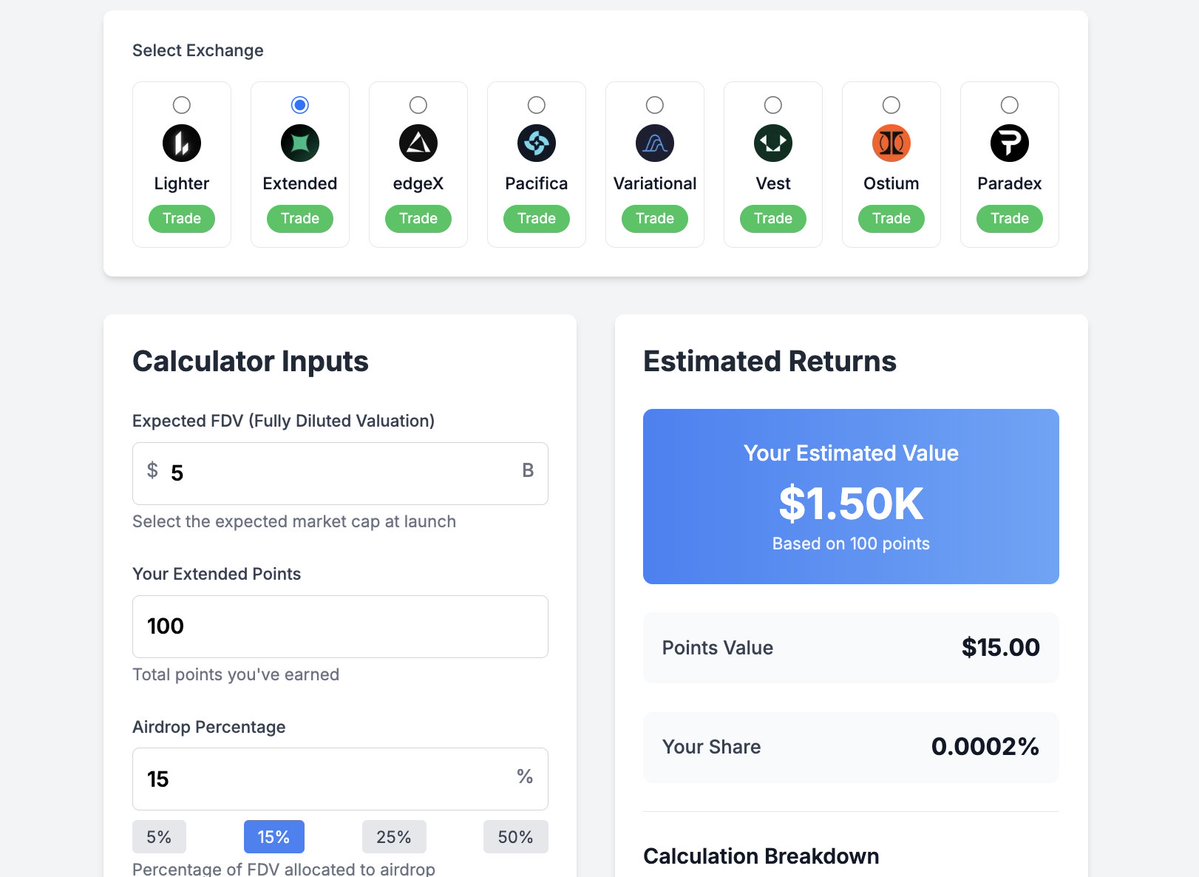
I've built the Ultimate Perp DEX Points Calculator Calculate your potential crypto airdrop from Lighter, Extended, Paradex, Ostium, Vest, edgeX, Pacifica and Variational. Test it here: cryptoexchange.sh/points-calcula… More alpha 👇
Przemek Chojecki | PC tweet media
English
52
40
259
74.1K