DUDE (vibe coding arc)@iamdudeCT
This is the only post you need to easily understand Proof–Carrying Computation
On @RialoHQ
There's a problem with blockchains that almost nobody talks about.
And it's the exact reason why blockchain apps are slow, expensive, and limited.
It's called Replicated Execution. 🧵
🔴 First – How Does a Blockchain Actually Work?
A blockchain is basically a shared ledger
Not stored by one computer. But by thousands of independent nodes called validators
At any point in time, the blockchain has a state means who owns what, what's stored where.
When a transaction happens, the state changes.
A sends 10 tokens to B → new state
Simple enough
But here's where it gets interesting
🔴 How Do Validators Confirm a Transaction is Correct?
They run it themselves.
Every single one of them.
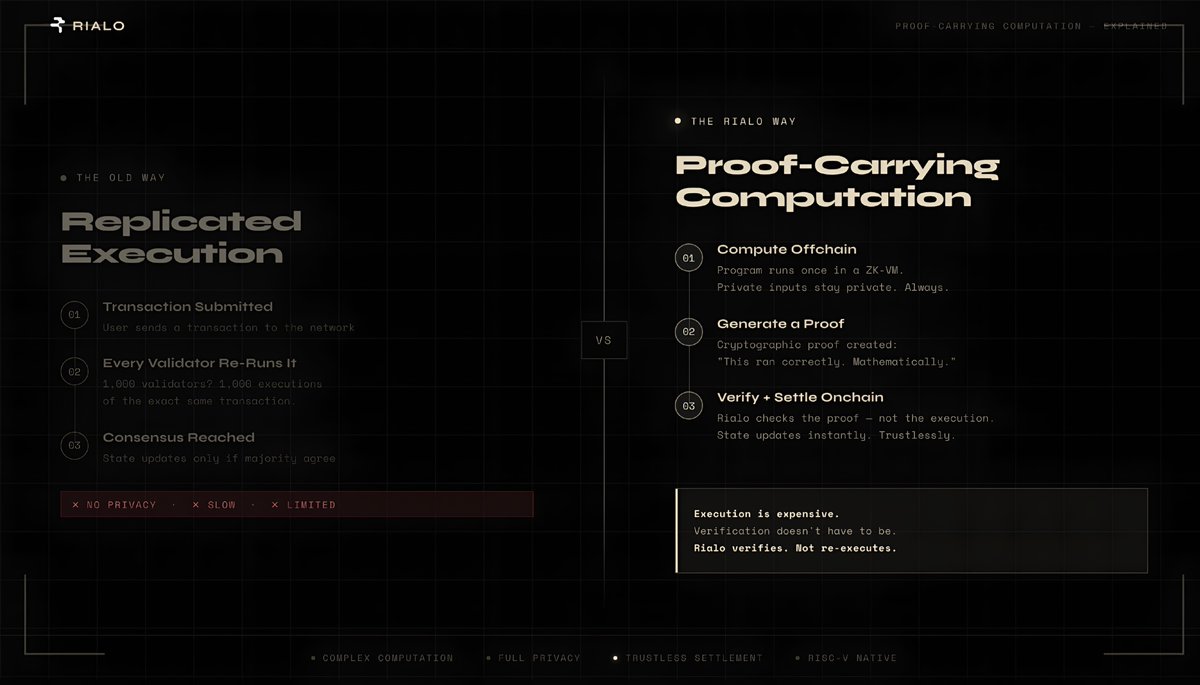
If there are 1,000 validators on a network – that one transaction gets executed 1,000 times.
This is Replicated Execution.
Think of it like a math exam where instead of one student solving the problem and others checking the answer
Every student solves the exact same problem from scratch
It sounds inefficient. Because it is.
But there's a very good reason it exists.
✅ Why Replicated Execution Exists
Blockchains don't trust anyone.
Not a single entity. Not a single node.
So instead of trusting one party to say yes this transaction is correct
Everyone verifies it independently
This gives blockchains their superpowers:
→ Fault Tolerance: If some nodes go offline or act maliciously, the system keeps running.
→ Decentralization: No single point of failure.
→ Security: The system only breaks if a majority of nodes collude – which is extremely hard.
This is blockchain's greatest strength.
But also its biggest limitation.
🚨 The Real Cost of Replicated Execution
When every validator has to re-run every computation – certain things become impossible.
❌ Complex computation
AI models, financial simulations, optimization algorithms – way too heavy for every validator to re-run.
❌ Private data
If validators need to re-execute your transaction, they need access to ALL your inputs.
There is zero privacy. Everything is visible to everyone.
❌ Real-time applications
High-frequency trading, real-time games, live simulations – the speed just isn't there.
This isn't a bug that can be patched.
It's a fundamental design constraint.
💡 The Insight That Changes Everything
Here's a question nobody asked for a long time:
Do validators actually need to RE-RUN a computation to confirm it's correct?
Or do they just need PROOF that it was done correctly?
Those are two very different things.
Execution is expensive.
Verification doesn't have to be.
✅ The Solution – Proof Carrying Computation
Instead of every validator re-running everything
What if computation happened once, somewhere, and came with a cryptographic proof saying:
This was executed correctly. Here's the mathematical proof.
Validators just check the proof.
Not the execution. Just the proof.
This is called Proof Carrying Computation.
And it changes the rules entirely:
→ Heavy computation? Run it offchain. Submit the proof.
→ Private data? Never touches the chain. Proof verifies without revealing inputs.
→ Real-time apps? Execute continuously offchain. Settle onchain periodically.
🏆 Why Rialo is Built For This — The RISC-V Advantage
Here's where most blockchains get stuck.
To verify a cryptographic proof, a chain must understand the language the proof was written in.
Most chains use their own custom virtual machines – EVM, SVM, Move VM.
When a ZK proof arrives written in a different language, they have two bad options:
→ Support multiple execution models in consensus logic – extremely complex and bug-prone
→ Translate foreign execution into native verifier logic – expensive, slow, and poorly optimized.
For example: verifying a single EVM opcode on a non-EVM chain requires checking stack behavior, memory access rules, gas accounting, and state updates – all separately. The overhead compounds fast.
Rialo made a different choice from day one.
It uses RISC-V as its execution target.
RISC-V is not a blockchain VM. It's a real-world instruction set architecture — the actual language modern processors speak.
And here's why that matters:
The most powerful modern ZK-VMs , SP1, RISC Zero – also compile programs to RISC-V
So when a proof arrives at Rialo, it's already written in the same language Rialo natively speaks.
→ No translation overhead.
→ No foreign execution models to emulate.
→ No bespoke verifier logic to audit and maintain.
Rialo doesn't just support Proof Carrying Computation.
Its entire architecture was built for it.
Correctness is defined at the instruction-set level – not at the VM level. This means one single, stable, unambiguous definition of what correct execution means.
That's the foundation proof verification needs.
And Rialo already has it.
🎯 Why This Matters
Blockchains were always good at one thing – trustless settlement
But replicated execution forced everything to be simple, public, and slow
Proof Carrying Computation separates execution from verification.
Execution can now be:
→ Complex
→ Private
→ Fast
→ Offchain
While verification stays:
→ Trustless
→ Decentralized
→ Onchain
You get the best of both worlds.
Blockchains don't need to run your computation anymore.
They just need to verify it happened correctly.
That's the shift.
And it's bigger than most people realize.