Donrado

108 posts

Donrado banner
Donrado

Donrado

@donrado

Creator of the Bonobo Diet See pinned comment for my swamp water stack. This is a n=1 experimental diet, not diet advice.

Katılım Aralık 2024
0 Takip Edilen26 Takipçiler
Sabitlenmiş Tweet
Donrado
Donrado@donrado·
Bonobo diet - Meat, Fruit, Salt and Natural Mineral Waters v0.2 The Bonobo diet is a n=1 experiment diet, because I couldn't find any diet after searching for 14 years that worked for me. Here is a Google sheet with everything included. docs.google.com/spreadsheets/d…
English
0
0
0
140
Donrado
Donrado@donrado·
I made a lot of edits to the Bonobo diet today, all included in the same Google sheets link. The diet doesn't include any veggies. The only veggie I might consider adding in the future would be lettuce, but I don't think I'll need to with my swamp water stack covering all the minerals I need.
English
0
0
0
8
Donrado
Donrado@donrado·
After spending 2 months going down the salt rabbit hole, I've come to the conclusion that almost any salt is basically the same, with some minor differences in trace minerals that are insignificant. But from my own testing I feel the best on refined or semi refined Salts. My top two salts are Maldon (semi-refined) and Diamond Crystal Iodized (refined). I prefer to get my minerals from fruit/meat and my swamp water stack instead of worrying about trace minerals in unrefined salts that are insignificant anyway. And I want to avoid any extra stuff that's not needed. These two salts will be the top choice in the Bonobo diet and I mix them up to ensure I'm getting enough iodine.
English
0
0
0
5
Donrado
Donrado@donrado·
Bonobo Insect Salt Options 🪳 ------- Chili is a botanical berry so fits into the Bonobo diet, and also bugs are a small but meaningful part of what Bonobos eat in the wild, so these 2 salts are now officially included as options in Bonobo diet. Sal de Gusano (Worm Salt): This is the gold standard. It’s a mix of salt, toasted agave worms, and dried chilis. Since both the worm and the chili (berry) are on the "allowed" list, it’s a perfect "High-Tech Bonobo" condiment. Sal de Chapulín (Grasshopper Salt): Another solid choice. It uses ground toasted grasshoppers and chilis.
English
0
0
0
10
Donrado
Donrado@donrado·
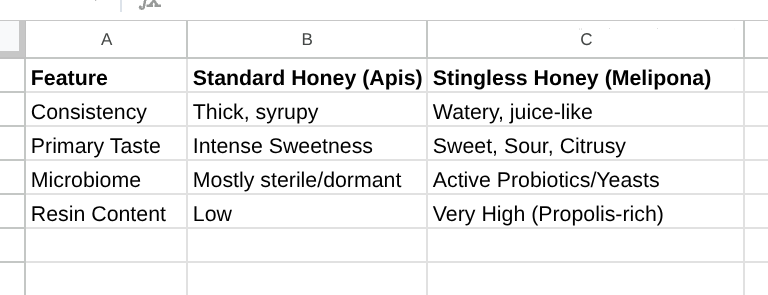
Raw melopina honey is the best fit for the Bonobo diet as an option, for those that feel benefits from honey. I probably won't be eating it much like eggs, but I will still include it as an optional component of the diet since Bonobos eat it and easily digested by most people. See the reason below why melopina honey is the best match for the Bonobo diet. Also note, with the adjustments I've made the diet has official reached a new version 0.3v, but since I'm editing the diet on the same worksheet the old link shows the new version, so no new link needed. ------- Stingless bee honey (often called Melipona or Trigona honey) is an excellent comparison to the wild honeys primates encounter in tropical forests. While it’s technically "bee" honey, it differs significantly from the commercial Apis mellifera honey we find on most grocery shelves. Here is why stingless honey is a closer match to the "wild" nutritional profile found in a bonobo’s habitat: 1. The Moisture & Fermentation Profile Commercial honey is typically dehydrated by bees to a moisture content below 18% to prevent spoilage. Stingless honey, however, is much more liquid, often containing 25% to 45% water. The Result: This high moisture leads to natural, slow fermentation. It contains active probiotics and acetic/lactic acids that are absent in processed honey. For a frugivore-leaning digestive tract, these organic acids assist in breaking down fiber and managing gut flora. 2. High "Botanical Warfare" Resistance Stingless bees store their honey in "pots" made of cerumen—a mixture of beeswax and plant resins (propolis). The Result: This honey is infused with significantly higher levels of phenolic compounds and flavonoids than standard honey. It acts more like a medicinal tonic with high antioxidant properties, which mimics the "dirty" unfiltered honey a primate would scrape out of a hollow log, full of resin and antimicrobial compounds. 3. Trehalulose and Low Glycemic Impact Recent research has shown that many stingless bee honeys contain a rare sugar called trehalulose. The Result: Unlike sucrose or high-fructose syrups that cause rapid blood glucose spikes, trehalulose is digested much slower. This provides a "slow-burn" energy source that is more consistent with the way wild animals metabolize sugars in the bush, avoiding the "sugar crash" associated with modern refined sweeteners. 4. Flavor & Acid Profile If you taste stingless honey, the first thing you notice isn't just "sweet"—it’s sour and tangy. The Result: This acidity comes from the high concentration of gluconic acid. This profile is much closer to the tart, under-ripe, or wild-fermented fruits that make up the bulk of a bonobo's caloric intake. In the context of a high-fruit, "clean-burning" Bonobo diet, stingless honey acts less like a sweetener and more like a functional fermented food. It bridges the gap between the simple sugars found in cultivated fruit and the complex, resinous, and acidic foods found in the wild.
Donrado tweet media
English
0
0
0
12
Donrado
Donrado@donrado·
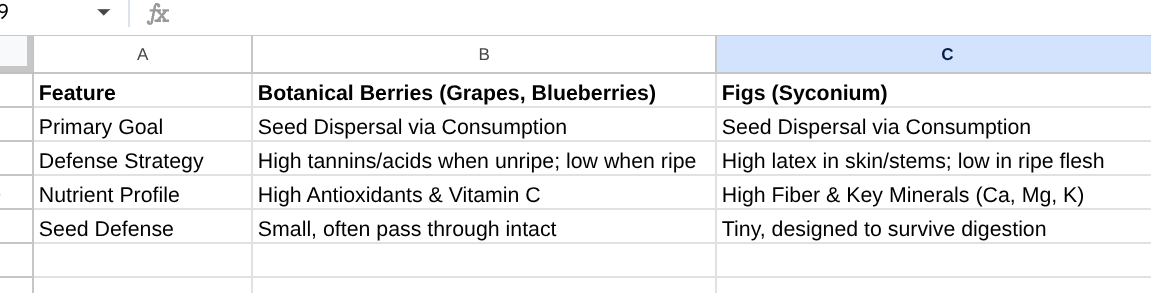
In addition to botanical berries I'm including figs as well, see reason below, and see attached comparison chart. Why Figs Fit The Bonobo Diet Botanically, a fig is not a single fruit but a syconium—essentially an inverted flower cluster. However, from an evolutionary and chemical perspective, they function exactly like the berries you already prioritize. The Evolutionary "Contract": Like berries, figs are designed by the plant to be consumed. The plant wants the animal to eat the fig to disperse its tiny, hard-shelled seeds. Because the plant wants the animal to eat the fruit once it is ripe, it reduces its chemical defenses (secondary metabolites) in the flesh as the fruit matures. Low "Plant Warfare": While the leaves and stems of a fig tree contain high levels of latex and irritating sap to deter herbivores, the ripe fruit is the "peace offering." By sticking to the ripe fruit, you avoid the lectins and phytates commonly found in high concentrations in seeds, grains, and legumes. The Bonobo Connection: You mentioned the bonobo diet, and for good reason. Figs are a "keystone resource" in tropical forests. Since they fruit at different times throughout the year, they provide a consistent source of glucose, fructose, and essential minerals (like calcium and magnesium) when other berries might be out of season. A Quick Biological Note It is worth noting that the "plant warfare" chemicals you are avoiding—like oxalates or specific alkaloids—are usually concentrated in the structural parts of the plant (leaves, stems, roots) or the progeny (seeds). Since figs are essentially a fleshy vessel for seeds designed to survive the digestive tract, they lack the aggressive chemical deterrents found in a "survival-focused" food like a kidney bean or a grain of wheat. Including them provides a dense source of energy and minerals that mirrors the high-performance foraging of primates without triggering the "brain fog" or digestive irritation associated with defensive plant tissues.
Donrado tweet media
English
0
0
0
24
Donrado
Donrado@donrado·
When it comes to plant based foods, the only food I eat is botanical berries. Why? Because these berries are the plants intentional gift, in exchange for fertilizing the seeds contained in them. These do not contain the anti-nutrients and plant warfare defense chemicals found it the majority of plant based foods because plants can not run, so they produce these chemicals to discourage animals or insects from eating them.
English
0
0
0
21
Donrado
Donrado@donrado·
By pairing meat with botanical berries and natural mineral waters, we achieve a state of zero-residue performance. We provide the body with the 'bribes' it evolved to crave and the 'structure' it needs to thrive, while bypassing the botanical warfare found in seeds, roots, nuts and leaves.
English
0
0
2
30
Donrado
Donrado@donrado·
Not everything a Bonobo eats is included on the Bonobo diet for various reasons. For example here are the reasons nuts are excluded: ----- The "fossilized" nuts in your pantry aren't performance food—they’re survival rations in a suit of armor. 🦴🚫 Here is why nuts have NO place in a high-performance, High-Flow protocol: 1. The "Survival Food" Myth ⚠️ Wild bonobos are fruit-focused. They only hit dense, oily nuts as "fallback foods" when their preferred fruits are out of season. Eating nuts daily isn't "natural"—it’s living in a permanent state of emergency rations. 2. Intention vs. Accident 🍉 Bonobos don't hunt for seeds. They consume them only as a byproduct of eating fruit, usually swallowing them whole so they pass through intact. They don't chew 500g of nut paste; they keep the "package" sealed. 3. Biological Fossils 🧪 Store-bought nuts are dehydrated "fossils" (~4% moisture). In the wild, they are eaten fresh at 40%+. Dry nuts act like a sponge, sucking water OUT of your system and causing a localized "drought" in your gut. Your digestion shouldn't require a bailout. 4. The Plant Defense Tax 🛡️ Unlike fatty meat, which provides stable fuel, nuts are protected by a suit of chemical armor. These lectins and enzyme inhibitors trigger a histamine response. If you get a stuffy nose or brain fog, your body is fighting the plant's defense system, not absorbing fuel. 5. The Soaking Trap 💧 Soaking is a high-maintenance, time-consuming process that fails to remove all toxins. For a High-Flow system, the "cleanup" isn't worth the effort. It’s better to avoid the irritation entirely and keep the pipes clear. 6. Digestive Hardware Gap 🦍 Bonobos have a rugged, massive hindgut designed to ferment dense matter. Humans have traded that "vat" for a high-powered brain. We lack the hardware to process "armored" plant fats without a massive energy tax. If it requires a "rugged" gut you don't have and triggers an immune response, it’s not fuel—it’s an irritant. Stick to the fruit. 🍎🚀 ------ Btw after further reflection and testing ginger didn't make the cut to make it into the diet.
English
0
0
0
26
Donrado
Donrado@donrado·
A lot of the carnivores i've met in real life are binge alcohol drinkers. Since I started drinking banana smoothies my desire to binge drink has gone to near zero. I think by starving the body of carbs it creates a panic in the body where the body says, it's time consume as much simple sugars as possible while it's available. We can't easily escape our philological design to eat botanical berries.
English
0
0
2
33
Donrado
Donrado@donrado·
So far my weight loss on Bonobo diet, I'm 5 10" so very over weight when I started. Initial weight that was lost was a lot of water, that was before I started adding in the swamp water stack. I feel very hydrated now at the gym. The 1 lb loss that week should be a fully hydrated weigh in, so it'll be interesting to see what happens next Monday. Note I am taking an appetite suppressant just for 2-3 months to get me over the hump. I feel like it makes a difference but not a night / day one, I still have to control my eating.
Donrado tweet media
English
0
0
0
31
Donrado
Donrado@donrado·
I can't test it fully yet because I'm on an appetite suppressant and only eating 1-3 bananas a day and about 400 calories of meat a day <1000 calories per day total, once I lose all the weight I'm going to start adding in the bananas to cover the calories I need. So far I'm down about 13 lbs. The felt terrible on the vegan diet, I either had chronic staph infections when I went higher fat, and when I went lower fat I gained a ton of weight because I never felt full. I feel much better without nuts, seeds oils and legumes. Meat actually makes me feel satiated, so I don't overeat the fruit.
English
0
0
1
13
Donrado
Donrado@donrado·
2 or 3 ten banana smoothies + a filet mignon + unrefined salt + a bit of mineral rich spring water would be a good day on the Bonobo Diet, 13.5% and 10.5% calories by fat respectively. Scenario 1: 2,000 Calories of Bananas + Filet Mignon Total Calories: 2,450 Total Fat: ~36.7g Calories from Fat: ~331 kcal Percentage of Calories from Fat: 13.5% Scenario 2: 3,000 Calories of Bananas + Filet Mignon Total Calories: 3,450 Total Fat: ~40.1g Calories from Fat: ~361 kcal Percentage of Calories from Fat: 10.5%
English
1
0
0
43
Donrado
Donrado@donrado·
The reason I failed on the keto / Paleo diet in the past is they push oil and dairy (butter), something that isn't allowed on the Bonobo Diet.
English
0
0
0
26
Donrado
Donrado@donrado·
I've cleaned up and rebranded my channel. 99%+ of my new posts will only focus on the Bonobo Diet, because the other topics were a huge time sink and a waste of time. I've almost completely lost interest in posting about tech.
English
0
0
0
25
Donrado
Donrado@donrado·
While Bonobos usually drink spring water, they do occasionally drink from mineral rich swamp water, which is why I use a variety of unrefined salts, and importantly include the two heaviest hitting mineral waters that are widely available in stores. I mix these into my swamp water stack.
Donrado tweet media
English
0
0
0
58
Donrado
Donrado@donrado·
My favorite meat on this diet is good quality pepperoni, it tastes good, pretty sure it's nose to tail because they put everything in it 😂, it's fermented so predigested, very easy to digest, and since I don't need a lot of calories from meat on the Bonobo diet, I don't need to eat a lot of it. I like mixing different unrefined salts to put on top. I know it has some additives but those are necessary because to remain shelf stable since it's aged.
English
0
0
0
43
Donrado
Donrado@donrado·
Probably the next step in the diet for me is to remove avocados, since Bonobos in their natural habitat don't eat them. But this would be in v0.3 testing. It wouldn't be a major mistake including them, I just want to minimize what I need to eat for full 100% performance. Gemini: Whether or not bonobos eat avocados in the wild is mostly a matter of geography—they simply don't live in the same part of the world. The Geographic Gap Bonobos are endemic to the Democratic Republic of the Congo in Central Africa. Avocados, meanwhile, originated in South Central Mexico. Because avocados are not native to the African rainforests where bonobos live, they aren't part of their natural ancestral diet. Diet in the Wild In their natural habitat, a bonobo's diet is primarily frugivorous (fruit-based), but it is quite diverse: Primary Source: Sweet, succulent fruits make up the bulk of their calories. Vegetation: They consume terrestrial herbaceous vegetation (THV), such as young shoots and pith. Protein: They occasionally eat small invertebrates, honey, and very rarely, small mammals.
English
0
0
0
32