Max Moroz

1.6K posts

Max Moroz banner
Max Moroz

Max Moroz

@Dor3s

ByteDance / TikTok Security. Past: @GoogleChrome Security and https://t.co/Ni4fXsguyC. @BalalaikaCr3w (& LC↯BC) CTF team. Hopefully all tweets are mine.

Katılım Eylül 2010
488 Takip Edilen2.1K Takipçiler
Max Moroz
Max Moroz@Dor3s·
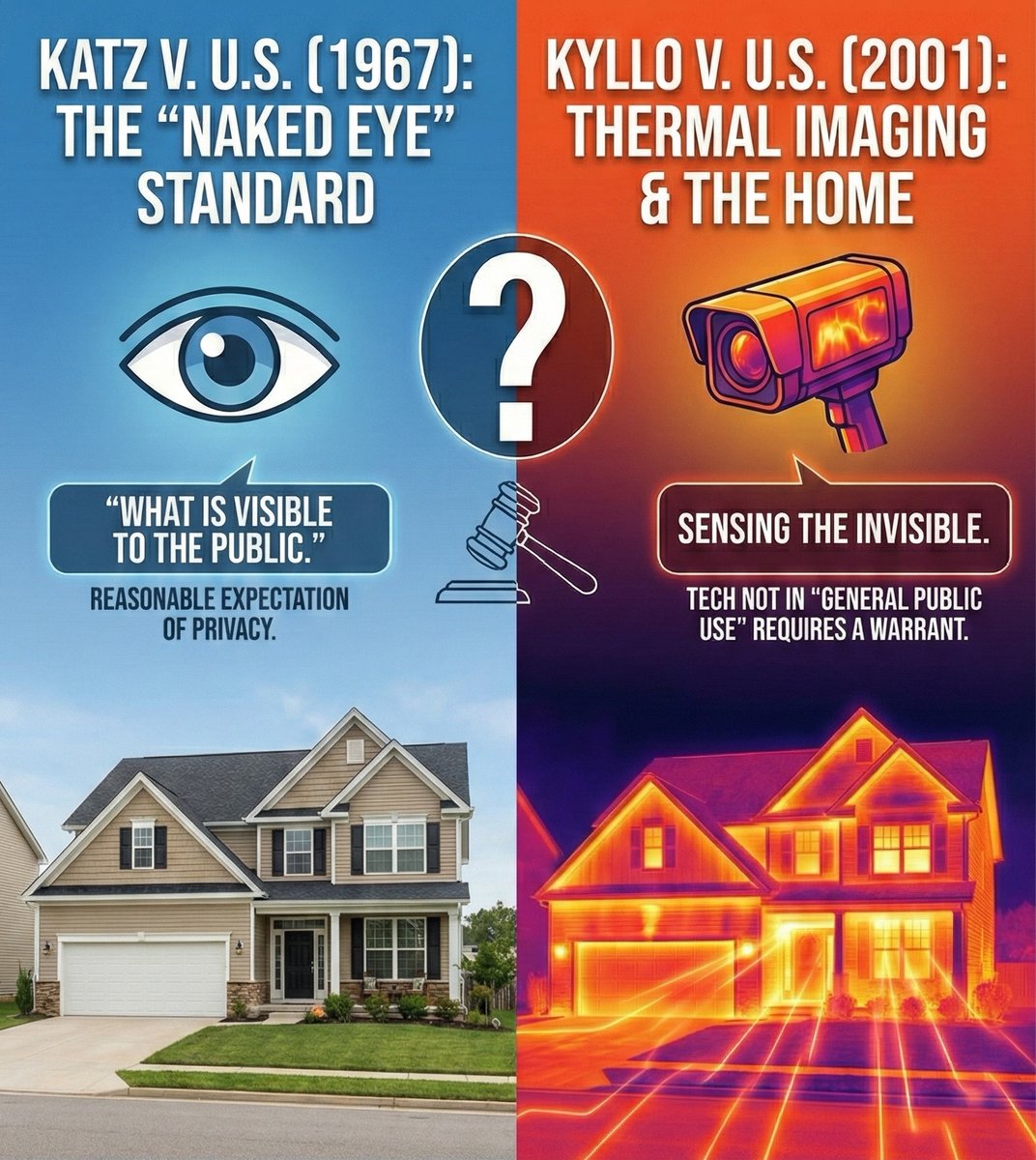
How has the analysis of the reasonable expectation of privacy doctrine evolved in the second half of the 20th century? Katz v. U.S. (1967) established the famous two-part test, highlighting a subjective expectation of privacy and a societal recognition of that expectation as reasonable. Later, Smith v. Maryland (1979) emphasized the third-party doctrine and assumption of risk, presuming that individuals accept the risk of disclosure when sharing data. California v. Greenwood (1988) extended this, denying protection to discarded trash, while Harris v. U.S. (1968) solidified the "plain view" exception. However, the Court began to draw finer lines. In Oliver v. U.S. (1984), the Court distinguished between "open fields" and the home's "curtilage," offering less protection to the former. California v. Ciraolo (1986) and Florida v. Riley (1989) involved aerial surveillance, limiting protection for what is visible from public airspace. Similarly, Dow Chemical v. U.S. (1986) permitted aerial photography of industrial facilities, distinguishing commercial privacy from the stricter sanctity of the home. Kyllo v. U.S. (2001) marked a turning point. The use of thermal imaging to see inside a home was recognized as a search requiring a warrant. The Court emphasized the intimacy of the home and held that employing technology not in "general public use" to obtain information was unconstitutional. This decision echoed Warren and Brandeis's call for adapting the law to new technologies, ensuring the Fourth Amendment protects the home even when the intrusion is invisible. While the core of the Katz test remains, its application has shifted. The analysis has become more nuanced, balancing privacy rights with law enforcement needs while reflecting an evolving understanding of privacy in the face of technological advancements.
Max Moroz tweet media
English
0
0
1
187
Max Moroz
Max Moroz@Dor3s·
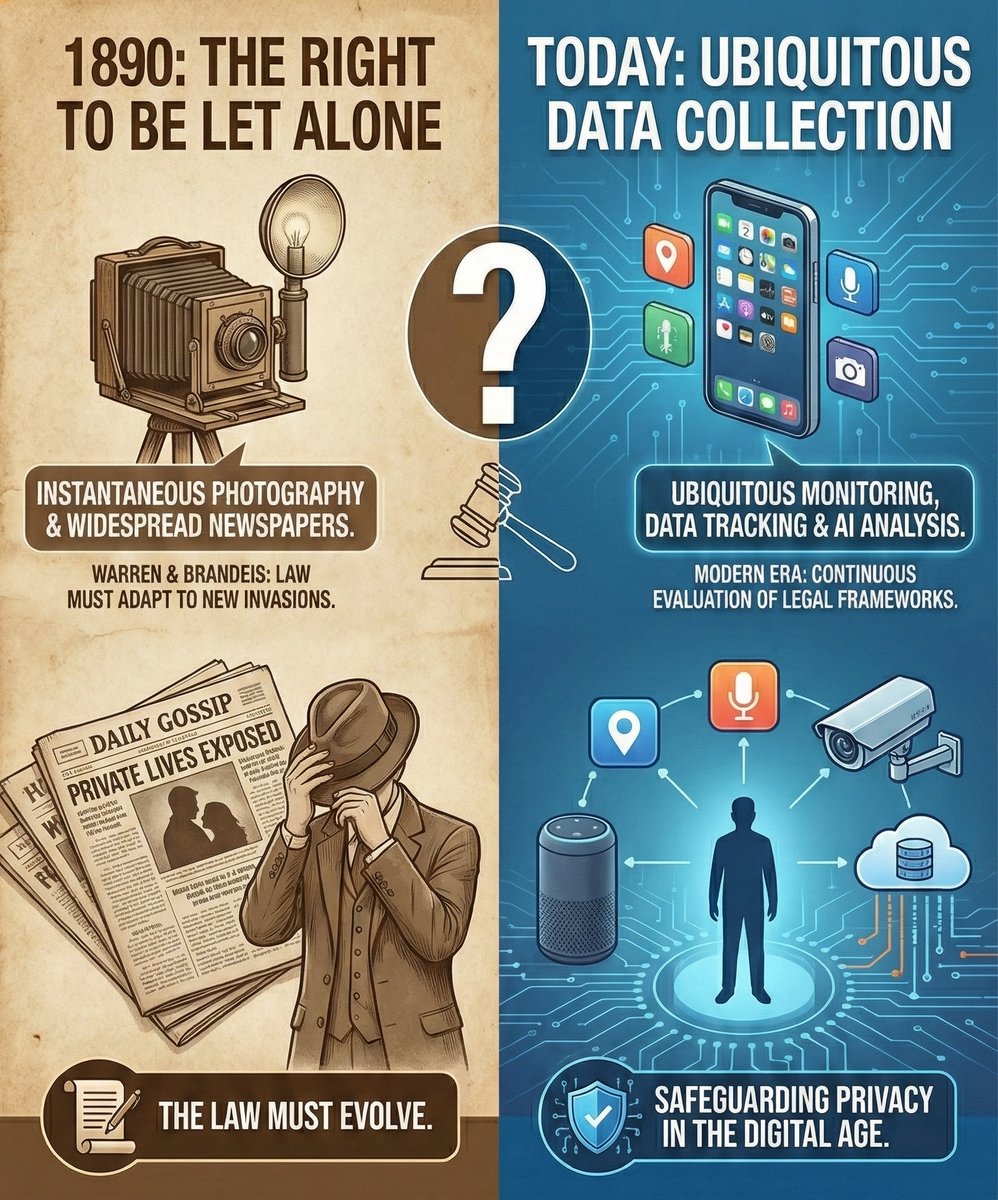
The "Right to Be Let Alone" (1890 vs. Today) In the Law Review article “The Right to Privacy” (1890), Samuel Warren and Louis D. Brandeis made an argument for the legal recognition of an individual’s right “to be let alone.” One of their central arguments, which is especially relevant today, was that the law should adapt to protect individuals from new forms of privacy invasion created by modern technological developments. Warren and Brandeis analyzed existing legal doctrines and precedents to highlight that the state of the law was not sufficient to address the challenges posed by innovations such as instantaneous photography and widespread newspaper enterprises. The authors asserted that the law must evolve to keep pace with changes in society and technology. They also analyzed remedies offered by the existing body of law, such as compensation for injuries due to defamation, and noted that these were not directly applicable to privacy intrusions. The main focus of protecting privacy, they argued, is the individual's right to an "inviolate personality," regardless of whether material damages resulted from the violation. This argument is extremely relevant today, as we live in an era of ubiquitous data collection, monitoring, and tracking due to the popularity and pervasiveness of digital devices. The core principle articulated by Warren and Brandeis—that the law must not remain stagnant in the face of technological and business progress—serves as a powerful reminder that we must continuously evaluate and advance our legal frameworks to safeguard our right to privacy.
Max Moroz tweet media
English
2
0
0
201
Max Moroz retweetledi
Ivan at Wallarm / API security solution
Looking for security researcher with great public profile. Remote. API / AI exploits focus on novel techniques. No XSSers please ;) reply here or DM. Please repost
English
4
9
22
5.7K
Max Moroz
Max Moroz@Dor3s·
United States (FBI) vs. Apple Inc. (2016): whether the government would have prevailed in compelling Apple to unlock an iPhone used by a terrorist remains a significant open question. The Fourth Amendment protects individuals from unreasonable searches and seizures. A reasonable search generally requires a warrant issued upon probable cause. Additionally, the All Writs Act allows courts to issue orders to help law enforcement carry out its duties. The key argument in the government’s motion was that the All Writs Act order is lawful and binding. In fact, the court had issued similar orders in the past, and Apple had complied with those orders without much objection. The government also claimed that Apple didn’t deny having the technical capability to comply with the order. This is factually correct, but Apple argued the issue was not about ability, but about compulsion. They contended that forcing them to write new code to create a "backdoor" constituted compelled speech in violation of the First Amendment. Unlike previous cases, Apple did not have the tool ready; they would have had to build it from scratch. Another argument the government made was that the tool developed by Apple for unlocking the iPhone could remain in Apple's full control. It is reasonable to expect that such a system would likely be needed for future cases. Therefore, the government argued it would be unreasonable for Apple to claim an undue burden just because they might have to use the system again. To strengthen the support of its motion, the government noted that no other statute limits the enforcement of the All Writs Act in this case. They specifically noted that the Communications Assistance for Law Enforcement Act ("CALEA") is not applicable and cited precedents of court authority to issue All Writs Act orders in support of lawful search warrants. Despite Apple's strong First Amendment defense, the government likely would have prevailed in compelling Apple to unlock the iPhone under the All Writs Act. P.S. This post in my “legal series” is really special, because the class where we studied this topic was taught by the very person who represented the government in the case–a United States Attorney Eileen M. Decker. What a privilege to have been able to learn about all this from the professor’s first-hand experience!
Max Moroz tweet media
English
1
0
0
156
Max Moroz
Max Moroz@Dor3s·
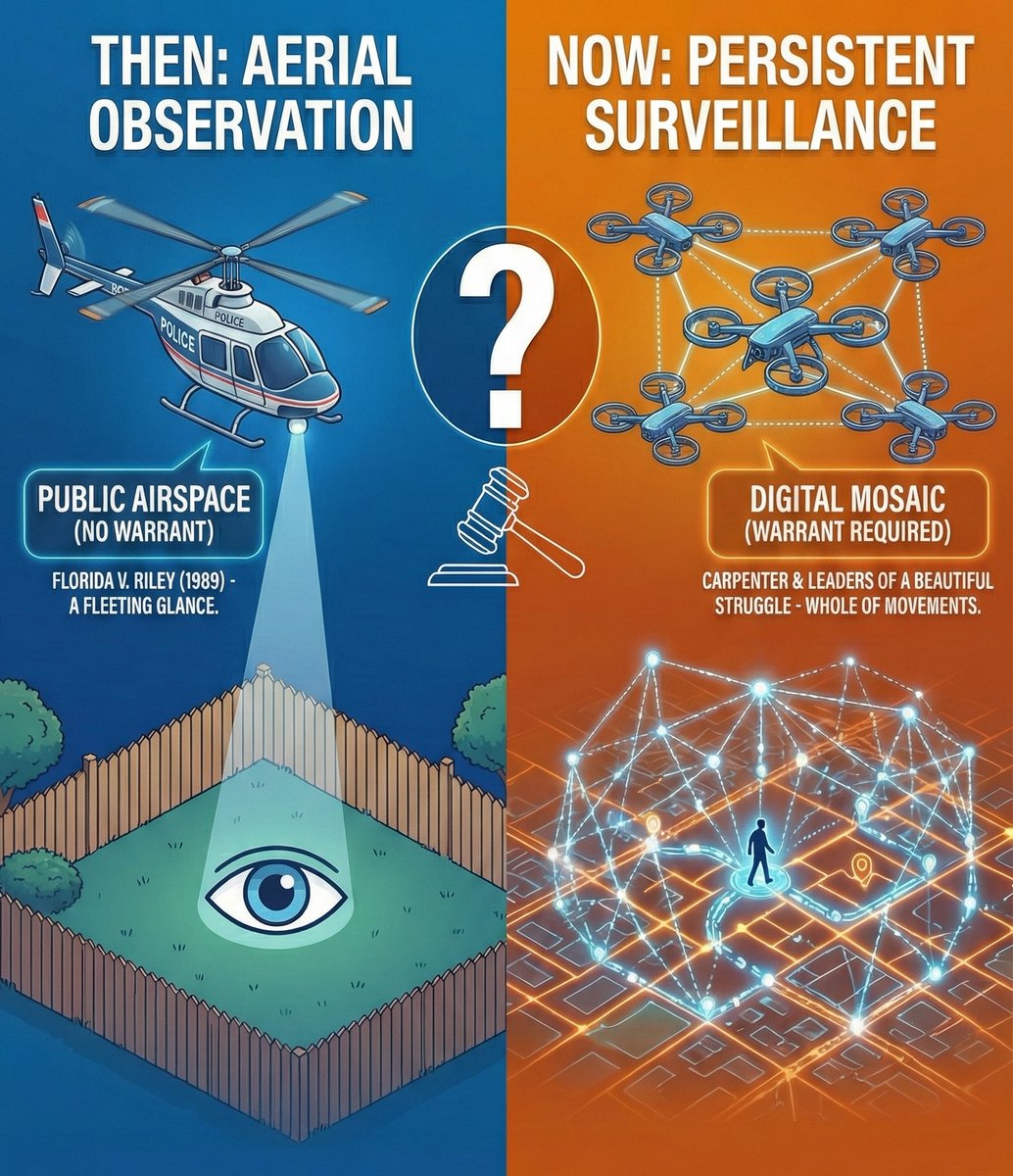
Must law enforcement obtain a warrant to gain access to information collected by Unmanned Aerial Systems (UAS)? The Fourth Amendment protects people from unreasonable searches and seizures. Generally, a warrant based on probable cause is required for a search to be considered reasonable. However, there are exceptions. The "plain view" doctrine allows the seizing of evidence if the officer is lawfully in a position to observe it (Harris v. United States, 1968) and it is visible to the naked eye (California v. Ciraolo, 1986). Additionally, in Florida v. Riley (1989), the Court held that aerial surveillance from a helicopter in public airspace did not constitute a search requiring a warrant. UAS (drones) are increasingly used by law enforcement. This technology offers notable benefits for police work, providing greater mobility and officer safety. On the other hand, it intensifies privacy concerns. In Katz v. United States (1967), the Court emphasized that the Fourth Amendment protects "people, not places." What a person "seeks to preserve as private, even in an area accessible to the public, may be constitutionally protected." While a single image taken by a drone from a public vantage point might not violate a reasonable expectation of privacy, continuous surveillance is a different story. Half a century after Katz, in Carpenter v. United States (2018), the Court held that obtaining cell-site location information required a warrant because individuals have a reasonable expectation of privacy in the "whole of their physical movements." A similar argument was used in Leaders of a Beautiful Struggle v. Baltimore Police Dept. (2021), where the Fourth Circuit ruled that a persistent aerial surveillance program was unconstitutional without a warrant Law enforcement generally must obtain a warrant to access UAS data, unless a specific exception such as the plain view doctrine or exigent circumstances applies.
Max Moroz tweet media
English
0
0
0
123
Max Moroz retweetledi
Parisa Tabriz
Parisa Tabriz@laparisa·
Lots of discussion about AI browsers these days! It's exciting, _and_ it comes with new security challenges that require proactive, layered defenses. Our latest @googlechrome security blog shares some of our approach to agentic security: goo.gle/3XKSufM 🔐🕸️🤖✨
English
2
14
58
11.6K
Max Moroz
Max Moroz@Dor3s·
Is unlocking your phone with your face or fingerprint a violation of your Fifth Amendment rights? The Fifth Amendment protects a person from being compelled to be a "witness against himself." This protection applies to testimonial evidence (revealing the contents of one’s mind). It generally does not apply to physical evidence, like a key to a safe or fingerprints used for identification. Courts have analyzed whether a biometric unlock is a "physical" or "testimonial" act, and the results are split. - The Physical View: Some courts argue it is analogous to providing a fingerprint for ID or standing in a lineup, which is not protected (State v. Diamond, Commonwealth v. Baust). - The Testimonial View: Others point out it is the functional equivalent of entering a passcode, which is testimonial and protected (In re Search of a Residence in Oakland). The distinction often comes down to the "Foregone Conclusion" doctrine. If the government already knows that a specific device belongs to a specific suspect and can prove they can unlock it, compelling the unlock reveals no new information--it is a non-testimonial "foregone conclusion" (Commonwealth v. Gelfgatt). However, if ownership is not established, the act of successfully unlocking the device testifies to your control over it. That act provides new information, arguably triggering Fifth Amendment protection. Whether compelling a fingerprint violates the Constitution depends on the specific facts. The key question is: does the act of opening the device simply grant access, or does it force the suspect to reveal facts the government doesn't already know?
Max Moroz tweet media
English
0
0
0
260
Max Moroz retweetledi
Malika Aubakirova
Malika Aubakirova@MaikaThoughts·
Excited to finally release the report @openrouter and I have been working on. The past year marked a decisive shift in how we build and use AI. Reasoning moved from the edges of research into the center of real-world production, driven by breakthroughs in model capability, open-source momentum, and the rise of AI-native applications. Today, we are releasing a large empirical study of this transition, based on more than 100 trillion tokens of real-world usage. OpenRouter now serves more than five million developers and routes traffic across more than 300 models from over 60 providers, with daily volume crossing one trillion tokens just last week. Happy anniversary, o1 🍓
OpenRouter@OpenRouter

We collaborated with @a16z to publish the **State of AI** - an empirical report on how LLMs have been used on OpenRouter. After analyzing more than 100 trillion tokens across hundreds of models and 3+ million users (excluding 3rd party) from the last year, we have a lot of insights to share.

English
4
7
44
9.3K
Max Moroz
Max Moroz@Dor3s·
As AI chatbots become increasingly popular and powerful, a critical legal issue arises: is a warrant required to access personal conversations with these agents? The Fourth Amendment generally requires a warrant for private communications, but the "third party doctrine" (Smith v. Maryland) creates an exception for information voluntarily shared with service providers. However, AI chatbot conversations are unique. They often involve personal thoughts and feelings, making them arguably similar to talking to a therapist or writing in a private diary. Unlike regular search queries, these responses carry a significant degree of individualization. Technically, the third party doctrine applies because users voluntarily disclose this information to the provider. The traditional view is that once you share data with a third party, you lose your expectation of privacy. But we must look at Carpenter v. U.S. (2018). In that case, the Court looked beyond just the volume of data and focused on the nature of the information. They ruled that data revealing the "privacies of life" requires protection. A comprehensive log of AI conversations is arguably far more revealing and sensitive than the cell-site location records discussed in Carpenter. Practically, I believe conversations with AI chatbots are similar to emails. They should be treated as "content" rather than "metadata," qualifying as protected electronic communications under the Stored Communications Act (SCA). A warrant should be required to access personal conversations with AI chatbots. We must ensure our laws recognize them for what they are: private dialogues and not just data points.
Max Moroz tweet media
English
0
5
10
43.6K
Max Moroz retweetledi
Parisa Tabriz
Parisa Tabriz@laparisa·
Awesome application of AI for defense, and encouraging proof-of-concept and impact! I feel proud to know some of the cool kids that worked on this project; well done @four @ralucaadapopa @halbecaf & many more from Google DeepMind and Google Security! 👏🔐✨
Demis Hassabis@demishassabis

Excited to share early results about CodeMender, our new AI agent that automatically fixes critical software vulnerabilities. AI could be a huge boost for developer productivity and security. Amazing work from the team - congrats!

English
1
2
42
9.5K
Max Moroz retweetledi
Oliver Chang
Oliver Chang@halbecaf·
Really excited to finally announce CodeMender! As part of this we've already submitted and upstreamed several patches to OSS projects via OSS-Fuzz. Check out our post at: deepmind.google/discover/blog/… There will be more technical details and exciting announcements to come!
English
0
11
47
6K
Max Moroz retweetledi
Google DeepMind
Google DeepMind@GoogleDeepMind·
Software vulnerabilities can be notoriously time-consuming for developers to find and fix. Today, we’re sharing details about CodeMender: our new AI agent that uses Gemini Deep Think to automatically patch critical software vulnerabilities. 🧵
English
75
327
1.9K
367.7K
Max Moroz
Max Moroz@Dor3s·
@mihaimaruseac Absolutely! Will sign up for a slot in two weeks (or the one after that)
English
1
0
1
46
Mihai Maruseac
Mihai Maruseac@mihaimaruseac·
@Dor3s Want to talk about it at the OpenSSF AI/ML WG?
English
1
0
1
79
Max Moroz retweetledi
Dmitry Vyukov
Dmitry Vyukov@dvyukov·
Uninitialized memory is the most under-recognized type of security bug (it looks like UAF/OOB got all attention). You don't need ROP, don't need to break ASLR, overlap objects, etc. Just read out crypto keys that the system nicely sends you.
Andrey Konovalov@andreyknvl

Wrote a trigger for CVE-2025-38494/5 (an integer underflow in the HID subsystem) that leaks 64 KB of OOB memory over USB. Still works on Pixels and Ubuntus (but the bug is fixed in stable kernels). github.com/xairy/kernel-e…

English
3
25
174
14.4K
Max Moroz retweetledi
the_storm
the_storm@the_st0rm·
Just touched down for @BlackHatEvents. Putting the final touches on tomorrow’s presentation: #decoding-signal-understanding-the-real-privacy-guarantees-of-e2ee-45355" target="_blank" rel="nofollow noopener">blackhat.com/us-25/briefing… Excited to see everyone there! 🙈🔒✉️ #BHUSA
the_storm tweet media
English
1
1
13
840
Max Moroz retweetledi
Heather Adkins - Ꜻ - Spes consilium non est
Today as part of our commitment to transparency in this space, we are proud to announce that we have reported the first 20 vulnerabilities discovered using our AI-based "Big Sleep" system powered by Gemini — goo.gle/bigsleep
English
17
74
280
98.1K