
Sabitlenmiş Tweet
a16z
25.5K posts

a16z
@a16z
It's time to build. https://t.co/A9eTFq6Xbx Posts are not investment advice or an advertisement for investment services. See https://t.co/nX2FtaLE06.
The Cloud Katılım Ağustos 2009
62 Takip Edilen1M Takipçiler
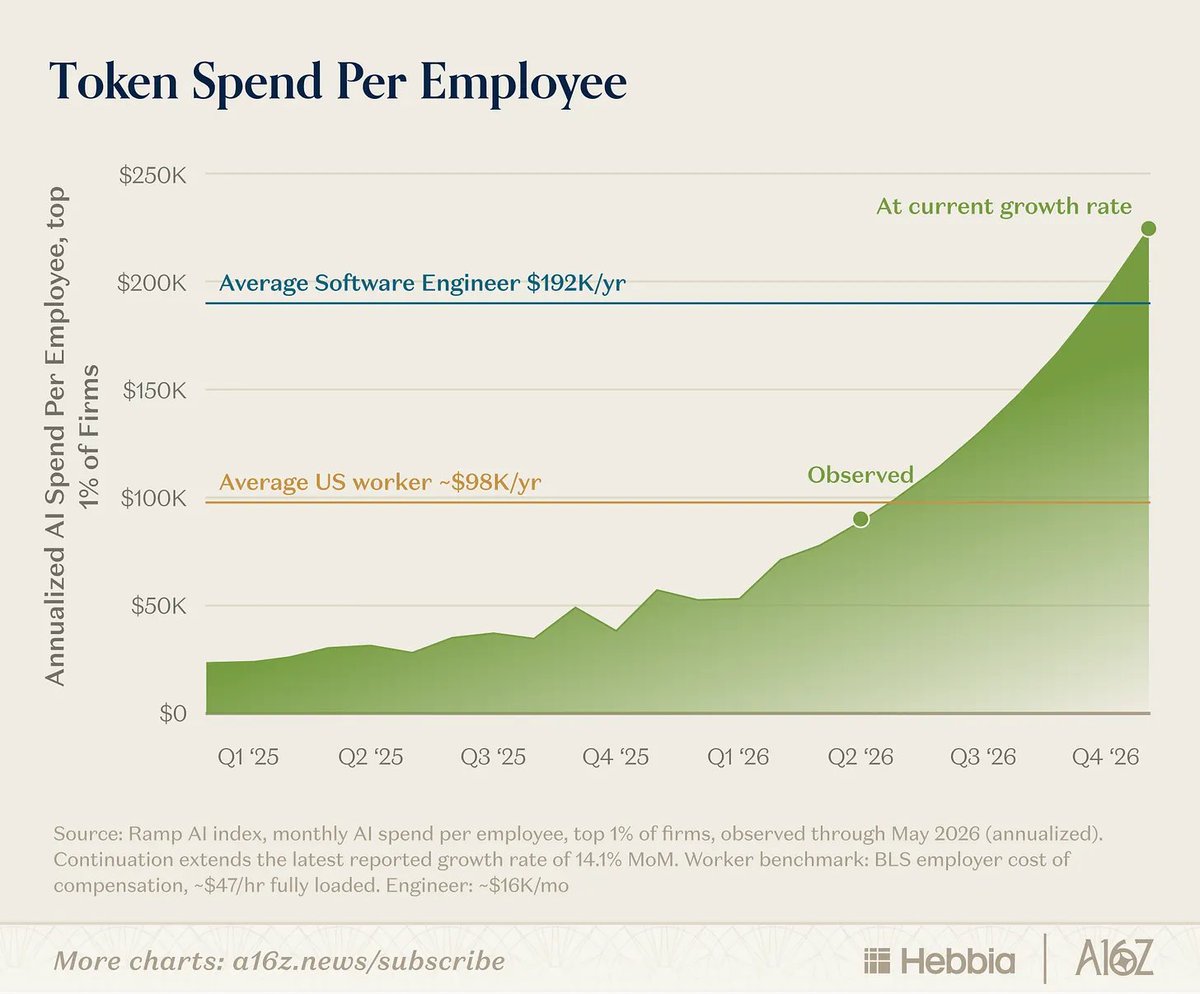
"Humans are cheaper than tokens on average, but good tokens are cheaper at scale."
For median firms, agent costs sit near $80/hour, roughly in line with a software engineer.
But at the tails, an agent can cost $4/hour or $7,000/hour depending on how it's managed.
Hebbia CEO George Sivulka on why 100X tokens are the new 10X engineers: a16z.news/p/the-next-ai-…

George Sivulka@gsivulka
English
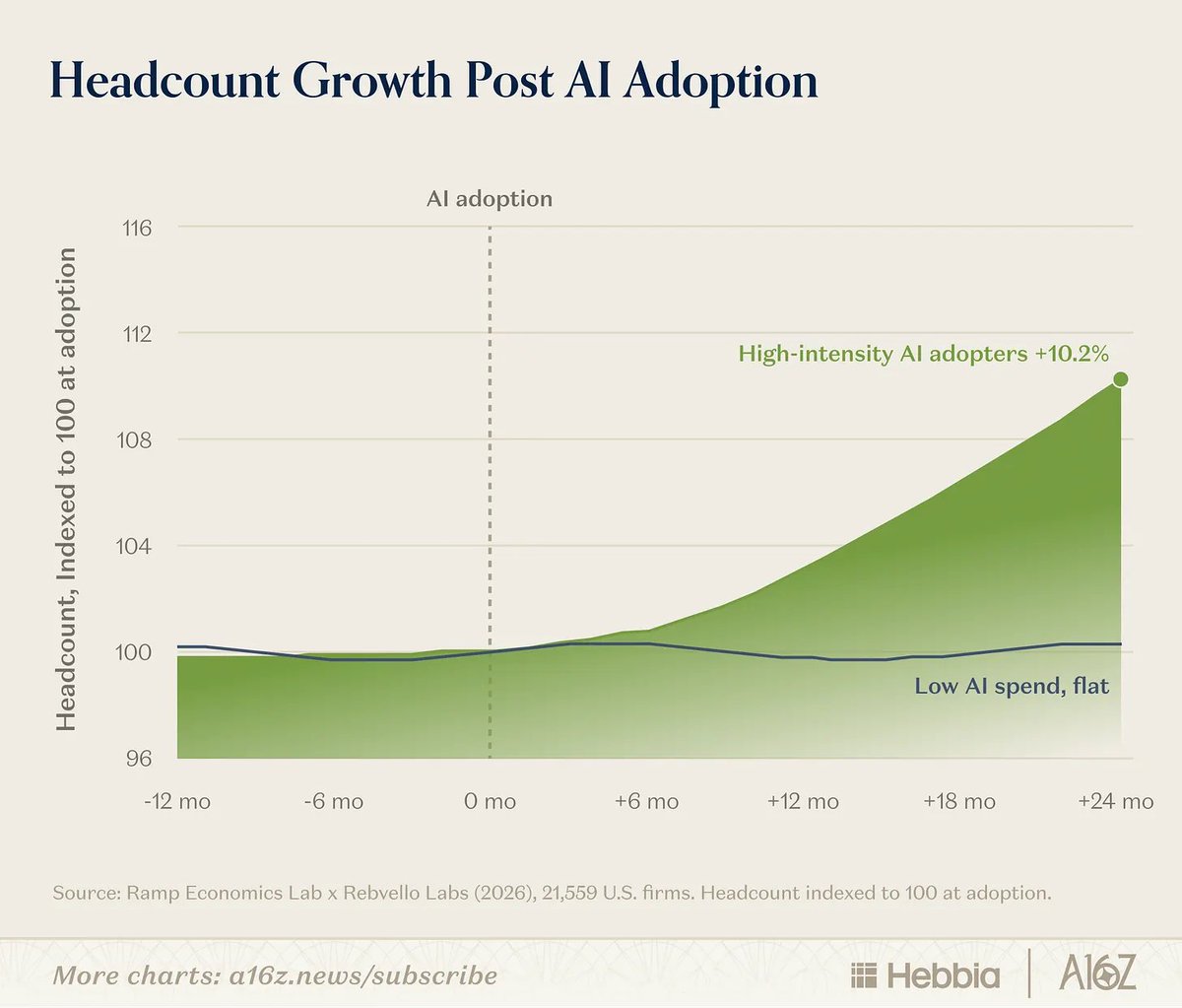
"AI was supposed to replace human labor.
It did the opposite.
For the first time in history, humans are cheaper than software.
And AI is creating more jobs than it eliminates."
Hebbia CEO George Sivulka on what the core lessons of human management mean for agent workforces: a16z.news/p/the-next-ai-…
George Sivulka@gsivulka
English
a16z GP Anish Acharya on AI being the first technology built to extend our emotions, not just our intellect:
"We've had 40 years of technology that extended our intellect and our minds. But most of the human experience is actually emotional and it's subjective."
"Now we have a technology that extends our emotions, our subjective experience, and it can address that."
"Let's start to really address the human experience through this next new technology. And I think that's where all this goes."
@illscience with @kevinrose
Anish Acharya@illscience
English
"For most of history, the bottleneck on making something was never the idea, it was the grind: acquiring the years of skill, raising the money, assembling the team, and getting the permission. So most people’s best ideas died inside them, unmade.
Lift that bottleneck and the thing that decides what gets built is no longer whether people can justify the VC funding or the enterprise-level capital expenditure, but who has something to say.
The most human thing about you stops being a private quirk and starts being the point.
Individuality was supposed to be the luxury you bought once you’d made it. I think it’s about to become the thing everyone gets to spend their life on, the work itself."
a16z GP Anish Acharya on why AI is the most human technology ever made: a16z.news/p/the-most-hum…
Anish Acharya@illscience
English
a16z retweetledi

Pearl Health has $110M in new capital to accelerate its mission of empowering healthcare providers with AI tools to deliver better care at lower cost. We @a16z are leading their $50M equity financing, and Pearl has secured an additional $60M in debt financing.
Today, @PearlHealth_ profitably manages $3.6B in healthcare spend across 10,000+ providers and 250,000+ Medicare beneficiaries in 40 states. It's been amazing to see their progress since we first invested in 2021.
@vintweeta @CarolineGoggs @DavidGeorge83 @a16zBioHealth

English
The Future of Enterprise Software with Steven Sinofsky
Seema Amble, Steven Sinofsky, and Elena Burger sit down to cover what headless software actually means, why enterprise stickiness is harder to kill than anyone thinks, and where the real opportunities are for startups building in the age of agents.
1:00 Intro to the episode and guests
1:58 What is headless software and what changes does it introduce
2:17 Salesforce Headless 360 announcement unpacked
9:49 Historically, what made software sticky
15:26 Steven's "The Death of Software, Nah" essay and why the SaaSpocalypse is overblown
17:11 Why legacy systems like SAP and insurance software are truly irreplaceable
26:04 Why enterprise software's two most-used features are "export to Excel" and "export as CSV"
29:25 The challenge of context, permissioning, and edge case handling for agents
35:07 Is automating the long tail the hardest problem in enterprise AI
36:54 Why productivity gains always create more work, not less
45:31 The rise of MCP servers and history rhyming with the Microsoft middleware era
52:20 Biggest startup opportunities in the agentic software landscape
@stevesi @VirtualElena @seema_amble
Seema Amble@seema_amble
English
Ben Horowitz says Silicon Valley is hard to recreate because it requires talent, policy, and culture:
"The first is you do need the talent... is there a great technical university that graduates people who know how to build things?"
"Many countries have that, that don't have a Silicon Valley. And what are they missing? They're missing the other two components."
"The second is, do you have a set of laws and policies that facilitate entrepreneurship, are essentially good for business?"
"The third one... is the culture such that young people, the most capable young people willing to make the biggest contribution, do they get status, social status reward?"
"That's the thing that's so hard to replicate, and it's so hard to build, and it's so easy to destroy."
@bhorowitz
English
Anne Neuberger says technology is now the arena of national power:
"Technology moved from being a tool of diplomacy, of national power, to the arena of it."
"The supply chain for chips was not a technology issue as much as a foundational economic and national security issue."
"A software vulnerability is now not an IT issue. It can be a source of leverage, particularly if that vulnerability is in key parts of your power systems or your water systems."
"Deterrence is no longer just the size of a military."
"Those technologies today are not being built by governments, they're being built by the private sector, whether that's AI systems, whether that's autonomous systems, whether that's cyber defense systems."
@AnneNeuberger
English
Technology Is the Arena of National Power.
Ben Horowitz, Anne Neuberger, Raghu Raghuram, and Jen Kha discuss a16z's expanding international strategy and the growing role technology plays in economic growth, national security, and global partnerships. They cover why America's technology leadership matters beyond Silicon Valley, how AI is reshaping relationships between governments and the private sector, why countries around the world are looking to adopt frontier technologies, and what it takes to build enduring technology ecosystems.
1:00 Why a16z's international strategy starts with America
4:48 Technology as the arena of national power
7:08 Why trusted AI infrastructure matters
9:05 How AI changes international go-to-market
11:18 ElevenLabs, TelevisaUnivision, and globalizing local content
18:33 How a16z prioritizes international markets and allies
29:05 AI, open source, and the future of cyber defense
37:00 What it takes to build a technology ecosystem
@bhorowitz @AnneNeuberger @RaghuRaghuram @jkhamehl
English
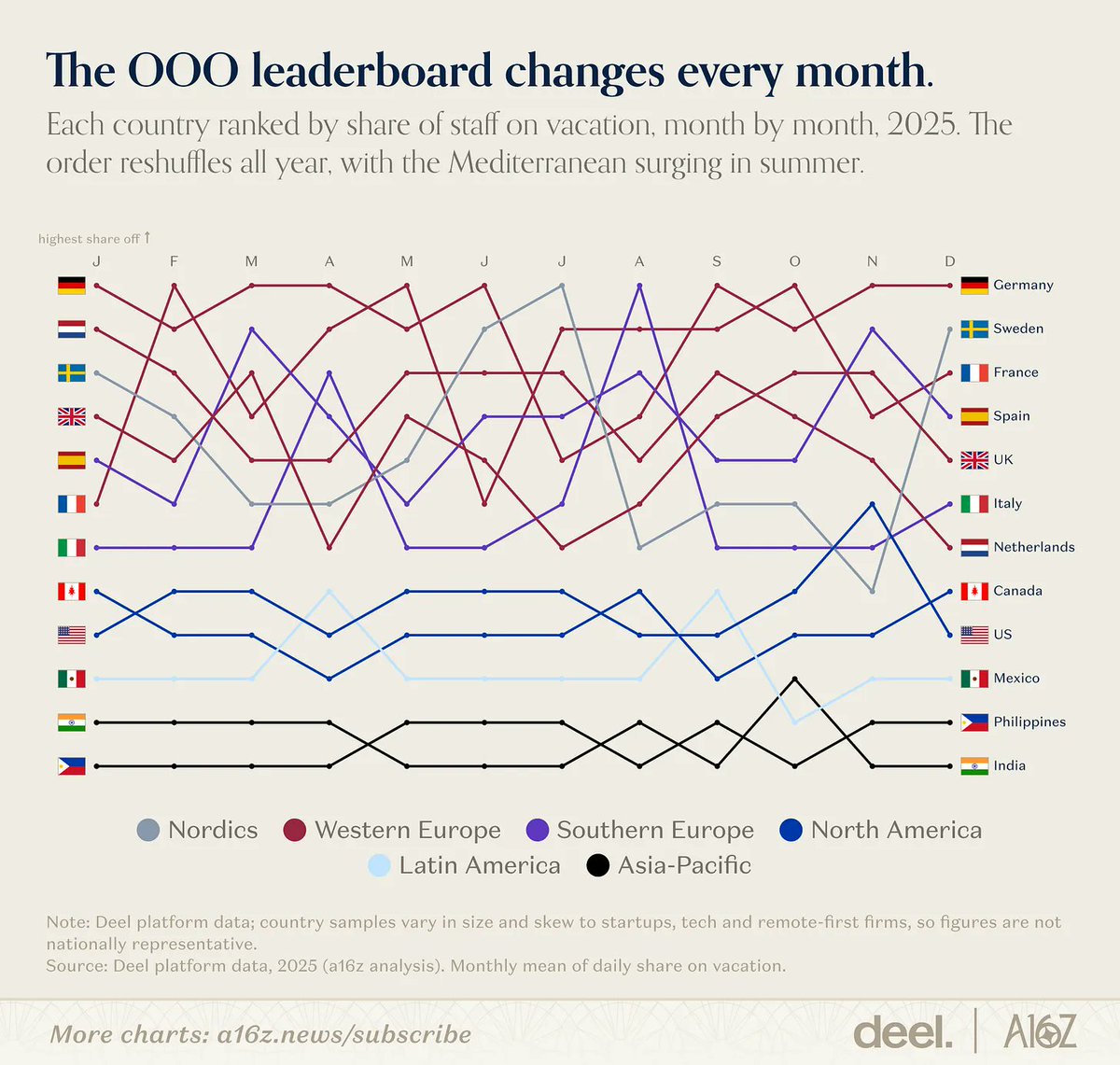
Vacation looks very different depending on where you work.
Over the course of the year, Germans hold the OOO crown. But not consistently! Swedes and Italians trade places in July and August, and in August, the French take over. Brazil breaks from the European pattern on summer break length. India books vacation days at the last minute.
And birthdays are popular days off, but only the big ones. Turning 31? Not worth celebrating, apparently.
We teamed up with @deel to look at how startup and tech workers around the world actually take vacation, not just how many days they're offered, but when they take them, how long, and whether they take them at all.
North America is stingier than Europe. Most "vacations" are a single day off. Long weekends spike on Mondays and Fridays in summer.
And no matter how hard the Europeans work to make their summer holidays count, Christmas break wins everywhere. The British are proportionately at their desks in peak summer; the Dutch over Christmas.
Except Armenia, for some reason.
Full piece: a16z.news/p/charts-of-th…


English
The a16z Editorial team’s summer reading list: open.substack.com/pub/a16z/p/the…

Alex Danco@Alex_Danco
The a16z New Media summer reading list is out! Here are some (joyful, thoughtful, bleak, ridiculous) suggestions from me and the editorial staff here. My picks were Moby Dick and The Magic Mountain a16z.news/p/the-2026-sum…
English


AI native startups have fewer employees
Charts of the Week: a16z.news/p/charts-of-th…

a16z@a16z
AI native startups run lean Charts of the Week: a16z.news/p/charts-of-th…
English

.@pmarca on the data center build-out and how America is holding itself back:
"What's happening literally in the US right now county by county with the ability to build data centers is profoundly destructive."
"And that's entirely domestic. And a large number of politicians are feeding that hysteria as much as they possibly can."
"A lot of our leading public figures, and a lot of intellectuals, and a lot of the press, and a lot of the analysts, and the rest of it, it's just this kind of hyper paranoia about building data centers and the consequences of data centers."
"This completely fake meme about water use, which is just factually not true, which is just running wild through the public discussion that somehow these data centers are basically destroying all the water, which is this completely insane idea. That factor is [such] a bigger factor holding us back than anything involving external trade."
"External trade is the thing that's easy to talk about. It's all of our internal issues that are much, much more important."
With @NGirishankar @CSISEST
Steve Everley@saeverley
Data center water use, contextualized (chart via @axios)
English