
Catrina

748 posts

Catrina banner
Catrina

Catrina

@dotcuriouscat

I like mental models | Leading 1st rounds for crypto founders, one per category | General Partner @PortalVentures | @Wharton

New York, NY Katılım Ağustos 2021
1.6K Takip Edilen3.7K Takipçiler
Sabitlenmiş Tweet
Catrina
Catrina@dotcuriouscat·
How I Source & How We Invest I get asked these questions a lot and figure putting this out in the open can help save everyone's time. 1. We only lead/co-lead and exclusively focus on the first round/pre-seed 2. I read all deal-related DM on here on X & LinkedIn. You don't need to get an intro through a mutual to reach me. Yes cold DM here works: some of my favorite portfolio companies were actually from cold DM on X/LinkedIn. I don't read cold emails as much. 3. I (ofc) will respond if it could be a fit for us. 4. The best format to DM is: blurb on what you are building + why + who you are (add LinkedIn/X) Nothing is too early: it's okay if you don't have a deck or website. What we look for is the right founder with the right insights in net-new sectors. 5. One per category: once we invest, we are all in to support the company for their entire lifecycle — the main reason we don't back competitors. 6. What we look for: weird stuff that I haven't heard of or thought of before. Or, to put it more bookishly, "disruptive" versus "sustaining" innovation per The Innovator's Dilemma. 7. I don't take calls lightly because founders' time is as valuable as my own. I rarely get on calls just out of curiosity—that's a waste of everyone's energy. Hope this helps clarify things. Will add to this thread as more come up
English
8
4
99
10.7K
Catrina
Catrina@dotcuriouscat·
Is there an X algo that can stop showing me HYPE shills? It is 💯 one of the most impressive businesses in the space — but it’s already at a ~$40B FDV with only ~25% in circulation. 1 in 3 founders I talk to these days are building HYPE competitors - sure most tried and failed but it’s not crazy to believe someone will one day. Crypto traders are mercenary by nature, and blockchain interop is def a bug not a feature for projects trying to retain their users. At some point traders will decide the upside from HYPE is just growing too slow and they want to farm new 10x opportunity using their liquidity. Network effect is very weak in crypto and I’ve written extensively about this (article link in comment). If I’m a retail investor looking to: 1.Buy crypto for a multi-year hold — why would I choose HYPE with a ~4x supply overhang from the remaining 76% yet to unlock, over BTC at $70K: the only digital gold, 100% vested, no central control, and completely irreplaceable? Hype needs to find 4x buyer just to maintain its current price. 2.Buy crypto for a 10x — why would I pick a token already at a $40B FDV, as consensus as it gets, with several competing DEXs floating around, and every KOL shilling their bags — over, say, a Fartcoin that’s 90% + down from its peak, memeable, high fluctuation, and actually fun? Go ask those KOLs if they’re still buying HYPE at this price. HYPE made a lot of traders rich — half the time they’re just shilling their bags.​​​​​​​​​​​​​​​​ But what do I know 🤷🏻‍♀️
English
1
3
6
2.2K
Catrina
Catrina@dotcuriouscat·
Among the list, the hardest by far is the third bullet: “conviction injection” — when the cheerleader (founder/CEO) needs to be cheer the lows. Venture is a game of fallible people (VCs) making fallible bets. Structurally, we can’t be bullish on every investment. We love being early and right, but the harsh truth of early-stage venture is that most of the portfolio go to zero, while a few winners return the fund multiple times over. That’s exactly why we back only one company per category and insist on lead or co-lead. When we’re right, we need to make damn sure we get rewarded for it. Here’s the part no one talks about: how long until you know if you’re right or wrong? It’s an indefinite grind. Validation can take anywhere from a few months to years - years! The obvious happy path is when founders get immediate receptivity from customers, partners, and other VCs via more $$ — here, the "conviction injection" comes from the market. The not-so-happy path is when you simply don’t know if you are too early or wrong. There are so many confounding variables behind why isn’t a portco getting market validation or struggle with their subsequent fundraise? It could be: 1. Too early: the product is complex and needs time to build or the sales cycle is long because of the sector 2. Hard macro puts VCs in risk-off/preservation mode 3. The idea simply doesn’t have PMF 4. The founder can’t execute the vision 5. Founder is a good builder but bad fundraiser 6. _______I can name a handful more We've had portco that struggle to raise for over a year then emerge as category leaders, and others that are still grinding: there's no crystal ball to tell whether we are "right but early" or simply wrong. And guess when founders need external conviction injection the most? Exactly then. A good VC is the source behind the source. May every founder find theirs.
Catrina@dotcuriouscat

I think a lot about where I'm actually useful to my portfolio companies VCs — myself included — love to think they have unique sector insights to guide founders. But the reality is if your portco leans on you for product, you probably backed the wrong one. Imo it boils down to five things. 1. Packaging for fundraise Regardless of how brilliant, first-time founders almost always struggle with packaging their pitch for VCs. This has nothing to do with their communication skills (which they have to be good at), but the ability to compress information into a VC-digestible format, for smaller vs. big-brain VCs. 2. Therapy & conviction injection I joke that I brainwash my founders when they aren't bullish enough. Being a founder is hard — no matter how good you are, it's a marathon, and it WILL have its low-lights. It's the founder's job to cheerlead their company — but who cheers up the cheerleader when they hit a wall? Who can they show vulnerability to? not their team because they might leave. not their friends because they won't get it. definitely not their customers or partners. Their investors are probably the only one sitting at the nexus of understanding the space + knowing the company + being in a position to "conviction inject" and calm the founders in distress 3. Competitive intelligence Founders go vertical and VCs go horizontal. Investors' bird's-eye view across competitive and substitutive categories can save founders weeks of research. 4. Social signal Think of it as outsourced BD for portcos. The conversion is just so much better on a warm intro versus going in cold. Plus the cap table is a decent noise filter for customers/partners. 5. The Magic Mirror This came from a recent founder hang — when I asked series A founders their biggest learnings since preseed. A big one is that when you're the CEO, it's hard to find someone who tell you the truth. Your investors can, and should.

English
0
0
14
1.2K
Sanat
Sanat@kapursanat·
@dotcuriouscat people are often surprised but the money helps too 😅
English
1
0
2
80
Catrina
Catrina@dotcuriouscat·
I think a lot about where I'm actually useful to my portfolio companies VCs — myself included — love to think they have unique sector insights to guide founders. But the reality is if your portco leans on you for product, you probably backed the wrong one. Imo it boils down to five things. 1. Packaging for fundraise Regardless of how brilliant, first-time founders almost always struggle with packaging their pitch for VCs. This has nothing to do with their communication skills (which they have to be good at), but the ability to compress information into a VC-digestible format, for smaller vs. big-brain VCs. 2. Therapy & conviction injection I joke that I brainwash my founders when they aren't bullish enough. Being a founder is hard — no matter how good you are, it's a marathon, and it WILL have its low-lights. It's the founder's job to cheerlead their company — but who cheers up the cheerleader when they hit a wall? Who can they show vulnerability to? not their team because they might leave. not their friends because they won't get it. definitely not their customers or partners. Their investors are probably the only one sitting at the nexus of understanding the space + knowing the company + being in a position to "conviction inject" and calm the founders in distress 3. Competitive intelligence Founders go vertical and VCs go horizontal. Investors' bird's-eye view across competitive and substitutive categories can save founders weeks of research. 4. Social signal Think of it as outsourced BD for portcos. The conversion is just so much better on a warm intro versus going in cold. Plus the cap table is a decent noise filter for customers/partners. 5. The Magic Mirror This came from a recent founder hang — when I asked series A founders their biggest learnings since preseed. A big one is that when you're the CEO, it's hard to find someone who tell you the truth. Your investors can, and should.
English
3
2
12
1.6K
Catrina retweetledi
Utexo
Utexo@utexocom·
Utexo has raised $7.5M from @tether, @BigBrainVC, and @PortalVentures to bring USDT natively on Bitcoin. After more than a decade, USDT is finally coming home.
English
318
560
2.9K
1.1M
Catrina retweetledi
Peter Walker
Peter Walker@PeterJ_Walker·
Fundraising benchmarks for software (see - mostly AI) companies in the latter half of last year. All-time peaks for median seed valuations, close to that at Series A as well.
Peter Walker tweet media
English
2
11
65
18.8K
Catrina
Catrina@dotcuriouscat·
Good work here. AI is getting all the limelight now, but quantum is an equally—if not more—transformative technology of our time that is approaching faster than most realize. We started digging into quantum in late 2024 too and backed @quipnetwork as an expression of the thesis. Our mental model here RE the quantum x crypto opportunity is: - Defense: quantum security. Startups charging customers to protect against quantum threats. A "cost center" - Offense: quantum computing. Startups helping customers onboard to the next paradigm in compute. A growth driver. Now everyone's talking about quantum attacks against BTC, but the reality for startups is that pitching a quantum product focused on "defense" is not an easy pitch. Especially the ones with a "quantum L1" approach, which is akin to pitching people to move to a nuclear bunker because of a war threat. The real opportunity here is on the offense because it's always an easier sell to your customers when you're helping them make money. Hence the thesis: portal.vc/the_right_quan…
English
0
1
3
289
Saneel
Saneel@sanlsrni·
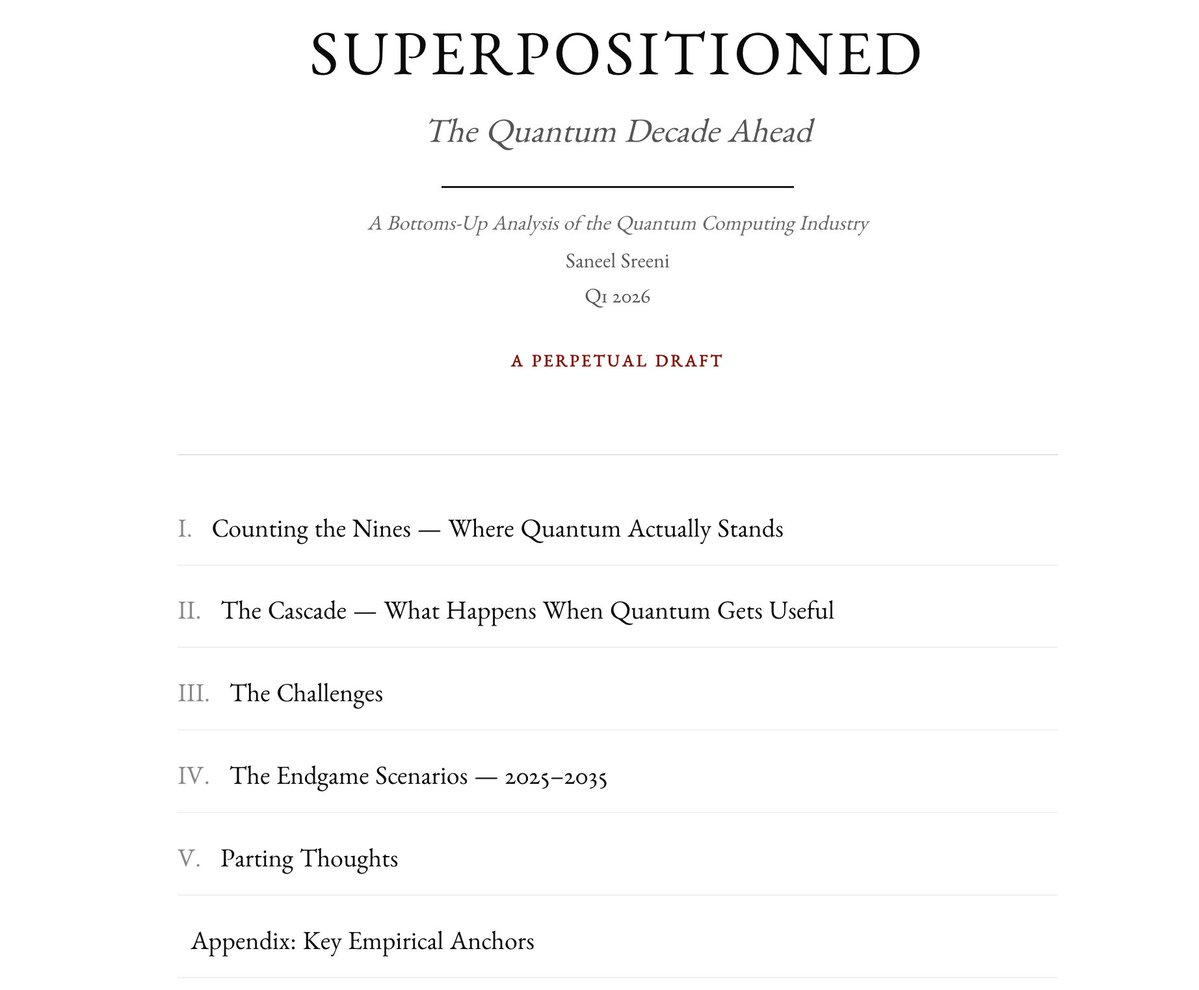
SUPERPOSITIONED: QUANTUM SITUATIONAL AWARENESS While everyone watches AI, quantum crossed a threshold in 2025 thought impossible 30 years ago. Yet, no analysis exists covering the breakthroughs, the money, the key players, and what's next. Until now. (Link in next tweet).
Saneel tweet media
English
39
68
578
171.6K
Catrina retweetledi
Tomasz Tunguz
Tomasz Tunguz@ttunguz·
Last quarter, my AI inference costs hit $100,000 annualized. I started small. Six months earlier, I was spending $200 a month on Claude. Then I added three agent subscriptions : Codex, Gemini, & Claude Code. I was paying $600 a month. Next I started using AI to transform my todo list into my done list, increasing tasks to 31 per day. $92 daily inference invoices started arriving. Then $400 per month on browser agents. Within two quarters, my inference spend grew from $7,200 to $43,000 to over $100,000 run rate. So I migrated to an open source model. It took a weekend. The key was building the right testing loops : I had six months of historical task data, so I could replay requests through the new model & hill-climb to parity with AI agents working through the night. By Sunday evening, they performed identically. At 12% of the cost. I’m not the only one paying attention to this cost. Technology companies are adding a fourth component to engineering compensation : salary, bonus, options, & inference costs. Levels.fyi pegs the 75th percentile software engineer salary at $375k. Add $100k in inference & the fully loaded cost is $475k. That’s 21% in tokens. The question CFOs will pose : what am I getting for all this inference spend? Can I do it cheaper? If the metric for a new cloud is gross profit per GPU hour, the employee equivalent is : productive work per dollar of inference. For me, the answer is 31 tasks a day at $12k annually. The engineer still burning $100k? They’d better be 8x more productive! Will you be paid in tokens? In 2026, you likely will start to be. tomtunguz.com/inference-as-c…
Tomasz Tunguz tweet media
English
21
8
118
24K
Catrina
Catrina@dotcuriouscat·
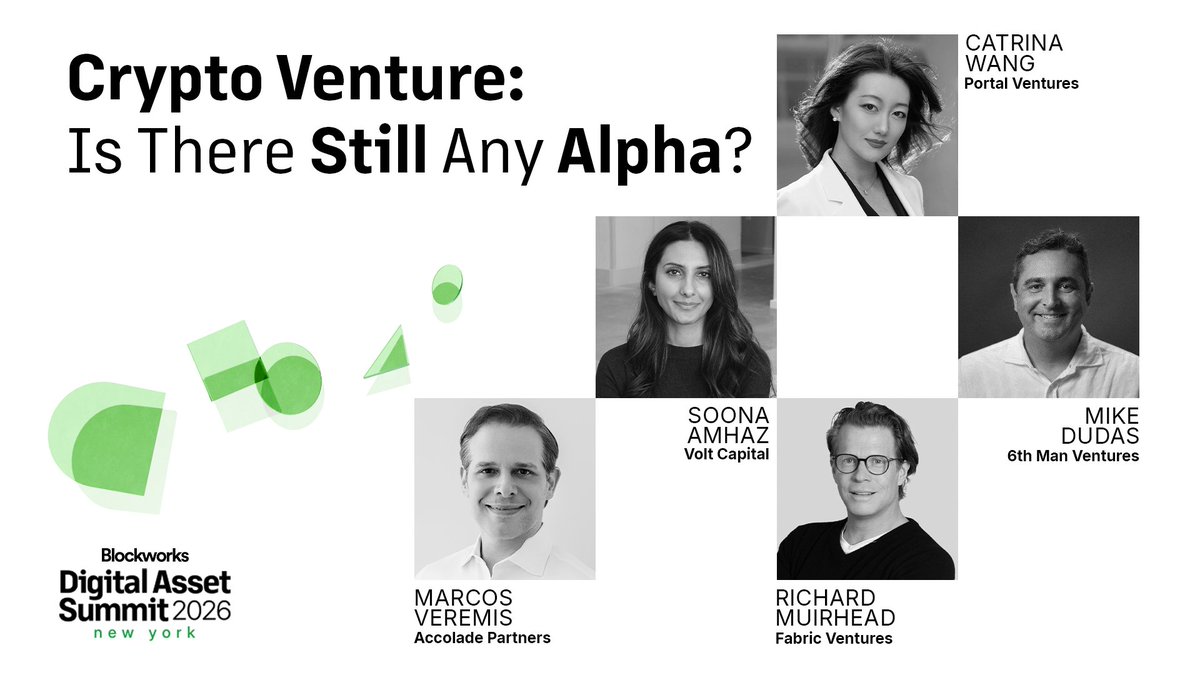
Excited to be back in NYC for @blockworksDAS What a lineup!
Catrina tweet mediaCatrina tweet media
English
2
1
15
563
Catrina retweetledi
Corey Hoffstein 🏴‍☠️
Corey Hoffstein 🏴‍☠️@choffstein·
For millennia, jocks ran everything. The nerds finally take over. And what do they do? Develop AI that wipes out their own coding/math/analysis moats. Creating a social premium on interpersonal skills. The irony.
English
341
996
19.1K
798K
Catrina
Catrina@dotcuriouscat·
Wow how can GPT suck so much even for non-technical work like VC dilligence... Claude literlaly blew it out of the water
English
1
0
6
260
Catrina
Catrina@dotcuriouscat·
Was a fantastic crowd - well done @DAF_Global
Catrina tweet mediaCatrina tweet media
English
0
0
8
227
azaztrader (福莫)
azaztrader (福莫)@azaztrader01·
@dotcuriouscat Experiment B's alignment incentive is clever, but implementing the redemption details seems challenging. Any thoughts on how to structure it fairly?
English
1
0
0
13
Catrina
Catrina@dotcuriouscat·
RE the token value accrual question of “onchain buyback is dumb, but what’s not”: here are two experiments to run. Neither are completely new in trad biz, but I haven’t seen them cleanly executed in crypto. Precondition: 1. You are a crypto biz generating $10M in revenue in treasury 2. You have launched your token on one or more CEXs (so no liquidity issue) 3. You are not seeking a public market exit (aka optimizing for token value accrual) Experiment A: Spend the majority of net income on marketing to: A1: increase awareness/eminance of your token A2: improve product distribution to grow the business for more revenue Rationale: The two types of token buyers are retail and hedge funds. The former buys based on brand/token awareness (achieved by A1); the latter buys based on revenue and growth potential (achieved by A2). Experiment B: Put net income into an onchain treasury, and token holders can *choose* to redeem a pro rata portion based on their holdings. There needs to be some sort of mechanism to indicate once token holders have claimed their share of the treasury to prevent double spend - the devil's obviously in the details Rationale: This creates game theory: if holders redeem early, they could miss out on the future growth of the pie—that is, future revenue potential. Same if they sell early. This creates a joint incentive for all token holders, including the team and investors, to be long-term and fundamentally aligned with the business’s growth.
English
3
2
14
258
Catrina
Catrina@dotcuriouscat·
Spitballing - could be sth like this Say you own 500k of ZYRO token and pro rata share of treasury rev atm is $50k In order to redeem the $50k, you transfer your token to a vault controlled by ZYRO with a min lockup time period. ZYRO project issues a certificate/NFT that shows it owes you 500k ZYRO token. When you want to sell, you go through the ZYRO UX that converts your certificate in real time to 500k ZYRO and execute sell at market value then transfer to you. This way, once you redeem your share of the treasury, your 500k ZYRO tokens goes to a vault vs. be returned to you to prevent double spend.
English
0
2
4
60
Zyro ( 资罗 )
Zyro ( 资罗 )@Zyrorivex·
@dotcuriouscat Interesting experiments. For B, how would you design the mechanism to prevent gaming the redemption system while still keeping it accessible for legitimate token holders?
English
1
0
0
24