
David Plon

108 posts

David Plon

David Plon

@Dplon88

Building AI-powered investment research at Portrait Analytics
NYC Katılım Mart 2011
429 Takip Edilen292 Takipçiler
David Plon
David Plon@Dplon88·
A very fun conversation! I’ve been a weekly listener to Business Breakdowns for years, so it was a thrill to chat with Matt about how investors are leveraging AI today (and how that is sure to evolve)
English
1
1
5
1.7K
David Plon
David Plon@Dplon88·
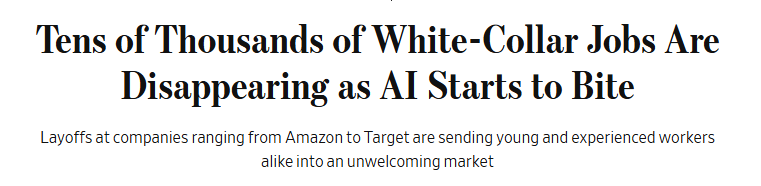
Well, looks like we're now seeing big layoffs (AMZN, TGT, UPS). Companies aren't explicitly citing AI as the key driver, though WSJ very clearly willing to make that leap
David Plon tweet media
David Plon@Dplon88

Correlation != causation, but I wonder if there's a little causation. Seems unlikely companies will replace folks with AI via sudden big layoffs. But I could imagine AI subtlety reducing the urgency to hire or back-fill positions, which would gradually slow employment growth...

English
0
0
2
388
David Plon
David Plon@Dplon88·
Correlation != causation, but I wonder if there's a little causation. Seems unlikely companies will replace folks with AI via sudden big layoffs. But I could imagine AI subtlety reducing the urgency to hire or back-fill positions, which would gradually slow employment growth...
David Plon tweet mediaDavid Plon tweet media
English
0
0
2
790
David Plon
David Plon@Dplon88·
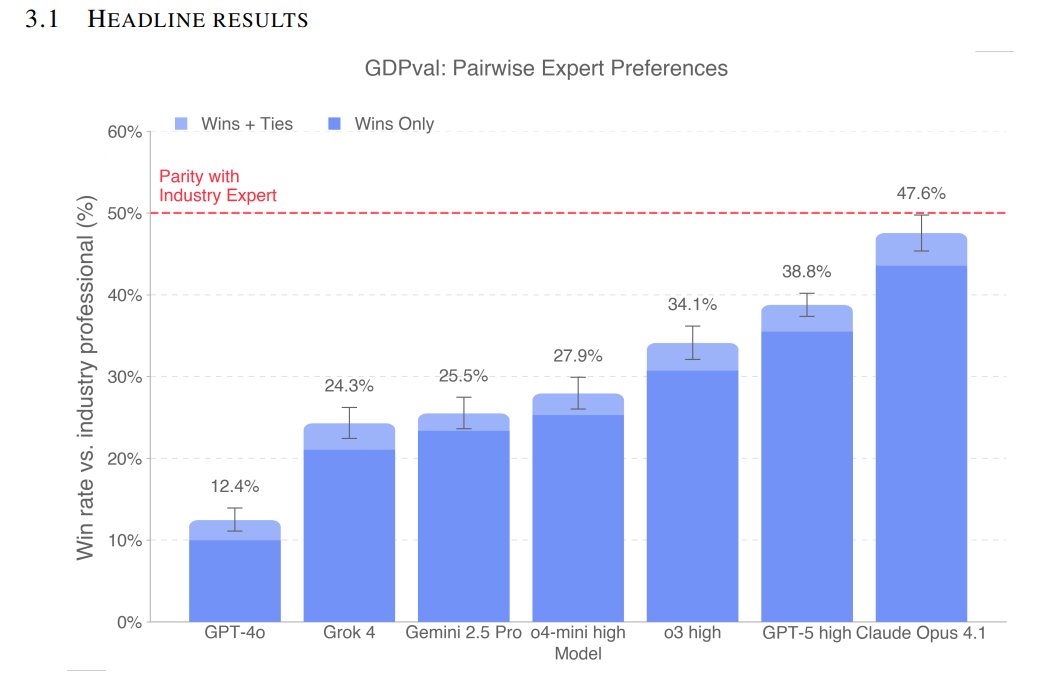
Picking the "right" LLM for a given task is not easy. There are multiple dimensions to this decision: - Do you use a commercial model or an open-source model you can self-host?? - If you go with commercially available model, which model family do you select (e.g. GPT, Claude, Gemini, Grok)? - Within a given model family, which model offers the optimal cost (both $ and latency) / intelligence tradeoff for your task? Furthermore, whatever answer you arrive at today will likely look different in 3 months from now as new models are released. At least, that's been our experience at Portrait. In theory, public benchmarks should help with model selection. But even here there are often conflicting signals. For instance: - The Artificial Analysis leaderboard, which scores models on a variety of standard eval sets, finds GPT-5 (high) to be the most intelligent LLM. - OpenAI's GDPEval study, which grades model performance on a sample of human-labeled projects across various industries, found Claude Opus 4.1 to be the most capable My experience is that any third-party benchmark is an imperfect proxy for whatever task you need to accomplish. We've found that each of the major model providers has various strengths and weaknesses, and use them all within Portrait. For individuals, the best thing you can do is come up with a few dozen "test" examples that serve as your own personal eval set. Whenever a new model comes out, try it against your "test" and see how it performs. At Portrait, we spend much of our time building large eval sets for all of the workflows within our application. It can be a grind, but it's an indispensable tool to make sure our users are always getting the latest & greatest model for any given task in the application.
David Plon tweet media
English
0
1
4
289
David Plon retweetledi
François Chollet
François Chollet@fchollet·
The idea that we will automate work by building artificial versions of ourselves to do exactly the things we were previously doing, rather than redesigning our old workflows to make the most out of existing automation technology, has a distinct “mechanical horse” flavor
English
179
561
5.6K
413.8K
David Plon
David Plon@Dplon88·
Something I've observed: If a SOTA LLM struggles to understand how to properly use a tool even after lots of prompt work, the fault usually lies in the fundamental design of the tool itself AI-centered design is becoming equally important as human-centered design
English
0
0
0
91
David Plon
David Plon@Dplon88·
With respect to AI, it feels like we’re in one of those key moments where the mainstream public “consensus” has diverged from the market "consensus". Anecdotally, most investors I speak with suspect we’re in an AI bubble, and the open question is timing (i.e. is it 1995 or 1999?). This skepticism has now reached the mainstream press, with the Economist and WSJ both running front-page features questioning the expected returns to massive AI-related capex spend. The market has a different view. Just looking at NVDA: even after growing earnings 10x since 2022, NVDA trades at ~50x LTM earnings, clearly implying rapid future growth from today's record levels. Predicting which view will prevail (and when) is tough, though gallons of ink will be spilled trying. One of my investing mentors would constantly say "observation over prediction", meaning it's far easier to observe the early signs of change happening (and then react accordingly), rather than stake a large bet on a prediction today. In the context of AI, if there is a bubble which begins to unravel, there will be plenty of subtle signposts along the way before the bottom truly falls out. This philosophy of observation > prediction is a core inspiration for the Datapoint Monitors we've built at Portrait. There are hundreds of companies tied to the AI buildout - virtually no analyst has the capacity to stay on top of all the calls and filings across this value chain to look for early signs of a slowdown (e.g. a network equipment supplier suddenly cuts guidance). But today, Portrait customers can simply set up a real-time Monitor for precisely this task. Reach out if you'd like to see our "Hyperscaler Capex Monitor", or any other mosaic you'd like to build and track!
English
0
1
5
411
David Plon
David Plon@Dplon88·
I'm struggling to figure out what the equivalent of this headline will be in 2030
Mostafa Rohaninejad@MostafaRohani

1/n I’m really excited to share that our @OpenAI reasoning system got a perfect score of 12/12 during the 2025 ICPC World Finals, the premier collegiate programming competition where top university teams from around the world solve complex algorithmic problems. This would have placed it first among all human participants. 🥇🥇

English
0
0
1
155
David Plon
David Plon@Dplon88·
This is the ultimate AI rorschach test
David Plon tweet media
English
0
0
2
133
David Plon
David Plon@Dplon88·
A common debate regarding AI is whether a model can truly be "creative", or capable of generating novel thoughts or ideas. Both sides of the debate can point to various research papers for support. I think this debate somewhat misses the point. Creativity is a tough concept to pin down with an academic definition, or test empirically in a study. What's more relevant is whether there's evidence of AI being creative in the real world, in a way that generates real value. The most obvious (and exciting) place this would show up is if AI began deriving fundamentally new mathematical or scientific insights - we're not here yet! But short of that, there is plenty of evidence of AI working as a creative source of intelligence. My favorite recent example is an article in the Economist a few weeks ago: "The rise of beer made by AI; Customers love it". I thought this quote stood out: "In one instance, after being asked to make a new lager, the bot suggested mixing Maris Otter malt, usually found in stouts, with Belgian candi syrup. “I would never have thought of doing that in a lager, ever,” he says. “We brewed it anyway, and I thought it was one of the best lagers I’ve ever made.” His customers apparently thought the same: Mr Warren says patrons usually rated the AI-crafted beers better than any of the beers thought up by he and his fellow brewers." Whether the AI had a novel thought or was just remixing data, the net result was the same: the AI came up with a counter-intuitive insight that proved to have real economic value. And at Portrait, we definitely are starting to see models shift from being a helpful assistant to a creative thought-partner. When I ask Portrait to write up the bear pitch on a stock, I'm often amazed at the 'creativity' of the short thesis. I doubt the academic debate will be settled anytime soon, but practically speaking, there's little doubt AI certainly can be a helpful for creative work today.
English
0
0
0
85
Barbarian Capital
Barbarian Capital@BarbarianCap·
Have not done a podcast round-up in a while so here are a few good ones (in order of my listening history) 1/n
English
6
3
28
14.2K
David Plon
David Plon@Dplon88·
At some point in the Three-Body Problem trilogy, the aliens understand humanity so deeply they begin creating compelling works of fiction (starring humans) that are avidly consumed on Earth. A new benchmark: Could an AI write Blood Meridian?
English
0
0
0
193
David Plon
David Plon@Dplon88·
Over the next few days I'll be sharing some observations on GPT-5. Within ChatGPT: If you're like me and previously relied on o3, make sure you select "ChatGPT 5 Thinking" before submitting a query. Otherwise, you'll notice a degradation on many queries, since the GPT-5 model router may incorrectly send a query that requires reasoning to a non-reasoning models. I've had multiple friends reach out complaining about GPT-5's performance on a task, and this was the culprit. This issue seems reasonably widespread: there's also been a fair bit of backlash online about the OpenAI model router not performing in line with users' expectations. At @portraitanalyst , I've come to appreciate that calibrating a query's difficulty (and therefore assigning it to the appropriate model) is far from a trivial task. Take a basic example: "For [ticker], what was organic revenue growth over the past 5 years"? Some companies disclosed organic growth metrics, which makes this query a simple retrieval problem. However, other companies do not disclose organic growth, and so answering this query requires a decent amount of reasoning and analysis to back into the figures (e.g. adjusting out M&A). However, at query time, it's hard to know ex-ante which is the case. The way we've solved this (for now) at Portrait is to give users total control, and make that control as frictionless as possible to express. This includes selecting the degree of reasoning required, as well as selecting data sources, time ranges, for a task. The reality is that users typically have far more context about a task then they can easily express in a prompt - so we make it easy for them to convey that by giving them the freedom to drive the AI system accordingly.
English
0
1
2
387
David Plon
David Plon@Dplon88·
Pumped to participate in this timely program led by Brett!
Brett Caughran@FundamentEdge

NEW PROGRAM: AI FOR INVESTMENT RESEARCH I am really excited to announce our newest cohort-based learning intensive: AI for Investment Research. Which is officially open for enrollment NOW for program kick-of September 15th. The evolution in AI from GPT 3.5 in November ‘22 to the sophistication of the models & tools that exist today has been nothing short of astounding. AI tools have the potential to significantly transform knowledge work, and investors are already generating significant process leverage by thoughtfully deploying AI & LLMs. The models will only improve, and I believe that effectively harnessing AI will be a critical investment analyst skill. But some key complications exist. The fundamentals of the LLM training process and next token prediction don’t necessarily align with the needs to the investor for quantitative precision, temporal reasoning and source transparency. Or, more specifically, LLMs are natively bad at numbers and dates and have a tendency to make things up. Additionally, if we bypass the grunt work of thesis development, will that negatively impact the comprehension & intuition that is so important in successful investing? In this program, we will cover all these issues and more: - LLM First Principles - Why a first principles understanding of LLMs matters for investment research - How to harness the strengths of LLMs while mitigating the weaknesses This no-code program will be highly practical and work-flow oriented (our specialty at Fundamental Edge, having trained over 1,200 buyside analysts in investing workflows). Our goal for students is that they walk away with a new skillset and a roadmap for augmenting their investment process with AI tools. Successful stock investing is a heterogeneous endeavor, so we will guide students through analyzing their own specific process and help them develop an AI-augmented process that works for them: - Learn prompting strategies for investment research - Identify your highest leverage AI-augmentation workflows - Turn those workflows into a prompt library - Parallel testing, experimentation & iteration - Creating validations systems Applying AI to finance is such a nascent field, and the models are evolving so rapidly, that there are no established “best practices”. Most “AI finance experts” have been studying the field for <18 months. I certainly personally still have more questions than answers. To address that issue, we have put together a “master-class” group of 3 instructors & 15+ guest speakers. I will be joined by instructors: - David Plon @Dplon88 (former Baupost, founder Portrait Labs) & Kris Bennatti @KrisBennatti (founder & CEO Hudson Labs, one of the earliest LLMs for finance). David & Kris are two of the most thoughtful, evidence-based thinkers in AI-finance that I have come across, and will provide a complement of AI expertise to my workflow & process orientation. Together, we will host 15+ guest speakers to provide a wide-range of viewpoints on AI for investment research: - Investment managers successfully deploying AI systems - “Power users” on the right tail of the AI-adoption bell-curve - Consultants & engineers helping firms build & implement systems - Entrepreneurs tackling challenging AI for finance problems We also expect this cohort to be highly interactive. We will start with the philosophical and go deep into the practical. The structure of the program will include: - Four live Zoom class-room sessions Monday nights starting September 15th - 15+ self-paced guest speakers sessions - Supplemental AI reading & video library - Five interactive, month-long proctored AI-augmentations case studies, supported by office hours - 12+ extended vendor trials to aid in completion of the case studies - An end of cohort capstone AI Showcase (think pitch competition, but for your most compelling AI use case) - Community learning discussion & prompt sharing - As with all of our programs, all sessions will be recorded and available for replay. In total, this will be a roughly 50 hour program, with one month of live classroom sessions followed by five months of proctored, experiential AI-case studies. This unique structure allows us as a cohort to “learn together” and share experiences on what is working and what still needs work. Our goal is to provide you with a comprehensive playbook to start your journey of augmenting your investment process with AI. If you would like to learn more, I am attaching the program syllabus and a link to our webpage. Additionally, we will host free webinars (registration available on the our webpage): August 25th: Navigating Earnings w/ AI September 8th: Prompting for Investment Research
English
0
0
6
663