Dr. Kayla Steele, Ph.D

385 posts

Dr. Kayla Steele, Ph.D banner
Dr. Kayla Steele, Ph.D

Dr. Kayla Steele, Ph.D

@drkaylasteele

📚 Postdoctoral research fellow @UNSW + @blackdoginst | 🧠 Clinical Psychologist + Psychodynamic Psychotherapist | 💭 Views my own

Sydney, New South Wales Katılım Eylül 2019
616 Takip Edilen267 Takipçiler
Dr. Kayla Steele, Ph.D
Dr. Kayla Steele, Ph.D@drkaylasteele·
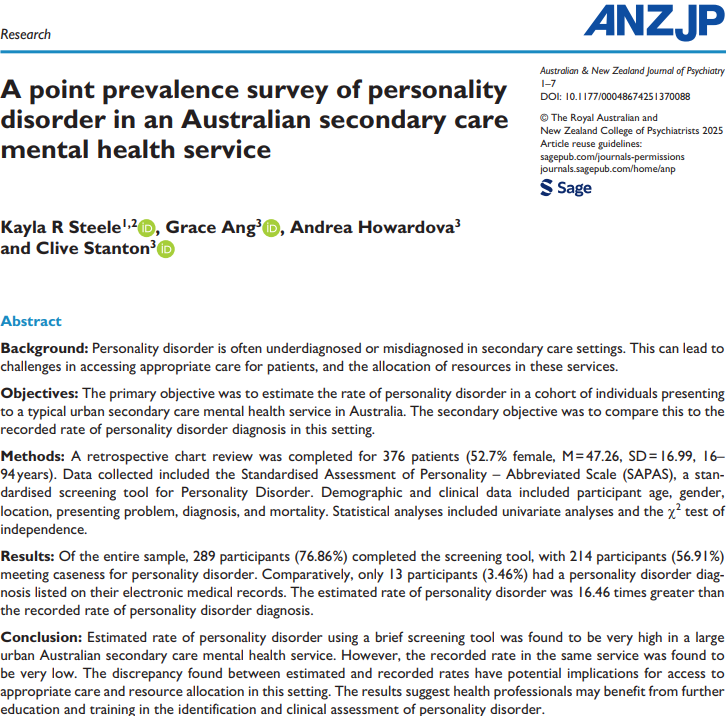
New paper🎉 In a retrospective audit (n=376) of an Australian mental health service: 👉57% patients had significant personality difficulties 👉Only 3.5% had a recorded PD diagnosis PD may be going unrecognised or undiagnosed in acute settings 🔗tinyurl.com/kph7fhtb
Dr. Kayla Steele, Ph.D tweet media
English
0
0
1
76
Dr. Kayla Steele, Ph.D
Dr. Kayla Steele, Ph.D@drkaylasteele·
Our new article ‘Whats the difference between shyness and social anxiety’ with @drjillnewby is now live via @ConversationEDU To learn more about social anxiety disorder, and how it differentiates from shyness, read below 👇 @UNSW | @UNSWScience | @blackdoginst
The Conversation - Australia + New Zealand@ConversationEDU

Both involve feeling uncomfortable in social situations. But, as @drkaylasteele + @drjillnewby (@UNSW) write, one can be debilitating. #Echobox=1717015721-1" target="_blank" rel="nofollow noopener">theconversation.com/whats-the-diff…

English
0
1
2
648
Dr. Kayla Steele, Ph.D retweetledi
Jonathan Shedler
Jonathan Shedler@JonathanShedler·
1/ I’m not sure, but leaning toward the view that all the research showing that therapeutic alliance predicts therapy outcome may be leading us astray. Here me out Just about any well-intentioned therapist can develop a decent working alliance with someone at the healthier end
English
21
64
387
85.6K
Dr. Kayla Steele, Ph.D
Dr. Kayla Steele, Ph.D@drkaylasteele·
3/ and embrace the spirit of critical enquiry and scientific collaboration using 'both/and' arguments. This creates the possibility for better, more tailored treatment for individuals who are suffering, which (hopefully) is at the heart of our work as health professionals.
English
0
0
0
132
Dr. Kayla Steele, Ph.D
Dr. Kayla Steele, Ph.D@drkaylasteele·
2/ A/Prof Loyola McLean says of the divide opinions within her profession: "It could well be that we're talking about two halves of the same whole". Rather than widen this divide with 'either/or' arguments, I'd prefer to see health professionals acknowledge their differences...
English
1
0
0
150
Dr. Kayla Steele, Ph.D retweetledi
David Kelly
David Kelly@daveidk·
Unconscious Motivations for Becoming a Therapist feat. McWilliams, Shedler, and Cundy For many therapists, formative relationships with confusing, unpredictable, or depressive caregivers that are internalised as relational templates are what drive us professionally. We come to study therapy to make sense of this experience. What we often miss is that providing therapy symbolically satisfies a deep, unconscious desire to save that caregiver. Both Nancy McWilliams (2011) and @JonathanShedler (2021) note that psychotherapists often have depressive personality styles: "Psychotherapists, as previously noted, often have significant introjective dynamics. They seek opportunities to help others so that their unconscious anxieties about their destructiveness will be kept at bay. Since it is hard to help people psychologically, at least as fast as we would all wish, and since we cannot avoid inflicting temporary pain on patients in the service of their growth or when we simply make a mistake, feelings of exaggerated responsibility and disproportionate self-criticism are common in beginning therapists" - McWilliams. "Depressive personality is the most common personality style among people drawn to the mental health professions. Clinical practitioners have endless opportunity to care for others instead of themselves, be unduly helpful, and fault themselves for falling short of unrealistic, self-imposed standards" - Shedler. Linda Cundy (2017) has also observed: "Most of my anxiously attached clients become aware that they misunderstand other people and recognise that it would help them to have a meaningful framework to make sense of human behaviour and human minds. Many of them choose to study psychology, counselling, or psychotherapy. Others are drawn to different paradigms, including religions, pop psychology, new age philosophies, spiritual practices, or astrology". This is why personal therapy is often so important for trainee therapists.
English
8
28
119
12.1K
Dr. Kayla Steele, Ph.D retweetledi
Dr Imogen Bell
Dr Imogen Bell@imo_bell·
So proud to announce the official launch of Mello - a free, evidence-based app to help the 1.3 million young Australians struggling with mental ill-health. The app works by targeting stuck thinking (worry/rumination). Download it in Oz for free - check out mello.org.au
Orygen@orygen_aus

We're excited to introduce Orygen Digital's newest innovation, Mello: a free app designed to address stuck thinking. It combines practical techniques with tailored therapy activities – and a recent trial found it eased stuck thinking for 83% of users. 🔗 mello.org.au

English
1
13
48
4.3K
Dr. Kayla Steele, Ph.D retweetledi
Jonathan Shedler
Jonathan Shedler@JonathanShedler·
Newly updated "Psychiatric diagnoses are descriptive, not explanatory. It's not that we don't know their causes 𝘺𝘦𝘵. It's that DSM diagnoses cannot speak to causes, now or ever. The DSM was not designed to speak to causes, only describe effects." psychologytoday.com/us/blog/psycho…
English
19
122
537
50.5K