Marcus T

2.2K posts

Marcus T

Marcus T

@drstrange92

Doctor by profession, investor by passion. Here for the long game.

Singapore Katılım Kasım 2018
557 Takip Edilen1.1K Takipçiler
Marcus T
Marcus T@drstrange92·
@RudraPatel1646 @OpenAI @sama Very interesting. I’m a primary care doctor from Singapore and I think this could be a new gen of intel
English
1
0
1
23
rudra.patel
rudra.patel@RudraPatel1646·
I’m a 2nd-year medical student in India. 🇮🇳🩺 I used the @OpenAI Vision API to turn my dermatology textbooks into a functional web app. CheckUrSkin analyzes skin parameters (erythema, texture, sebum) in seconds—helping patients triage before seeing a doctor. @sama It’s wild that a student in a hostel room can build diagnostic tools this powerful today. Link : [ checkurakin.vercel.app]
English
1
0
1
98
Rose Celine Investments 🌹
Rose Celine Investments 🌹@realroseceline·
Unfortunately, on my birthday (4/9), I was in a severe accident and fractured my pelvis in 6 places, which led to a 9 hour surgery. The last few days since have been completely unhinged. I’m recovering now and taking it day by day, and it definitely puts everything into perspective fast. Grateful to be here. 🌹
English
152
0
572
40.2K
Marcus T
Marcus T@drstrange92·
Bought more $META at $530s. At least the current AI capex is not to fund Metaverse, and if they can be a 6-bagger since, then there’s no reason to distrust Zuckerberg. Fear is palpable in the market, so I’ll be adding slowly
English
0
0
0
175
Marcus T
Marcus T@drstrange92·
@TihoBrkan May I know what are your top stocks on watchlist now given the prices ?
English
1
0
1
31
Tiho Brkan
Tiho Brkan@TihoBrkan·
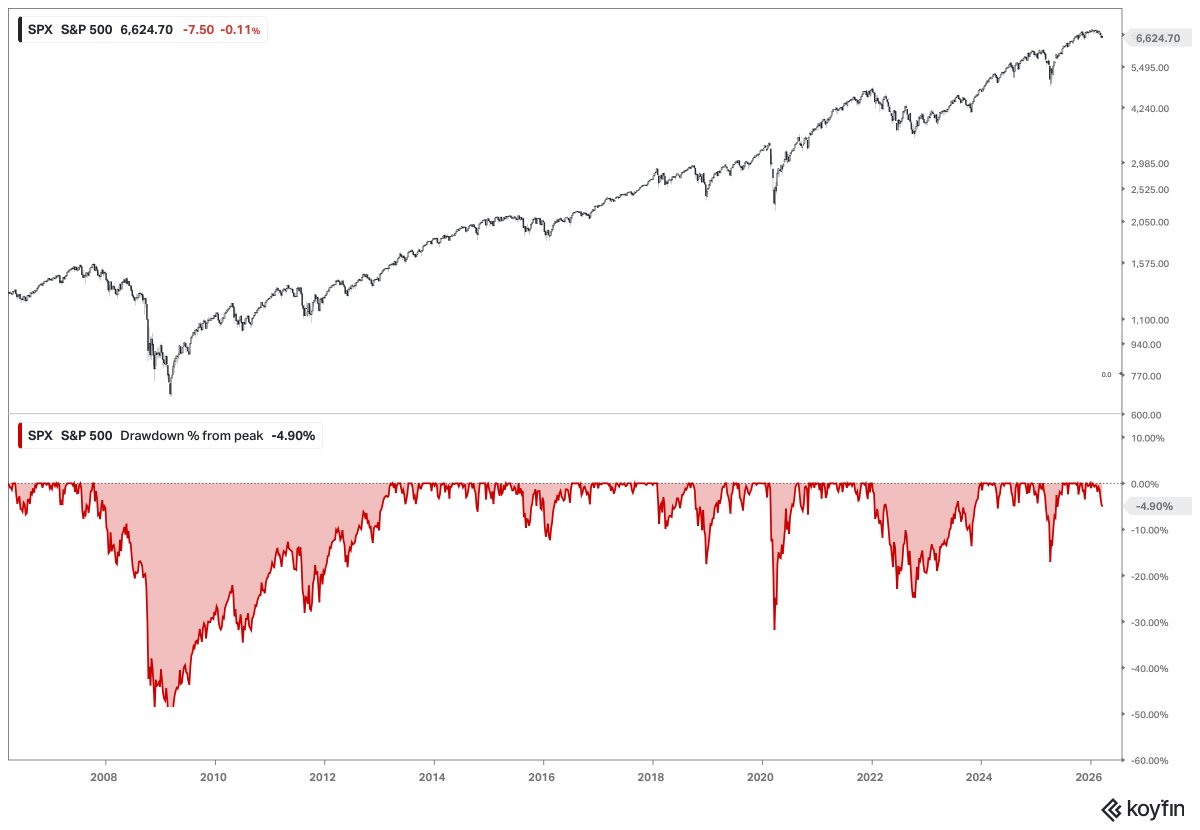
The most-followed index in the world, the S&P 500 $SPY, is down less than 5% from its record high. It is a market-cap-weighted strategy that allows winners to run while remaining agnostic to extremes in valuation. In contrast, our investable universe of circa 100 high-quality stocks — across various sound industries and sectors — is down 26% from its record high, on average. In simple terms, the average stock we track closely has a 6 times larger drawdown than the S&P 500 benchmark. Additionally, more than a quarter of our investable universe is down 40% or more. If these are current holdings, it indicates a difficult last couple of years. Only a handful of things have worked, while many haven't. Conversely, if these are prospects on the watchlist, it might indicate there are (finally) more bargains than the index itself is suggesting.
Tiho Brkan tweet media
English
2
2
36
4.2K
Marcus T
Marcus T@drstrange92·
Warned about $HIMS and sold it in the mid 50s. Sad to see how people are still investing in a stock claiming to do personalized medicine but really just a company dressed up to sell branded drugs cheap. open.substack.com/pub/marcusteo/…
Marcus T@drstrange92

Very questionable ethics imo, so while it may be a moonshot in the short run, I am not confident that this will last the test of time, especially when copycats start popping up, or if big pharm start taking actions. But we’ll see

English
0
0
0
399
Marcus T
Marcus T@drstrange92·
Bought more $MSFT at $400 and $NOW at $104. AI Agents will live inside these platforms rather than recreate the business logic and workflows that has vast amounts of context and customer data. $MSFT at lower risks since Azure captures more AI workloads while transitioning SaaS
Avory & Co.@AvoryCo

Our CIO wrote this over the weekend on how agentic AI is good thing for software platforms. A good casual read... Especially if you are in software land. $CRM $TEAM $NOW $IGV

English
0
0
2
458
Marcus T
Marcus T@drstrange92·
💯 I’ll be buying more $NOW at $130s. Holding $ADBE at $300.
Marcelo P. Lima@MarceloLima

Counterpoints: 1. Platform differentiation trends toward zero Rebuttal: While AI makes it easier for a startup to write code, it does not give them the 15 years of proprietary customer data, complex permission structures, and custom workflows locked inside a Salesforce or ServiceNow. If everyone has the same LLM, the winner is the platform that feeds the LLM the best, most structured proprietary data. Incumbents own the "Context Window" of the enterprise. A startup can replicate the interface, but they cannot replicate the data graph required to make the AI accurate. 2. Value accrues to the agentic layer sitting on top Rebuttal: The System of Record (SOR) *is* the Agentic Layer. The idea of a thin "agentic layer" floating above the System of Record ignores enterprise security and latency. CIOs will not authorize a third-party agent to read/write into their critical financial or HR databases without strict governance. Instead, the SORs are building their own agentic layers (e.g., Salesforce Agentforce). The value accrues to the incumbent because they own the security perimeter required for the agent to actually execute tasks. 3. Investor sentiment becomes a structural headwind Rebuttal: Sentiment follows FCF growth, and AI is the ultimate efficiency lever. The current de-rating is based on uncertainty. However, top-tier SaaS companies are using AI to flatten their own org charts—automating support and entry-level engineering—which (should) drastically reduce their opex. We are entering a "Golden Age" of margins for incumbents who use AI to run leaner while charging customers more for AI features. Once the "AI revenue" line item proves to be margin-accretive, the multiple expansion will return. 4. AI-native startups eat incremental LTV with better prices Rebuttal: The "Bundle" crushes the "Point Solution." Startups have a distribution problem; Incumbents have a feature problem. It is infinitely easier for Atlassian to add "AI coding agents" to Jira than it is for a startup to build an enterprise sales force, get SOC2 compliance, and displace a trusted vendor. CIOs will simply pay a modest upsell to a trusted vendor (zero marginal CAC for the incumbent) rather than onboard a risky new vendor for a "cheaper" price. 5. Seat-based revenue will decline Rebuttal: History shows that when you reduce the friction of a task, demand for that task increases. As AI makes employees more productive, companies often hire more people to attack higher-order problems. More seats! Furthermore, top-tier SaaS is already pivoting to consumption/outcome-based pricing (per conversation, per resolution). This allows them to capture the value of the digital labor directly, likely expanding the TAM beyond what human "seats" could ever cap out at. 6. Legacy SaaS will struggle to transition to outcomes Rebuttal: They are the only ones capable of selling outcomes. To sell an "outcome," you must be able to measure the "before" and "after." The System of Record holds the historical truth. ServiceNow knows exactly how long an IT ticket took to resolve in 2023 vs 2026. They are in the absolute best position to prove value and charge for the outcome because they own the ledger that defines what an "outcome" is. A startup has no baseline data to prove they delivered the result. 7. Diminished pricing power and lock-in Rebuttal: AI creates "Intelligence Lock-In." An AI model is generic, but an AI model trained on your specific 5-year history of Jira tickets or Sales Cloud interactions is a proprietary asset. The longer you stay with the incumbent, the smarter the AI gets about your specific business. Moving to a competitor doesn't just mean migrating data rows anymore; it means lobotomizing your organization's institutional memory and retraining a brain from scratch. 8. Gross margins will deteriorate Rebuttal: This assumes the cost of compute stays static. Instead, inference costs are dropping exponentially. Meanwhile, top-tier SaaS companies have ~80% gross margins and can absorb the initial opex to secure the market. Unlike startups, they can negotiate wholesale compute deals with hyperscalers. Over time, they will charge a premium for AI features (e.g., $30/user/month) that vastly outstrips the plummeting cost of the inference required to run them. 9. Decreased organic traffic increases CAC Rebuttal: Irrelevant for Enterprise SaaS. This point is a valid fear for PLG (Product-Led Growth) tools or SMB software, but Workday and ServiceNow do not close 7-figure enterprise deals because a CTO googled "HR software" and clicked an SEO link. They close via field sales, partner channels (Accenture/Deloitte), and multi-year relationships. LLMs answering search queries changes nothing about the high-touch enterprise sales motion. 10. Competition for talent increases SBC/Opex Rebuttal: Application AI is not Research AI. The "talent war" is for the 0.001% of researchers building Foundation Models (OpenAI, Anthropic). SaaS companies just need engineers who know how to use APIs and orchestrate models—skills that are becoming standard. Furthermore, AI makes the incumbent’s existing engineering team 30-50% more productive. They can ship more product with less headcount growth, which neutralizes the cost of talent.

English
0
0
0
275
Marcus T
Marcus T@drstrange92·
@realroseceline Great post Celine. What do you think should be a fair valuation for such a serial acquirer ?
English
2
0
0
154
Rose Celine Investments 🌹
Rose Celine Investments 🌹@realroseceline·
What makes $CSU special isn’t any one product. It isn’t even the specific businesses they’ve acquired, as important as those are. It’s the skill of acquiring itself. The culture, the process, and the discipline around capital allocation. That is an extremely rare elite skill. Markets compress time emotionally but businesses expand time economically. A 40% drawdown feels like an event. To the business, it’s noise. Customers still rely on the software. Cash will com in and get redeployed. The only thing that changes is the volume of opinions. Moments like this don’t test intelligence. They test temperament. Knowing facts gets you into positions. Understanding what you own decides whether you stay in them. We live in a market that demands explanations every quarter and certainty every week. That’s not how compounding works. Great businesses don’t announce themselves. They just show up years later having done the work quietly. Growing earnings is impressive. Growing earnings while respecting ownership is something else entirely. Dilution is easy but discipline is hard. $CSU clearly chose discipline. Over the next twenty years, I expect this company to acquire many more businesses. The targets will change and perhaps environment will change. Even tools will change, even the playing field may even tilt. But the game stays the same. There are always risks. Just like walking outside and something falling out of the sky. That’s life… What I don’t see going away is the rare ability to acquire businesses at an elite level and compound capital without dilution. That’s not something you copy overnight. And it’s not something that’s easily replaceable. 2/2 🌹
English
11
8
167
7.6K
Rose Celine Investments 🌹
Rose Celine Investments 🌹@realroseceline·
Thoughts on $CSU: $CSU is dealing with something it has almost never dealt with before, a roughly 40% percent drawdown. The largest in the company’s history. That alone feels strange, because this has been a business that for decades has done nothing but compound extraordinarily. No drama or hype, just steady execution. It has felt almost untouchable like a ray of sunshine type of company. I’ve watched it in admiration from the sidelines for a very long time. I remember a very specific moment. During peak Covid, when everything felt broken and shut down, I was staying at one of the America’s Greatest Hotels properties in Colorado. There was a large lake right in front of the hotel. Every morning I walked around it for exercise. Empty paths, no people. At the time, $CSU was valued at around $18b. They were doing roughly $400m. I studied it seriously, and like a dummy I passed. I’ve regretted that decision ever since. Not because the stock went up. But because the more time passed, the more obvious it became how rare this business really is. Over roughly two decades, earnings and cash flow have grown more than twenty fold. That alone puts it in elite company. But the metric that almost nobody talks about, and the one that matters arguably more, is the share count. It has not increased by a single share! That is more extraordinary than a garden full of roses!! I honestly don’t know how many companies in history have managed to grow earnings twenty times over without diluting shareholders even once. Most great compounders still issue stock. Stock based compensation sneaks in. Acquisitions get paid with equity. $CAU didn’t do that!! ZERO! That’s not an accident, it’s the culture. Managers are required to invest their bonuses into company stock and hold it for years. Not encouraged, “Required”. That one rule changes behavior in a significant way. When your own capital is locked alongside shareholders, you think differently. You allocate differently and act like an owner. There are real concerns today, and they shouldn’t be brushed aside.The founder and long time CEO is stepping away for health reasons. He is a once in a generation manager. Almost a “Lord of the Rings” type mystical figure but in the software world. Losing someone like that matters. But the successor is not an outsider. He was the very first acquisition Constellation ever made. He has been with the company for two decades. He grew up inside the system Then there is AI. A lot of $CSU software looks old. Some of it is genuinely archaic. People worry AI will sweep it away. I don’t dismiss that. Software will change and AI will matter. It’s ignorant to think otherwise. What I think gets missed is how hard it actually is to replace deeply embedded, mission critical systems inside real organizations. Replacement risk is often discussed by people who have never tried to rip out software that runs billing, compliance, scheduling, or reporting at a small but essential business. Boring software tends to survive precisely because it works. I’ve seen this firsthand. One of the small businesses I own built its own software about 15 years ago because nothing on the market fit. By today’s standards it’s completely outdated, yet replacing it is unthinkable. The entire business is built around it. Every process and decision runs through that system. Switching wouldn’t be an upgrade, it would be starting over. That’s what people miss when they talk about old software being disrupted. It survives not because it’s modern, but because it’s embedded in how real businesses operate. I’m not interested in level one thinking here. Everyone has the same information. Everyone knows the headlines. There is no informational advantage in this game. The only advantage is how you process what everyone already knows. 1/2 👇
English
30
25
361
52K
Marcus T
Marcus T@drstrange92·
@P_Remarks $NOW really the only one worth considering. $MSFT has 20% of cloud revenues tied to Open AI
English
0
0
1
125
Marcus T
Marcus T@drstrange92·
$NFLX $WB. Expected forward PE of 28x, with EPS growth of 16% and forward PEG is at 1.68 (compared to historical norms of 2-3x), seems like a good entry point for this media conglomerate
English
0
0
0
73
Marcus T
Marcus T@drstrange92·
$NFLX $WB What to look for: Effects of post-merger price hike. They will likely hike prices by $2-3 after integration. Historically, Netflix can absorb a price hike with only a 0.2% - 0.5% temporary spike in churn. If this churn rises >4%, that’s a red flag 🚩
English
1
0
0
88
Marcus T
Marcus T@drstrange92·
$NFLX Netflix’s situation is quite tricky $59B new debt (from the $23/cash paid to WB) + their existing $14B debt + WB’s $10B debt to new entity , so total debt will be $83B. Annual EBITDA (NFLX) about $30B and WB $10B, total $40B. So Debt/EBITA about 2x (not too bad)
English
1
0
0
110
Marcus T
Marcus T@drstrange92·
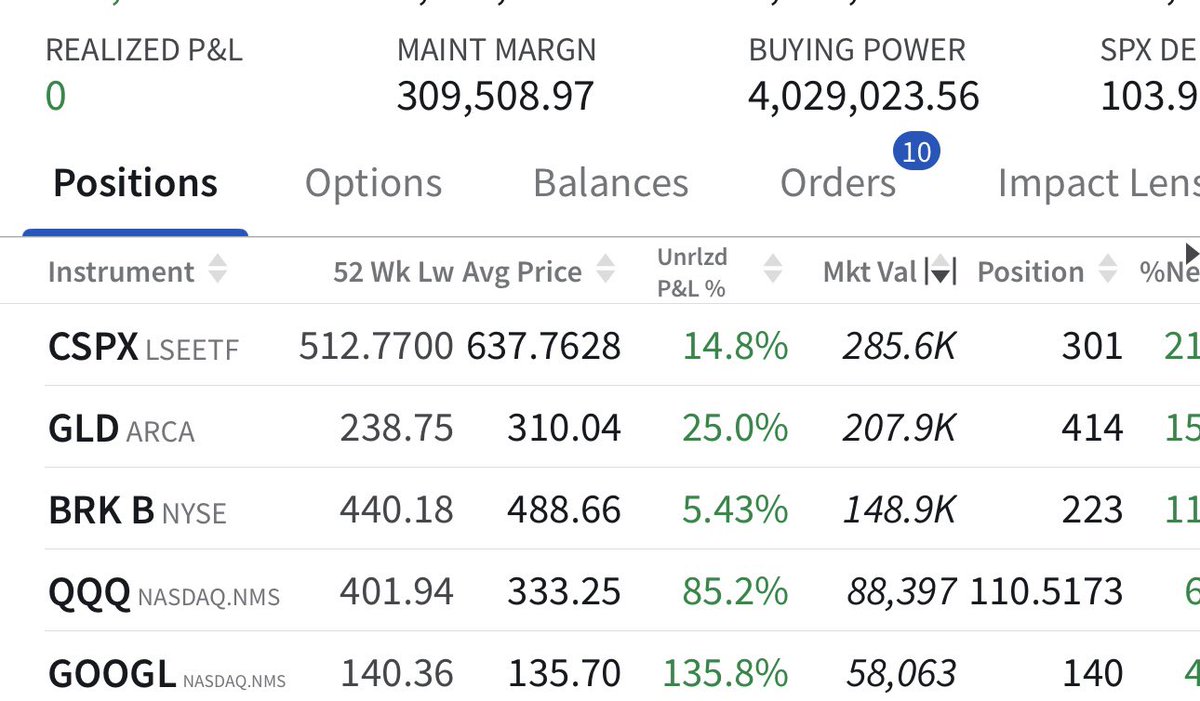
Bought 3x LEAP $QQQ puts $625 today. We’re probably very near the top.
Marcus T tweet media
English
0
0
0
340
Marcus T
Marcus T@drstrange92·
Anyone else thinking of buying $QQQ puts ? It’s beginning to look like a matter of when, not if, for the AI bubble to pop. No one wants to be the first to leave the party.. until it’s too late. Open AI will be the first domino to fall
English
1
0
0
96
Marcus T
Marcus T@drstrange92·
If OpenAI can’t figure out profitability even at a such scale, their collapse is a matter of when, not if. That’s why as much as I like $NVDA, I don’t want to invest more into it apart from what I own (currently up 376%).. because they’ll be the greatest loser when that happens
English
0
0
1
62