de Sec

13.8K posts

de Sec banner
de Sec

de Sec

@dscndt

가장 큰 속임수는 정보를 그 맥락에서 분리하는 데 있습니다. 유명한 고양이처럼, 어떤 정보든 그 맥락이 드러나기 전까지는 참일 수도 있고 거짓일 수도 있습니다.

Italia Katılım Şubat 2012
383 Takip Edilen697 Takipçiler
de Sec
de Sec@dscndt·
@miriamberzi @Barbaramenteme Renzi dimentica il piccolo dettaglio che fu lui a mettere sul piatto il ritorno “a casa”. E Floris che lo intervista si guarda bene dal ricordarlo.
Italiano
0
0
0
20
miriamberzi
miriamberzi@miriamberzi·
@Barbaramenteme Ho perso il conto del numero dei post, tutti uguali. È decisamente una questione personale oltre che politica.
Italiano
3
0
12
147
de Sec
de Sec@dscndt·
Il parterre “vario e pluralista” di Floris: Veltroni, Conte, Casalino, Gratteri, Schlein, più il ”comico” sfottiMeloni e lo stesso Floris che con zelo alza la palla alla sua squadra. Poi si lamenta che Meloni non va da lui.
Italiano
0
0
4
108
Disorder
Disorder@rb0638·
@dscndt @fabio___ta @lorepregliasco Non erano solo intenti, ma vere proprio dichiarazioni piuttosto aggressive verso la magistratura da mettere sotto schiaffo in quanto "plotoni di esecuzione'. Riferimenti continui a casi giudiziari che nulla avevano a che fare con la riforma.
Italiano
1
0
1
16
Lorenzo Pregliasco
Lorenzo Pregliasco@lorepregliasco·
Dentro il No c'è stato anche un voto moderato e 'civico' che non era contrario alla riforma in sé o alla separazione delle carriere, ma che tiene a garanzie istituzionali, separazione dei poteri, limitazione dell'esecutivo e ha voluto inviare un segnale al governo: calmatevi.
Italiano
240
319
2.7K
121.2K
de Sec
de Sec@dscndt·
@rb0638 La Costituzione vigente prevede un unico CSM, quindi con pm che decidono sulle carriere dei giudici e viceversa.
Italiano
0
0
0
5
Disorder
Disorder@rb0638·
@dscndt Nella Costituzione esiste la separazione delle funzioni e non delle "carriere", quindi questo risultato poteva essere ottenuto attraverso leggi ordinarie (come la legge Cartabia)
Italiano
1
0
0
10
de Sec
de Sec@dscndt·
Ho convintamente sostenuto nel merito le ragioni del SÌ. A urne chiuse posso dire che il risultato negativo era previsto e prevedibile perché in Italia è più facile mobilitare contro pericoli immaginari che a favore di proposte concrete, specie su argomenti tecnici che non è semplice far comprendere. Crisi internazionale e carobenzina non hanno aiutato. Inoltre, se il campo del No ha usato mezze verità e illazioni tendenziose, quello del Sì ha fatto una serie dí autogol con dichiarazioni temerarie che sembravano fatte apposta per dare un assist alla squadra avversaria. Ciliegina sulla torta, la premier è un gigante circondato da nani: ancora non si libera di alcuni "geni" di governo e sottogoverno che servono solo a farsi impallinare il giorno prima del voto.
Italiano
10
8
89
3.7K
de Sec
de Sec@dscndt·
@rb0638 Ora a giudicare sui magistrati dovrebbe essere il CSM eletto dagli stessi magistrati. L’Alta corte non sarebbe stata elettiva.
Italiano
0
0
0
5
Disorder
Disorder@rb0638·
@dscndt L'istituzione dell'Arta Corte Disciplinare che avrebbe avuto il compito di essere più "severa" verso gli errori giudiziari formata dalla contemporanea presenza di componenti giudicanti e requirenti in rapporto di 9 su 15 togati
Italiano
1
0
0
8
de Sec retweetledi
Lukasz Olejnik
Lukasz Olejnik@lukOlejnik·
The best defence against misinformation turns out to be... age. A resource that compounds slowly and cannot be nudged, boosted, or delivered via a software patch. Older people (including those less digitally literate, more likely to share misinformation) were paradoxically better at telling true from false headlines than younger adults who grew up online. More education results in no improvement in accuracy (but it gives more confidence that what is being read is "probably fine").
Lukasz Olejnik tweet media
English
14
98
329
24.9K
de Sec
de Sec@dscndt·
Beh, almeno ci siamo liberati di un paio di mine vaganti al ministero della Giustizia.
Italiano
1
1
3
25
de Sec
de Sec@dscndt·
@omoelele @cb_doge If you don't need to do anything, you are not needed. Draw the consequences.
English
0
0
0
39
Gracie
Gracie@omoelele·
@cb_doge There will definitely be some downside to this innovation. So what are the cons
English
13
2
21
5K
DogeDesigner
DogeDesigner@cb_doge·
ELON MUSK: "In the future, the robots will make so many robots, that they will actually saturate all human needs, meaning you won't be able to even think of something to ask the robot for at a certain point, like there will be such an abundance of goods and services. There'll be more robots than people. I think everyone on earth is going to have one humanoid robot because you would want a robot to watch over your kids, take care of your pet, take care of elderly parents. I'm very optimistic about the future. I think we're headed for a future of amazing abundance, which is very cool. Definitely we are in the most interesting time in history."
English
2.7K
1.5K
6.7K
587.3K
de Sec
de Sec@dscndt·
I've used AI myself to "vibe code" some personal projects. I think it's very useful as long as you know how to ask good questions and verify the answers. Not just "Does it work now?", but also: does it work in situations A, B, and C? Is it reliable in all circumstances? Is it secure? Can it be exploited? Is the code easy to maintain? Will it alert me if something breaks? Is it scalable if I want to turn it into a larger project? And so on.
English
2
0
4
838
Volker Panzer
Volker Panzer@volkerpanzer·
@milan_milanovic I was about to hand over a $30K app project to an implementation team, but ended up building it with Claude instead. With my engineering background, I handled the concept, architecture and Data Modeling, and Claude Code did the rest. AI basically replaced the developers.
English
18
0
50
5.1K
Dr Milan Milanović
Dr Milan Milanović@milan_milanovic·
Most of the people who think that AI will replace developers are: - Managers who don’t code - Investors and startup founders selling it - People outside tech Developers: "It's helpful."
English
222
242
3.3K
79.5K
de Sec retweetledi
SWG
SWG@swg_research·
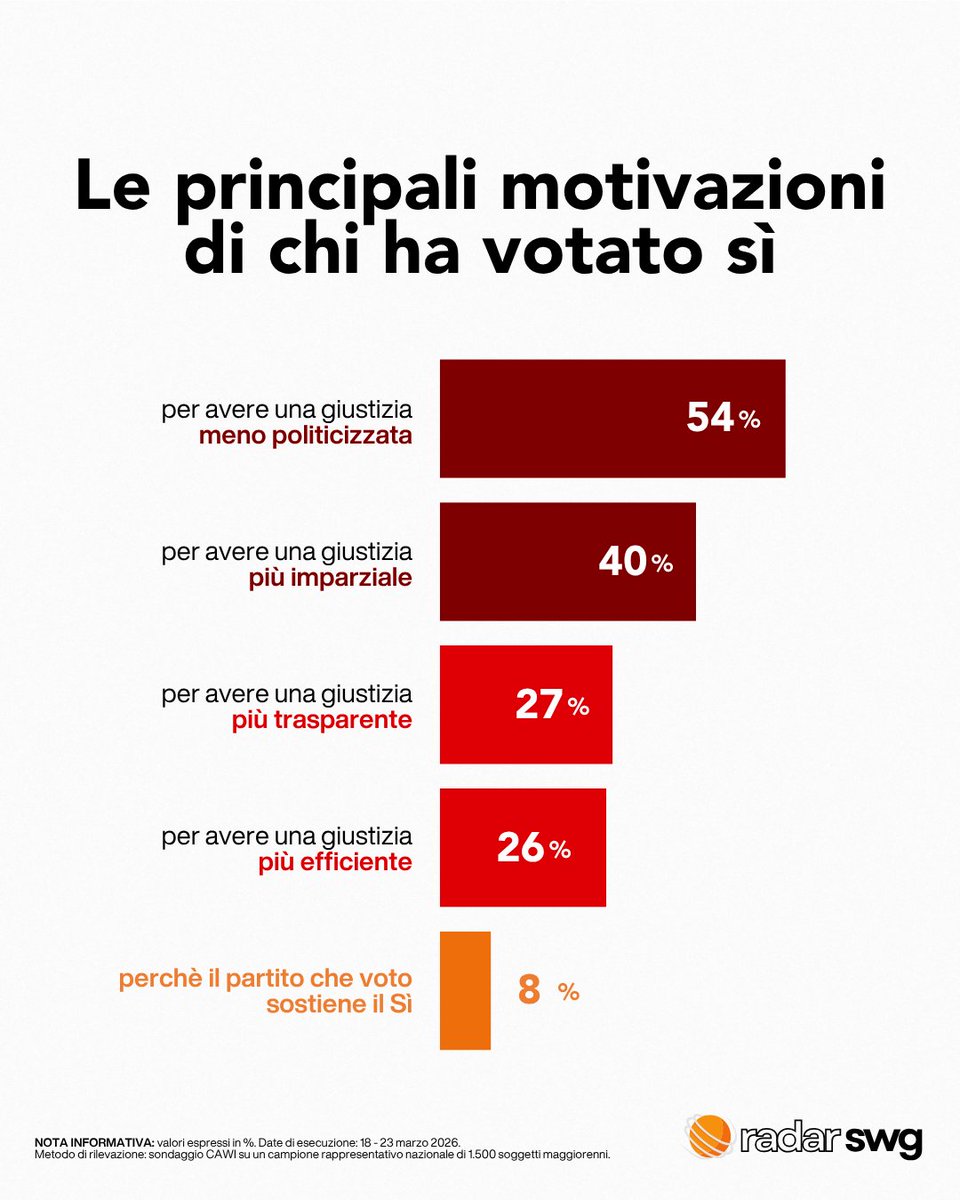
Referendum: chi ha votato Sì l'ha fatto principalmente per avere una giustizia meno politicizzata e più imparziale
SWG tweet media
Italiano
21
56
332
17.5K
de Sec retweetledi
Hillel Neuer
Hillel Neuer@HillelNeuer·
Francesca Albanese appeared today at the United Nations Human Rights Council to present her annual report. I was the first NGO to take the floor: “Ms. Albanese, in your report on torture, why is there not one single mention of Hamas’ horrific torture of Israeli hostages? You’ve said: ‘It’s not in my mandate.’ But on March 4th, you signed a UN statement condemning US and Israeli strikes in Iran. Are you mandated to speak on events a thousand miles away from your focus area, and not to say one word on the atrocities committed by Hamas on October 7th, and for two years after in their Gaza tunnels? And when you choose to speak on Iran, why is it only to defend the regime—after you refused to say a single word for the thousands of protesters they massacred? One year ago, the Council President announced that he spoke to you about your conduct, and that you acknowledged his considerations. However, on September 15, you said ‘380,000 children under five’ were killed in Gaza. Are you aware, this is more than the entire population of children under five in Gaza? On October 22, you reposted this statement: ‘Israel is the incarnation of evil.’ Yes or no, is this still your position? On January 6, you reposted this: ‘Israel is pure evil in a way the world has never seen before.’ Yes or no, is this still your position? Canada and Germany condemned you for antisemitism and Holocaust inversion. The French Prime Minister has called for your resignation. The UK has called for an investigation. Italy, Netherlands, Argentina and others condemned your conduct. When so many democracies speak with one voice, the problem is not them—it’s you.” Albanese did not respond.
English
403
2.9K
12K
282.6K
de Sec retweetledi
CG
CG@cgtwts·
Anthropic CEO: “50% of all entry-level Lawyers, Consultants, and Finance Professionals will be completely wiped out within the next 1–5 years." grad students and junior hires are cooked.
Claude@claudeai

You can now enable Claude to use your computer to complete tasks. It opens your apps, navigates your browser, fills in spreadsheets—anything you'd do sitting at your desk. Research preview in Claude Cowork and Claude Code, macOS only.

English
1.3K
2.4K
17.1K
5.2M
de Sec
de Sec@dscndt·
Chi oggi festeggia la "grande vittoria democratica" su un quesito alquanto tecnico della cui universale comprensione sarebbe lecito dubitare, probabilmente tornerà a lagnarsi del "popolo analfabeta" quando darà la maggioranza alla parte politica avversa.
Italiano
0
0
1
29
de Sec
de Sec@dscndt·
@worldernest Si vota tra un anno. L'attuazione della riforma sarebbe stata gestita da chi democraticamente eletto dagli italiani, e con le solite salvaguardie (controfirma PdR, possibilità ricorso Corte costituzionale).
Italiano
0
0
4
179
Ernesto
Ernesto@worldernest·
Credo che la vittoria del no sia una buona cosa per l'Italia perché: 1. Evita una riforma che, anche se (forse) giusta, sarebbe stata gestita da persone incapaci e inadatte 2. Assesta una bastonata salutare (per il ns futuro) al governo che cominciava a credersi invincibile 👇
Italiano
26
3
80
4.3K
de Sec retweetledi
Nicola Giocoli
Nicola Giocoli@ngiocoli·
@lafedecorsi Oh, non ci arrivano proprio a capire che chi giudica non può essere parte. E neanche sembrarlo. Non gli entra proprio in testa.
Italiano
1
39
360
3.9K
Luca G
Luca G@lucag977597·
@maurorizzi_mr 1) Vero e falso, condivido ma credo che sposterebbe poco. Perché anche se gli impresentabili fossero stati allontanati per l'opposizione ci sarebbe stato cmq qualcosa da recriminare. Non si vince giocando al gioco dell' avversario. E poi c'è invece una parte dell'elettorato dx,
Italiano
2
0
1
142
m a u r o
m a u r o@maurorizzi_mr·
Ovviamente governo e maggioranza hanno le loro colpe nell’aver sprecato l’opportunità di questa riforma. La responsabilità sta nel fatto che chi non ha gli strumenti per valutare una legge, si basa molto sulla credibilità di chi la propone, e oggettivamente la lista di impresentabili è troppo lunga, ed è stata difesa per troppo tempo. Santanchè, Dal Mastro, Montaruli, sono solo alcuni dei nomi. Capisco che ci siano degli equilibri di coalizione e che ogni governo ha avuto la sua lista di impresentabili, ma arriva sempre il momento in cui si paga elettoralmente.
Italiano
17
12
100
2.7K
Disorder
Disorder@rb0638·
@fabio___ta @lorepregliasco Confermo pure io non ero contrario al sorteggio o alle separazione carriere, ma l'insieme della riforma era indigesta e con intenti poco edificanti.
Italiano
1
0
3
185
de Sec
de Sec@dscndt·
@lorepregliasco Le riforme si approvano o si bocciano, non si usa un referendum costituzionale per mandare un segnale a un governo
Italiano
2
3
9
305
de Sec
de Sec@dscndt·
@rohanpaul_ai You are right, AI does introduce a major risk: the delegation of thinking to an external system. But the key is to use it to accelerate work you already understand well, so you can review and verify the output effectively.
English
0
0
1
39
Rohan Paul
Rohan Paul@rohanpaul_ai·
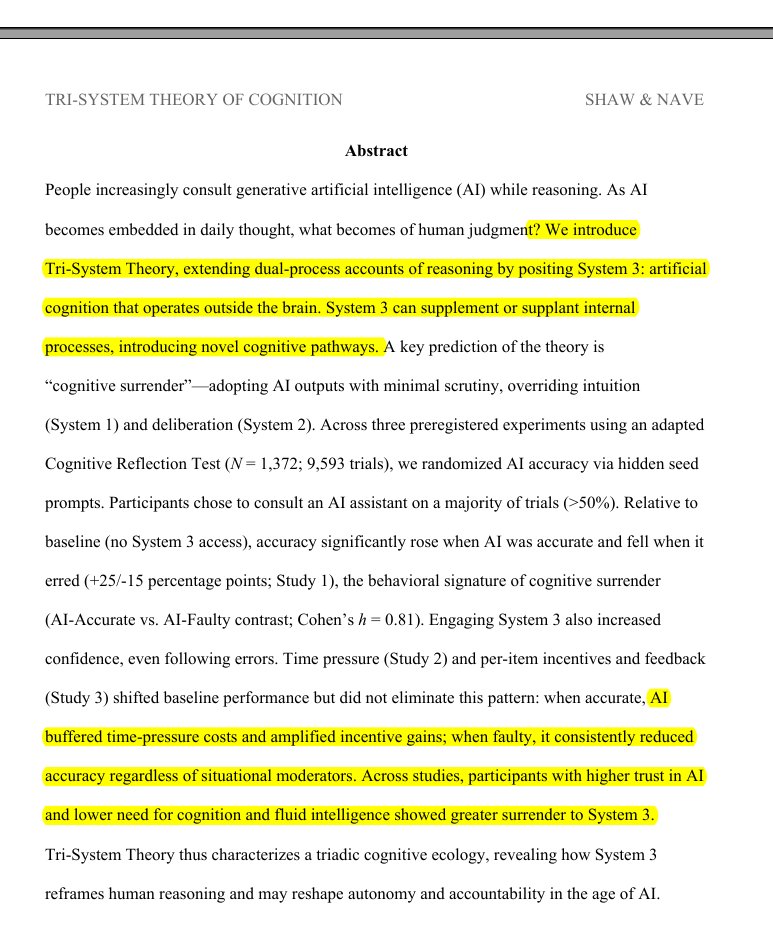
Wharton’s latest AI study points to a hard truth: “AI writes, humans review” model is breaking down Why "just review the AI output" doesn't work anymore, our brains literally give up. We have started doing "Cognitive Surrender" to AI - Wharton’s latest AI study points to a hard truth: reviewing AI output is not a reliable safeguard when cognition itself starts to defer to the machine.when you stop verifying what the AI tells you, and you don't even realize you stopped. It's different from offloading, like using a calculator. With offloading you know the tool did the work. With surrender, your brain recodes the AI's answer as YOUR judgment. You genuinely believe you thought it through yourself. Says AI is becoming a 3rd thinking system, and people often trust it too easily. You know Kahneman's System 1 (fast intuition) and System 2 (slow analysis)? They're saying AI is now System 3, an external cognitive system that operates outside your brain. And when you use it enough, something happens that they call Cognitive Surrender. Cognitive surrender is trickier: AI gives an answer, you stop really questioning it, and your brain starts treating that output as your own conclusion. It does not feel outsourced. It feels self-generated. The data makes it hard to brush off. Across 3 preregistered studies with 1,372 participants and 9,593 trials, people turned to AI on over 50% of questions. In Study 1, when AI was correct, people followed it 92.7% of the time. When it was wrong, they still followed it 79.8% of the time. Without AI, baseline accuracy was 45.8%. With correct AI, it jumped to 71.0%. With incorrect AI, it dropped to 31.5%, worse than having no AI. Access to AI also boosted confidence by 11.7 percentage points, even when the answers were wrong. Human review is supposed to be the safety net. But this research suggests the safety net has a hole in it: people do not just miss bad AI output; they become more confident in it. Time pressure did not eliminate the effect. Incentives and feedback reduced it but did not remove it. And the people most resistant tended to score higher on fluid intelligence and need for cognition. That makes this feel less like a laziness problem and more like a cognitive architecture problem.
Rohan Paul tweet mediaRohan Paul tweet media
English
171
688
2.9K
258.7K
Marco Doda
Marco Doda@MarcoDod46·
@marattin @ARomano1987 @giupenni @Partito_Libdem Ma le riforme si possono fare anche in parlamento coinvolgendo le opposizioni e cercando ampio consenso, e non a colpi di maggioranza. Quando capirete che il problema è anche di metodo? Se una riforma è e viene percepita come punitiva verso uno dei poteri dello Stato succede...
Italiano
1
0
1
128
Luigi Marattin
Luigi Marattin@marattin·
5 CONSIDERAZIONI 1) Quando il popolo parla, la politica obbedisce. Complimenti al fronte del NO per la vittoria netta. Il @Partito_Libdem si è schierato senza dubbio a favore del Sì, lo rivendica e ancora pensa - differentemente dalla maggioranza degli italiani - che era una riforma giusta. Noi non siamo abituati a non dire come abbiamo votato, persino a urne chiuse. 2) Dopo tre tentativi in 20 anni (Berlusconi 2006, Renzi 2016 e Meloni 2026) pare ormai chiaro che l’unico modo per cambiare la Costituzione per le cose “pesanti” è farlo in Parlamento con il consenso di tutte le forze politiche o quantomeno la stragrande maggioranza di esse. Perché ogni volta che si portano queste domande al popolo, accadono due cose: a) le contrapposizioni politiche che si registrano in Parlamento si riflettono inevitabilmente nel voto popolare, indipendentemente dal merito della riforma o persino dal fatto che in passato la stessa riforma era patrimonio della propria parte politica. b) una parte importante dell’elettorato - di qualsiasi orientamento politico - è sensibile quando qualcuno gli racconta che toccare la Costituzione, fosse anche solo per una virgola, equivale a mettere in discussione le libertà democratiche e far arrivare i carri armati. 3) Una parte importante dello schieramento politico - il centrosinistra - non sembra essere disposto in nessun caso a toccare la Costituzione, considerata più come una reliquia che come un testo scritto 80 anni fa e di cui gli stessi Padri Costituenti, in alcuni casi, chiedevano modifiche a breve. Ne’ per la giustizia, ne’ per i rapporti tra livelli di governo, ne’ per il bicameralismo, ne’ per l’architettura istituzionale. Ne deriva che, ragionevolmente, non vi è più alcuna speranza di toccare la Costituzione, in nessun aspetto rilevante, nei prossimi anni o forse persino oltre. E se c’è qualcuno che pensa che questa sia una buona notizia per la vita quotidiana degli italiani, beh, noi no. E sicuramente con noi non avrà nulla a che fare. 4) Sul piano politico, io da sempre sono convinto di una cosa di cui praticamente non è convinto quasi nessuno: non esiste NESSUN canale di trasmissione tra due elezioni differenti. Le amministrative di Pisa non influiscono sulle regionali in Piemonte, le regionali in Sicilia non influiscono sulle elezioni europee. Così come un referendum sulla giustizia non influisce sulle elezioni politiche che si svolgono più di un anno dopo. Gli italiani sono abituati (molto più della classe politica) a capire che schede elettorali diverse servono a cose diverse, soprattutto in momenti temporali diversi e in un paese non caratterizzato da una grande memoria collettiva. E lo diciamo noi che non abbiamo alcun interesse a difendere né l’attuale centrosinistra ne’ l’attuale centrodestra. 5) per noi del Partito Liberaldemocratico non cambia nulla: nei mesi che ci separano dalle elezioni continueremo a lavorare per costruire un’offerta politica - più grande della nostra - di stampo liberale e in grado di indirizzare il governo del Paese verso alcuni temi “””””scomodi”””””” ma che in realtà sono cruciali per evitare il declino.
Italiano
249
136
1.1K
74.3K