D T

343 posts

D T

D T

@dtgrafico

Katılım Nisan 2013
2.2K Takip Edilen1.4K Takipçiler
D T retweetledi
BLANCA ELENA
BLANCA ELENA@elenavilla28·
Vecina si no compras las aerpas vaya coma damier. Firmes por la patria
Español
18
164
579
19.1K
D T retweetledi
Alberto Sierra
Alberto Sierra@AlbertoSierrave·
@MJDuzan ○ Para algunos, el valor de una tragedia no está en conocer la verdad, sino en encontrar rápidamente un adversario al que exigirle una declaración. El activismo performático termina siendo más importante que la justicia para la víctima.
Español
1
29
139
1.5K
D T retweetledi
MiL
MiL@milcaricaturas·
MiL tweet media
ZXX
2
335
696
8K
D T retweetledi
BetoBarreto
BetoBarreto@betobarreto·
BetoBarreto tweet media
ZXX
13
423
1.7K
19.4K
D T retweetledi
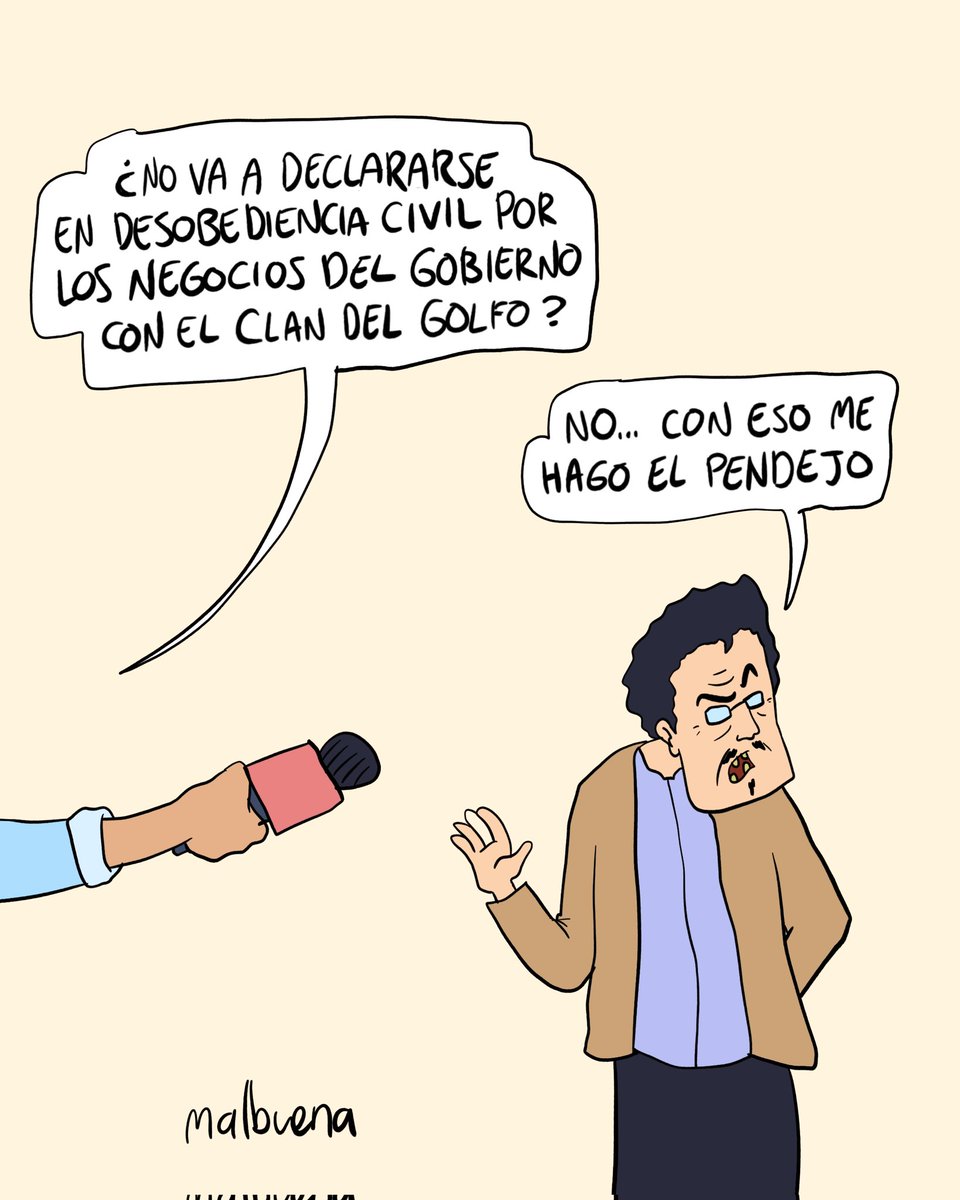
malbuena
malbuena@malbuena·
Y se nota
malbuena tweet media
Español
21
990
2.8K
27.7K
D T retweetledi
Julián
Julián@JUDAN_1020·
Amanecimos contentos con la canción de @ElQueLosDELATA 🤣🕺
Español
69
235
908
40.6K
D T retweetledi
Russy Millán
Russy Millán@millanrussy·
Pidieron escrutinio para encontrarle votos a Cepeda, pero terminaron encontrándole votos a Abelardo, jajaja.
Español
115
1.9K
10.9K
133.7K
D T retweetledi
Liliana
Liliana@indignada2021·
Disque ganamos por poquito ⁉️ Le parece poquito todo lo que nos estaban haciendo⁉️
Español
1
87
157
2K
Archaeo - Histories
Archaeo - Histories@archeohistories·
The legacy of sexagesimal still survives to this day, in the form of degrees (360° in a circle or 60° in an angle of an equilateral triangle), arcminutes and arcseconds in trigonometry and the measurement of time, although both of these systems are actually mixed radix. A common theory is that 60, a superior highly composite number (the previous and next in the series being 12 and 120), was chosen due to its prime factorization: 2×2×3×5, which makes it divisible by 1, 2, 3, 4, 5, 6, 10, 12, 15, 20, 30, and 60. Integers and fractions were represented identically—a radix point was not written but rather made clear by context. Babylonians did not technically have a digit for, nor a concept of, the number zero. Although they understood the idea of nothingness, it was not seen as a number, merely the lack of a number. Later Babylonian texts used a placeholder to represent zero, but only in the medial positions and not on right-hand side of the number, as we do in numbers like 100.
Archaeo - Histories tweet media
English
2
8
46
7.6K
Archaeo - Histories
Archaeo - Histories@archeohistories·
Babylonian civilisation in Mesopotamia replaced Sumerian civilisation and Akkadian civilisation. Certainly in terms of their number system Babylonians inherited ideas from the Sumerians and from the Akkadians. From the number systems of these earlier peoples came the base of 60, that is the sexagesimal system. Yet neither the Sumerian nor the Akkadian system was a positional system and this advance by the Babylonians was undoubtedly their greatest achievement in terms of developing the number system. Some would argue that it was their biggest achievement in mathematics. Babylonian cuneiform numerals, also used in Assyria and Chaldea, were written in cuneiform, using a wedge-tipped reed stylus to print a mark on a soft clay tablet which would be exposed in the sun to harden to create a permanent record. Babylonians, who were famous for their astronomical observations, as well as their calculations (aided by their invention of the abacus), used a sexagesimal (base-60) positional numeral system inherited from either the Sumerian or the Akkadian civilizations.[1] Neither of the predecessors was a positional system (having a convention for which 'end' of the numeral represented the units). Often when told that Babylonian number system was base 60 people's first reaction is: what a lot of special number symbols they must have had to learn. Now of course this comment is based on knowledge of our own decimal system which is a positional system with nine special symbols and a zero symbol to denote an empty place. However, rather than have to learn 10 symbols as we do to use our decimal numbers, the Babylonians only had to learn two symbols to produce their base 60 positional system. Now although Babylonian system was a positional base 60 system, it had some vestiges of a base 10 system within it. This is because the 59 numbers, which go into one of the places of the system, were built from a 'unit' symbol and a 'ten' symbol. This system first appeared around 2000 BC; its structure reflects the decimal lexical numerals of Semitic languages rather than Sumerian lexical numbers. However, use of special Sumerian sign for 60 (beside two Semitic signs for the same number) attests to a relation with Sumerian system Babylonian system is credited as being the first known positional numeral system, in which the value of a particular digit depends both on the digit itself and its position within the number. This was an extremely important development because non-place-value systems require unique symbols to represent each power of a base (ten, one hundred, one thousand, and so forth), which can make calculations more difficult. Only two symbols (𒁹 to count units and 𒌋 to count tens) were used to notate the 59 non-zero digits. These symbols and their values were combined to form a digit in a sign-value notation quite similar to that of Roman numerals; for example, the combination 𒌋𒌋𒁹𒁹𒁹 represented the digit for 23. These digits were used to represent larger numbers in the base 60 (sexagesimal) positional system. For example, 𒁹𒁹 𒌋𒌋𒁹𒁹𒁹 𒁹𒁹𒁹 would represent 2×602+23×60+3 = 8583. A space was left to indicate a place without value, similar to the modern-day zero. Babylonians later devised a sign to represent this empty place. They lacked a symbol to serve the function of radix point, so the place of the units had to be inferred from context: 𒌋𒌋𒁹𒁹𒁹 could have represented 23, 23×60 (𒌋𒌋𒁹𒁹𒁹␣), 23×60×60 (𒌋𒌋𒁹𒁹𒁹␣␣), or 23/60, etc. Their system clearly used internal decimal to represent digits, but it was not really a mixed-radix system of bases 10 and 6, since the ten sub-base was used merely to facilitate the representation of the large set of digits needed, while the place-values in a digit string were consistently 60-based and the arithmetic needed to work with these digit strings was correspondingly sexagesimal. #archaeohistories
Archaeo - Histories tweet media
English
3
79
323
29.6K
D T retweetledi
DoñaPily
DoñaPily@dona_pily2·
¿Qué tiene @FicoGutierrez ome? ¿Qué es ese amor por él, de todos desde chiquitos?😂😂😂❤️
Español
310
640
2.6K
65.1K
D T retweetledi
Luis Guillermo Vélez
Luis Guillermo Vélez@LuisGuillermoVl·
A ver, pequeño saltamontes, estás necesitando otra lección de historia patria. Pon atención. En la mañana del 29 de octubre de 2008, después de recibir el informe del Ministro de Defensa, el Presidente Uribe retiró del ejército a 3 generales, 3 coroneles y 21 oficiales y suboficiales, supuestamente involucrados en el delito de ejecuciones extra-judiciales. Esos militares habían incumplido con los principios de la política de Seguridad Democrática expedida en 2003 basada en el más estricto respeto a los DDHH y al DIH. No es ocioso recordar que, antes de Santos, Uribe tuvo tres ministros de defensa que si fueron capaces de hacer cumplir esa política entre la tropa. En junio de 2009 estuvo en Colombia Philip Alston, comisionado por el Consejo de Derechos Humanos de las Naciones Unidas para “investigar los homicidios cometidos violando los DDHH o el DIH”. En su informe concluyó: “No he visto ninguna prueba que indique que la comisión de esos homicidios formara parte de una política oficial o hubiera sido ordenada por altos funcionarios”. En 2011, el CINEP, entidad de investigación creada y orientada por el cura de Roux, publicó un informe titulado “23 años de falsos positivos: 1988-2011” en el cual se reportan 941 casos de falsos positivos en 23 años. En resumen: 1. Uribe fue el primero en combatir los falsos positivos sacando del ejército a los militares acusados de la comisión de ese delito. 2. La investigación de la ONU concluyó que los falsos positivos no obedecieron a ninguna política oficial ni fueron ordenados por altos funcionarios. 3. Los investigadores del CINEP, entidad fundada y orientada por el cura de Roux, documentaron 941 casos en 23 años, antes de que la tal comisión de la verdad decidiera enlodar el prestigio de Uribe. Para más lecciones de historia patria no dudes en exponer tu ignorancia en público, pequeño saltamontes.
Juan Carlos Upegui@JuanCaUpeguiV

Los pobres uribestias van a seguir negando los falsos positivos por siempre. No importa el dolor de las víctimas, ni la confesión de generales. Tienen lavado el cerebro.

Español
608
1.7K
3.7K
330.3K
D T retweetledi
Salud Hernández-Mora
Salud Hernández-Mora@saludhernandezm·
Así son las marchas de la oposición. El ESMAD sin oficio. (Fantástica foto. No es mía) @petrogustavo
Salud Hernández-Mora tweet media
Español
250
1.9K
5.1K
99.1K
D T
D T@dtgrafico·
D T tweet media
ZXX
0
0
2
84