
Sabitlenmiş Tweet
es gibt
2.8K posts


es gibt
@dvxhadrianvs
bem-vindos ao meu girlblog
in hac lacrimarum valle Katılım Aralık 2022
235 Takip Edilen214 Takipçiler


René Girard explains this quote from Heraclitus as showing that the many gods of primitive people is not an innocuous, jovial matter:
“The Bible, in revealing the single victim mechanism, enables us to understand the type of world that polytheism projects. It appears superficially more harmonious than ours because ruptures in the harmony are generally resolved by triggering a single victim mechanism and the emergence of a new god, who prevents the victim from appearing as a victim.
The indefinite multiplication of primitive and pagan gods looks like an amiable fantasy to many in our time, something created for no serious reason, playful, we might say, or rather ‘ludic’... It is a playful fantasy of which an overly serious monotheism, not playful at all, tries to deprive us.
In reality, however, the primitive and pagan gods are not playful; they are mournful and destructive. Before placing too much confidence in Nietzsche, our era should have meditated on one of the most sharp and brilliant sayings of Heraclitus: ‘Dionysos is the same thing as Hades.’ Dionysos, in other words, is the same thing as hell, the same thing as Satan, the same thing as death, the same thing as the lynch mob. Dionysos is the destructiveness at the heart of violent contagion.”

Jambus@JambusCrumbs
"Dionysus is the same thing as Hades."
English
@julienries13 ...nos termos que faz, no período histórico onde faz, respondendo aos autores pelos quais ele faz isso. Leitura estrutural não ironicamente desmonta de um modo escroto a neurose dessa gente de tentar ler todos os autores segundo uma chave de leitura esotérica que "só eu" tenho
Português
@julienries13 É só ler o autor como ele mesmo, ao invés dele enquanto partícipe da narrativa de uma história da filosofia recortada arbitrariamente delimitada que eu tenho na minha cabeça. Seria muito estranho tentar descartar um autor prescindindo da investigação que ele se propõe fazer ...
Português

@_bonaventurian @julienries13 tell me you can't read modern philosophy without telling me you can't read modern philosophy
English

Hegel conflated the indeterminate potentiality to be all things in the possible intellect, with pure being per se equated falsely with privative inchoate being. Hence, how he is able to say "nothing is" despite the obvious incoherence to it. His concept of being is equivocal.
English

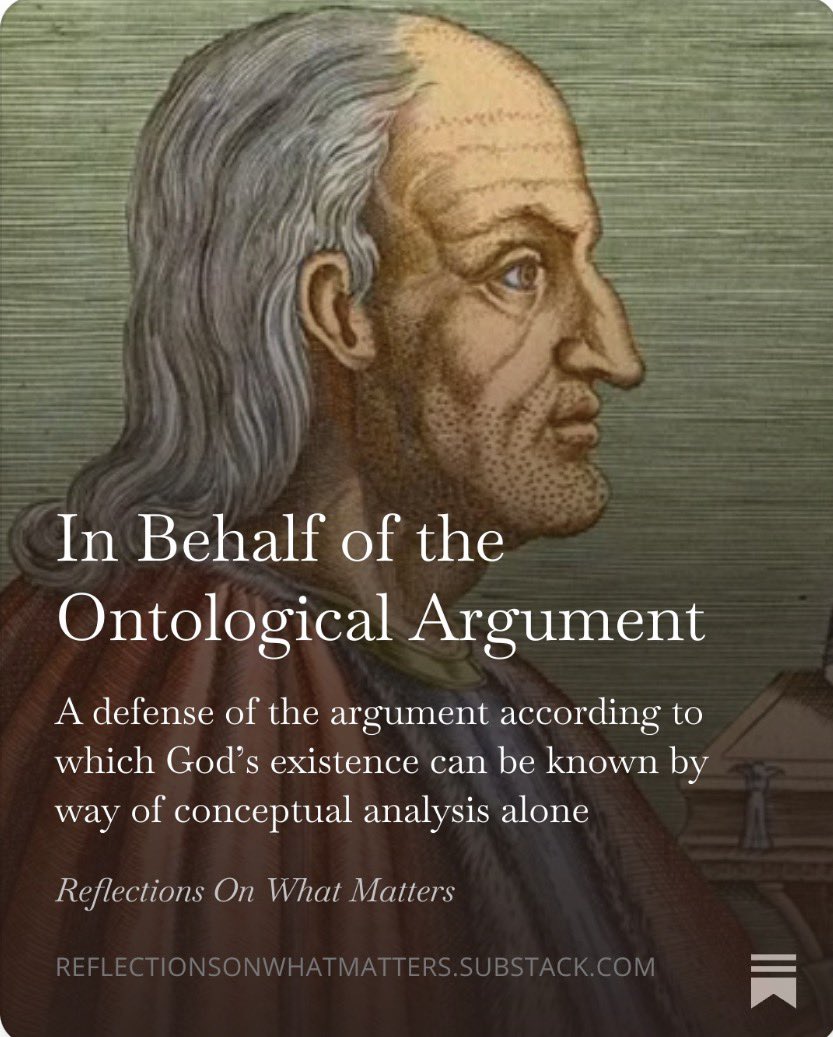
My brief defense of the ontological argument, in commemoration of the feast of St. Anselm. People love to hate on the argument, but it’s much easier to hate on it than to show that it’s unsound.
open.substack.com/pub/reflection…
Bishop Robert Barron@BishopBarron
Today is the feast of St. Anselm, one of the great geniuses of the theological tradition. In his “Cur Deus Homo,” he offered an explanation of the cross that beguiles theological minds to this day. But he is most famous, of course, for what came to be called the “ontological argument” for God's existence. Brilliant people have criticized it (Aquinas and Kant most famously), but equally brilliant people have defended it (Bonaventure, Descartes, Charles Hartshorne, and Alvin Plantinga to name a few). Einstein's colleague Kurt Gödel famously advocated it, arguing that a supremely perfect being must have all possible perfections, including that of necessary existence. Therefore, we can conclude from the very notion of God that God necessarily exists. Perhaps we could honor St. Anselm today by taking the time to think deeply about “that than which nothing greater can be thought.”
English

@dvxhadrianvs @robbertleusink There's Jordan Maxwell and Milton William Cooper.
English

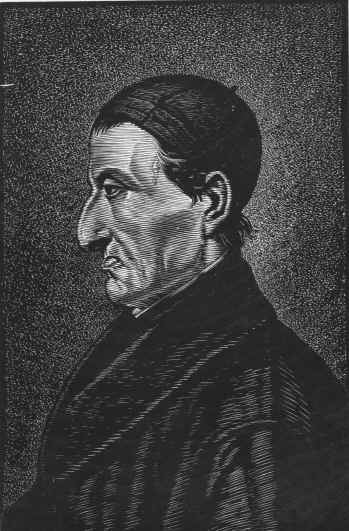
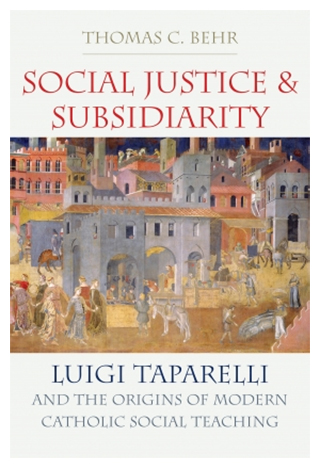
The term 'social justice' was coined in 1840 by a Jesuit priest
Luigi Taparelli d'Azeglio used it to describe a natural law framework for society rooted in Catholic social teaching
Every progressive activist using the term today is borrowing vocabulary invented by a 19th century Italian Jesuit to defend the Church's understanding of human dignity
English
@OfKnight1776 @robbertleusink but that doesn't imply jesuits had participation in secret societies
English
@dvxhadrianvs @robbertleusink You pretty much answered your question at the last part of your comment. Also write on YouTube (ancient Iranian bloodlines), hopefully it will give you some answers.
English
@tenshi_anna this is literally not in thomist nor scotistic philosophy or scholarship, but oblivious to both. you might as well talk about star wars or lego batman
English

The split between analogical-Thomist and univocal-Scotist metaphysics is de facto the Christian analogue to the split between Mahayana and Hinayana (“Theravada”) Buddhism, respectively. As will become clear, I am a Mahayana Christian partisan. The method of St. Thomas Aquinas is properly that of a charitable bodhisattva (but was St. Thomas, perhaps, still too uncharitable to that infamous spiritual revolutionary Joachim of Fiore? For that superessential order of charity, we have the equally bodhisattvic St. Bonaventure!), while Scotus risked a solipsistic disconnection from the erotic stakes of the relation between appearance and essence, a repressed Eros that returned with full force in the apocalyptically rich catastrophic ordeal of Ockham’s nominalism, which was to find its Antichrist terminus in the Reformation rebellion, replicating on a self-referential level the antisocial conceit of Scotist univocity.
In this sense, the “evangelical” (Mahayana) position is really more properly the broadly Catholic Thomist one, while Protestant individualism in fact fails to even begin to enter into the bodhisattva path.
On an Augustinian level, the conceit of univocity could perhaps be defended from the standpoint of the act of speaking propositionally into the symbolic order of desire for the vita beata universally embedded in human nature. However, I do believe that this desire is epistemically stratified by differential investment in sin, and in conscious avoidance (generating what psychoanalysis calls the unconscious) of truth as erotic ordeal, which is to say, truth precisely as supernaturally analogical (“esoteric”).




Anna K. Winters@tenshi_anna
The post-nominalist crisis of the intellectualist metaphysics of nature, placed in historical perspective and considered through the theoretical apparatus of René Thom, is the discovery of its own catastrophic minimum in the semiophysical constitution of its horizon as morphogenetical, or, in other words, in terms of the situational production of intellectual form through the personal opening to divine grace as a valence of being’s givenness (Marion). The gap between the metaphysical heritage of Aristotle and the semiophysical opening of Thom can be interpreted metacritically in terms of a providentially and apocalyptically situated transformation which itself belongs to neither paradigm (which relate within themselves as a perfect ahistorical amphiboly of “before” and “after”), but rather lies “beside” them; for these reasons, O. Bradley Bassler’s language of the “paraphysical” is apt for the catastrophic operation of form in the ordeal of truth which is salvation history itself. This history is the real of becoming as a narrative temporality between two Incarnations, stretching metaxologically between Christ’s birth to Mary and the apocalyptically promised parousia, marked by myriad morphogenetical distortions and revelations within a rhythmic arc expressed intellectually as the trial of the “metaphysical” interpretation of nature in the face of the supernatural paradigm of Incarnation as setting nature Sophianically in constitutive receptivity to divine will.
English
@OfKnight1776 @robbertleusink What sources do you base yourself in? I haven't fully understood yet the connection made of the jesuits and the occult. As far as I know, early secret societies in Germany and Austria borrowed the jesuitic model of confession and fraternity, but that's all
English
@robbertleusink That is true. However sadly the Jesuits and the Vatican have done a lot of harm to society especially with their occult nonsense they love to perform so much.
English
es gibt retweetledi
es gibt retweetledi
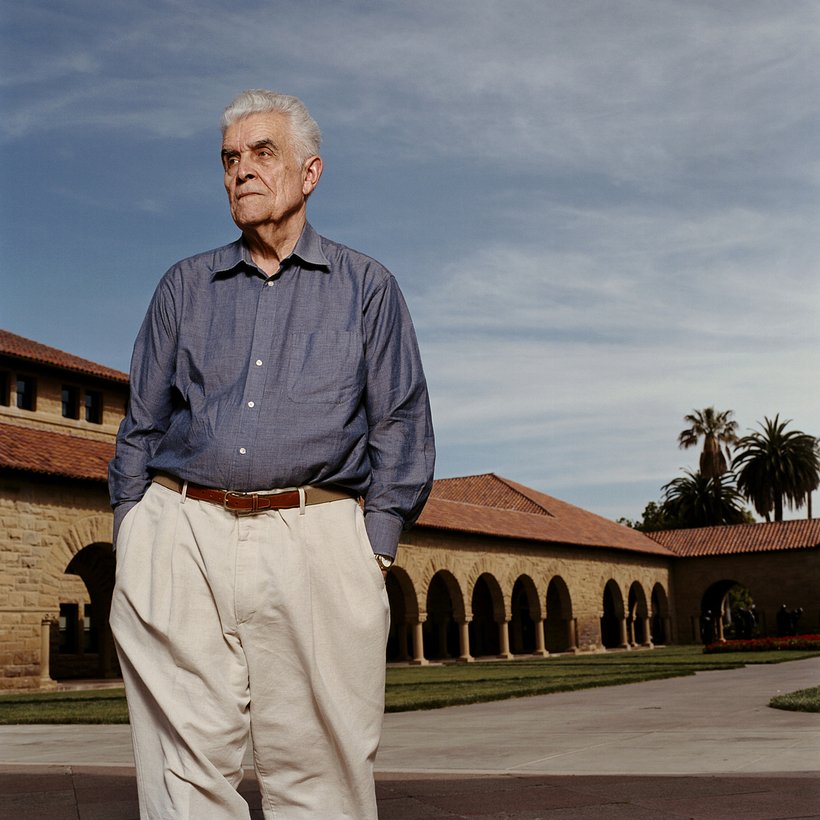
“Since the Renaissance, Western culture has consistently been divided against itself. First, we were for the Ancients and against the Moderns; then we were against civilization and for the savages; then, during the romantic period, we were for the exotic and against the familiar, and so on. In our era, many people think that they're breaking with tradition when in reality they're repeating it, but without the elegance displayed by their ancestors.”
— René Girard
English