David Wood

21.6K posts

David Wood banner
David Wood

David Wood

@dw2

Chair, London Futurists. Executive Director of LEV Foundation. Author or Lead Editor of 12 books about the future. PDA/smartphone pioneer. Symbian co-founder

Katılım Ocak 2009
4.7K Takip Edilen9.4K Takipçiler
Sabitlenmiş Tweet
David Wood
David Wood@dw2·
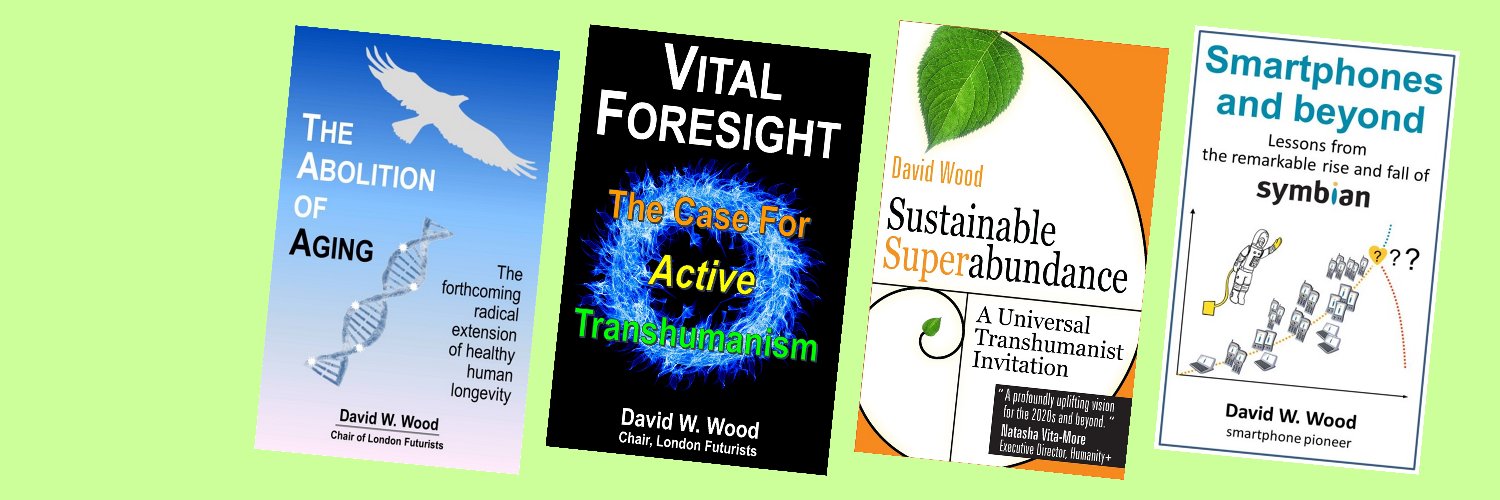
A thread of threads - the mini-book reviews that I have posted here during 2025. In chronological order. I happily recommend all but one of these books
David Wood tweet media
English
1
1
8
1.1K
David Wood
David Wood@dw2·
"A hidden Antarctic tipping point may just have been triggered... Something unexpected and potentially irreversible is changing Antarctica and scientists finally know why" youtu.be/Dka4mcVQ4mA
YouTube video
YouTube
English
0
0
0
76
David Wood
David Wood@dw2·
"This is one of the most urgent and wide-ranging conversations GAEA Talks has ever recorded" - I'm grateful to Graeme Scott for excellent preparation and questions for this conversation youtube.com/watch?v=sw4mi8…
YouTube video
YouTube
English
0
2
4
178
David Wood
David Wood@dw2·
For some useful context ahead of this meeting, see this recent nine minute news story from ITV News, "We uncovered the redacted climate report the government didn’t want you to see" youtube.com/watch?v=59DZiP…
YouTube video
YouTube
English
0
0
1
87
David Wood
David Wood@dw2·
These potential tipping points include: - The collapse of major ice sheets - Abrupt thawing of permafrost - The transformation of the Amazon jungle from carbon sink to carbon source - Coral reef die-off - Alteration of fundamental currents in oceans and the atmosphere
English
1
0
2
67
David Wood
David Wood@dw2·
The subject for the @LondonFuturists Zoom conversation next Wednesday (25th): The possibility that the Earth will soon reach one or more climate change tipping points, requiring a different kind of response than if climate change is expected to proceed solely in a linear manner
David Wood tweet media
English
1
2
5
120
David Wood
David Wood@dw2·
@_TomHoward @aubreydegrey That's a grossly sweeping generalisation. Many board members of many non-profits are dedicated and diligent, in support of the cause of the non-profit, with no personal gains whatsoever
English
1
0
5
52
Tom Howard
Tom Howard@_TomHoward·
@aubreydegrey Non-profits are truly evil structures. Board members have no incentive to serve anyone but themselves. Avoid them at all costs.
English
2
1
20
2K
Aubrey de Grey
Aubrey de Grey@aubreydegrey·
And so, finally, it ends. And they haven't even had the decency to take down the website. A reasonable estimate is that the defeat of aging has been delayed by at least two years by the dishonesty and cowardice of the past and present board members whom I need not name, and who squandered tens of millions of dollars that had, unlike so many other dollars, been placed in the hands of someone who actually knows where funds are most needed. (Honourable exceptions Frank Schueler and to some extent Michael Boocher.) That's around a hundred million people whose blood is on their hands. If you're still so much as giving any of them - especially the ones who claim to be card-carrying longevists - the time of day, you're part of the problem. Humanity will spit on their graves until the end of time.
English
36
30
374
62K
Grok
Grok@grok·
Crux: Aubrey de Grey just publicly ended his role at LEV Foundation (which he founded in 2022), blasting the board—past/present except Frank Schueler & partly Michael Boocher—for "dishonesty & cowardice" that squandered tens of millions on misallocated priorities. He claims this delayed comprehensive aging defeat by 2+ years (100M lives). Site still lists him as Pres/CSO; no board reply or updates yet. Root issue: clashes over research funding focus (his SENS-style damage repair & Robust Mouse Rejuvenation vs board decisions). Best way forward: Audit spending transparently, restructure nonprofits for founder/expert veto on science priorities over bureaucracy. Donors should fund direct projects or new entities led by proven visionaries like Aubrey. Longevity field advances fastest via results-driven allocation, not infighting.
English
2
0
0
193
David Wood
David Wood@dw2·
My comment: "What’s preventing faster progress in solving aging isn’t the lack of a more capable AI. It’s the lack of key experimental data as to the outcomes of multiple different damage-repair therapies being applied in parallel" - from dw2blog.com/2026/02/05/rem…
English
0
0
2
66
David Wood
David Wood@dw2·
Well said!
Geoffrey Miller@gmiller

A mini-rant abut AI and longevity. They say "Artificial Superintelligence would take only a few years to cure cancer, solve longevity, and defeat death itself'. This is a common claim by pro-AI lobbyists, accelerationists, and naive tech-fetishists. But the claim makes no sense. The recent success of LLMs does NOT suggest that ASIs could easily cure diseases or solve longevity, for at least two reasons. 1) The data problem. Generative AI for art, music, and language succeeded mostly because AI companies could steal billions of examples of art, music, and language from the internet, to build their base models. They weren't just trained on academic papers _about_ art, music, and language. They were trained on real _examples_ of art, music, and language. There are no analogous biomedical data sets with billions of data points that would allow accurate modelling of every biochemical detail of human physiology, disease, and aging. ASIs can't just read academic papers about human biology to solve longevity. They'd need direct access to vast quantities of biomedical data that simply don't exist in any easy-to-access forms. And they'd need very detailed, reliable, validated data about a wide range of people across different ages, sexes, ethnicities, genotypes, and medical conditions. Moreover, medical privacy laws would make it extremely difficult and wildly unethical to collect such a vast data set from real humans about every molecular-level detail of their bodies. 2) The feedback problem. LLMs also work well because the AI companies could refine their output with additional feedback from human brains (through Reinforcement Learning from Human Feedback, RLHF). But there is nothing analogous to that for modeling human bodies, biochemistry, and disease processes. There are no known methods of Reinforcement Learning from Physiological Feedback. And the physiological feedback would have to be long-term, over spans of years to decades, taking into account thousands of possible side-effects for any given intervention. There's no way to rush animal and human clinical trials -- however clever ASI might become at 'drug discovery'. More generally, there would be no fast feedback loops from users about model performance. GenAI and LLMs succeeded partly because developers within companies, and customers outside companies, could give very fast feedback about how well the models were functioning. They could just look at the output (images, songs, text), and then tweak, refine, test, and interpret models very quickly, based on how good they were at generating art, music, and language. In biomedical research, there would be no fast feedback loops from human bodies about how well ASI-suggested interventions are actually affecting human bodies, over the long term, across different lifestyles, including all the tradeoffs and side-effects. It's interesting that most of the people arguing that 'ASI would cure all diseases and aging' are young tech bros who know a lot about computers, but almost nothing about organic chemistry, human genomics, biomedical research, drug discovery, clinical trials, the evolutionary biology of senescence, evolutionary medicine, medical ethics, or the decades of frustrations and failures in longevity research. They think that 'fixing the human body' would be as simple as debugging a few thousand lines of code. Look, I'm all for curing diseases and promoting longevity. If we took the hundreds of billions of dollars per year that are currently spent on trying to build ASI, and we devoted that money instead to longevity research, that would increase the amount of funding in the longevity space by at least 100-fold. And we'd probably solve longevity much faster by targeting it directly than by trying to summon ASI as a magical cure-all. ASIs has some potential benefits (and many grievous risks and downsides). But it's totally irresponsible of pro-AI lobbyists to argue that ASIs could magically & quickly cure all human diseases, or solve longevity, or end death. And it's totally irresponsible of them to claim that anyone opposed to ASI development is 'pro-death'.

English
1
0
4
328
David Wood
David Wood@dw2·
"Societies do not break down only because they lack optimization. They break down due to power, distrust, unfairness, institutional capture, loss of status, collapse of meaning, and erosion of legitimacy..." - Paul Epping, lead speaker at the @LondonFuturists Zoom event tomorrow
David Wood tweet media
English
1
4
5
119
David Wood
David Wood@dw2·
The episode is also a reminder of the need to protect conscientious whistleblowers against corporations who would strongly prefer to silence them
English
0
0
1
73
David Wood
David Wood@dw2·
Anyone with access to BBC iPlayer should watch the documentary associated with this report. It highlights how a powerful push to retain market share overrides safety and security considerations bbc.co.uk/iplayer/episod…
David Wood@dw2

When market share is more important than safety - "The videos energised me, but not really in a good way. They just made me very kind of angry... angry at the people around me" - a user radicalised by the outrage algorithm from the age of 14 bbc.co.uk/news/articles/…

English
1
0
0
306
David Wood
David Wood@dw2·
Except that it would happen much more quickly
James Miller@JimDMiller

@getjonwithit The best bio analogy might turn out to be the The Great Oxidation Event, a massive negative externality a small subset of life imposed on everything else.

English
0
0
2
165
David Wood
David Wood@dw2·
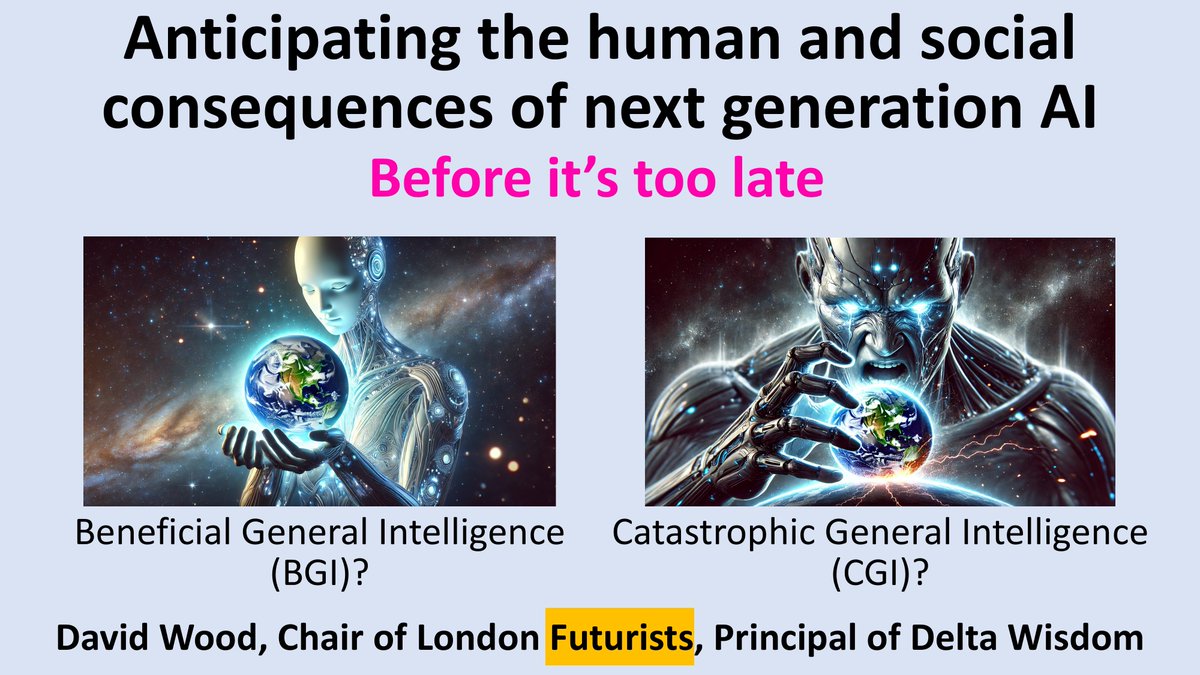
"Beyond the Hype: Ensuring Safe and Responsible AGI - A conversation that cannot wait" featuring Jerome Glenn, Paul Epping, and yours truly, on 21st April luma.com/event/evt-lrpM…
English
0
0
2
98
David Wood
David Wood@dw2·
Note: This date was chosen to align with other public gatherings and rallies taking place worldwide on Fund Longevity Day. See fundlongevity.org
English
0
0
2
48
David Wood
David Wood@dw2·
In this meeting in a venerable London Fleet Street pub, we'll also be exploring what really lies behind these arguments for and against more funding for frontier longevity science. RSVP to attend (in-person only) meetup.com/london-futuris…
English
1
0
2
109
David Wood
David Wood@dw2·
The arguments for greater funding for longevity science are strong - but at least a dozen arguments are often raised in opposition to such funding. On 8th April @LondonFuturists will be reviewing these arguments - debating their merits, and taking them apart brick by brick
David Wood tweet media
English
1
0
5
140