Digital Wellness Standard

88 posts

Digital Wellness Standard banner
Digital Wellness Standard

Digital Wellness Standard

@dws_standard

Quantifying coercive design. 📉 Auditing Systemic Behavioral Exploitation via the Hierarchy of Harm. Home of the Design Manipulation Index (IDM). 🏗️

Katılım Aralık 2025
24 Takip Edilen29 Takipçiler
Sabitlenmiş Tweet
Digital Wellness Standard
Digital Wellness Standard@dws_standard·
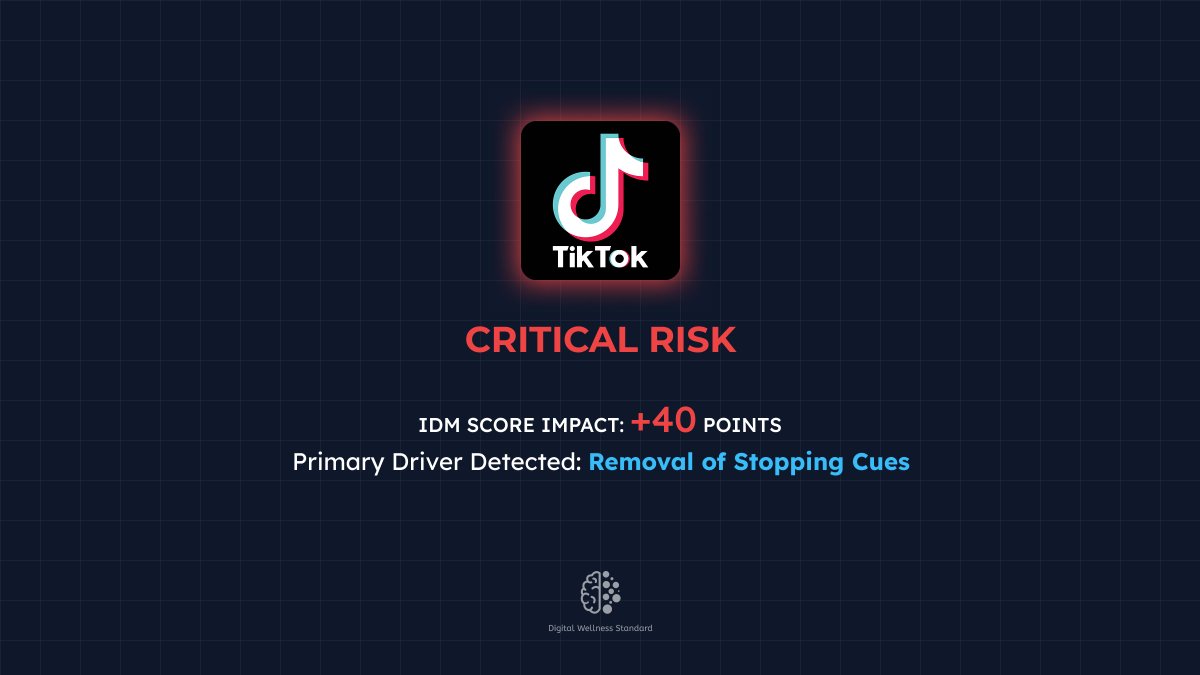
🚨 DWS Audit: TikTok We ran a full IDM (Index of Design Manipulation) analysis on TikTok's UX. While we identified multiple dark patterns, one specific mechanic drives the critical risk score: 🚩 The Pattern: Removal of Stopping Cues. 🔢 Impact: Contributes +40 points to the total IDM score. Here is a deep dive into this specific variable 🧵👇
Digital Wellness Standard tweet media
English
1
2
7
379
Digital Wellness Standard
Digital Wellness Standard@dws_standard·
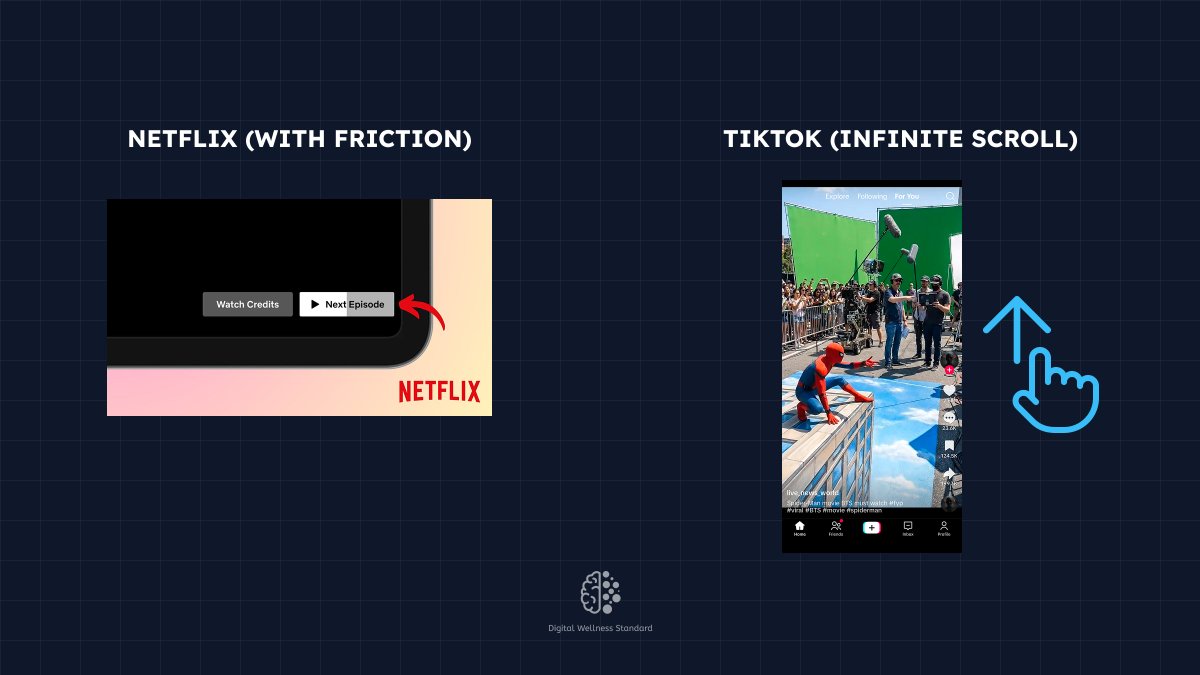
When you finish a chapter in a book, nothing happens. It waits for you. You must decide to turn the page. When you finish a video on YouTube, the next one loads in 5 seconds. The machine decides for you. This is "Default On" design. It treats your attention as a resource to be mined, not respected. Friction is freedom. We need to bring it back. #DigitalWellness #EthicalDesign
Digital Wellness Standard tweet media
English
1
1
2
113
Digital Wellness Standard
Digital Wellness Standard@dws_standard·
@AndrewSchrbr This flowchart gives me anxiety just looking at it... which proves your point perfectly. We are stuck in that 'unneeded vs. anxiety' loop because interfaces lack a real model of user intent. Fixing this is the core mission of our standard. Great visualization.
English
0
0
0
4
andrew schreiber
andrew schreiber@AndrewSchrbr·
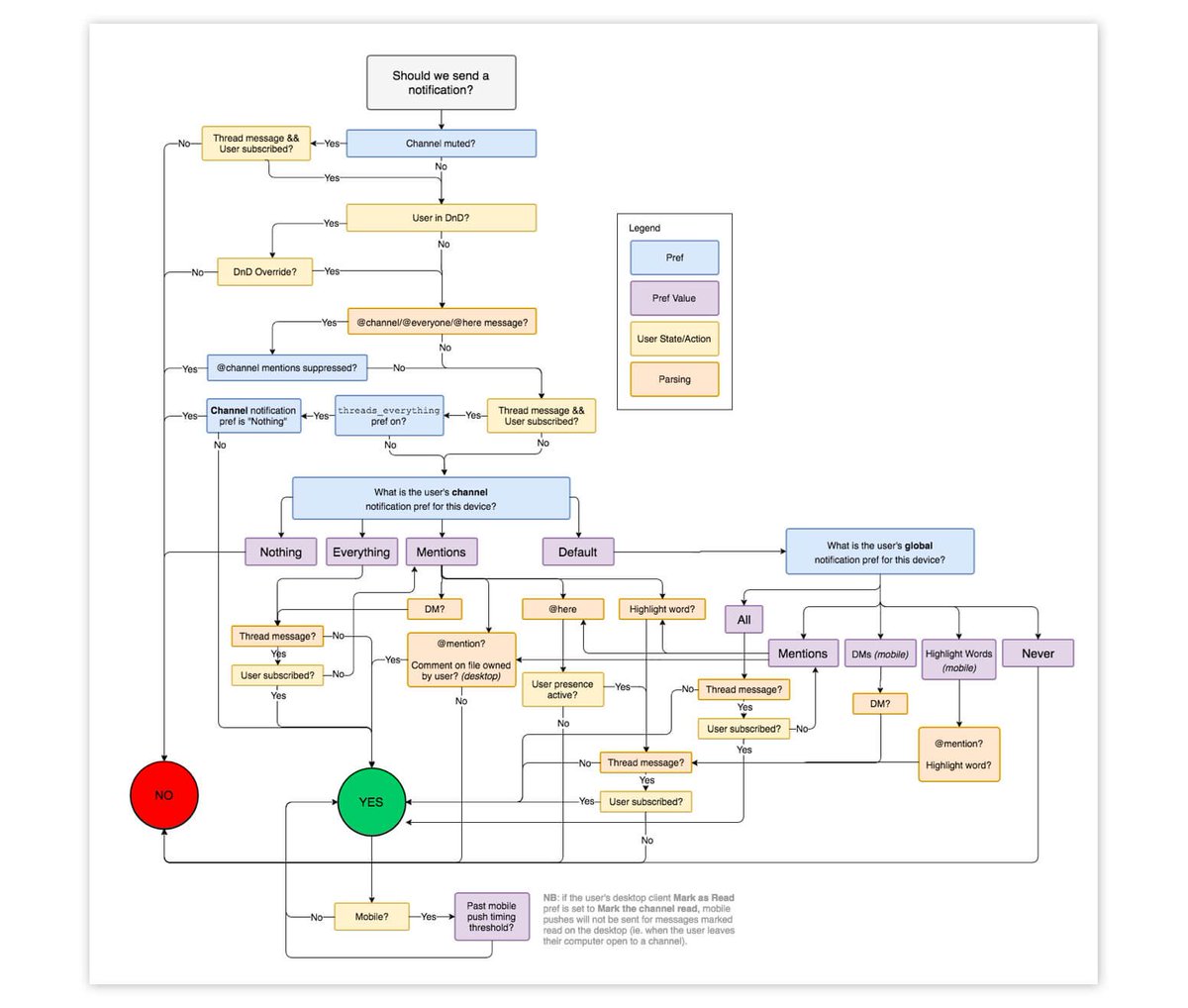
notifications are distracting when unneeded, but not having them when i need them produces anxiety the ideal event notifier builds a model of the worker's priorities and intentions, then decides which kind of notification is merited. breaks out of Slack's heuristics hell
andrew schreiber tweet media
English
2
0
1
228
Digital Wellness Standard
Digital Wellness Standard@dws_standard·
The 'anxiety vs. distraction' loop is a design failure. This flowchart shows exactly why rigid heuristics fail: they ignore context. In our IDM methodology, we analyze precisely this: Does the interface respect the user's intent, or just follow a blind rule? We need context-aware design, not just more switches. Great visualization of the problem 👇
andrew schreiber@AndrewSchrbr

notifications are distracting when unneeded, but not having them when i need them produces anxiety the ideal event notifier builds a model of the worker's priorities and intentions, then decides which kind of notification is merited. breaks out of Slack's heuristics hell

English
0
0
1
51
Digital Wellness Standard
Digital Wellness Standard@dws_standard·
You just described the physiological cost of 'Hyper-responsiveness'. That 'heart jump' is a conditioned reflex. Your nervous system is reacting to a digital signal as if it were a physical threat. As we discussed today: We are confusing Connectivity (being reachable) with Productivity (outcomes). The former is actively destroying the latter.
English
0
0
0
19
Tech Fusionist
Tech Fusionist@techyoutbe·
The day I realized I was never actually offline My laptop was closed. Slack was muted. Work was “done.” But my brain didn’t know that. At dinner, my phone buzzed. Not a message - just a notification sound from another app. My heart jumped. I mentally scanned: - Is prod down? - Did I miss an alert? - Will someone need me? Nothing happened. But the damage was already done. That’s the hidden cost of being “always on” in tech. No pager. No official on-call shift. Just an unspoken expectation: Be reachable. Just in case. Over time, you stop relaxing. You stop going places without signal. You sleep lightly. You wake up tired - even on holidays. Not because you worked late. But because your nervous system never clocked out. Burnout doesn’t always look like exhaustion. Sometimes it looks like: - Anxiety when your phone vibrates - Guilt for being unavailable - Fear of missing a message Measuring every moment by “what if something breaks?” No manager ever said: “You must stay alert at all times.” They didn’t have to. The culture did. And here’s the uncomfortable truth: Availability is often rewarded more than outcomes. The quiet engineer who fixes things fast but sets boundaries is remembered less than the one who always replies instantly. Until they burn out. Disappear. Or quietly leave the industry. If your job requires you to be reachable after hours, that’s not “flexibility.” That’s unpaid emotional labor. And if you feel guilty for wanting your evenings back— you’re not weak. You’re human.
English
3
0
32
5.8K
Digital Wellness Standard
Digital Wellness Standard@dws_standard·
We confuse 'Connectivity' with 'Productivity'. When your team is locked in hyper-responsive messaging loops, they aren't working. They are reacting. Research shows it takes ~23 mins to recover from a notification. Your tools charge you a monthly fee, but the real cost is the destruction of your team's attention span.
English
0
1
2
66
Digital Wellness Standard
Digital Wellness Standard@dws_standard·
The decline in Executive Function isn't a bug; it's a feature of the interface. We just audited this exact mechanism. By removing 'Stopping Cues' (friction), TikTok prevents the prefrontal cortex from engaging, keeping the user in a purely reflexive loop. We visualized the structural difference here: x.com/dws_standard/s…
English
0
0
0
34
Nicolas Hulscher, MPH
Nicolas Hulscher, MPH@NicHulscher·
🚨Study Finds TikTok, Instagram, and YouTube Shorts Induce Measurable BRAIN ROT Brain Rot has advanced from meme to a documented state of cognitive atrophy. Doomscrolling, zombie scrolling, and dopamine-driven streams of low-quality content are producing measurable cognitive impairment across an entire generation. A new review paper analyzed 381 studies and found that consuming rapid, low-information stimuli (ultrashort videos, memes, reaction clips, and trivial entertainment fragments that provide novelty without cognitive substance) induces: 🧠 Working Memory Declines Short-form, high-novelty content disrupts the brain’s ability to hold and manipulate information. ⚡ Attention Span Collapses Constant micro-stimuli train the brain to seek instant novelty while rejecting anything slow or nuanced. 🔁 Dopamine Feedback Loops Hijack Reward Circuits Infinite scroll + unpredictable hits = addiction-like neurobiology. 📉 Executive Function Weakens Planning, prioritization, impulse control, and decision-making all degrade under chronic overstimulation. 😵‍💫 Doomscrolling = Emotional Hyperactivation Overexposure to negative content elevates stress hormones, damages memory formation, and induces hypervigilance. 🥴 Zombie Scrolling = Dissociation & Cognitive Drift Mindless, passive scrolling erodes focus, emotional regulation, and present-moment awareness. 🧩 Preclinical Dementia Signatures Are Already Appearing Reduced hippocampal activity, disrupted salience networks, slowed learning, and cognitive load patterns that mirror early neurodegeneration. Adolescents—whose prefrontal cortex is still developing—show the most severe cognitive impairment. Social media short-form apps are reshaping and degrading the developing brain at population scale.
Nicolas Hulscher, MPH tweet media
English
11
134
265
30.3K
Digital Wellness Standard
Digital Wellness Standard@dws_standard·
This data aligns perfectly with our structural analysis. The 'Negative' platforms (TikTok, IG, YT) all share a specific design pattern: Infinite Scroll & Algorithmic Feeds (Removal of Stopping Cues). The 'Neutral' ones (WhatsApp, Snapchat) rely on finite interactions (the conversation ends). It’s a design problem, not just a 'screen time' problem.
Digital Wellness Standard tweet media
English
0
0
0
19
Jay Van Bavel, PhD
Jay Van Bavel, PhD@jayvanbavel·
Does social media harm everyone? No. But it harms *most* adolescents, according to a new study. And not all platforms have harmful effects. A new analysis of 44,211 daily diaries from 479 adolescents over 100 days finds that the majority of adolescents (60%) experienced small, but consistently negative effects of social media, suggesting that social media use is a notable contributor to mental health issues. However, a minority (13.6%) of adolescents experienced simultaneously harms and benefits across different dimensions of their mental health. Exploratory analyses revealed negative impacts of TikTok, YouTube, and Instagram use and positive or null effects of Snapchat and WhatsAp. This means that social media doesn't have to be harmful. link.springer.com/article/10.100…
Jay Van Bavel, PhD tweet media
English
40
199
810
427.9K
Digital Wellness Standard
Digital Wellness Standard@dws_standard·
This is exactly what happens when an interface removes all 'Stopping Cues'. 🧠 The brain never receives the signal that the session is 'over', so the loop continues in the background. It’s not just catchy songs; it’s conditioning. We just audited this specific design mechanic here: x.com/dws_standard/s…
English
0
0
0
287
Raora Panthera🐱holoEN
Raora Panthera🐱holoEN@raorapanthera·
Walking down the street with my mom, I start humming TikTok songs, doing the little moves and dances too… and I realize that even without my phone, I’m still doomscrolling in my own head....
English
116
512
13.6K
153.1K
Digital Wellness Standard
Digital Wellness Standard@dws_standard·
From a behavioral standpoint, this design effectively suppresses the prefrontal cortex (decision making) and hijacks the dopamine reward loop. It’s a "Skinner Box" optimized for time-on-screen, disregarding the long-term churn caused by user burnout and regret.
English
1
0
2
38
Digital Wellness Standard
Digital Wellness Standard@dws_standard·
🚨 DWS Audit: TikTok We ran a full IDM (Index of Design Manipulation) analysis on TikTok's UX. While we identified multiple dark patterns, one specific mechanic drives the critical risk score: 🚩 The Pattern: Removal of Stopping Cues. 🔢 Impact: Contributes +40 points to the total IDM score. Here is a deep dive into this specific variable 🧵👇
Digital Wellness Standard tweet media
English
1
2
7
379
Digital Wellness Standard
Digital Wellness Standard@dws_standard·
Before you write your 2026 resolutions, read this. 👇 Willpower is a battery. It drains. Engineering is a wall. It stays. If you want to reclaim your time this year, stop relying on motivation. Start understanding the slot machine mechanism designed to drain you. The blueprint:
Digital Wellness Standard@dws_standard

Most apps aren't "engaging." They are efficient slot machines. 🎰 We analyzed the #1 mechanism tech giants use to hack retention: Variable Ratio Reinforcement (VRR). In the DWS Standard, this single pattern (A1) carries a 40-point penalty. Here is the engineering breakdown. 🧵👇

English
0
0
0
35
Digital Wellness Standard
Digital Wellness Standard@dws_standard·
@benjamuniverse1 @jzux True, the tech will get more immersive. But you can upgrade the screen, not the nervous system... Running infinite stimulation on 50,000-year-old biological hardware isn't evolution, it's just a faster burnout.
English
0
0
0
100
Benjamuniverse
Benjamuniverse@benjamuniverse1·
@dws_standard @jzux It's not a pendulum. Trust people will just move on to the next fix. The next stage is augmented reality or full immersion. We want magic and those 2 get us there.
English
1
0
0
146
trash jones
trash jones@jzux·
it honestly comforts me that we’re collectively coming to the realization that this level of Phone All the Time is unsustainable and making us worse. maybe naive but i hope this is the beginning of a quieter, slower era where we all look up and return to ourselves and each other
English
91
3.1K
33.6K
1.5M
Digital Wellness Standard
Digital Wellness Standard@dws_standard·
It's basically fast food for the brain. High stimulation, zero nutrition. The algorithm serves you what keeps you staring, not what makes you happy. It’s not culture, it’s just retention engineering.
English
1
0
2
137
Karthik Balachandran
Karthik Balachandran@karthik2k2·
Instagram is pure brain rot. No other platform has contributed more to the enshittification of our culture 😭
English
75
265
2.7K
71.4K
Digital Wellness Standard
Digital Wellness Standard@dws_standard·
Note that they kept computer access. This proves the issue isn't 'screens', it's the lack of friction. Mobile data removes the gap between impuse and reward. Simply re-introducing that friction (blocking mobile data) allows the executive function to reboot.
English
0
0
0
50
Massimo
Massimo@Rainmaker1973·
Two weeks without mobile internet restored sustained attention to levels typical of someone ten years younger. A recent preregistered randomized controlled trial published in PNAS Nexus demonstrates that simply disabling mobile internet access on smartphones—while retaining calls, texts, and computer-based browsing—can yield substantial psychological benefits in as little as two weeks. Participants who blocked mobile data showed marked enhancements in sustained attention (with objective test performance improving to levels comparable to reversing a decade of typical age-related decline), mental health (including reductions in depression and anxiety symptoms exceeding those often seen with antidepressants), and subjective well-being (higher life satisfaction and positive affect). Notably, 91% of participants improved in at least one of these domains. The key insight is that the intervention targets the unique "always-available" connectivity of smartphones, which drives constant interruptions and fragmented focus. Without this mobile tether, individuals reported reallocating time toward in-person socializing, exercise, and nature—activities that mediated much of the gains. Although not all cognitive functions were affected equally, and full compliance varied, even partial adherence produced meaningful benefits. This evidence underscores how pervasive mobile connectivity may quietly erode mental clarity and mood, making targeted digital breaks a practical strategy for reclaiming focus in a hyper-connected era. [Castelo, N., & Kushlev, K. (2025). Blocking mobile internet on smartphones improves sustained attention, mental health, and subjective well-being. PNAS Nexus, 4(2), pgaf017]
Massimo tweet media
English
28
222
1.1K
61.9K
Digital Wellness Standard
Digital Wellness Standard@dws_standard·
Apps are engineered to remove all friction between impulse and reward. This study proves that simply adding that friction back allows the bran to reboot. It's not that you are broken. It's that the design is too efficient.
Shining Science@ShiningScience

Two weeks without mobile internet restored sustained attention to levels typical of someone ten years younger. Imagine regaining the mental sharpness you had a decade ago just by adjusting how you use your phone. A groundbreaking randomized controlled trial published in PNAS Nexus suggests this is possible. Researchers found that individuals who restricted mobile internet access on their smartphones for just two weeks experienced dramatic improvements in sustained attention and overall well-being. The cognitive gains were so significant that participants' performance on attention tests mimicked results typically seen in adults ten years younger, proving that our constant digital tethers may be taxing our brains more than we realize. The study highlights that the benefit comes from reducing the relentless "always-on" stimulation unique to mobile devices. Interestingly, participants were not required to quit the internet entirely; they could still use computers and access basic phone features like calls and texts. By specifically cutting the umbilical cord of mobile data, participants allowed their focus and psychological health to rebound. While the effects did not extend to every aspect of cognition, the impact on sustained attention and mood offers a compelling case for periodic digital detoxes to preserve mental clarity in an increasingly distracted world. Source: Castelo, N., & Kushlev, K. (2025). Blocking mobile internet on smartphones improves sustained attention, mental health, and subjective well-being. PNAS Nexus, 4(2), pgaf017.

English
0
0
1
55