
dylta

36 posts

dylta

dylta

@dyltadev

Katılım Nisan 2025
19 Takip Edilen1 Takipçiler
dylta
dylta@dyltadev·
@_weidai This is a really good explanation
English
0
0
0
35
Wei Dai
Wei Dai@_weidai·
Privacy 101: How to think critically about privacy. I. Privacy is not secrecy; privacy is the appropriate flow of information. Example 1: Your doctor may share your medical information with other doctors--that's probably appropriate. But that info shouldn't be leaked publicly. Example 2: Your credit card history is private to most entities, but your bank reports your payment status to credit score agencies. What is "appropriate" is really a matter of social consensus. Different groups may think differently. II. There are many types of privacy. To list a few: - Financial privacy (e.g. onchain txns, credit card txns) - Communication privacy (e.g. DMs, texts, email) - Data privacy (e.g. personal data, medical data) - Voting privacy Each requires a different treatment, as there is a distinction between what is "appropriate" in each context. There are also many different existing regulations (e.g. GDPR for data, BSA for finance) for each of these categories. Whenever privacy comes up, I encourage you to think through these two points: 1. What type of privacy is being talked about? 2. What is the appropriate flow of information in that context?
English
39
22
171
18K
Pedro Domingos
Pedro Domingos@pmddomingos·
Hinton is no longer afraid of superintelligence.
English
567
622
4.1K
815.9K
dylta
dylta@dyltadev·
@melee_game Give the people what they deserve
English
0
0
1
16
dylta
dylta@dyltadev·
agents controlling browsers > agentic browsers
English
0
0
0
57
dylta
dylta@dyltadev·
@SebastienBubeck "I have seen similar moments where GPT-5 makes connections between very different fields, where the same results were proven in completely different languages" This is significant. It is a foundational skill to have if we hope to automate research.
English
0
0
0
199
Sebastien Bubeck
Sebastien Bubeck@SebastienBubeck·
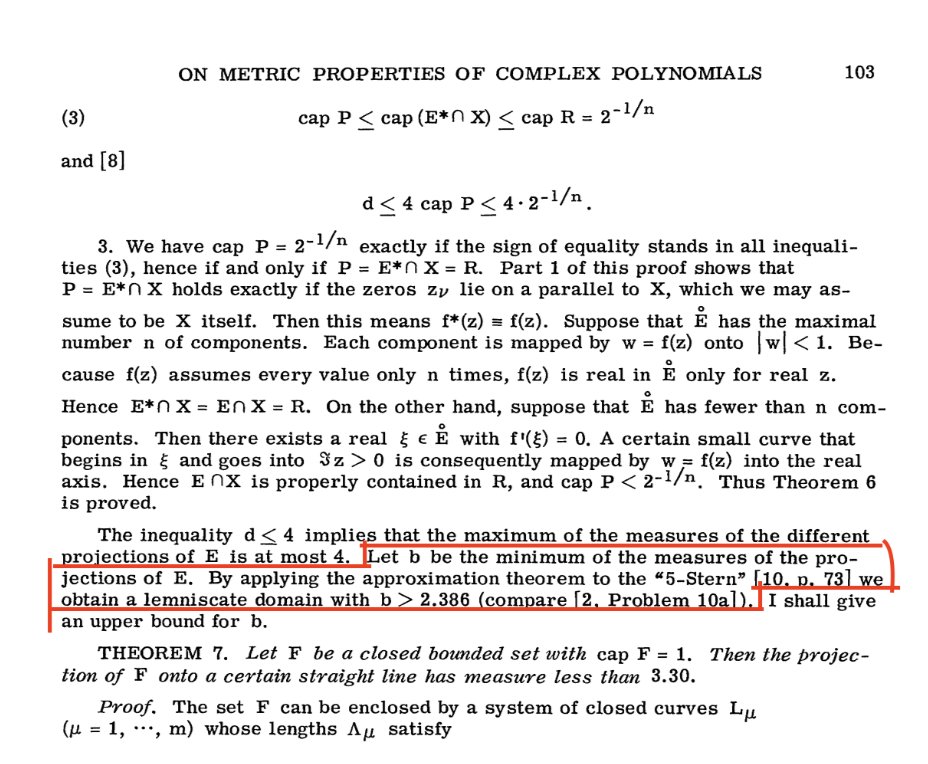
My posts last week created a lot of unnecessary confusion*, so today I would like to do a deep dive on one example to explain why I was so excited. In short, it’s not about AIs discovering new results on their own, but rather how tools like GPT-5 can help researchers navigate, connect, and understand our existing body of knowledge in ways that were never possible before (or at least much much more time consuming). Note that I did not pick the most impressive example (we will discuss that one at a later time), but rather one that illustrates many points at play that might have eluded people who see literature search as an embarrassingly trivial activity. Meet Erdős' problem #1043 erdosproblems.com/forum/thread/1…. This problem appeared in a paper by Erdős, Herzog, and Piranian in 1958 [EHP58]. It asks the following beautiful question: consider a set in the complex plane defined by being the pre-image of the unit ball under a complex polynomial with leading coefficient 1. Is there at least one direction in which the width of this set is smaller than 2? (2 is of course the best one can hope for, if the polynomial is a monomial then this set is the unit ball and so the width is 2 in all directions.) This problem didn't stand for very long: just three years later, Pommerenke wrote a paper [Po61] solving problem #1043 (with a counterexample), and that's what GPT-5 surfaced when asked this question. So what's the big deal? Well, a couple of things: 1) [EHP58] does not contain a single problem, but in fact sixteen. [Po61] says in the introduction that it will solve a few problems from [EHP58] but does NOT discuss problem #1043. In fact my understanding is that experts (at least in combinatorics) who knew both about [Po61] and problem #1043 did not know that the solution to the latter could be found in the former. This is quite clear on erdosproblems.com itself since problems (1038, 1039, 1045, 1047) all have a reference to [Po61], yet #1043 was not listed as having any connection to [Po61]. Another evidence that this had been at least partially forgotten is that on Mathscinet (MR0151580) the review of [Po61] attempts to give all the problems that are solved there and does not mention #1043 either. 2) The solution to #1043 can actually be found in the middle of the paper, sandwiched between the proof of Theorem 6 and the statement Theorem 7, as an off-hand comment, see picture. To find this you need to know this paper really well, and read it fully and carefully. I'm sure many people in the 1960s knew about it, but it seems like 60 years later there is a much smaller set of people that were aware of this brief comment in the middle of a 1961 paper. That's where the power of a "super-human search" lies, and this is way way beyond any search index capability (obviously; in fact it’s beyond the capabilities of the previous generation of LLMs). You need to read and understand the paper. 3) But there is more: the paper says that the proof follows by invoking [10, p. 73]. This is very important, because in math it's not so much about the result itself but rather about the understanding that comes with it (and with its proof). So what is [10]? Well it's the previous paper by the author, which was written in German ... and here again something truly accelerating happens: GPT-5 translated the paper and explained the proof in modern language. I believe that this is indeed very much accelerating. This is just one example, and each example has its own interesting story. I have seen similar moments where GPT-5 makes connections between very different fields, where the same results were proven in completely different languages (e.g., game theory versus high-dimensional geometry), sometimes 20 years apart. This is not about AI discovering new knowledge, this is about AI making all of the scientific literature come ALIVE — linking proofs, translations, and partially forgotten results so existing ideas can be understood and built upon more easily. When that happens, science moves forward with greater context and continuity. In my view it's a game changer for the scientific community. *About the confusion, which I again apologize for, I made three mistakes: i) I assumed full context from the reader, in the sense that I was quoting a tweet that was itself quoting my tweet from October 11, and that latter tweet was clearly stating that this is only about literature search; but it is totally understandable that this nested quoting could lead to lots of misreadings and I should have realized that. ii) The original (deleted) tweet was seriously lacking content, and this is probably the biggest problem. By trying to tell a complex story in just a few characters I missed the mark. I will not do that again, and rather, like I have always done, explain as many details as I can. This is vital given the stakes of the AI debate at the moment. iii) When I said in the October 11 tweet that “it solved [a problem] by realizing that it had actually been solved 20 years ago”, this was obviously meant as tongue-in-cheek. However, I now recognize that this moment calls for a more serious tone.
Sebastien Bubeck tweet media
English
189
223
1.7K
617K
dylta
dylta@dyltadev·
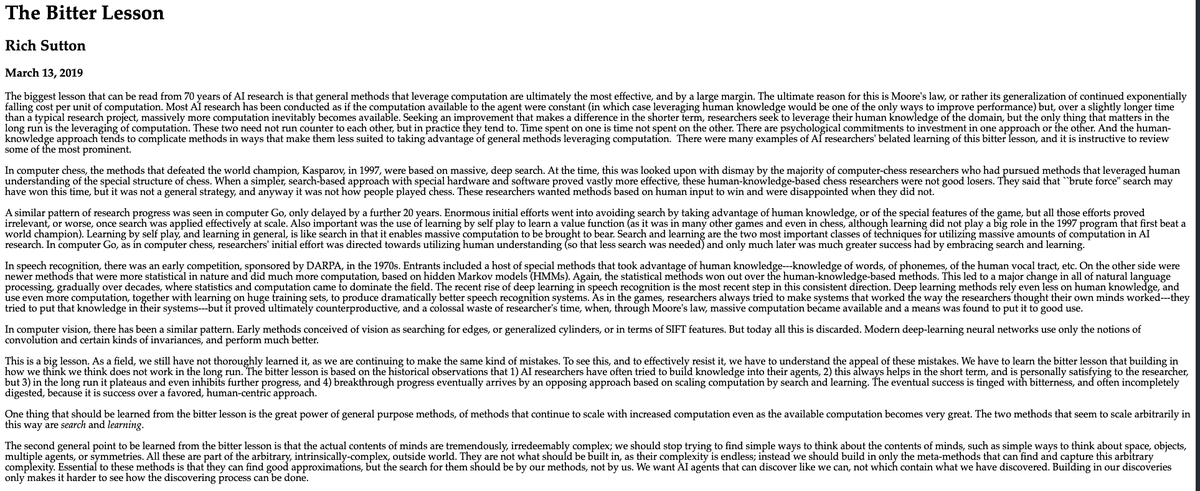
The Bitter Lesson. It may be responsible for the current compute meta. It may be responsible for inspiring belief that AGI is attainable in the decade ahead. After watching Richard's recent discussion, I believe it might be misunderstood.
dylta tweet media
English
0
0
0
129
dylta
dylta@dyltadev·
Actionable advice for the world ahead. "Keep planning for a world where you as an individual have more leverage"
English
0
0
0
109
dylta
dylta@dyltadev·
Robotics AI is progressing. Moravec's paradox: Intellectual tasks are easy for computers, physical tasks are hard. Evidence against it: • Locomotion is easily solvable with RL • LLMs as judges can scale feedback for robotics tasks • Rapid progress is already being made
English
1
0
0
130
dylta
dylta@dyltadev·
"It's worth building into respective world views that there's a pretty serious chance we get something that is AGI." This is a really great episode filled with loads of insights on the current & future state of AI. For those w/o the time to watch, here are my big takeaways:
Matt Turck@mattturck

Sonnet 4.5 & the AI Plateau Myth — epic conversation with @_sholtodouglas of @AnthropicAI 0:00 - Intro 1:09 - What's Behind The Rapid Pace of AI Releases at Anthropic 2:49 - Opus, Sonnet, and Haiku Model Tiers 4:14 - Sholto's Story: From Australian Fencer to AI Researcher 12:01 - The YouTube Effect: Mastery Through Observation 16:16 - Breaking Into AI Research Without Traditional Academic Signals 18:29 - DeepMind, Gemini, and Building Inference Stacks 23:05 - Why Anthropic? Culture and Mission Differences Amongst AI Research Labs 25:08 - What Is "Taste" in AI Research? 31:46 - This Week's Big Launch: Sonnet 4.5, Best Coding Model in the World 36:40 - From 7 Hours to 30 Hours: The Long-Running AI Agent Breakthrough 38:41 - How AI Agents Self-Correct and Maintain Coherence 43:13 - The Role of Memory in Extended Coding Sessions 47:42 - Pre-Training vs. RL: Textbooks vs. Worked Problems 52:11 - Test-Time Compute & Reinforcement Learning 55:55 - Why RL Finally Started Working on LLMs in 2024 59:38 - The Path to AGI 1:02:05 - Are We Hitting a Plateau in AI? So Many Low Hanging Fruits 1:03:41 - Beyond Coding: GDPVal & Impact Economic Sectors 1:05:47 - Preparing for 10-100x Individual Leverage & The Upcoming Robotics Explosion

English
1
1
2
2.4K
dylta
dylta@dyltadev·
No reflection < reflection < reflection with external feedback.
English
0
0
0
98
dylta
dylta@dyltadev·
When evaluating reflection prefer rubrics with weighted scoring over straight comparisons. LLMs have a position bias for the first entry. Using weighted scoring eliminates this bias.
English
1
0
0
106