
Emeka Ajene ✍🏽

7.5K posts

Emeka Ajene ✍🏽 banner
Emeka Ajene ✍🏽

Emeka Ajene ✍🏽

@eajene

Insights on business, innovation, & prosperity in African markets • Co-founded @GozemTG & strategic intelligence platform @AfridigestHQ • Words in @FT @NYTimes

🌍 Katılım Ekim 2007
778 Takip Edilen7.3K Takipçiler
Sabitlenmiş Tweet
Emeka Ajene ✍🏽
Emeka Ajene ✍🏽@eajene·
In 2018, I moved to Togo & spent the next four years building Africa's super app, starting w/ Francophone Africa Today, Gozem operates across multiple verticals in 🇹🇬, 🇧🇯, 🇬🇦, and 🇨🇲 I recently transitioned away & had some time to reflect Here are 10 lessons I learned...
Emeka Ajene ✍🏽 tweet media
English
32
243
794
0
Emeka Ajene ✍🏽
The US & the UK are the top two source countries for remittance inflows to Nigeria. The third is perhaps surprising — it’s Cameroon. In fact, Cameroon to Nigeria is the largest intra-African remittance corridor across the continent. Nigeria isn't just a top destination for intercontinental remittances — it's the dominant hub for intra-African flows too. Here's a look at the top five corridors: #1 - Cameroon to Nigeria #2 - Niger to Nigeria #3 - South Africa to Zimbabwe #4 - Nigeria to Ghana #5 (tie) - Ghana to Nigeria #5 (tie) - Benin to Nigeria In total, ~$20B in remittances are sent within Africa annually. And that's a significant prize that fintechs & banks across the continent and beyond are increasingly targeting. Just this week, for example, Tanzanian fintech @NALAmoney and British-Estonian money transfer platform @Wise both announced securing International Money Transfer Operator licenses from the Central Bank of Nigeria. --- Via Afridigest Intelligence — Cut through complexity & act with confidence in Africa's growth markets: afridigest.com/intelligence
Emeka Ajene ✍🏽 tweet media
English
9
53
108
7.2K
Emeka Ajene ✍🏽
@DrAyopop On your last point: A lot of intra-African remittances do move through informal channels. On your first point: You're entitled to your feelings.
English
0
0
0
29
Ayobami Abayomi Popoola
@eajene I disagree about Cameroon. I felt it is South Africa. However, many happen in the informal sector.
English
1
0
0
46
Emeka Ajene ✍🏽
@SunkyBlues They're not in the top 5 Egypt is actually Africa’s #1 recipient of remittance inflows overall But most of it comes from the Gulf & Europe/North America — very little from other African countries
English
1
0
4
167
Blue Horizon
Blue Horizon@SunkyBlues·
@eajene What about Egypt and her neighbours and East Africa?
English
1
0
0
217
Charles Otieno
Charles Otieno@omeratweets·
@eajene wrong...E.A isn't underbanked.Its the internal rate of return on Equity that they seek.Access Bank CEO once said that for every dollar they deploy in EA,they get 3 back!
English
1
0
0
80
Emeka Ajene ✍🏽
Where growth is, capital follows. East Africa has been Africa's fastest-growing region for over a decade and is projected to stay that way. But many residents still lack banking services. Plus, return on equity for banks in the region is nearly double the global average. So it makes sense that Africa's largest banks — sitting on some of the continent's deepest pools of capital — are now looking East and betting on Kenya as the beachhead. Underpenetrated + highly profitable + fast-growing = Irresistible.
Emeka Ajene ✍🏽 tweet media
Bloomberg@business

Africa’s biggest lenders are converging on Kenya, betting the country offers the best gateway into East Africa’s fast-growing but underbanked economies bloomberg.com/news/articles/…

English
2
34
93
5.8K
Emeka Ajene ✍🏽
Global investors systematically undervalue Africa. So says the @MilkenInstitute's Africa Chair. She argues that the world's dependency on the continent is empirically undeniable — for minerals, food production, energy security, growth, and more. But that dependency isn’t reflected in capital flows, asset valuations, or policy priority. Does the world depend on Africa? Or does Africa depend on the word? Read the post & comments here ➜ linkedin.com/posts/afridige… [h/t @AfridigestHQ]
Emeka Ajene ✍🏽 tweet media
English
2
5
25
395
ZaraRaise Al Rumaithi
ZaraRaise Al Rumaithi@GulfREUno·
@eajene @TheEconomist Impressive scale. His refinery and fertilizer operations prove African markets support world-scale industrial capacity when vision meets capital.
English
1
0
1
117
Emeka Ajene ✍🏽
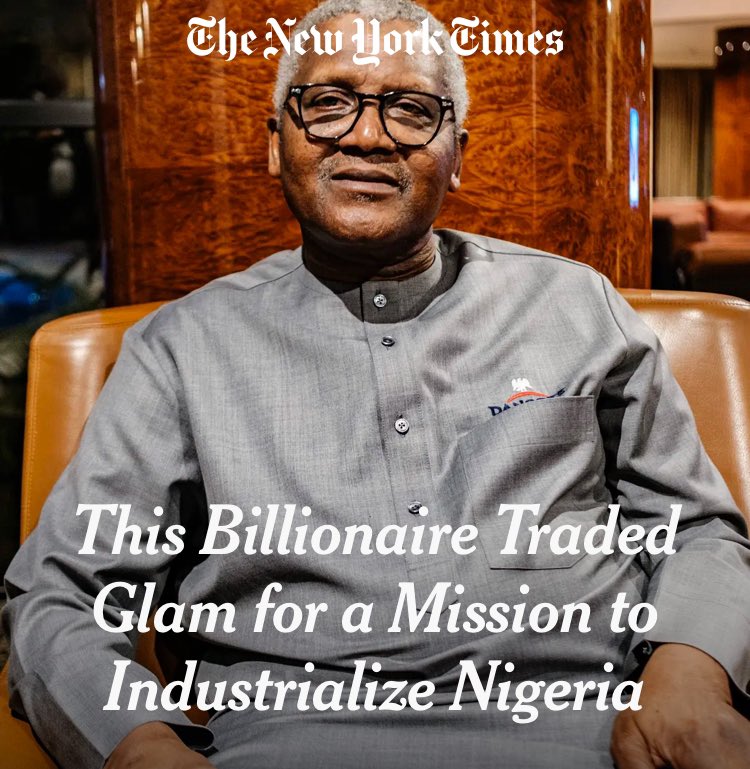
Africa's industrialist-in-chief, Aliko Dangote, shared his theory of African industrialization in an interview @TheEconomist published earlier this week. "If we don’t invest, nobody will come and invest in our continent." Who led investment into East Asia? "It wasn’t the Europeans. It was led by themselves as Asians." The industrialists building India? "They’re all Indians." "If we Africans don't lead in the industrialization of Africa, Africa will never industrialize." That argument isn't necessarily new. But Dangote is uniquely credible among those who make it. • His petroleum refinery processes up to 650k barrels of oil per day — the IMF estimates that run at full capacity it adds 1.5% to Nigeria's non-oil GDP. • His fertilizer plant produces 3M metric tons of fertilizer annually — more than any other plant in Africa. • His cement operations produce over 48M metric tons annually across multiple plants, making Dangote Cement the continent's largest producer. It's evidence that huge returns can be had in African markets by installing the kind of industrial capacity that exists everywhere else in the world. But to transform Africa from a resource exporter to an industrial powerhouse at scale, a new generation may need to follow Dangote's blueprint. The challenge as the man himself notes: "Africans generally might not have this kind of capital. Even when they have, they don’t want to invest." What do you think? What would it take for a new generation of industrialists to emerge across Africa?
Emeka Ajene ✍🏽 tweet media
English
10
93
254
12.2K
Joshua Pi'Rwot
Joshua Pi'Rwot@pirwot·
@eajene @TheEconomist East Asia's big leap came from their own folks pouring in investments and taking risks, not just waiting around.
English
1
0
0
312
Emeka Ajene ✍🏽
@jamesagada Sharp comment To your point, Dangote's refinery relies heavily on Indian managers & his cement business relies on a Chinese firm to build plants There's definitely room to do more, but even one step above resource extraction is better than no steps above resource extraction
English
1
1
3
276
jamesagada
jamesagada@jamesagada·
@eajene @TheEconomist we cant argue with Dangote. but there is a missing piece - Asia invested in the machines that make the machines. webare making cement but not making the machines that make the cement. we are one step above the resource extraction.
English
1
1
3
273
Victor Bassey
Victor Bassey@djvickiejay·
@eajene @TheEconomist Everything he said are true. The new generation is seeing what he's doing in all the sectors. I am one of those watching him very closely and learning from him and currently doing my bit. Soon the world will hear about me and what I'm building in agriculture and food security.
English
1
0
3
167
Emeka Ajene ✍🏽
@seyiadeoye_me A summary of his argument: x.com/grok/status/20…
Grok@grok

In his Feb 24, 2026 Project Syndicate piece "The Perils of Premature Automation" and the related Brookings viewpoint (Feb 2026 Foresight Africa chapter), Gabon’s Minister Mark-Alexandre Doumba argues developing countries (esp. Africa) should sequence AI adoption deliberately—not rush it—to avoid "premature automation." Core thesis: Greatest risk isn’t missing the AI revolution but joining too early, before building foundations. Embedding frontier AI in outdated, paper-based systems (e.g., Gabon hospital handwritten registers) risks displacing middle-skill jobs (call centers in Kenya/Rwanda, logistics in SA, finance in Nigeria) without new growth engines, deepening unemployment (12M new jobseekers/yr vs 3M formal jobs), dependency (export raw data, import algorithms), and inequality—echoing failed premature industrialization like Ghana 1950s-60s or Rodrik’s premature deindustrialization. Stats: Africa 38% internet penetration (vs global 68%), <1% global data centers/GPUs/AI research. Solution: Digitize first (data sovereignty, IDs, payments like Gabon’s GIMACPAY/Kenya M-Pesa), invest digital infra (local centers), pilot in sandboxes, leverage late-mover edge for governance (e.g., SA AI Institute, Brazil Pix). Quote: “The greatest risk is not missing the AI revolution, but joining it too early.” AI is transformative if synchronized with development goals—not a race.

English
1
0
1
13
Seyi Adeoye 🖤🦅
Seyi Adeoye 🖤🦅@seyiadeoye_me·
@eajene I think I kind of subscribe to his take on AI, it is not a race we can win, we didn't invent it. They lead we follow as far as tech innovation is concerned. We can follow constructively, we haven't even fully caught up with the internet revolution especially the govt sector.
English
2
0
1
49
Emeka Ajene ✍🏽
Africa should slow down on AI. That's the argument from Gabon's Minister of Digital Economy and Innovation — the person whose job, ostensibly, is to accelerate it. He warns against 'premature automation': adopting frontier tech before building the foundations to use it well. Wisdom or defeatism? The comments on @AfridigestHQ's Linkedin page are worth reading. Read the post here ➜ linkedin.com/posts/afridige…
Emeka Ajene ✍🏽 tweet media
English
7
6
17
1.4K
Emeka Ajene ✍🏽
@GavinMabie Surely if the argument is meritless, it's easy enough to attack the idea and not the individual
English
1
0
0
62
Gavin Mabie 🇿🇦
Gavin Mabie 🇿🇦@GavinMabie·
@eajene Some people just can't resist projecting their limited village experience onto a whole continent. It would've had some merit if he was the Minister Of Digital Economy for Africa, but he's not!
English
1
0
0
49
Emeka Ajene ✍🏽
@Fredareyouaman @grok what does Mark-Alexandre Doumba actually argue in his February 2026 Project Syndicate piece "The Perils of Premature Automation" and related Brookings contribution?
English
1
0
1
17
FREE CAMEROON 🇨🇲
FREE CAMEROON 🇨🇲@Fredareyouaman·
@eajene Defeatism - Gabon should be using AI to catch up after decades of resource extraction and underdevelopment. They even have a small population, there's no excuses.
English
1
0
0
43
Hassan Al Mansoor
Hassan Al Mansoor@alMansoor_ae·
@eajene Practical wisdom. Rushing into frontier tech without foundations creates dependency, not development. African nations are right to define their own digital timelines and build readiness first.
English
1
0
1
37
Chisom Rutherford
Chisom Rutherford@ruthefordml·
@eajene So are they actually building the foundations he's talking about? Or everybody should br at a standstill while they take another century to build basic infrastructure.
English
1
0
1
40
Emeka Ajene ✍🏽
Africa's 10 largest economies can be split into 3 groups: • Diversified industrial & financial hubs (🇿🇦, 🇪🇬) • Hydrocarbon-driven economies (🇳🇬, 🇩🇿, 🇦🇴) • Diversifying, reform-oriented growers (🇲🇦, 🇰🇪, 🇪🇹, 🇨🇮, 🇬🇭) These three countries account for the top spots — and they tell three distinct stories: 𝗦𝗼𝘂𝘁𝗵 𝗔𝗳𝗿𝗶𝗰𝗮 - $444B - diversified industry, the continent's deepest capital markets, advanced financial infrastructure — but constrained by persistent energy challenges, high unemployment, and sluggish growth. 𝗘𝗴𝘆𝗽𝘁 - $400B - a large and young domestic market, strategic geography bridging Africa and the Middle East, significant infrastructure investment — but working through IMF-backed reforms and currency stabilization. 𝗡𝗶𝗴𝗲𝗿𝗶𝗮 - $334B - Africa's most populous nation, but currency depreciation and macro instability have compressed its nominal GDP. The gap between its demographic weight and economic size is one of the defining tensions in African business today. Three very different engines. Three very different trajectories. GDP tells you where value has accumulated. It doesn't always tell you where it's going next. Follow Afridigest on Instagram ➜ instagram.com/afridigest
Emeka Ajene ✍🏽 tweet media
English
1
3
17
488
FreeThinking Paul💫 🌍
@eajene We haven’t even picked up any pace other than being consumers as usual. Would actually love to read his full statement, do you have a link ?😅
English
1
0
2
83