Joseph

407 posts

Joseph banner
Joseph

Joseph

@easybrane

Katılım Ağustos 2020
550 Takip Edilen176 Takipçiler
Joseph
Joseph@easybrane·
Some of the paid projects I've worked on since @Web3Bridge involved people I met during the program. Those relationships turned into real collaboration, and I'm grateful for every one of them.
English
0
0
1
2
vickish
vickish@Vickish11·
Everyone is talking about lack of Talent since Andela but Web3Brigde is the new Andela
English
12
33
80
6.3K
Joseph retweetledi
karo
karo@karoblaq·
web3 boys signing the 100k naira per month job after swearing in 2024 that they’d never do 9-5 in their lives.
English
1.1K
1.8K
11.7K
1.2M
Joseph retweetledi
Resolva
Resolva@ResolvaHQ·
P2P was good… but that’s so 2025. Ditch the stress. Come onboard Resolva. Fast and seamless. It’s the Resolva way. #Resolva #cryptotwitter
English
0
5
23
644
Joseph retweetledi
ICON0X
ICON0X@0xIconoke·
Security update 🚨 Completed a private Solana audit for CONI Wallet and the results are a reminder of why audits matter: • 1 Critical vulnerability • 2 Medium issues • 6 Low-risk findings Every bug caught before deployment is a win. The critical issue is already being addressed, and we’re working closely with the team to strengthen the overall security posture. Now looking to partner with more builders who take security seriously. Need a smart contract audit or security consultation? Reach out on Telegram 📩 t.me/Icon0x Build fast but secure it faster.
ICON0X tweet media
English
2
2
15
529
Joseph retweetledi
SliqPay
SliqPay@SliqPay·
You’re tired of "transaction failed" but getting debited anyway. So are we. Meet SliqPay: a simpler way to move money, pay for bills, airtime, and everyday services in Africa. A payment system that actually works. Every time. Everywhere. 🔺🇳🇬
English
11
17
35
450
Marvy
Marvy@Marvysmind·
Day 29/100 of ZK 🔐 Today we finished the core of KZG polynomial commitments by walking through the last two steps: proving an evaluation and verifying it. Quick recap from yesterday: * Trusted setup gives us the structured reference string (SRS): powers [τ⁰]₁, [τ¹]₁, …, [τ^d]₁ in G₁ and corresponding powers in G₂. * Commitment to a polynomial f(x) of degree ≤ d is C = [f(τ)]₁ — one group element. Step 3: Proving an evaluation Verifier sends a random challenge a (usually via Fiat-Shamir hash of previous messages). Prover wants to show f(a) = b. Compute the quotient polynomial: q(x) = (f(x) - b) / (x - a) Since f is degree ≤ d and (x - a) is degree 1, q has degree ≤ d-1. The proof is simply π = [q(τ)]₁ ∈ G₁ — again, a single group element. Step 4: Verification Verifier checks one pairing equation: e(π, [τ - a]₂) = e(C - [b]₁, [1]₂) This holds if and only if f(τ) - b = (τ - a) · q(τ), which is true exactly when f(a) = b. Pairings are bilinear, so the equality checks the polynomial identity without ever seeing f or q. Why this is so powerful * Commitment = 1 group element * Proof = 1 group element * Verification = 1 pairing check (fast on modern hardware) * Security rests on the q-SDH assumption (q-Strong Diffie-Hellman) — no known attacks when τ stays secret. We also talked about why the random challenge a is essential: without it, a malicious prover could precompute fake proofs for fixed points. Fiat-Shamir turns the interactive challenge into a non-interactive hash, making the protocol secure in the random-oracle model. @Oba_Ddev #ZeroKnowledgeProof #BuildingInPublic
English
3
2
18
581
mia
mia@Mia_szn2·
Eid Mubarak everyone! 🌙✨ May this blessed occasion bring peace, joy, and countless blessings to every home😚
mia tweet media
English
21
41
62
710
Joseph retweetledi
PhantomOz
PhantomOz@SuperDevFavour·
Just looking at what we've cooked for our users @joinhodl, all I can say is..... 🚀🚀🚀 #HODL
GIF
English
0
2
3
77
Joseph retweetledi
Abi Joseph 🫆
Abi Joseph 🫆@thegraphicghost·
Megumi fan art ... and yes I love anime
Abi Joseph 🫆 tweet media
English
0
1
3
92
Joseph retweetledi
milahh💕🦋
milahh💕🦋@Milaaaa2626·
Just made my first @Moku_HQ art... What do you think? 👀 This is just the beginning.
milahh💕🦋 tweet media
English
7
4
25
621
ogazboiz
ogazboiz@AkpoloOgaga·
I just want to share what I’ve been up to last month and this month. I’ve been attending my ZK classes at @Web3Bridge and combining that with BLOK Capital. I’ll be sharing updates about my ZK journey soon, there’s a lot to unpack. Today is Day 2 of @blok_cap Cohort 1. We discussed the Diamond contract, how it works, and how its functions are structured. The session was led by @mudgen. Fellow cohort members, I hope you’re enjoying it as much as I am. We also touched on ERC-8153, which aims to make things easier and more understandable. It was motivated by the fact that ERC-2535 has perceived complexity, high gas costs when deploying diamonds, and complexity in managing function selectors. #blowthisup #ethereum #Web3 #الرياض_الان
ogazboiz tweet media
English
5
6
41
1.1K
Marvy
Marvy@Marvysmind·
I love when a new month starts on a Monday. My brain automatically interprets it as a full system reset. It feels illegal to waste it. So obviously I’ve already planned my workouts, study blocks, work, life in general 😭😂 What are you looking forward to this month?
GIF
English
1
0
6
176
Marvy
Marvy@Marvysmind·
Happy Monday, back to studying ZK and staying locked in.
English
7
3
30
1.5K
Joseph
Joseph@easybrane·
@SliqPay @avax Great work!!..Congratulations to the sliqpay
English
0
0
1
26
SliqPay
SliqPay@SliqPay·
We’re thrilled to announce that SliqPay has been selected for the @avax Build Games 2026! Africa’s payment landscape needs a fail-safe rail, & we’re building it on the most reliable infrastructure in Web3. 6 weeks of building. 1 goal: Eliminate failed transactions. 🚀 #SliqPay
SliqPay tweet media
English
9
2
15
291
Marvy
Marvy@Marvysmind·
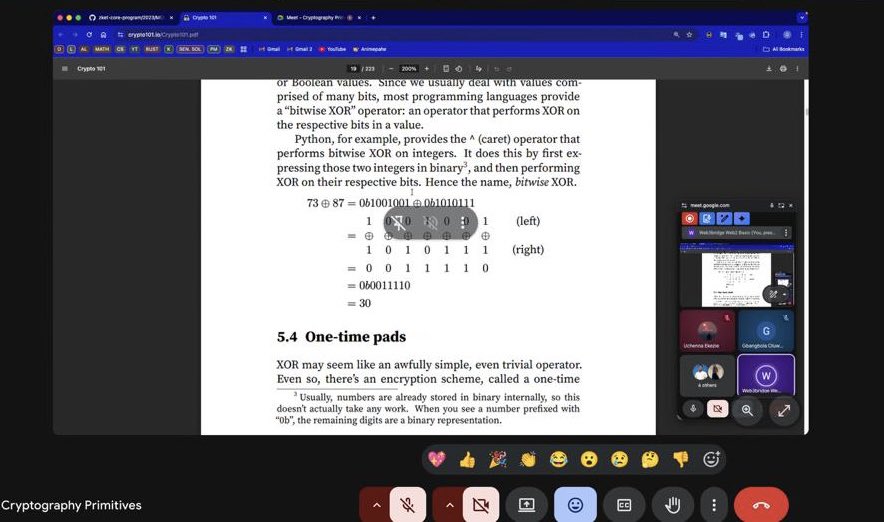
Day 16/100 of ZK 🔐 Today we focused on XOR, a powerful operator in crypto and ZK circuit design. Exclusive OR (XOR) is a binary Boolean operator: output is true (1) only when the two inputs differ (one true, one false). Truth table: * 0 ⊕ 0 = 0 * 0 ⊕ 1 = 1 * 1 ⊕ 0 = 1 * 1 ⊕ 1 = 0 Think of it as a programmable inverter: fix one input (the “control” bit). If control = 0, the other bit passes through unchanged. If control = 1, the other bit gets flipped (inverted). This flip operation is why we call it “bit flipping” in crypto. Key properties of XOR that matter for ZK: * Commutative: a ⊕ b = b ⊕ a * Associative: (a ⊕ b) ⊕ c = a ⊕ (b ⊕ c) * Self-inverse: a ⊕ a = 0 (flipping twice returns to original) * Identity element: a ⊕ 0 = a * Distributive over itself in certain ways, but most importantly: XOR is linear over GF(2) — huge for arithmetic circuits and constraint systems. Bitwise XOR extends this bit-by-bit across multi-bit values (e.g., 1010 ⊕ 1100 = 0110). In ZK, bitwise XOR gates are cheap to encode as constraints and appear constantly in hash functions, symmetric ciphers, and random linear combinations. One-time pads (OTP): The standard of perfect secrecy. To encrypt message m with key k (same length, truly random), ciphertext c = m ⊕ k. Decrypt with k ⊕ c = m. Shannon proved OTP is information-theoretically secure, unbreakable if the key is never reused and perfectly random. But real-world “one-time pads” get attacked hard: * Key reuse → turns OTP into a Vigenère cipher (breakable via frequency analysis or known-plaintext). * Poor randomness → attacker can exploit patterns. * Implementation leaks (side-channels, padding oracles, etc.). * Key management disasters (predictable generation, storage failures). In ZK context, XOR gates are everywhere because they’re linear and easy to constrain, while understanding OTP reminds us why perfect secrecy is rare, and why we need zero-knowledge to prove things without leaking the actual secrets.
Marvy tweet media
English
2
1
18
332