ebr

6.5K posts

ebr banner
ebr

ebr

@ebr

not to be confused with East Baton Rouge, Eric Buell Racing, the Turkish art of paper marbling, etc

Katılım Kasım 2006
6.3K Takip Edilen237 Takipçiler
ebr
ebr@ebr·
@default_friend Was she friends with the tech bro who wanted to reinvent the ride share & reinvented the bus?
English
0
0
4
278
Katherine Dee 🐬/acc
Katherine Dee 🐬/acc@default_friend·
Remember that woman who thought she invented the concept of hanging out
English
6
0
80
4.6K
ebr
ebr@ebr·
@katrosenfield I miss the stiff upper lip & reserve of the old WASP class. Karl Marx could show up & the gentry WASPs would have given him a very cold reception
English
0
0
0
123
Kat Rosenfield
Kat Rosenfield@katrosenfield·
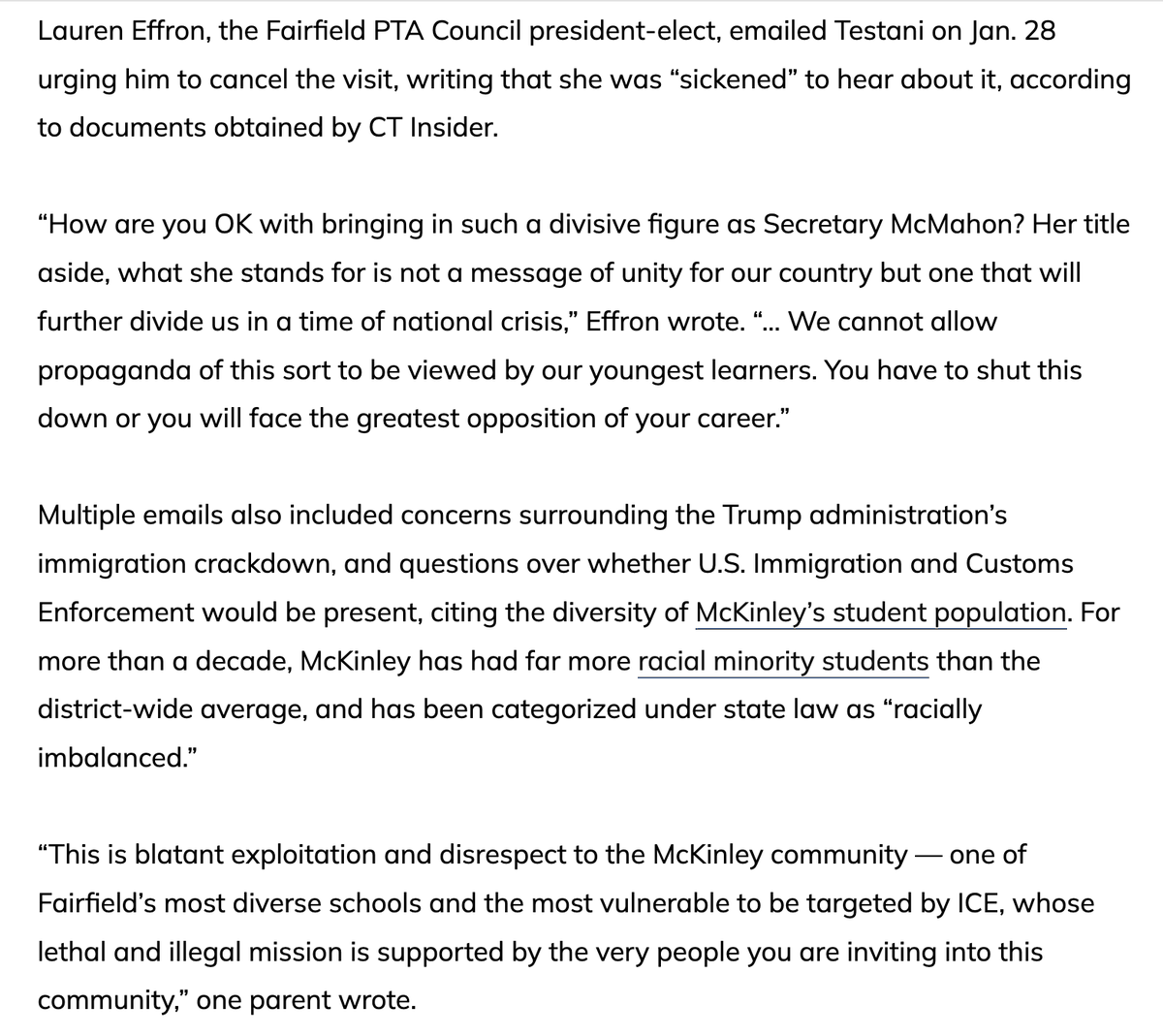
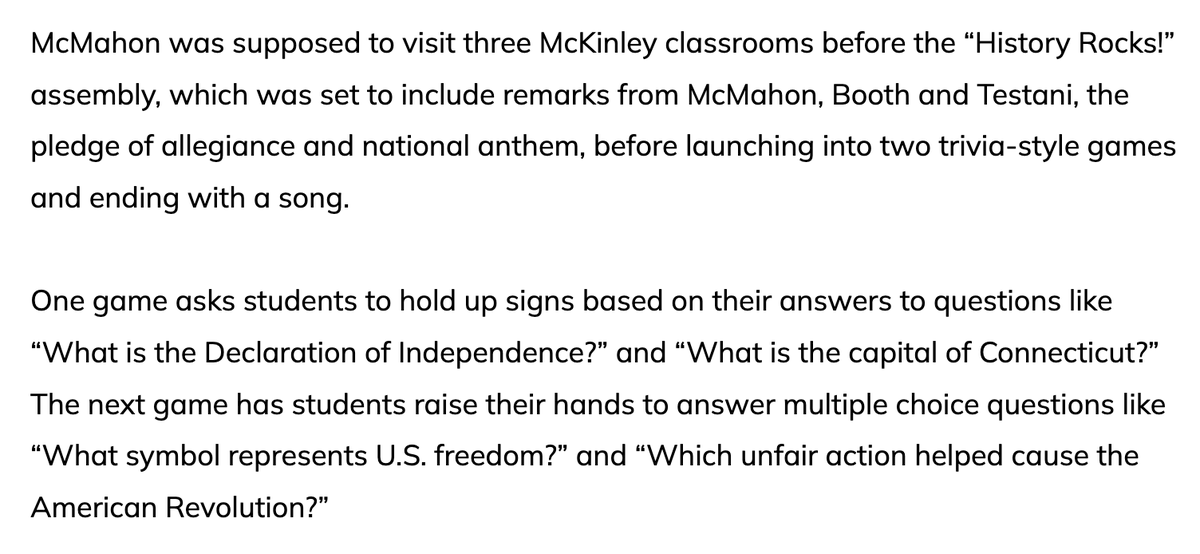
Wild story about a massive meltdown here in CT after parents in Fairfield freaked out over a planned visit by Sec. of Education Liinda McMahon in honor of the 250th US anniversary: "Emails to district officials pointed to plans for a protest and district-wide walkout."
Kat Rosenfield tweet mediaKat Rosenfield tweet media
English
31
25
233
21.8K
ebr retweetledi
Ceb K.
Ceb K.@CEBKCEBKCEBK·
Dracula is a novel about doxxing. “The Count” is an Eastern European autodidact anglophile shut-in, with odd social tics & sexual proclivities, who collects & treasures old books on all sorts of topics—from politics & law to business & science—& worships modernization, & sends messages by post & wire across the decadent western world, in hopes of attracting some foppish emissaries from its core, whom he can use to influence his way into the center of modernity, to revitalize it before it grows prematurely old. The story covers his use of lawyers, language, records, railways, & other such modern tools to exchange his decaying inheritance for property in London, & ship his body & homeland soil there, so he can take local women & mix their blood with his, so his thus rejuvenated old blood & soil can make real use of the modern wealth & power that has made its own elite core subjects into effete superstitious hysterics. Consider who Dracula faces opposition from: -the over-educated cuckold credentialist van Helsing “MD, PhD, DLitt, etc” whose wife is “dead to [him], but alive by Church’s law, though no wits, all gone,” & yet who is “faithful husband to this now-no-wife”—because though she’s also in some sense undead at least she’s also boring & pathetic—& who relishes pompous obfuscation so much that he causes one of his friends to die rather than tell them why he’s putting up garlic to protect them; -literal schoolmarm Lucy Westenra, who makes 3 weak men propose to her on the same day, tries to accept all 3, then whines for them to remain friends with each other & with her even after she just picks the rich one, because she’s just ever so modern & liberated (she then immediately & repeatedly seeks out intimate midnight encounters with Dracula, demands attention & support from all her simps for how tired & sore these ordeals leave her, & abandons them anyway for the nightlife); -the podcaster therapist Dr John “Jack” Seward MD, who literally institutionalizes the sensitive young man R M Renfield for eating “too much” meat—Renfield’s “crazy” belief in the health benefits of “excessive” animal protein consumption is explicitly & repeatedly likened to vampirism (so he eats bugs instead while he’s forced into treatment for this)—& who records interviews with his patients on phonographs for distribution (he also larps as a real doctor to simp hard for Lucy, even though she rejected his proposal, when she needs help recovering from her nightly affairs with Dracula); -Mina Harker, who compulsively collects & arranges & copies everyone’s records of everything, to create the novel we read—which is entirely composed of chronologically ordered journals, journalism, letters, logs, etc (because she’s worried that vampires are using intelligence & agency & charisma to gaslight them)—in order to dox Dracula’s location & report on him to all kinds of relevant authorities for various technicalities (when her pathetic simpy superstitious groupthink doxing network uses her secretarial work to trap the romantic individualist she journals “Oh it did me good to see the way that these brave men worked. How can women help loving men when they are so earnest, and so true, and so brave! And, too, it made me think of the wonderful power of money!"); -& the rest of their goofy little goody-two-shoes gang fits nicely into this mold (a self-pitying “cute & sad” trust fund ally, a beta clerk who keeps putting himself in compromising positions so he can get dommed by male & female vamps, a white knight who dies “nobly” simping in transparently try-hard cucked ways, etc). The novel clearly contrasts domesticated Western Europe’s over-socialized modern discipline with Eastern Europe’s backward slapdash animalism. But most seem to assume—wrongly—that Dracula’s just emergent from, or perhaps even behind, this eastern backwardness, when actually he’s the synthesis: the only independent character, with independent interests, rather than superstitious hysterias; a force of nature who can thus force others to naturally follow his lead (he has extreme skill in domesticating animals, & he’s thus able to keep the domesticated men who administer ships, trains, inspections, commerce, realty, science, tech, etc on track for his transcendent goals, until the bugmen hack their own hive’s petty protocols into canceling him for MeToo BS). For instance, Dracula lands in Britain by hypnotizing a Russian boat captain who had already been hypnotized by English commerce, & then by further “automating” the crew, so that the “unmanned” boat can run aground in exactly the right way to let him head where he’s going—on time & with all his effects—with legal protection & logistical support from the Board of Trade & others. Likewise he brings fog & night, & roams around freely when it’s naturally dark, in the brand new capital of artificial light, while its “modern subjects” cower inside in fear of his “magic.” Many such cases. Bram Stoker intended this as a sequel of sorts to his first book—“The Duties of Clerks of Petty Sessions in Ireland”—about how Ireland should be granted “home rule” but also folded into bloodless versions of anglo-international standardized proceduralism. He wanted us to dream of exporting our decaying shrill administrative superstitions to the world, rather than importing their land & vitality to rejuvenate what could’ve been our immortal visionary individualist empire. But the immortal transcendentalists he wanted us to hate have aged much better than the faddish conformists he wanted us to follow.
English
13
58
539
33.9K
ebr
ebr@ebr·
@default_friend The summer of Covid I did stuff like this. Did you know you can make your own lasagne noodles? A mix of nostalgia and “I never want to go through that again.”
English
0
0
0
58
ebr retweetledi
Izabella Kaminska
Izabella Kaminska@izakaminska·
🧵BOOK 1: Here begins what stands to be an enduring thread setting out the researches of Izabella Kaminska of Ealing, which she publishes, in the hope of thereby preserving from decay the remembrance of what men have done, and of preventing the great and wonderful actions of the Americans and the Persians from losing their due meed of glory; and withal to put on record what were their grounds of feud. For it has seemed to me that the deeds of men in our time are no less worthy of remembrance than those of old; yet they are in greater danger of being misunderstood. For where once stories passed from mouth to mouth and were shaped by memory, now they are multiplied without number via the socials, so that truth is scattered among many voices, and the loudest are not always the most faithful. And I have observed that when events are nearest to us, men speak of them not as inquirers, but as partisans — each praising his own side and condemning the other, so that the causes of things are hidden beneath anger and fear. In such a time, even those who wish to know are carried along by the current of opinion, and seldom pause to ask what has truly happened, and why. Therefore I have resolved to write of these matters in the manner of an ancient literary hero, gathering accounts from many sources and from what is said among different peoples, so that the great and troubling deeds of our age may not fade into confusion, nor be remembered only as each side would have them. For it is my belief that by setting these things at a distance — by treating them as one might treat the wars of former times — they may be seen more clearly, as objects appear more distinct when viewed from afar than when pressed close before the eyes. And so I undertake this work: not to declare what is certainly true in all respects, for that belongs to the gods alone, but to preserve what is said, to examine what seems likely, and to give an account that may endure beyond the noise of the present moment.
English
10
21
108
43.9K
ebr
ebr@ebr·
ZXX
0
0
0
17
ebr
ebr@ebr·
ZXX
0
0
0
14
ebr
ebr@ebr·
@Avonleebythesea I know a recent college grad with no knowledge of Chanticleer, and although this might be dismissed as an obscure reference, their theory of mind was generally impoverished. I explained the reference in the language of “The 48 Laws of Power” so yah that is where culture is now
English
0
0
1
47
Rebecca 📖
Rebecca 📖@Avonleebythesea·
This is increasingly becoming an issue across the board. When I was teaching English, students often were not familiar with references to things like chicken little or the emperor’s new clothes because they were not read to as children. This makes it difficult for them to read classic novels, which are full of what were once common cultural references, it can be frustrating for both students and teacher. If we lose these ties to a common history and framework, we lose our identity and sense of self. I think a good deal of the lack of patriotism, the propensity towards self-flagellation is downstream of this.
FischerKing@FischerKing64

Not long ago @romanhelmetguy posted course offerings from Harvard today and 100 years ago, and what struck me was the near total elimination of introductory survey courses (eg "Modern Europe from 1500-1789" or "English literature from Chaucer to Shakespeare"). Instead they get highly politicized courses on very narrow subjects. So eburke here is right, but I would just add that Harvard makes little effort to provide a "common frame of reference." If the humanities courses must all be for beginners it's also because Harvard doesn't lay the groundwork for going deeper.

English
90
342
3.1K
345.8K
David Betz
David Betz@DavidBe31099196·
Read this and the thread. ‘Civil War doesn’t happen in wealthy states, you’re a dummie/rightwing troll, David. Go read a book.’ I’ve heard this so many times, often from other academics. The complacency, the failure to seriously examine assumptions, it’s quite astonishing.
Zynx@ZynxBTC

No one is prepared for how materially poorer the UK is likely to become over the next two decades. A disproportionate share of British wealth is concentrated in housing. Over 40% of total household wealth, approaching £4 trillion, is tied up in residential property. For the past 30 years that seemingly worked very well. Housing absorbed a significant share of monetary premium in an environment defined by falling interest rates, expanding credit and persistent monetary easing. It ceased to function purely as shelter and instead became leveraged money and a store of value. The UK faces a combination of headwinds that means this is going to change. An ageing population, low birth rates, slowing population growth and increasing capital outflows as high net-worth individuals relocate to more favourable jurisdictions in the Middle East and Asia. At the same time, housing is no longer the only recipient of excess liquidity. The global choice for storing value has expanded and alternative monetary assets, such as Bitcoin, are beginning to compete for that premium. The UK has mistaken housing inflation for wealth creation for three decades. What follows is unlikely to be a sudden collapse but a slow erosion of real value concealed by nominal stability. A large portion of British wealth is far more fragile than widely understood.

English
21
28
268
27.6K
Pascal-Emmanuel Gobry
Pascal-Emmanuel Gobry@pegobry_en·
The opening to this piece is incredible. A writer tells an audience of libs the most obvious thing about postliberalism, and they're all baffled. They really are incapable of formulating a theory of other minds. noemamag.com/the-return-of-…
English
11
17
129
12.3K
ebr
ebr@ebr·
@DavidBe31099196 Have you ever seen “Latin American security architecture” it’s sort of cyberpunk in Miami
English
0
0
0
5
David Betz
David Betz@DavidBe31099196·
A couple of years ago I published a book The Guarded Age: Fortification in the 21st Century. I’d been seriously interested in fortification strategies years before that and was arguing that they were coming to define military affairs of our time. I think it’s fair to say that a lot of my colleagues thought I’d gone a little odd. No one else was saying we live in a densely castellated time, or that fortification engineering is coming back to the sort of importance it had in late modern era. But I was right. When I’m finished with current writing projects I’m going back to write another book on society and military architecture. Amongst other things I intend to argue that walled cities will be back in fashion by mid to late-mid century—already happening in a few places.
Tyler Rogoway@Aviation_Intel

Hardened Underground Facilities Now Being Sought For Al Udeid Air Base Iranian attacks highlight the glaring need for hardened infrastructure and shelters to protect troops and military assets. twz.com/news-features/…

English
21
12
131
9K
ebr
ebr@ebr·
@katrosenfield the media is noticing 😃
James L. Nuzzo, PhD@JamesLNuzzo

The following is a true story from my life, which is related to the contents of this article in The Guardian: In July 2009, I hiked part of the Grand Canyon with an ex-girlfriend, who I will call Sara. Sara and I were both in our 20s, and we were accompanied by four high school-aged relatives/friends. The plan was to head off early in the AM to hike the 10 miles down, stay over night at the bottom, and then hike the 10 miles up the next day. During the hike down, Sara's walking was slow, and she was pre-occupied with taking nature photos at every possible opportunity. Her slow walking was a problem because, although we started early, it was July and the sun was starting to beat down on us--something that would only becoming progressively worse with more time on the trail. As I recall, everyone in the group recognised Sara's slow walking as a problem. Everyone but Sara understood that we needed to get to the bottom of the Canyon sooner rather than later, because we were in the sun doing strenuous exercise, and we didn't have endless supplies of water. It was also the first time any of us had hiked the Grand Canyon. Sara continued her slow walking and picture taking. At multiple points, we offered to carry Sara's bag for her so that her load would be lighter and she could walk more easily. Sara refused to give up her bag. She wanted to prove that she could do the hike without help. If my memory is correct, around the 5 mile mark, the group decided to split up. I stayed with Sara, and the high schoolers went on ahead of us, walking at their "fast" (i.e., appropriate) pace. Sara continued to walk slow, and signs of extreme fatigue / heat exhaustion were setting in. Sara became unwell physically and mentally. Again, I offered to carry her bag for her. Again, she refused. Though I was fit, I was also starting to feel unwell. In fact, I don't think I've ever felt that close to health exhaustion in my life. I was also not in a good place. Making matters worse, we ran out of water, and there were no water stations for the remainder of the hike. The key reason that why we ran out of water was Sara's slow walking, which continued to expose to the sun. Moreover, when we ran out of water, we weren't even close to the end. As I recall, we were still about 2-3 miles away from the end when we ran out of water, and we didn't even know where the end was because we were unfamiliar with the trail. Also, by that time, there wasn't a single soul left on the trail--no one walking down or up. We were alone. It was an awful experience. At one point, Sara had basically given up; she sat down in the middle of the path and wouldn't move. Eventually, perhaps through motivational efforts, Sara continued walking and we got to the end. When we got to the bottom, the high schoolers told us that they were so worried about us that were thinking about calling a rescue party to look for us. We slept over night at the bottom and then hiked the 10 miles back up the next day. Remarkably, after all that, Sara still would not allow anyone to carry her bag on the way up. Sneakily, when she was not looking, we would take things out of her bag to lighten her load. Bottom line: Sara's stubbornness, her desire to prove how strong and independent she was, her lack of adequate fitness, and her unwillingness to listen to people who understood nature, physiology, and physical fitness better than her, almost killed her...and me. She caused the high schoolers significant distress, and had they stayed with us, she might have also put them at increased health risk. During the hike, Sara exhibited a set of behaviors that I wanted nothing to do with moving forward. The "alpine divorce" can work in both directions but for different reasons.
English
0
0
0
106
ebr
ebr@ebr·
@michelletandler Lord help us all but I will defend the media. The media should be in the dry facts business not the moral censor business. I hated the moral censoriousness of the last few years & we should not adopt this bad habit
English
0
0
0
55
ebr
ebr@ebr·
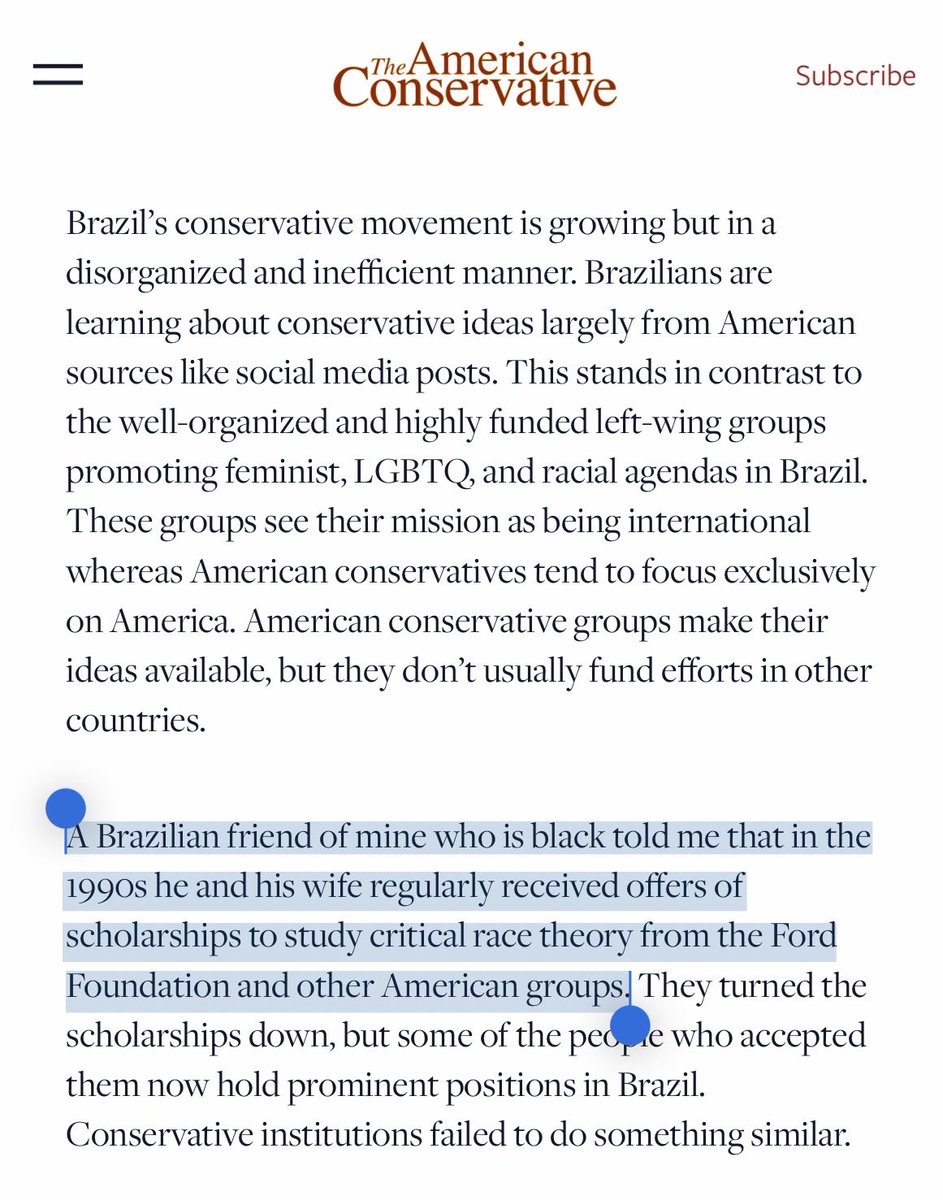
@herandrews If conservatives did have such a foundation & funding, what would be taught? The old Reagan fusion platform is spinning apart. Teach the federalist papers? Would that be useful to a young Brazilian academic? 🤷‍♀️
English
0
0
0
110
Helen Andrews
Helen Andrews@herandrews·
When I was at TAC, we published a piece by someone who lived in Brazil who mentioned that her black Brazilian friends were constantly being invited by the Ford Foundation to come to the U.S. for fully funded fellowships in anti-racism. This was in the 1990s.
Helen Andrews tweet media
English
13
55
434
38.9K
Helen Andrews
Helen Andrews@herandrews·
It’s an interesting question: Is anti-racism/critical race theory an American import? Both sides have good arguments but on balance I say yes. America invented this model and then spread it abroad.
Nemets@Peter_Nimitz

@FistedFoucault Nic we're responsible for a lot of what goes on in Germany because of the occupation, but at least in France we're innocent. Their race issues are milder because they have civil law & a centralized equality apparatus, but both were made by people who were not under our influence.
English
24
32
343
43.3K
Sarah Ditum
Sarah Ditum@sarahditum·
How did the self-appointed tormenter of Bad Men ™ end up writing propaganda for the surrendered life? And why did she stop being funny? They're not unrelated questions. Me for @unherd unherd.com/2026/03/how-li…
English
13
34
276
38.3K
Sarah Ditum
Sarah Ditum@sarahditum·
Lindy West invented the voice of 2010s internet feminism - abrasive, bratty and seemingly fearless. Now she's written a memoir about how she convinced herself that she was fine, actually (completely fine!) with her husband moving his girlfriend into their home. Link follows...
English
5
14
420
46K
ebr
ebr@ebr·
@default_friend No, bad idea. I would never worry about “was it good for you” with an AI or see myself reflected in the eyes of an AI. A dystopian future would be the young trained to by an AI feedback loop how to love. Science fiction short anyone?
English
0
0
0
47
Katherine Dee 🐬/acc
Katherine Dee 🐬/acc@default_friend·
Ok I’m awake again. Yes. You should. Sam let’s talk
Katherine Dee 🐬/acc tweet media
English
12
0
64
5K