Ebunker
1.7K posts

Ebunker
@ebunker_eth
One of Asia’s largest node operators with $1.5B+ ETH staked. A solid bunker built for Ethereum.
Katılım Ocak 2023
116 Takip Edilen1.3K Takipçiler
Sabitlenmiş Tweet

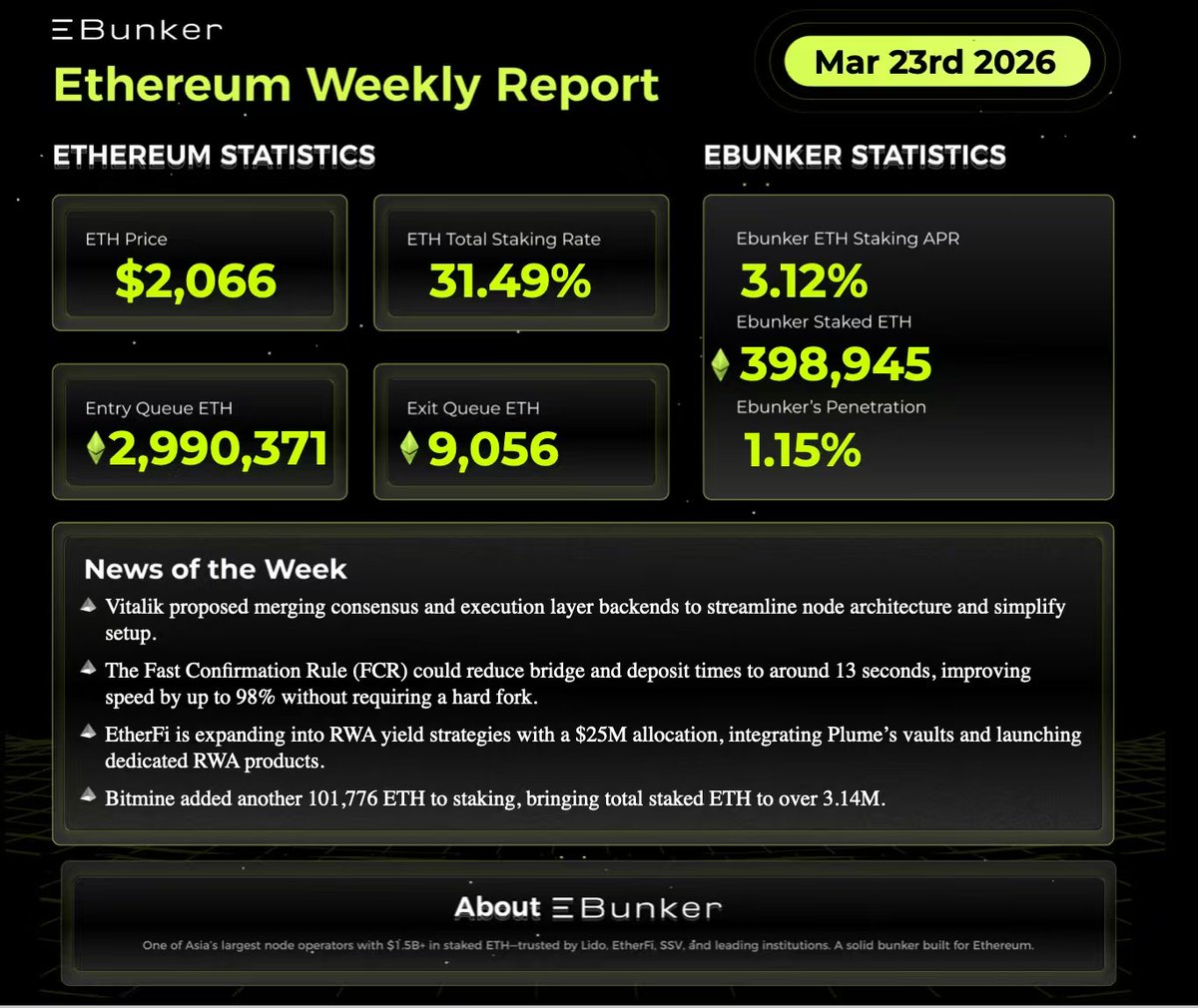
🗓 Ethereum Staking Weekly | Mar 23, 2026
• 38.01M ETH staked → staking rate 31.49%
• Ebunker APR: 3.12% | penetration 1.15%
• Queue dynamics: entry queue ~52 days, exit queue very low (~4h)
• Effectiveness: Ebunker 98.7% (+0.43% vs avg 98.27%)
📰 News of the Week (Highlights)
• One-click staking progresses with DVT-lite, simplifying institutional validator deployment while improving resilience and risk distribution.
• Fast Confirmation Rule (FCR) could cut bridge and deposit times by up to 98%, enabling near-instant confirmations without a hard fork.
• Vitalik proposed merging consensus and execution layer backends to streamline node architecture and simplify setup.
• Institutional staking expands: BitMine increased holdings to ~4.6M ETH with ~⅔ staked, while BlackRock’s ETHB ETF reached $254M AUM within one week.
• EtherFi is moving into RWA yield strategies with a $25M allocation, signaling diversification of staking-linked yield products.
• Lido confirmed funds remain safe after the Resolv Labs incident, reinforcing trust in liquid staking infrastructure.
• Layer 2 trends: FCR testing targets ~13s confirmations, while the number of active L2s continues to consolidate.

English

The FCR introduces ~13-second confirmations on Ethereum without requiring a hard fork, by leveraging attestation weight instead of traditional block-depth heuristics.
While distinct from finality, FCR provides strong guarantees under reasonable assumptions, significantly improving L1-to-L2 and exchange deposit times.
Under the hood, this shift further emphasizes the importance of validator participation, uptime, and timely attestations in maintaining network reliability.
Julian@_julianma
English

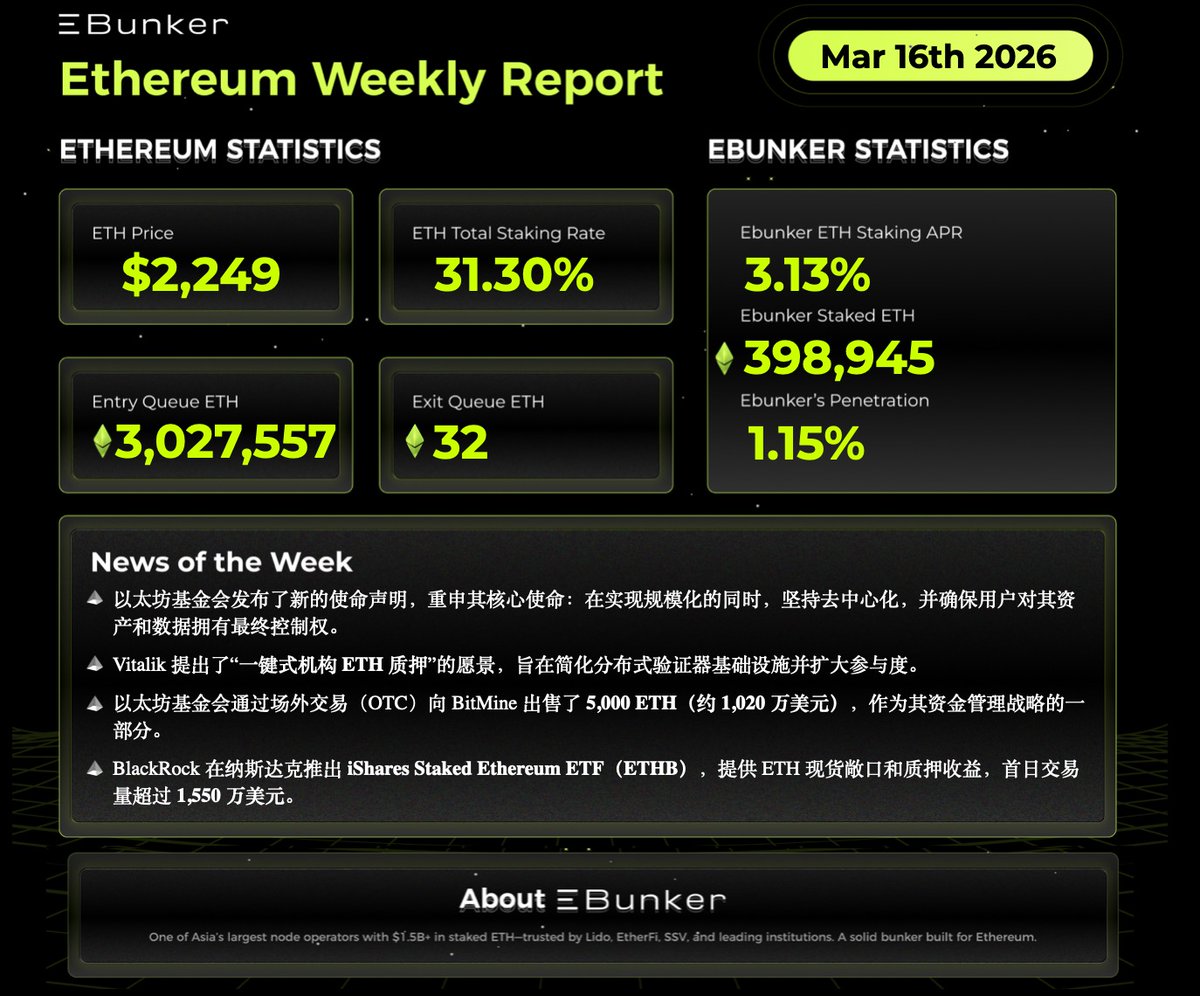
🗓 Ethereum Weekly Report | Mar 16, 2026
• 37.78M ETH staked → staking rate 31.30%
• Ebunker APR: 3.13% | penetration 1.15%
• Queue dynamics: entry queue ~52 days, exit queue near zero
• Effectiveness: Ebunker 98.75% (+0.36% vs avg 98.39%)
📰 News of the Week (Highlights)
• Vitalik proposed simplifying Ethereum node software to make self-sovereign node operation more user-friendly.
• The Ethereum Foundation mandate reaffirmed decentralization and user sovereignty as core principles while pursuing mass-scale adoption.
• Vitalik outlined a vision for “one-click” institutional ETH staking, aiming to simplify distributed validator infrastructure and broaden participation.
• The Ethereum Foundation sold 5,000 ETH (~$10.2M) to BitMine via OTC as part of its treasury strategy.
• BlackRock launched the iShares Staked Ethereum ETF (ETHB) on Nasdaq, offering ETH exposure with staking yield and recording $15.5M+ day-one trading volume.
• BitMine’s treasury reached 4.535M ETH (~3.76% of total supply) after adding over 60k ETH in one week.
• Ethereum researchers demonstrated “native rollups” (EIP-8079), enabling L1 to directly verify L2 state transitions.
• OP Labs announced layoffs to narrow focus while continuing Optimism ecosystem development.

English

As activity rises and transaction costs decline, Ethereum’s base layer is quietly getting stronger. 🛡️
Token Terminal 📊@tokenterminal
Ethereum is the #1 chain in terms of application TVL, stablecoin supply, and tokenized RWA market cap. Now the network is catching up also in terms of performance. The cost to transact on Ethereum is at an all-time low, while the onchain activity is at an all-time high.
English
Ebunker retweetledi
Ebunker retweetledi

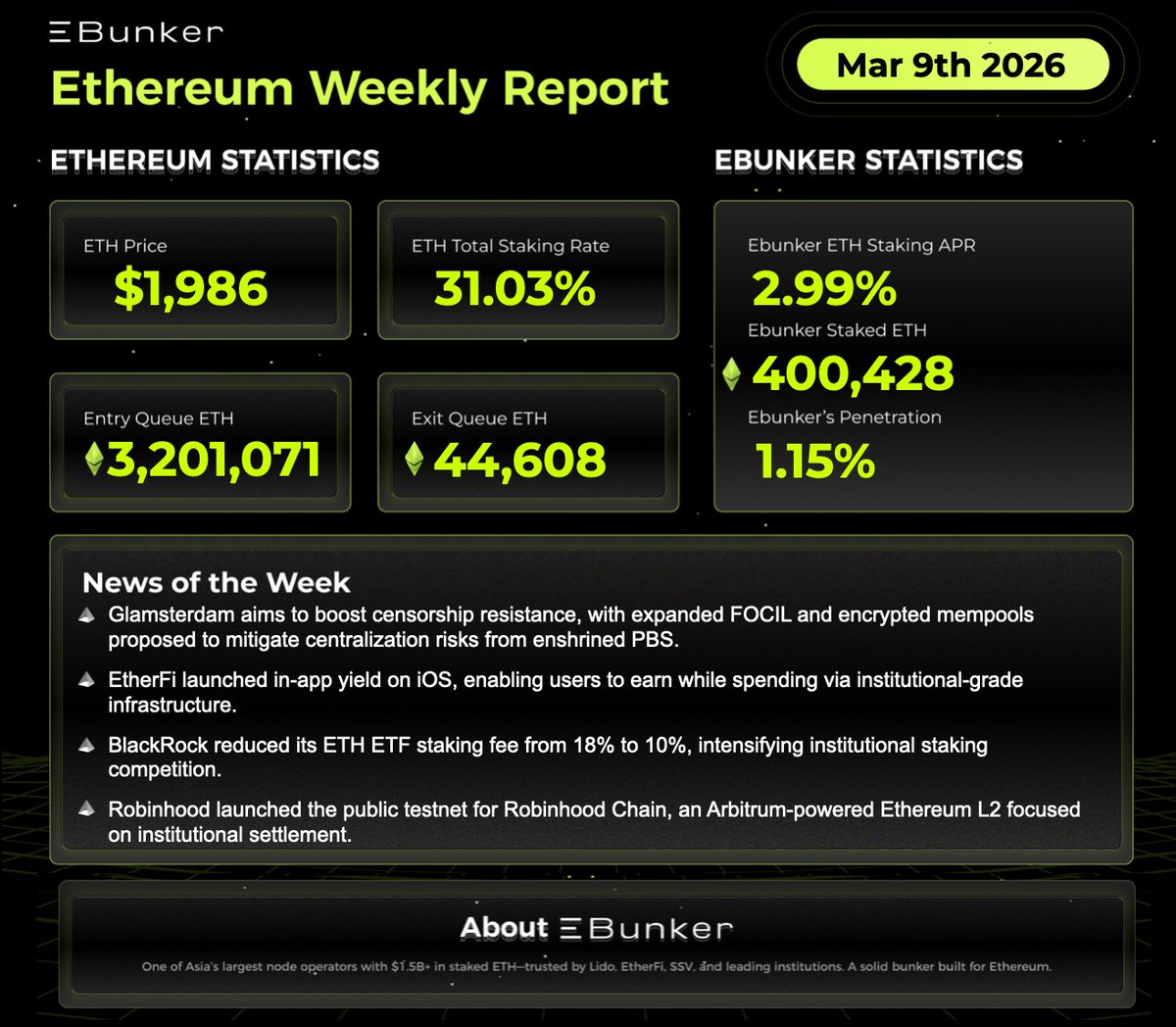
🗓 Ethereum Staking Weekly | Mar 9, 2026
• 37.46M ETH staked → staking rate 31.03% (new high)
• Ebunker APR: 2.99% | penetration 1.15%
• Queue dynamics: entry queue ~56 days, exit queue under 1 day
• Effectiveness: Ebunker 98.7% (+0.63% vs avg 98.07%)
📰 News of the Week (Highlights)
• Vitalik said AI coding still has major caveats, but Ethereum’s roadmap could move faster than expected.
• Vitalik encouraged bolder experimentation at the application layer while safeguarding Ethereum’s trustless core.
• Glamsterdam upgrade focuses on censorship resistance, with expanded FOCIL and encrypted mempools proposed to offset enshrined PBS centralization risks.
• Geth v1.17.1 released, delivering bug fixes and performance improvements with upgrade recommended.
• BlackRock cut ETH ETF staking fees from 18% to 10%, intensifying institutional staking competition.
• Robinhood Chain testnet launched on Arbitrum, signaling deeper institutional use of Ethereum L2 infrastructure.

English

@VitalikButerin Bold on the application layer. Uncompromising on CROPS.
English

I think it's healthy for us in the Ethereum world to have a more bold and open mindset to many things, particularly on the application layer and on how we see ourselves in the world.
We should not compromise on core properties: censorship resistance, open source, privacy, security (CROPS). We should not have "open mindedness" of the type that leaves people with no confidence of what security properties the L1 will still have one year from now. We should not ask ourselves questions like "do we really need light clients to be able to trustlessly verify correctness of the chain?". But especially on the layer of applications and Ethereum's interface to the world, we should be more willing to radically rethink various concepts and step outside our comfort zone.
This includes issues of technological direction, eg. "what if AI basically means that wallets as browser extensions and mobile extensions are dead within a year?"
One example last year was the shift to thinking about privacy as a first-class consideration, something we value equally to the other types of security. This implies a radically different Ethereum application stack, because the entire stack so far has not been built around privacy. Great, let's build a radically different Ethereum application stack!
An example this year is the growing work on the networking side of privacy, both inside the EF and outside.
It includes application-layer issues, eg. "what if the rest of defi is basically just universal futures markets on top of a good decentralized oracle and letting users self-organize on top of that?", and "what if the ideal decentralized oracle is just a SNARK over M-of-N small LLMs over zk-TLSes of some major news sites?"
(BTW this is interrelated with the AI issue: one consequence of AI is that it moves "applications" away from being discrete categories of behavior with discrete UIs, and more toward being a continuous space, so "build fewer apps and rely on users to self-organize around them" should inevitably expand as a pattern)
One example this year is rethinking from zero the role of L2s, and what kind of L2s are actually most synergistic and additive to Ethereum.
It also includes culture. This is a big part of "the whole milady thing" for myself, @AyaMiyagotchi and others. Yes, it's a silly meme. Yes, I find the political takes of some milady partisans cringe and sometimes outright bootlickerish (though other milady partisans are quite the opposite). But the core underlying subtext, the message behind the message, is: rip off the suit and tie. If you have your suit and tie on, be willing to grab the nearest wine glass and spill it all over your suit and tie, so you have no choice but to rip it off and reclaim your body's full flexibility and freedom. Actually imagine yourself doing this the next time you get invited to a richpeopleslop formal gala dinner. Take the preconception that you are "respectable", write it down on a piece of paper, crumble it up and burn it. The psychological baptism of doing this leads to the intellectual baptism of unlocking greater creativity and expanding overton windows.
For too long, our algorithm in Ethereum has been: we have this existing ecosystem, what's the logical next step to make it one step better? Now, our algorithm should be: we have this L1 that is amazing and will become more amazing, we have a growing array of tools, both those built within our ecosystem and outside it, what are the most valuable things to build, knowing what we know now? If YOU had to write the section of the 2014 Ethereum whitepaper that talked about applications, and take a first-principles perspective of what makes sense in defi, decentralized social, identity, and elsewhere, what would you write? At least take the step of marking all path-dependence concerns down to zero, pretend for a brief moment that the Ethereum chain today has exactly zero usage and you're the one suggesting or building the first apps, and see what comes out. Do this even if you're the one building today's existing apps. This is how Ethereum can grow back stronger.
English


🗓 Ethereum Staking Weekly | Mar 2, 2026
• 37.24M ETH staked → staking rate 30.85%
• Ebunker APR: 3.10% | penetration 1.15%
• Queue dynamics: entry queue ~60 days, exit queue near zero
• Effectiveness: Ebunker 99.1% (+0.4% vs avg 98.7%)
📰 News of the Week (Highlights)
• Account abstraction (smart accounts) is expected to ship with the Hegota upgrade within about a year, according to Vitalik.
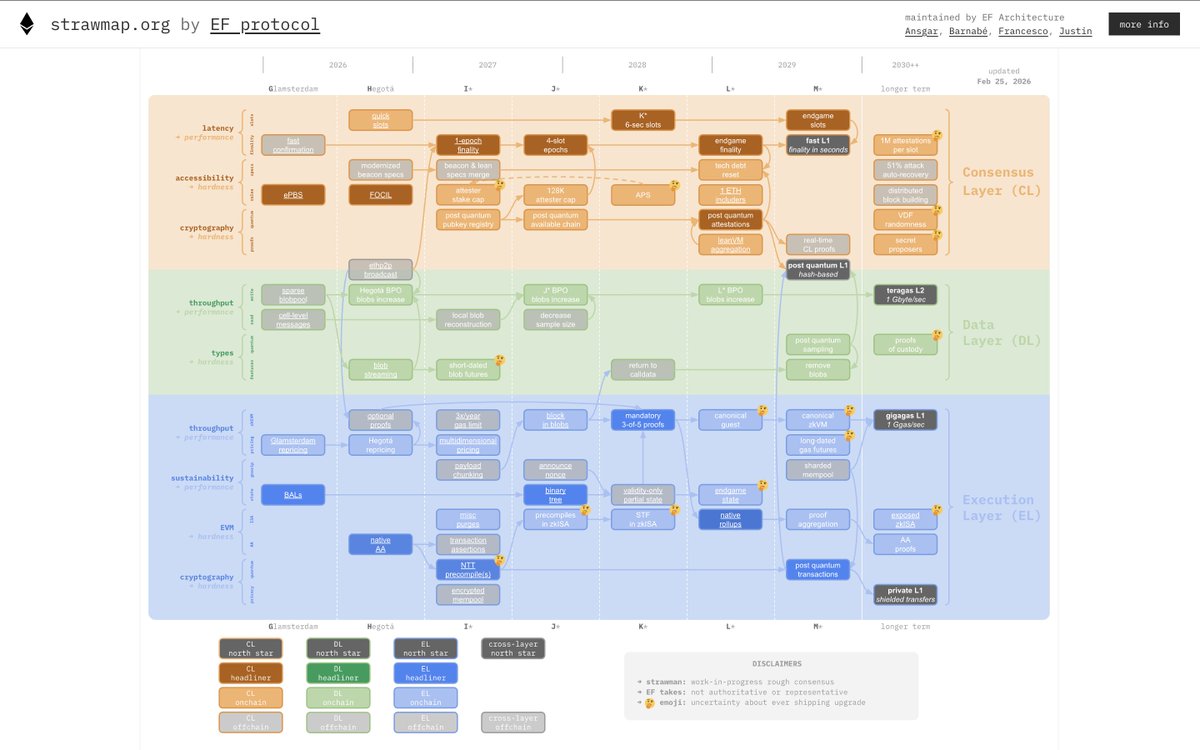
• Justin Drake’s “Strawmap” roadmap proposes seven protocol forks through 2029, targeting upgrades every ~6 months and reducing slot times from 12s → 2s.
• Vitalik outlined two major execution-layer directions: migrating to a binary state tree (in progress) and a longer-term potential EVM replacement.
• Ethereum Foundation began staking its treasury, starting with 2,016 ETH and planning up to ~70,000 ETH, emphasizing minority clients and distributed infrastructure.
• Base moving away from the OP Stack signals a major shift in L2 stack competition, as Optimism unveiled its 2026 roadmap focused on faster blocks, fee customization, interoperability, and zk proofs.

English
Ebunker retweetledi

Introducing strawmap, a strawman roadmap by EF Protocol.
Believe in something. Believe in an Ethereum strawmap.
Who is this for?
The document, available at strawmap[.]org, is intended for advanced readers. It is a dense and technical resource primarily for researchers, developers, and participants in Ethereum governance. Visit ethereum[.]org/roadmap for more introductory material. Accessible explainers unpacking the strawmap will follow soon™.
What is the strawmap?
The strawmap is an invitation to view L1 protocol upgrades through a holistic lens. By placing proposals on a single visual it provides a unified perspective on Ethereum L1 ambitions. The time horizon spans years, extending beyond the immediate focus of All Core Devs (ACD) and forkcast[.]org which typically cover only the next couple of forks.
What are some of the highlights?
The strawmap features five simple north stars, presented as black boxes on the right:
→ fast L1: fast UX, via short slots and finality in seconds
→ gigagas L1: 1 gigagas/sec (10K TPS), via zkEVMs and real-time proving
→ teragas L2: 1 gigabyte/sec (10M TPS), via data availability sampling
→ post quantum L1: durable cryptography, via hash-based schemes
→ private L1: first-class privacy, via shielded ETH transfers
What is the origin story?
The strawman roadmap originated as a discussion starter at an EF workshop in Jan 2026, partly motivated by a desire to integrate lean Ethereum with shorter-term initiatives. Upgrade dependencies and fork constraints became particularly effective at surfacing valuable discussion topics. The strawman is now shared publicly in a spirit of proactive transparency and accelerationism.
Why the "strawmap" name?
"Strawmap" is a portmanteau of "strawman" and "roadmap". The strawman qualifier is deliberate for two reasons:
1. It acknowledges the limits of drafting a roadmap in a highly decentralized ecosystem. An "official" roadmap reflecting all Ethereum stakeholders is effectively impossible. Rough consensus is fundamentally an emergent, continuous, and inherent uncertain process.
2. It underscores the document's status as a work-in-progress. Although it originated within the EF Protocol cluster, there are competing views held among its 100 members, not to mention a rich diversity of non-EFer views.
The strawmap is not a prediction. It is an accelerationist coordination tool, sketching one reasonably coherent path among millions of possible outcomes.
What is the strawmap time frame?
The strawmap focuses on forks extending through the end of the decade. It outlines seven forks by 2029 based on a rough cadence of one fork every six months. While grounded in current expectations, these timelines should be treated with healthy skepticism. The current draft assumes human-first development. AI-driven development and formal verification could significantly compress schedules.
What do the letters on top represent?
The strawmap is organized as a timeline, with forks progressing from left to right. Consensus layer forks follow a star-based naming scheme with incrementing first letters: Altair, Bellatrix, Capella, Deneb, Electra, Fulu, etc. Upcoming forks such as Glamsterdam and Hegotá have finalized names. Other forks, like I* and J*, have placeholder names (with I* pronounced "I star").
What do the colors and arrows represent?
Upgrades are grouped into three color-coded horizontal layers: consensus (CL), data (DL), execution (EL). Dark boxes denote headliners (see below), grey boxes indicate offchain upgrades, and black boxes represent north stars. An explanatory legend appears at the bottom.
Within each layer, upgrades are further organized by theme and sub-theme. Arrows signal hard technical dependencies or natural upgrade progressions. Underlined text in boxes links to relevant EIPs and write-ups.
What are headliners?
Headliners are particularly prominent and ambitious upgrades. To maintain a fast fork cadence, the modern ACD process limits itself to one consensus and one execution headliner per fork. For example, in Glamsterdam, these headliners are ePBS and BALs, respectively.
(L* is an exceptional fork, displaying two headliners tied to the bigger lean consensus fork. Lean consensus landing in L* would be a fateful coincidence.)
Will the strawmap evolve?
Yes, the strawmap is a living and malleable document. It will evolve alongside community feedback, R&D advancements, and governance. Expect at least quarterly updates, with the latest revision date noted on the document.
Can I share feedback?
Yes, feedback is actively encouraged. The EF Protocol strawmap is maintained by the EF Architecture team: @adietrichs, @barnabemonnot, @fradamt, @drakefjustin. Each has open DMs and can be reached at first.name@ethereum[.]org. General inquiries can be sent to strawmap@ethereum[.]org.

English