Econolicious

1.5K posts

Econolicious

Econolicious

@econo

Economist, ubiquitous

NYC Katılım Aralık 2008
845 Takip Edilen243 Takipçiler
Econolicious
Econolicious@econo·
Literature search homebrew
Andrej Karpathy@karpathy

LLM Knowledge Bases Something I'm finding very useful recently: using LLMs to build personal knowledge bases for various topics of research interest. In this way, a large fraction of my recent token throughput is going less into manipulating code, and more into manipulating knowledge (stored as markdown and images). The latest LLMs are quite good at it. So: Data ingest: I index source documents (articles, papers, repos, datasets, images, etc.) into a raw/ directory, then I use an LLM to incrementally "compile" a wiki, which is just a collection of .md files in a directory structure. The wiki includes summaries of all the data in raw/, backlinks, and then it categorizes data into concepts, writes articles for them, and links them all. To convert web articles into .md files I like to use the Obsidian Web Clipper extension, and then I also use a hotkey to download all the related images to local so that my LLM can easily reference them. IDE: I use Obsidian as the IDE "frontend" where I can view the raw data, the the compiled wiki, and the derived visualizations. Important to note that the LLM writes and maintains all of the data of the wiki, I rarely touch it directly. I've played with a few Obsidian plugins to render and view data in other ways (e.g. Marp for slides). Q&A: Where things get interesting is that once your wiki is big enough (e.g. mine on some recent research is ~100 articles and ~400K words), you can ask your LLM agent all kinds of complex questions against the wiki, and it will go off, research the answers, etc. I thought I had to reach for fancy RAG, but the LLM has been pretty good about auto-maintaining index files and brief summaries of all the documents and it reads all the important related data fairly easily at this ~small scale. Output: Instead of getting answers in text/terminal, I like to have it render markdown files for me, or slide shows (Marp format), or matplotlib images, all of which I then view again in Obsidian. You can imagine many other visual output formats depending on the query. Often, I end up "filing" the outputs back into the wiki to enhance it for further queries. So my own explorations and queries always "add up" in the knowledge base. Linting: I've run some LLM "health checks" over the wiki to e.g. find inconsistent data, impute missing data (with web searchers), find interesting connections for new article candidates, etc., to incrementally clean up the wiki and enhance its overall data integrity. The LLMs are quite good at suggesting further questions to ask and look into. Extra tools: I find myself developing additional tools to process the data, e.g. I vibe coded a small and naive search engine over the wiki, which I both use directly (in a web ui), but more often I want to hand it off to an LLM via CLI as a tool for larger queries. Further explorations: As the repo grows, the natural desire is to also think about synthetic data generation + finetuning to have your LLM "know" the data in its weights instead of just context windows. TLDR: raw data from a given number of sources is collected, then compiled by an LLM into a .md wiki, then operated on by various CLIs by the LLM to do Q&A and to incrementally enhance the wiki, and all of it viewable in Obsidian. You rarely ever write or edit the wiki manually, it's the domain of the LLM. I think there is room here for an incredible new product instead of a hacky collection of scripts.

New York, USA 🇺🇸 English
0
0
0
22
Econolicious retweetledi
Incepta Labs
Incepta Labs@inceptalabs·
Agree; avoiding sycophancy and actively encouraging divergent analysis is essential for more trustworthy human–AI reasoning. Just published: “An Antidote to Sycophancy: Toward Epistemic Divergence in Human–AI Reasoning” It introduces MODAC identical prompts run across independent LLMs (different vendors, tabula-rasa conditions). Divergence is deliberately preserved as diagnostic signal, not noise. Human remains the final adjudicator. It is an LLM corollary to Medical Grand Rounds. doi.org/10.5281/zenodo… x.com/inceptalabs/st…
English
0
1
7
4.2K
Econolicious retweetledi
Rimsha Bhardwaj
Rimsha Bhardwaj@heyrimsha·
Prompt engineering is dead. Anthropic recently released the real playbook for building AI agents that actually work. It’s a 30+ page deep dive called The Complete Guide to Building Skills for Claude and it quietly shifts the conversation from “prompt engineering” to real execution design. Here’s the big idea: A Skill isn’t just a prompt. It’s a structured system. You package instructions inside a SKILL .md file, optionally add scripts, references, and assets, and teach Claude a repeatable workflow once instead of re-explaining it every chat. But the real unlock is something they call progressive disclosure. Instead of dumping everything into context: • A lightweight YAML frontmatter tells Claude when to use the skill • Full instructions load only when relevant • Extra files are accessed only if needed Less context bloat. More precision. They also introduce a powerful analogy: MCP gives Claude the kitchen. Skills give it the recipe. Without skills: users connect tools and don’t know what to do next. With skills: workflows trigger automatically, best practices are embedded, API calls become consistent. They outline 3 major patterns: 1) Document & asset creation 2) Workflow automation 3) MCP enhancement And they emphasize something most builders ignore: testing. Trigger accuracy. Tool call efficiency. Failure rate. Token usage. This isn’t about clever wording. It’s about designing an execution layer on top of LLMs. Skills work across Claude, Claude Code, and the API. Build once, deploy everywhere. The era of “just write a better prompt” is ending. Anthropic just handed everyone a blueprint for turning chat into infrastructure. Download the guide here: resources.anthropic.com/hubfs/The-Comp…
Rimsha Bhardwaj tweet media
English
161
956
7.9K
1.2M
Econolicious retweetledi
Steven Pinker
Steven Pinker@sapinker·
Emily Oster @profEmilyOster,always fierce with data and gentle with people, offers more wise advice: Ignore advice about the claimed advantages of this or that type of exercise when they are based on correlational studies, & do the kind of exercise you enjoy (and thus will stick with). nytimes.com/2026/02/23/opi…
English
0
16
204
35.4K
Econolicious
Econolicious@econo·
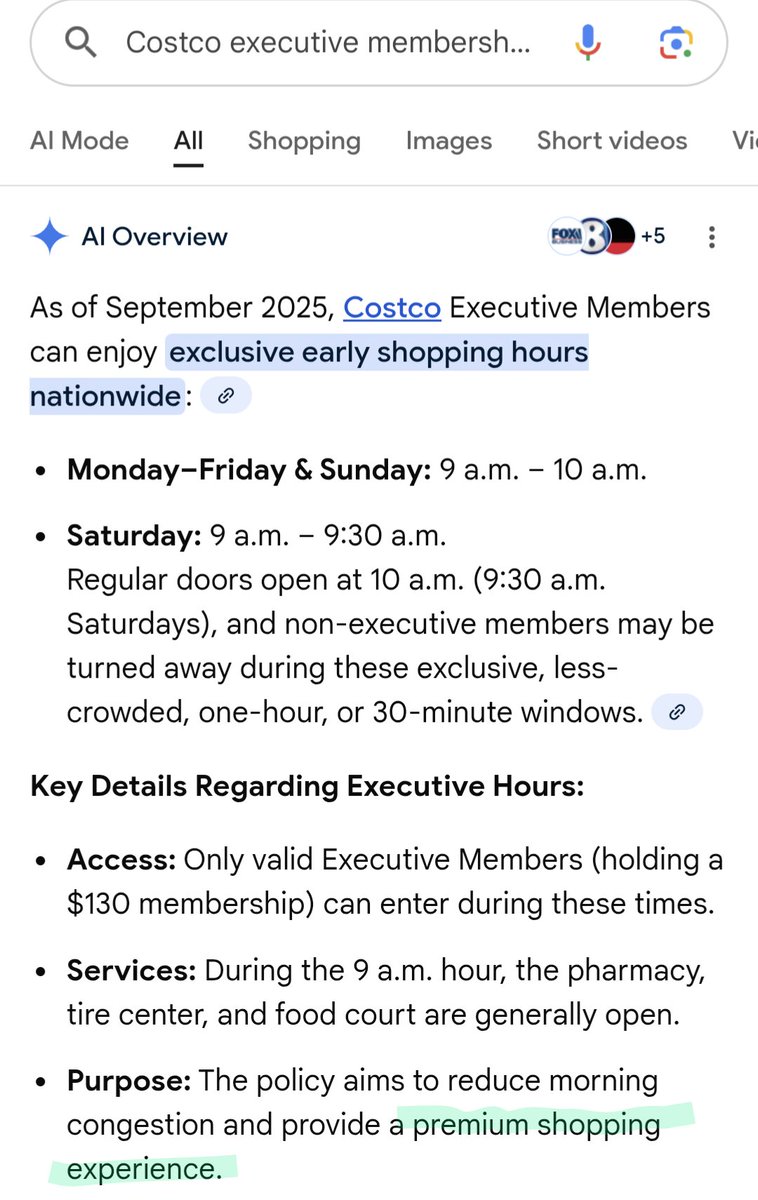
Six months ago, CostcoUSA started widely promoting executive membership for an extra $10/month to gain an exclusive executive-only 30 or 60 minute daily store hours for shopping. Costco knows.
Econolicious tweet media
Hugh Rant@hughs_rants

@Pavel_Asparagus Yesterday, I would have scrolled right by this post. Today, my brother dragged me to Costco to "pick up a few things." Costco -- where abundant crap goes to be pawed at by armies of reincarnated cart-pushing zombies. All I wanted was to a premium to shop alone.


English
1
0
1
52
Econolicious retweetledi
Dario Amodei
Dario Amodei@DarioAmodei·
It's a companion to Machines of Loving Grace, an essay I wrote over a year ago, which focused on what powerful AI could achieve if we get it right: darioamodei.com/essay/machines…
English
146
230
2.4K
836.7K
Econolicious retweetledi
Steve McGuire
Steve McGuire@sfmcguire79·
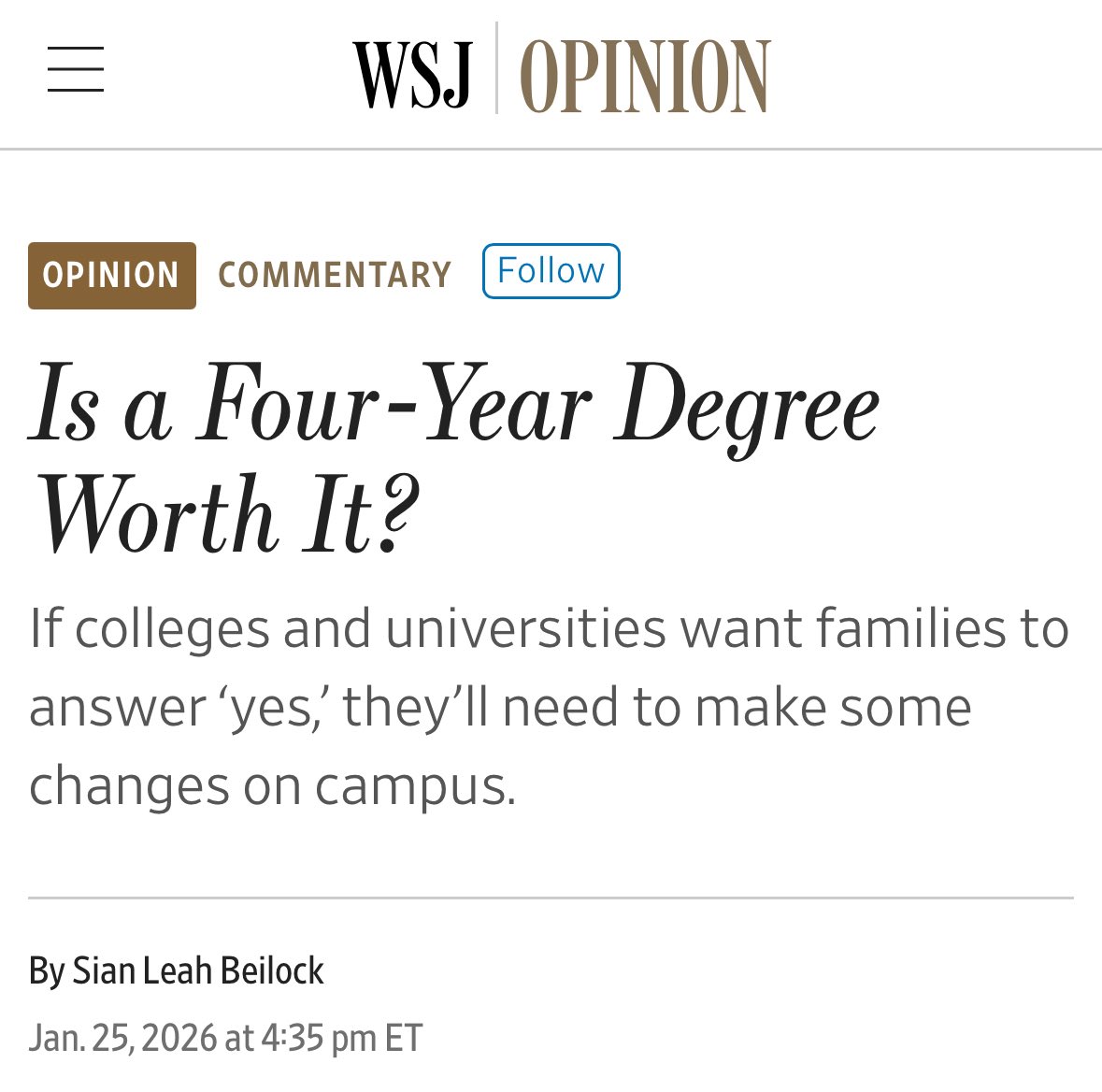
Dartmouth President Sian Beilock: “Assuming that most Americans value our mission is a recipe for irrelevance and decline. We must demonstrate to students and families—and to the broader public—that we’ve heard their criticisms and will address them.” Five steps: 1. “Make college affordable” 2. “Return on investment matters…there must be an undeniable return.” 3. “Re-center higher education on learning rather than political posturing.” 4. “Emphasize equal opportunity, not equal outcomes.” 5. “Testing is important.”
Steve McGuire tweet media
English
131
526
4.4K
1.1M
Econolicious retweetledi
JLee🟧
JLee🟧@X0_1_7ex·
"This is the modern university in miniature. On the outside: polished, generic optimism. On the inside: exhausted scientists, shrinking trust, and a widening gap between what administrators say and what actually happens." Very powerful, Dr. Locasale. I wonder if they didn't get the idea from the Democrats. For decades Democrats have been more committed to form/PR over substance. It has worked well for them bc the media backs them 💯. It's the same w universities. The media is fully committed to the establishment, and presents it the best light without exception [Christopher Rufo exclued].
English
0
1
1
171
Econolicious retweetledi
Austin Berg
Austin Berg@Austin__Berg·
Chicago is investigating how residents learned of a meeting to hike their property taxes. It’s a story that reads like The Onion. Chicago Board of Education President Sean Harden called a special meeting over the Christmas holiday. He had one objective: Quietly pass a $25 million property tax hike. But Harden’s plan hit a snag. Fox 32 Chicago political reporter @paschutz published news of the meeting before the school board posted a public notice of its own. And now Harden—with Brandon Johnson’s imprimatur—is spending taxpayer money on a law firm to conduct an investigation into how news of the meeting leaked to a journalist. That’s absurd. But there’s an even bigger scandal here: The school board is subverting democracy. Specifically, Chicagoans should be seeing a referendum vote on an extra $550 million increase in property tax collections that will flow to Chicago Public Schools this year, above what’s allowed under the state’s property tax cap. But Chicagoans will not get that vote. Go deeper in this week’s edition of The Last Ward ⬇️ open.substack.com/pub/thelastwar…
English
54
418
1.5K
65.3K