Erik Duboué

780 posts

Erik Duboué banner
Erik Duboué

Erik Duboué

@eduboue

Neuroscientist, New Orleanian, dog lover. Associate Professor at FAU studying neuronal mechanisms underlying behavioral adaptation using zebrafish and cavefish.

West Palm Beach, FL Katılım Ocak 2011
716 Takip Edilen342 Takipçiler
Erik Duboué
Erik Duboué@eduboue·
Holiday cheer + science = the best team vibes! 🎄 Grateful for this incredible crew: our holiday party was a perfect reminder of how collaboration fuels great research. Bring on 2026! #LabLife #ScienceCommunity
Erik Duboué tweet media
English
0
0
1
70
Erik Duboué
Erik Duboué@eduboue·
Together, this system shows how evolution has enacted itself on a functional circuit, revealing insight into this fundamental question. Moreover, this is a unique model that can be used to now address fundamental questions in the evolution of neural circuits. 15/15 fin
English
0
0
0
117
Erik Duboué
Erik Duboué@eduboue·
Whether these light-tuned neurons represent a novel cell type, or whether an existing cell type has changed its functional properties remains unclear, though the system is well poised to address the question. 14/15
English
1
0
0
132
Erik Duboué
Erik Duboué@eduboue·
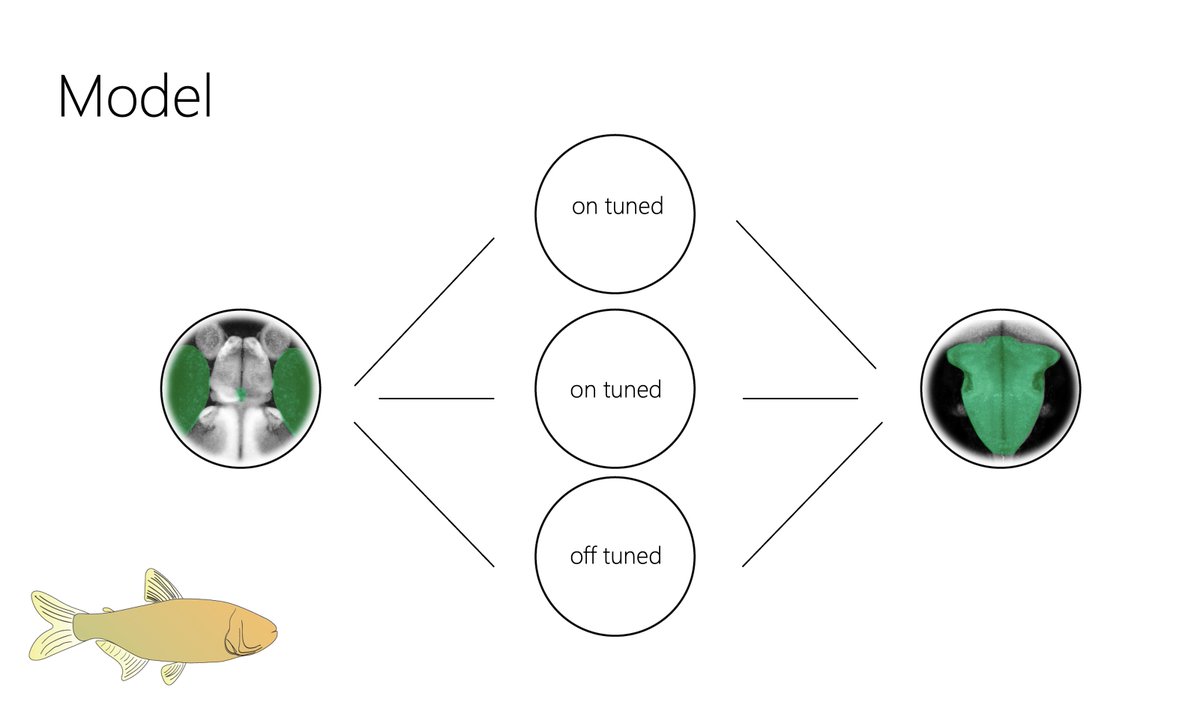
Our model is that the pineal controls light fluctuations in both forms and hindbrain motor neurons, fed by a dopaminergic motor circuit, drive photokinesis. We show that neurons in the hypothalamus have changed their tuning properties to drive photokinesis during light. 13/15
Erik Duboué tweet media
English
1
0
0
96
Erik Duboué
Erik Duboué@eduboue·
Our hypothesis is that this circuit has emerged to keep cavefish in the darkness where they thrive, while mining surface fish in lit conditions where their vision gives them an advantage. 12/15
English
1
0
0
101
Erik Duboué
Erik Duboué@eduboue·
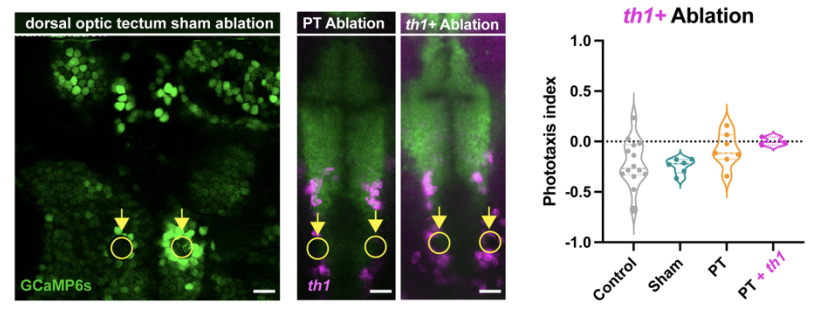
We then used the brain atlas to define the neuronal identity of these neurons. These neurons mapped to a set of DA neurons. To test these cells, we used pharmacological antagonists, and laser-mediated ablations of these cells, and found that photokinesis was dysregulated. 11/15
Erik Duboué tweet media
English
1
0
0
86
Erik Duboué
Erik Duboué@eduboue·
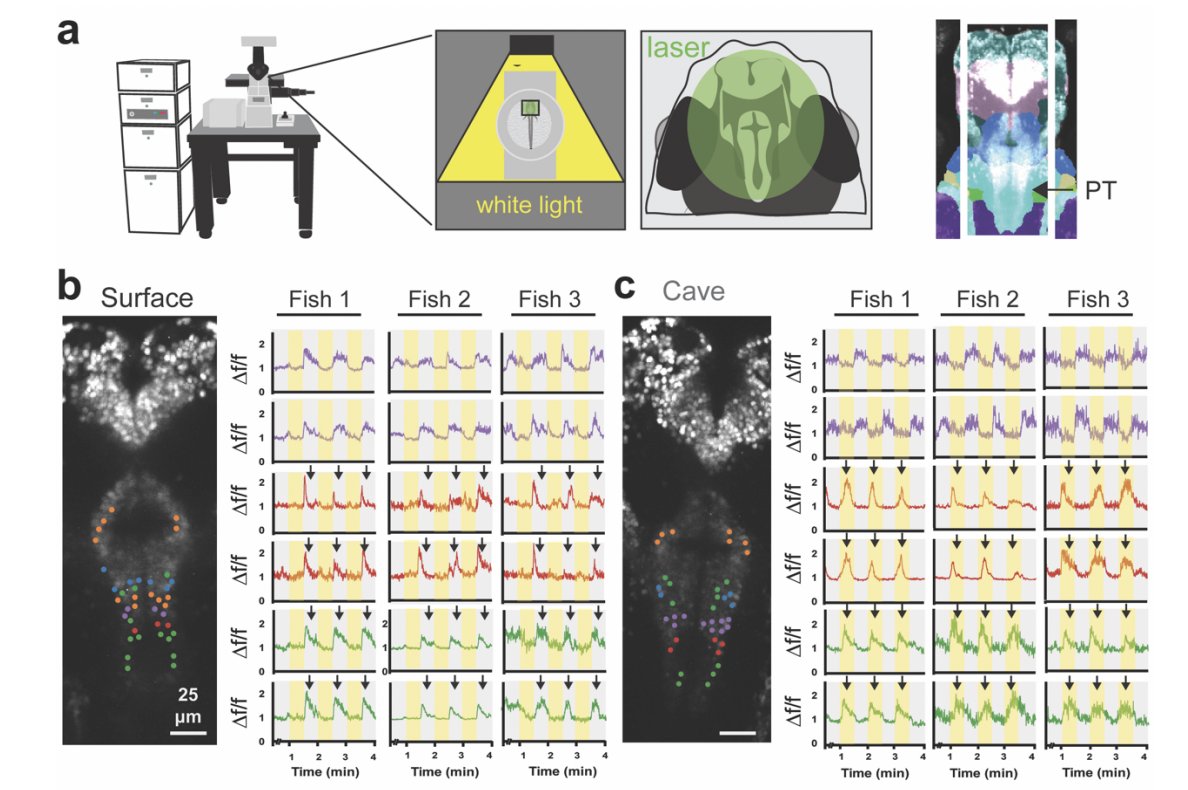
We then used transgenic Astyanax expressing GCaMP pan-neuronally (elavl3:H2B-GCaMP6s) and examined neural activity during light transitions. We found that in surface fish, most clusters tended to be dark-tuned, but in cavefish, a subset of these clusters are light-tuned. 10/15
Erik Duboué tweet media
English
1
0
0
98
Erik Duboué
Erik Duboué@eduboue·
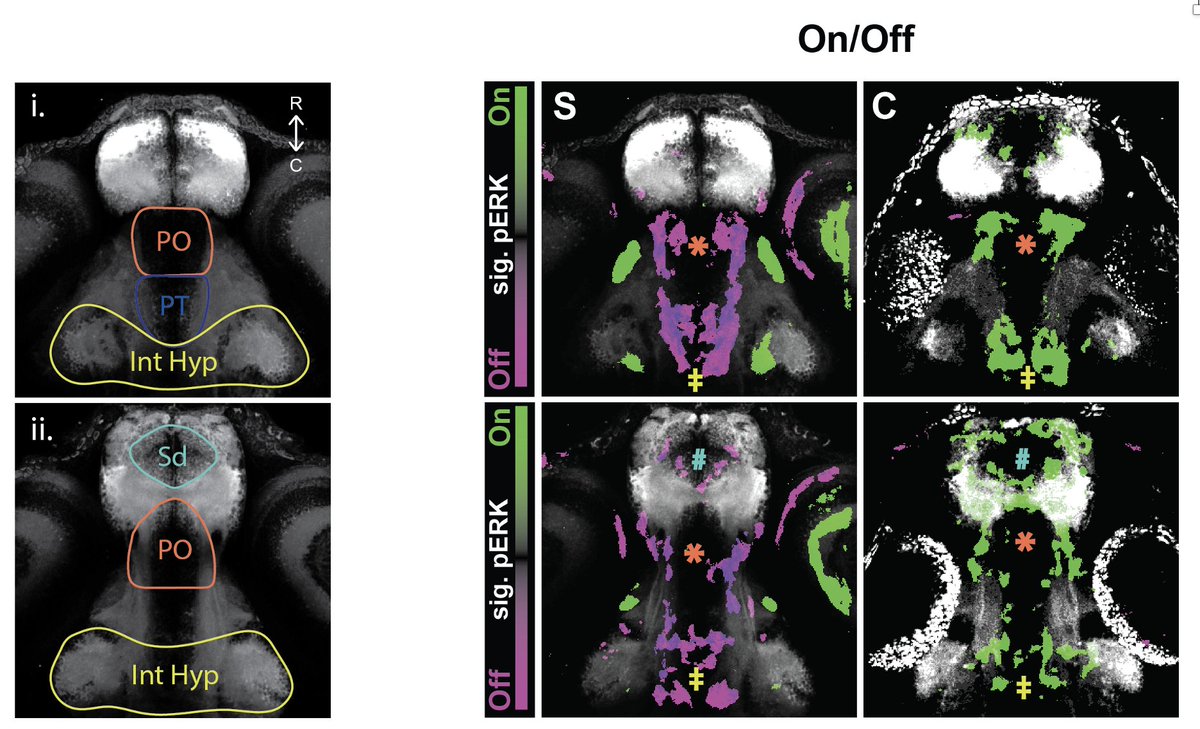
Using whole-brain phosoERK mapping, we found a region of the brain that was active during dark exposure in surface fish and became active in cavefish during light exposure. The area mapped to a region containing the anterior hypothalamus (PT). 9/15
Erik Duboué tweet media
English
1
0
0
85
Erik Duboué
Erik Duboué@eduboue·
The simplistic circuit to explain this behavior has three nodes: light sensing, motor output, and something that integrates the info. We think the pineal is sensing illumination in both forms. Question is: what part of the brain integrates this info? 8/15
Erik Duboué tweet media
English
1
0
0
69
Erik Duboué
Erik Duboué@eduboue·
But what about behavior? Photokinesis is a well-established phenomenon in fish. When a larva is transitioned from a lit background to darkness, the fish becomes hyperactive. This hyperactivity is thought to be a light-searching behavior (credit Luchtenburg et al, 2019). 6/15
Erik Duboué tweet media
English
1
0
0
78
Erik Duboué
Erik Duboué@eduboue·
In this study, we looked at this behavior. We find that both forms have a photokinesis, but that the valence is reversed. Surface fish become hyperactive in darkness, presumably light-searching, but cavefish become active in light, presumably a dark-searching behavior. 7/15
Erik Duboué tweet media
English
1
0
0
81
Erik Duboué
Erik Duboué@eduboue·
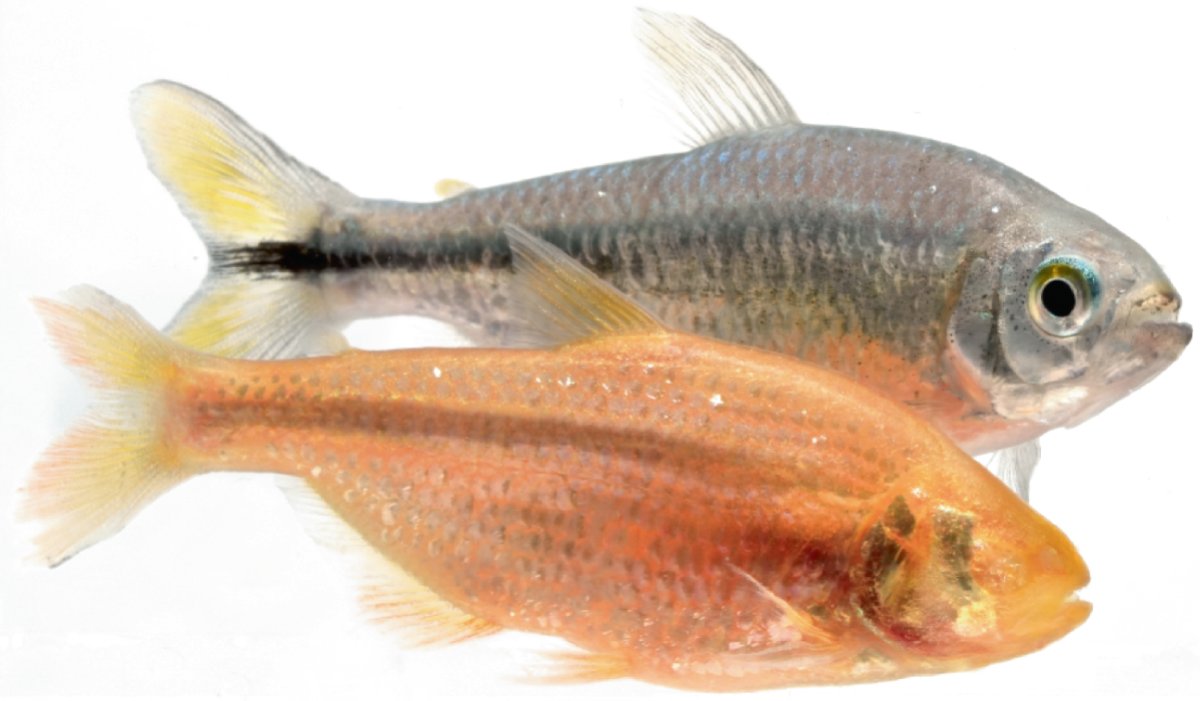
The blind cavefish, Astyanax, could address this question. The system has eyed surface fish and at least 30 populations of cavefish. Over the years we have brought this system into the genetic era and have shown a number of behaviors that differ between surface and cavefish. 4/15
Erik Duboué tweet media
English
1
0
0
82
Erik Duboué
Erik Duboué@eduboue·
It seems like this is an easy question to address, but the lack of a suitable model, amendable to genetic assessment, that has a change to a known behaviorally relevant circuit is a significant impediment to addressing this question. 3/15
English
1
0
0
74
Erik Duboué
Erik Duboué@eduboue·
A recent perspective piece was just published, which highlighted that while our understanding of neural circuits function is detailed, less is known about how these circuits evolve. 2/15 nature.com/articles/s4158…
English
1
0
2
96