edy ♦️

3.2K posts

edy ♦️ banner
edy ♦️

edy ♦️

@edy500

Web3 learner & builder | Adding value through insights @DataHaven_xyz

Katılım Ağustos 2009
5.5K Takip Edilen478 Takipçiler
edy ♦️
edy ♦️@edy500·
UnitFlow Finance presents itself as a trading-focused platform designed to connect users, builders, and liquidity in a streamlined environment. Positioned as more than just a DEX, it highlights features like liquidity management tools, support for reflection tokens, and trustless USDC-based agents for automated operations. The platform aims to offer a frictionless experience for communities and participants exploring decentralized trading. #unitflowfinance
English
0
0
0
2
edy ♦️
edy ♦️@edy500·
The UnitFlow Finance dashboard provides a clear overview of user activity and progress within the platform. At the top, users can track global metrics such as the total number of Genesis Passes and Activity NFTs minted. Personal stats are also displayed, including the number of NFTs minted, current rank (such as Vanguard), and verification status. The dashboard shows the connected wallet, indicating the active network, and includes a verification section confirming linked accounts like Discord and Twitter. Additionally, users can view their owned NFTs, such as the Genesis Pass and Activity NFTs, with mint status clearly indicated. Overall, the dashboard offers a structured and accessible way to monitor participation, achievements, and identity verification within UnitFlow Finance. #unitflowfinance
English
0
0
0
7
edy ♦️
edy ♦️@edy500·
UnitFlow Finance: DEX is available for beta testers, offering a smooth experience for swapping and providing liquidity. In the current V2.5 pools, users can interact with pairs like EURC / WUSDC, contributing liquidity and earning trading fees. The interface highlights key metrics such as liquidity value, pool share, and token balances, making it easy to manage positions. As development continues, upcoming versions (V3 and V4) promise even more advanced features for DeFi participants. #unitflowfinance
English
0
0
0
7
Konnex
Konnex@konnex_world·
"The era of isolated machines is over." Meet our CEO, @JOllwerther . Business leader with 15+ years in robotics, drone-tech, and media. Jon led commercial teams at Measure (Drone as a Service) and Aerobo/Vermeer. Now, he’s creating TCP/IP for Motion. Get ready to experience Konnex.
English
45.9K
3.8K
30.7K
181.5K
edy ♦️
edy ♦️@edy500·
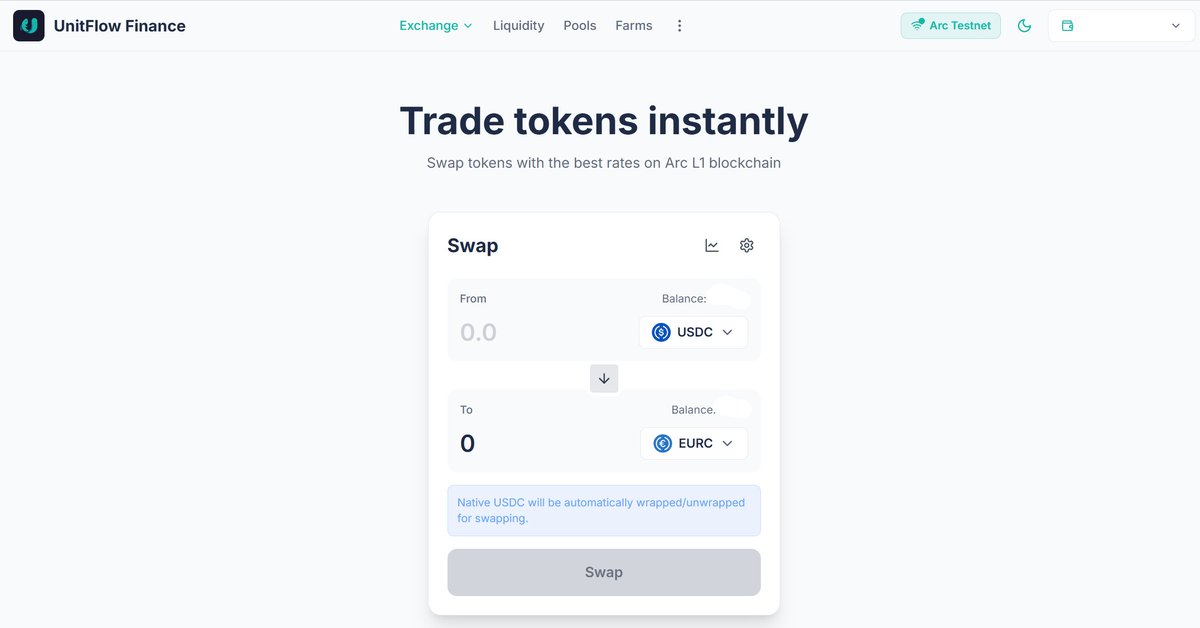
UnitFlow Finance’s DEX is available to beta testers, offering a straightforward way to interact with the Arc L1 ecosystem. Users can swap tokens, provide liquidity, and explore pools and farming features within a single interface. As a beta release, it gives early access to core DeFi functionalities while the platform continues to evolve based on user feedback. #unitflowfinance
edy ♦️ tweet media
English
0
0
1
7
edy ♦️
edy ♦️@edy500·
Start your journey on UnitFlow Finance by completing a few simple steps: follow the project on X, join the Discord server, and verify your participation. After that, mint your Genesis Pass NFT and proceed with Activity NFT missions by submitting your posts. A straightforward onboarding flow designed to guide new users into the ecosystem. #unitflowfinance
English
0
0
0
55
edy ♦️
edy ♦️@edy500·
How Do Concrete Vaults Actually Work? At first glance, DeFi vaults, especially Concrete vaults, feel simple. ● You deposit. ● You receive shares. ● Your balance grows. But once you look a little deeper, a natural question appears: What is actually happening under the hood? Start With the User Perspective and imagine your first interaction. You open the app, deposit your assets, and suddenly you see: ● vault shares in your wallet ● numbers like eRate and NAV ● a balance that changes over time At this point, most users think: “Am I just earning yield passively… or is something else going on?” This is where understanding the system changes everything. Vault Shares & eRate: Your Slice of the System When you deposit into Concrete vaults, you are not just “locking tokens.” You are entering a pooled capital system, and in return, you receive vault shares. A simple way to think about it: ● The vault is a large pool of capital ● Your shares represent your ownership of that pool ● Each share = your percentage of the system Now comes the key metric: eRate The eRate is the value of each share. If the vault performs well → eRate increases and if eRate increases → your shares become more valuable. You don’t need more shares to grow and your existing shares increase in value over time. This is where automated compounding quietly happens. NAV: Understanding the Total Value To understand the full picture, you need to understand NAV (Net Asset Value). Think of it like this: NAV = total value of all assets inside the vault Shares = your portion of that total A simple mental model: ● NAV is the full pie ● Shares are your slice of that pie When the vault generates yield: NAV grows and each share becomes worth more (via eRate). So even if your number of shares stays the same, your position becomes more valuable because the entire system grows. Why Time Matters More Than You Think This is one of the most important concepts in managed DeFi. Vaults are not designed for quick in-and-out behavior. They are designed for time-based growth. Here’s why: ● Strategies need time to generate results ● Onchain capital deployment involves execution costs (gas, fees) ● Rebalancing doesn’t happen instantly — it happens strategically ● Short-term fluctuations can hide long-term performance A useful analogy: A vault is not a vending machine. It’s more like a garden. You plant capital, and over time: strategies grow, yield accumulates and compounding starts to accelerate. The longer you stay, the more the system works in your favor. Active Management: Not Passive at All One common misconception: “Vaults are passive”, but in reality, Concrete vaults are actively managed systems. Behind the scenes, capital is constantly being: ● deployed across different strategies ● adjusted based on market conditions ● rebalanced to improve efficiency Think of it like a professional operator: Not just storing capital but actively positioning it. Or even better: Like a chef refining a recipe: tasting, adjusting, improving continuously. This is what defines managed DeFi, how Yield Is Actually Generated and Yield doesn’t come from nowhere. It comes from how capital is used. Inside the vault: Capital is continuously allocated across different opportunities, with strategies executed onchain, rewards and returns being captured along the way, and gains automatically reinvested to keep the system compounding over time. This creates automated compounding, instead of: claiming rewards manually and redeploying capital yourself. The vault does it for you, continuously. Connecting Everything: The Real Outcome Now combine all the pieces: Shares give you clear ownership in the vault, while NAV reflects the total value of the entire system and eRate continuously tracks how much your portion is worth; at the same time, active management works in the background to improve how capital is allocated, and over longer periods, time allows compounding to fully develop and amplify your results. What happens? ● Rebalancing captures better opportunities ● Compounding increases efficiency over time ● Longer participation smooths volatility ● Your capital benefits from continuous optimization The result is not just yield. It’s structured, managed, and optimized yield. A Simple Mental Model If you remember just one thing, remember this: ● Vault = pooled capital system ● Vault shares = your ownership ● eRate = value of your share ● NAV = total vault value ● Time = growth driver ● Management = optimization layer Once you see it this way, everything becomes clearer. You are not just depositing into a product. You are participating in a living financial system designed to make capital work more efficiently over time. Explore Concrete at app.concrete.xyz @ConcreteXYZ
English
0
0
0
4
edy ♦️
edy ♦️@edy500·
UnitFlow Finance is positioning itself as a liquidity hub on Arc, connecting builders, communities, and institutions in a seamless trading environment. The DEX is currently available to beta testers, allowing early users to explore its features, test liquidity flows, and interact with the platform in a controlled environment as development continues. The platform highlights features like reflection token support and trustless USDC agents, aiming to simplify and automate trading operations. #unitflowfinance
English
0
0
0
6
edy ♦️
edy ♦️@edy500·
UnitFlow Finance is building a seamless trading experience, connecting communities, builders, and liquidity in one place. With features like reflection token support and trustless USDC agents, it’s shaping a more efficient and accessible DeFi ecosystem. #unitflowfinance
English
0
0
0
14
edy ♦️
edy ♦️@edy500·
Start Your Journey with UnitFlow Finance Getting started is simple and unlocks access to exclusive NFT rewards. Here’s how to begin: Step 1: Follow on X Follow @UnitFlowFinance and verify your account. Step 2: Join Discord Join the community on Discord and complete verification. Genesis Pass NFT Once verified, you can mint your Genesis Pass NFT, your entry into the ecosystem. Activity NFT Mission Submit your X post link and mint additional Activity NFTs as you participate. UnitFlow Finance combines community engagement with on-chain rewards, making it easy to start and grow your presence. Start your journey and explore the ecosystem. #unitfllowfinance
English
0
0
0
27
edy ♦️
edy ♦️@edy500·
UnitFlow Finance Rank: A progression system with multiple ranks that reflect user activity within the ecosystem. Participants can level up by: • Posting about UnitFlow Finance on X • Submitting their post links on the platform • Minting Activity NFTs based on those submissions As users accumulate NFTs, they unlock new ranks such as Egg Token, Alevin Initiate, Fry Miner, Fingerling Trader, Parr Analyst, and higher tiers like Spawner Elite. Each rank represents a milestone in engagement, with higher levels requiring more minted NFTs. This system creates a structured way for users to track their participation and progress within UnitFlow Finance. #unitflowfinance
edy ♦️ tweet media
English
0
0
0
15
edy ♦️
edy ♦️@edy500·
UnitFlow Finance is evolving beyond a traditional DEX, positioning itself as a liquidity hub within the Arc ecosystem. With features like reflection token support and trustless USDC agents, it aims to simplify liquidity management and enable more efficient, automated trading. The platform is currently open for testing, offering users the opportunity to explore its tools and participate in early-stage features like NFT missions and token creation. #unitflowfinance
English
0
0
0
12
edy ♦️
edy ♦️@edy500·
UnitFlow Finance is positioning itself as more than just a DEX, aiming to serve as a liquidity hub that connects builders, communities, and institutions. The platform highlights features such as reflection token support and compatibility with trustless USDC agents, focusing on streamlined and automated trading experiences. With its evolving infrastructure, UnitFlow Finance continues to expand its role within the broader DeFi ecosystem. #unitflowfinance
English
0
0
0
11
edy ♦️
edy ♦️@edy500·
Exploring UnitFlow Finance UnitFlow Finance is positioning itself as more than just a decentralized exchange, aiming to act as a broader liquidity hub within the Arc ecosystem. The platform focuses on connecting builders, communities, and institutions in a streamlined trading environment. Some features highlighted on the platform include: Reflection Token Support Enables creators to whitelist the UnitFlow LiquidityRouter, allowing more efficient liquidity management for reflection token pools. Trustless USDC Agents Supports automated trading operations through a system of trustless USDC-based agents. DEX Access: For Beta Testers Users can interact directly with the exchange through a simplified interface designed for trading and liquidity operations. Additionally, the platform introduces a rank-based progression system, where users unlock levels based on activity (such as NFT holdings), adding a gamified layer to participation. Overall, UnitFlow Finance appears to be evolving toward an infrastructure-focused approach within DeFi, combining trading tools, automation, and community-driven elements. #unitflowfinance
English
0
0
0
12
edy ♦️
edy ♦️@edy500·
Why DeFi Needs Vault Infrastructure In traditional financial systems, capital rarely depends on constant human intervention. It flows through structured mechanisms designed to allocate, optimize, and preserve it. As decentralized finance evolves, it is approaching a similar inflection point. DeFi has unlocked unprecedented access to financial opportunities, but with that expansion comes complexity. The challenge is no longer access. The challenge is management. The next phase of DeFi will not be defined by who can chase yield the fastest, but by who can build systems that allow capital to move intelligently on its own. Fragmentation: The Expanding Opportunity Set DeFi today is vast, dynamic, and highly fragmented. New protocols emerge constantly, each offering different incentives, structures, and risk profiles. At the same time, capital is distributed across multiple blockchains, each with its own ecosystem and liquidity conditions. This creates an environment rich in opportunity, yet difficult to navigate efficiently. Users are exposed to: • hundreds of protocols competing for liquidity • multiple chains with isolated opportunities • yields that change rapidly over time • an ever-growing list of strategies and instruments The result is a paradox. There is more opportunity than ever before, but extracting value from it requires continuous attention. Keeping capital productive becomes an active process rather than a passive one. The Operational Burden of Participation To remain competitive in this environment, users must take on a significant operational role. Managing capital in DeFi often resembles managing a portfolio full-time. This means constantly observing how yields fluctuate across different platforms and reacting quickly when those changes occur. It requires actively moving liquidity whenever better opportunities arise, ensuring funds are not left behind in underperforming positions. Users also need to claim rewards regularly and reinvest them to maintain effective automated compounding, which adds another layer of effort. On top of that, every adjustment comes with transaction costs, as gas fees must be paid repeatedly. At the same time, capital is often spread across multiple protocols and chains, making it necessary to continuously track exposure, evaluate risks, and maintain a clear view of overall positioning. Each action introduces friction. What should function as a seamless financial system becomes a sequence of manual tasks. Instead of focusing on strategy, users are forced to focus on execution. Over time, this reduces efficiency and increases the likelihood of missed opportunities. Idle Capital and Hidden Inefficiencies As complexity increases, inefficiency becomes inevitable. Even experienced users struggle to keep up with the pace of change, and as a result, capital often becomes underutilized. Funds may remain idle in wallets, or stay allocated to strategies that are no longer optimal. In many cases, users delay reallocating capital because the effort required outweighs the perceived benefit. This leads to a silent but significant cost. Capital that could be earning is instead inactive. Opportunities that exist in the market go unclaimed. The issue is not the lack of yield, but the difficulty of accessing it efficiently. Operational complexity, more than market conditions, becomes the main barrier to capital efficiency. Vault Infrastructure as the Turning Point To address these challenges, DeFi needs to evolve beyond manual interaction. This is where DeFi vaults introduce a fundamental shift. Vault infrastructure transforms the way capital is managed by replacing manual processes with automated systems. Instead of requiring users to constantly reposition funds, vaults handle allocation, optimization, and compounding internally. With Concrete vaults, this shift becomes clear: Manual strategy management transitions into managed DeFi systems Through this infrastructure, capital can dynamically rebalance itself as market conditions evolve, ensuring that funds are always positioned in more optimal opportunities without constant user intervention. It also enables the aggregation of liquidity across strategies, which improves efficiency and reduces fragmentation at the execution level. Rewards are no longer something users need to manually claim and reinvest, as automated compounding ensures that returns are continuously recycled back into the system. At the same time, capital remains actively deployed onchain, minimizing idle periods and maximizing productivity. All of this is abstracted into a much simpler experience, where what was once a complex set of actions becomes a single, streamlined interaction for the user. This is not just a usability improvement. It is a structural upgrade to how capital operates within DeFi. How Concrete Vaults Enable Managed DeFi Concrete vaults are designed as systems, not just pools. Their goal is to create a coordinated framework where capital is deployed efficiently without requiring constant user input. This is achieved through a combination of components that work together: The Allocator is responsible for actively deploying capital across available opportunities, ensuring funds are always positioned effectively. The Strategy Manager defines the universe of strategies that the vault can interact with, creating a structured and controlled environment for capital allocation. The Hook Manager enforces risk parameters and operational rules, adding a layer of protection and consistency to the system. In addition to these components, automated compounding ensures that rewards are continuously reinvested, while onchain capital deployment guarantees transparency and verifiability. Together, these elements form a managed DeFi infrastructure where capital is not static. It is dynamic, responsive, and continuously optimized. This approach shifts the focus away from manual yield chasing and toward long-term capital efficiency. A Practical Example: Concrete DeFi USDT A clear illustration of this model is Concrete DeFi USDT. This vault offers a stable yield of approximately 8.5%, but the significance lies in how that yield is generated and maintained. Within this structure, strategy management is fully integrated into the infrastructure. Capital does not depend on constant user decisions. Instead, it remains continuously deployed and actively managed. Rewards are compounded automatically, and allocation decisions are handled at the system level. This ensures that capital remains productive over time without requiring frequent intervention. The result is a more consistent and sustainable outcome. Rather than relying on short-term optimization, the system prioritizes efficiency and stability. This is a key step toward institutional DeFi, where infrastructure replaces manual processes and enables scalable capital management. The Shift Toward Infrastructure-Driven DeFi As DeFi continues to grow, its complexity will increase alongside it. More protocols will launch, more chains will emerge, and more strategies will compete for capital. In such an environment, manual strategy management becomes unsustainable. It does not scale with the size or speed of the ecosystem. The future points toward a different model. • Infrastructure will replace constant repositioning. • Automation will replace repetitive execution. • Vaults will become the default interface for deploying capital. In this new paradigm, the competitive edge is no longer about identifying the highest yield in a given moment. It is about building systems that ensure capital is always working efficiently. Conclusion Vault infrastructure represents a foundational evolution in decentralized finance. It addresses fragmentation, reduces operational burden, and unlocks higher capital efficiency by transforming how funds are managed. As DeFi matures, the role of the user will shift from active operator to capital allocator. The systems beneath will handle execution, optimization, and risk management. This transition moves DeFi closer to the efficiency of mature financial systems, while preserving the transparency and openness of onchain environments. The future of DeFi will not be driven by manual effort, but by intelligent infrastructure. Explore Concrete at app.concrete.xyz 🚨 @ConcreteXYZ
English
0
0
0
10
edy ♦️
edy ♦️@edy500·
I built TradeMirror Dashboard AI for the Binance AI Contest 🤖 Most tools show prices. This one shows WHY you make bad trades. It analyzes FOMO, panic selling, and discipline, then gives AI-driven insights based on your behavior. Turning trading data into self-awareness. Feedback welcome 👇
Binance@binance

Calling all builders. 👷 Build the future of Crypto AI and win a share of 48.6 BNB. Create your own OpenClaw AI assistant. This could be a trading bot, crypto educator, or a tool that improves the Binance user experience. To join: 👉 Build anything that enhances Binance product ecosystem 👉 Quote this post to show your project 👉 Submit your entry: binance.com/en/survey/c707… Campaign period: Mar 4 to Mar 18, 2026

English
0
0
1
53