Egor Khimichenko

12.3K posts

Egor Khimichenko banner
Egor Khimichenko

Egor Khimichenko

@egkhimi

Working with @Sentient_agency (25 million+ follower network & helping AI/Tech companies go viral)

Katılım Temmuz 2022
450 Takip Edilen980 Takipçiler
Egor Khimichenko
Egor Khimichenko@egkhimi·
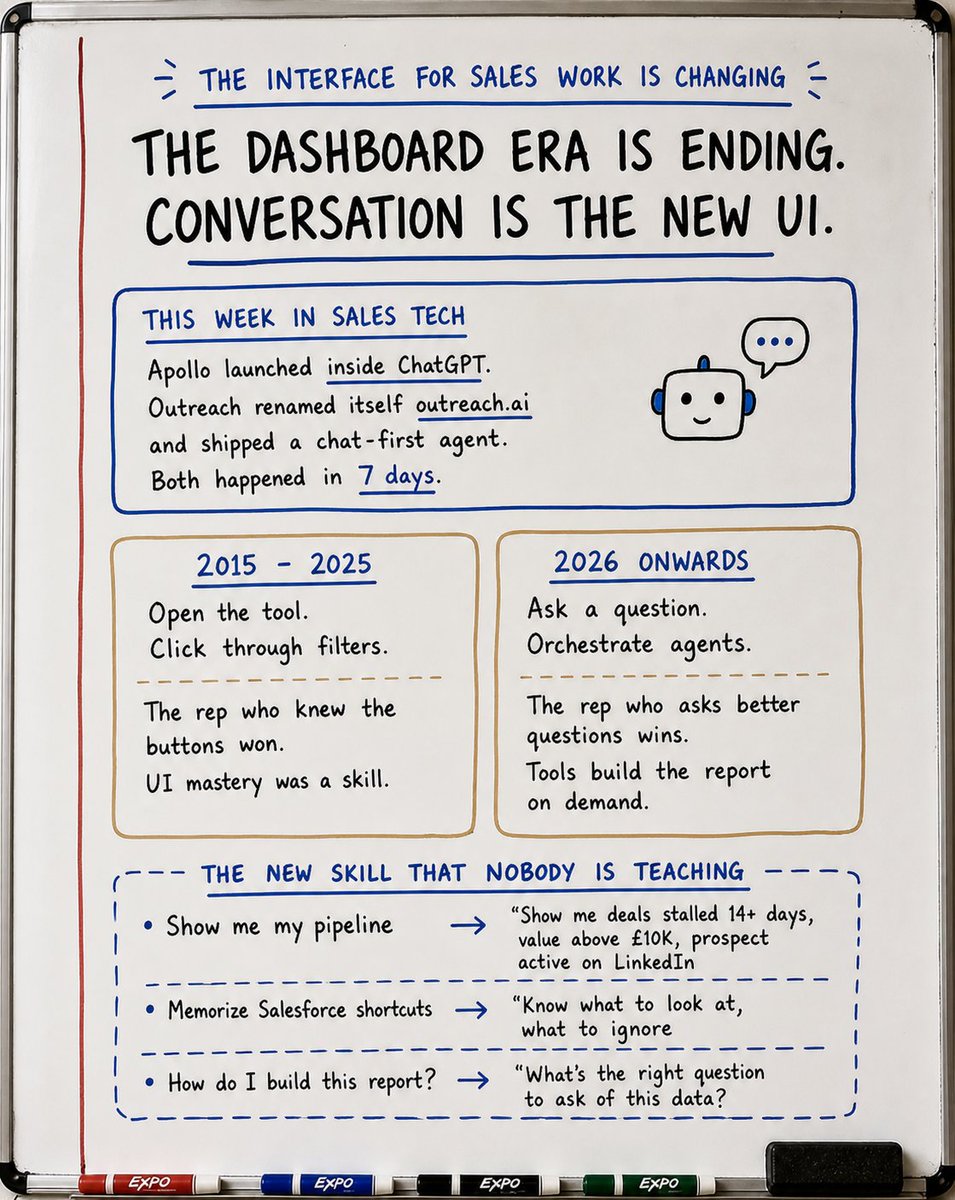
Apollo launched inside ChatGPT this week. Outreach renamed itself outreach.ai and shipped a chat-first agent the same week. Both happened in 7 days. The shift is bigger than two product launches. The interface for sales work is moving away from dashboards entirely. Here's what's actually changing: For 15 years, sales tools competed on UI. Who had the cleanest pipeline view, the prettiest charts, the easiest sequence builder. That whole game is over. The new interface is conversation. You don't open a tool, you ask a question. You don't click through filters, you describe what you want. You don't navigate dashboards, you orchestrate agents. What this means for sales teams right now: The "rep who knows the tools" advantage disappears. Anyone can ask a question. The "ops person who builds beautiful reports" role compresses. The reports build themselves on demand. The actual differentiator becomes asking better questions. The reps who win in 2026 aren't the ones who memorized Salesforce shortcuts. They're the ones who know what to look at and what to ignore. The skill nobody is teaching: Knowing what a good question looks like. Not "show me my pipeline." That's lazy. But "show me the deals where the last meaningful interaction was over 14 days ago, the deal value is over £10K, and the prospect has posted on LinkedIn in the last week." That's a question that produces an action. Your tools are becoming chat interfaces whether you want them to or not. The reps who learn to interrogate them well will outperform the reps who just learned the new buttons.
Egor Khimichenko tweet media
English
0
0
0
15
Egor Khimichenko
Egor Khimichenko@egkhimi·
Most companies try to out-feature bigger competitors. Wrong move. You can't out-feature a company with 100x your engineering team. They'll always have more features, more integrations, more case studies, more everything. The positioning that actually works when you're the smaller player: Don't compete on what they have more of. Compete on what they can't do. Three angles that work when you're smaller: 1. Speed of decision-making. Big companies move slow. If a client asks a custom question, big vendors take 3 weeks to answer. You can answer in 24 hours. That's not a feature, it's an identity. 2. Who's actually on the project. At a big company, the salesperson disappears after signing and a team of account managers takes over. At yours, the founder might be in the kickoff call. Make that visible. 3. Depth in one specific problem. Big competitors are platforms. They solve 40 problems okay. You solve one problem exceptionally well. Stop apologizing for being "just" focused. That's the whole point. The positioning line we use now: "We're not the biggest. That's kind of the point. You get the team that wrote the playbook, not the team that was hired to follow it." Every feature argument becomes a marketing argument. You lose those by default. Reframe the conversation to what you actually do better, and watch the objections disappear.
Egor Khimichenko tweet media
English
0
0
0
7
Egor Khimichenko
Egor Khimichenko@egkhimi·
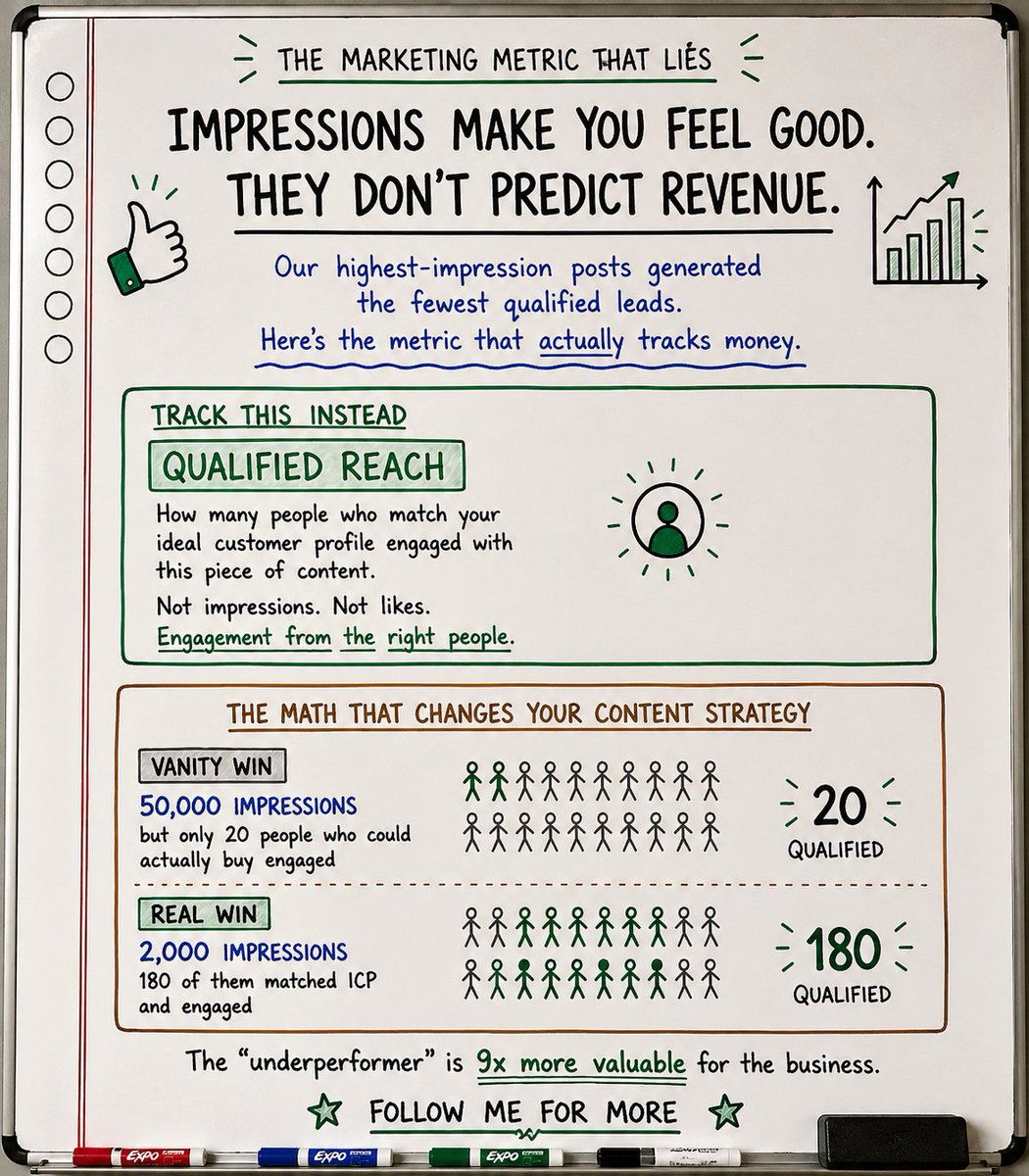
Impressions are the most dangerous metric in marketing. They make you feel like things are working when they aren't. I tracked our content for a quarter and found something uncomfortable: Our highest-impression posts generated the fewest qualified leads. Our lowest-impression posts generated the most. Why? Because the posts that got big reach were designed to get big reach. Broad, punchy, hook-driven content that landed with everyone. "Everyone" doesn't convert. Specific people do. Here's the metric I track instead, that actually predicts revenue: Qualified Reach: How many people who match my ideal customer profile engaged with this piece of content? Not impressions. Not likes. Not reach. Engagement from the right people. The math is simple: → A post that hits 50,000 people but gets engagement from 20 who could buy = 20 qualified views. → A post that hits 2,000 people but gets engagement from 180 who match ICP = 180 qualified views. The second post "failed" by vanity metrics. It's 9x more valuable for the business. Check your content from the last 90 days. Look at who actually commented or reshared. Not the number, the names. You'll find the posts that "underperformed" were your best revenue content. Vanity metrics feel good. They don't pay bills.
Egor Khimichenko tweet media
English
0
0
0
3
Egor Khimichenko
Egor Khimichenko@egkhimi·
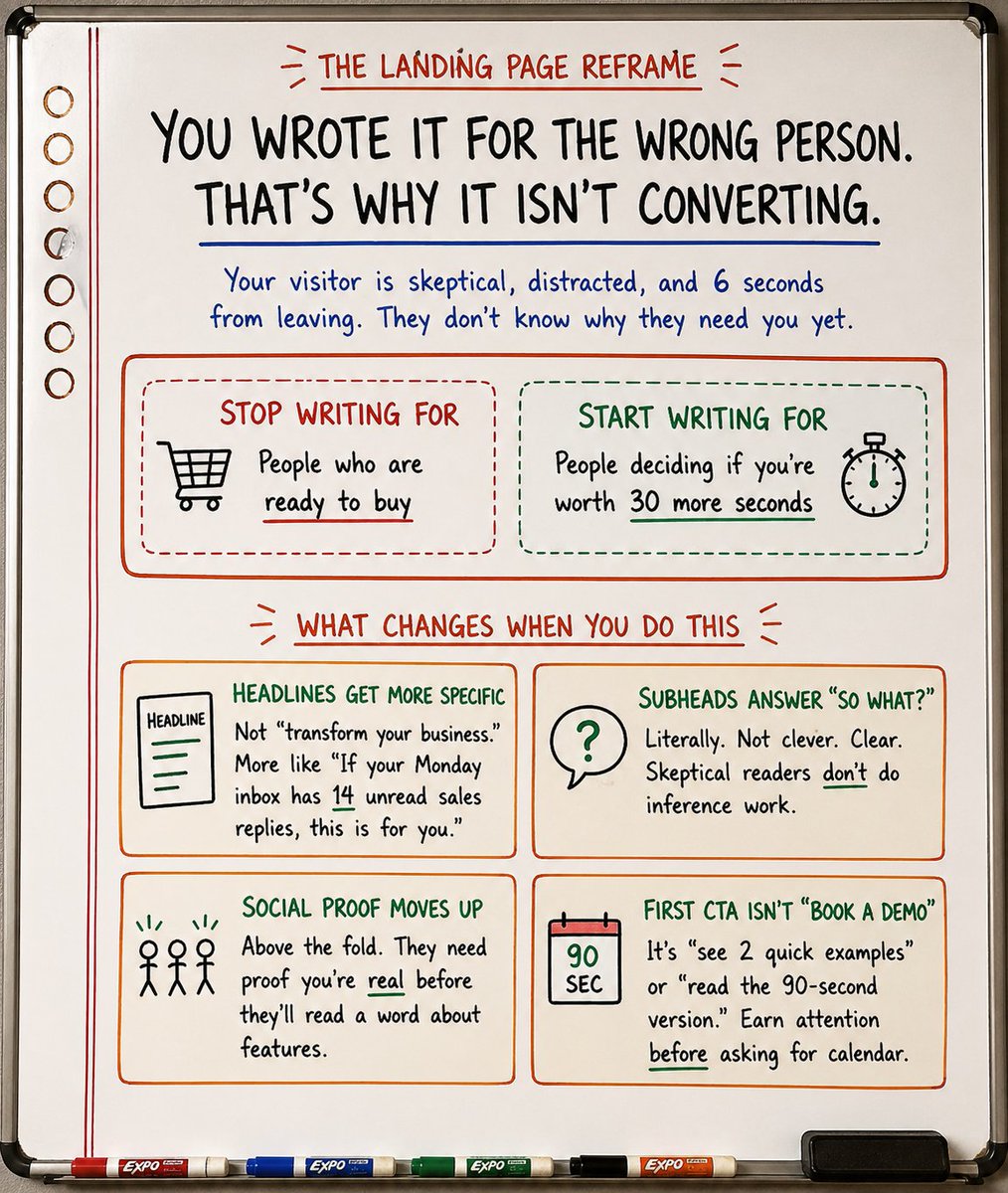
Your landing page isn't converting because you wrote it for the wrong person. Not your target customer. The version of your target customer who already understands why they need you. That person doesn't exist. The person actually landing on your page is skeptical, distracted, and 6 seconds away from leaving. They don't know why they need you. They barely know what you do. Here's the reframe that fixed our conversion rate: Stop writing for people who are ready to buy. Start writing for people who are trying to decide if you're worth 30 more seconds of their attention. What changes when you do this: → Headlines get more specific. Not "transform your business." More like "if your Monday inbox has 14 unread sales replies, this is for you." → Subheads answer the "so what?" question literally. Not clever. Clear. → Social proof moves above the fold. They need proof you're real before they'll read a word about your features. → The first CTA isn't "book a demo." It's "see 2 quick examples" or "read the 90-second version." Something that earns their attention before asking for their calendar. The best landing pages don't sell. They earn each scroll. If your page can't survive the 6-second test, no amount of copywriting cleverness further down will save it. Fix the top 10% of the page first. The rest follows.
Egor Khimichenko tweet media
English
0
0
0
18
Egor Khimichenko
Egor Khimichenko@egkhimi·
I doubled my cold outreach reply rate with a 5-minute review I do before sending anything. No fancy tools. No automation. Just 5 minutes. Here's exactly what I do: Minute 1: Read their last 3 posts on LinkedIn. Not their bio. Their actual posts. Bios are frozen. Posts tell you what they're thinking about right now. Minute 2: Find one specific detail I can reference. A phrase they used. A point they made. A question they asked. Something that proves I read, not skimmed. Minute 3: Write the message ignoring my pitch entirely. First draft is just a genuine reaction to their thinking. No product mention. No "we help companies like yours." Minute 4: Add the softest possible bridge to what I do. One sentence. Optional to engage with. Usually phrased as a question or an offer of a specific resource. Minute 5: Re-read it as if I received it. If it reads like a template, I delete and start again. If it reads like a human who thought about me for 5 minutes, I send. Most cold outreach fails because it takes 30 seconds to write. Prospects can tell. 5 minutes of genuine attention makes you stand out from the 100 other messages hitting their inbox that day. This isn't a hack. It's just treating people like people. Reply rate went from ~3% to ~7%. Not massive on paper. Double the meetings in practice.
Egor Khimichenko tweet media
English
0
0
0
10
Egor Khimichenko
Egor Khimichenko@egkhimi·
Your best leads aren't ghosting you. They're stuck. Took me way too long to figure this out. I used to assume ghosting meant "not interested." So I'd mark the deal dead and move on. Then I started asking the leads who eventually came back: "What happened?" Their answers fell into 4 categories: 1. Internal politics got in the way. (most common) Someone else on their team blocked the decision. Not you, not your offer, just internal friction they couldn't tell you about. 2. They had to prove the problem was worth solving. They went silent while building an internal business case. Your pitch was fine. They just needed time to sell it upward. 3. A bigger priority landed on their desk. Not dead, just deprioritized. They'll be back when the fire they're putting out is out. 4. They actually decided not to move forward but felt awkward saying so. This is the smallest category. Most silence isn't rejection. Here's the shift that changed my pipeline: Stop treating silence as a "no." Start treating it as "not right now, and I don't know why." The follow-up that works for stuck leads isn't "just checking in." It's: "No pressure at all. If you've gone internal on this, happy to send over anything that might help you make the case. If the priority shifted, I get it. Either way, I'm here when it's useful." You acknowledge the actual reasons without forcing them to explain. They reply way more often than you'd expect.
Egor Khimichenko tweet media
English
0
0
0
9
Egor Khimichenko
Egor Khimichenko@egkhimi·
We changed one thing about our content strategy and inbound leads 4x'd in 90 days. Stopped writing for "our audience." Started writing for one specific person. Here's what that actually looked like in practice: Before: "5 tips for improving your social media engagement" Written for everyone. Generic advice. Landed with nobody. After: "What I'd do if I had 2,000 LinkedIn followers and no clue what to post on Monday" Written for one specific person in one specific situation. Felt like a direct message. That's the only thing that changed. Same topics. Same research. Same length. Different framing. Three principles I now use for every piece of content: → Write to one person, not a segment. "Marketing managers at B2B SaaS companies" is not a person. "A marketing manager whose boss just asked for proof the content budget is working" is. → Name the exact moment they're in. Not "when you're thinking about X." It's "Tuesday morning, staring at a blank doc, knowing you need to post something but nothing feels right." → Write the title as if only one person will ever read it. Counterintuitively, this is what makes it resonate with thousands. Generic content gets generic results. Specific content feels like a conversation, and people respond to conversations. Stop writing for your audience. Start writing for the person in your audience who needs this most today.
Egor Khimichenko tweet media
English
0
0
0
9
Egor Khimichenko
Egor Khimichenko@egkhimi·
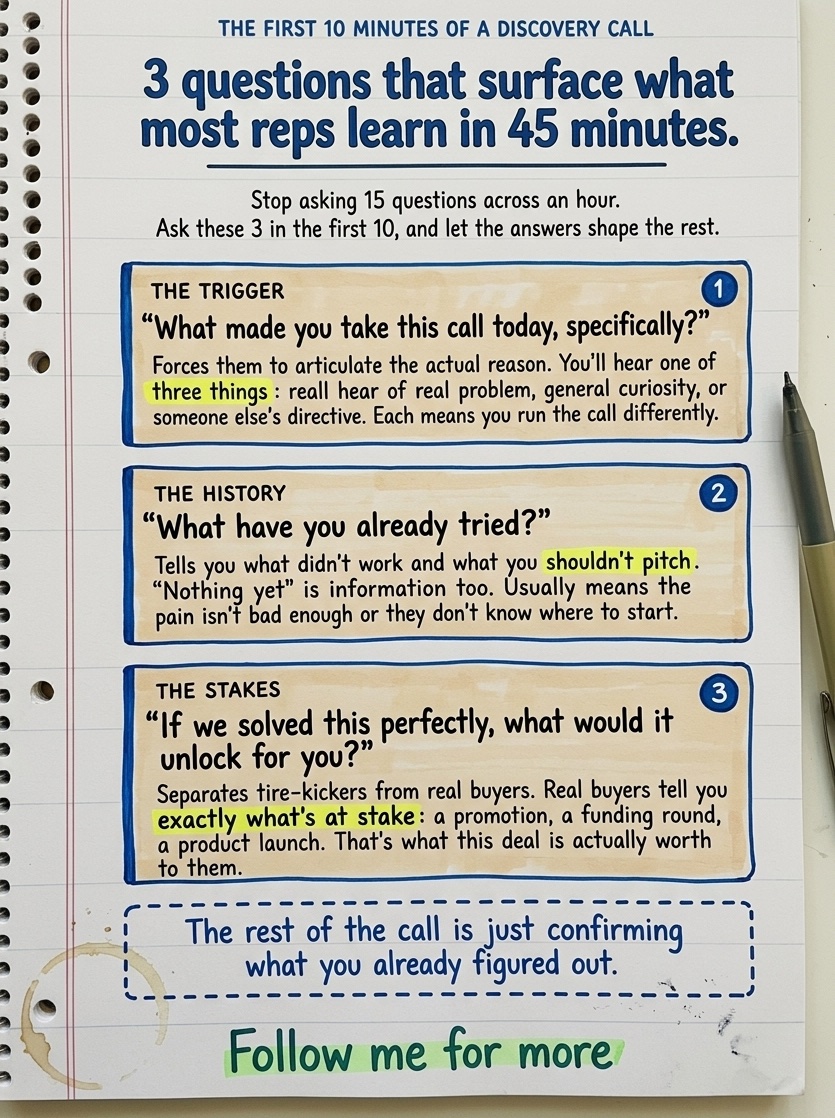
Most discovery calls spend 45 minutes uncovering things 3 questions could have surfaced in 10. I used to ask 15 questions across a 45-minute call. Now I ask these 3 in the first 10 minutes, and let the answers shape the rest: 1. "What made you take this call today, specifically?" Not "tell me about your business." That gets you their website copy. This question forces them to articulate the actual trigger. You'll hear one of three things: a real problem with urgency, general curiosity, or someone else's directive. Each one means you run the call differently. 2. "What have you already tried?" Tells you what didn't work and why. Also tells you what you shouldn't pitch (because they've already rejected it). If they say "nothing yet," that's information too. It usually means the pain isn't that bad yet, or they don't know where to start. Both change the conversation. 3. "If we solved this perfectly, what would it unlock for you?" This is the question that separates tire-kickers from real buyers. Tire-kickers give vague answers. Real buyers tell you exactly what's at stake (a promotion, a funding round, keeping their job, launching a product). Once you know what's at stake, you know what this deal is actually worth to them. 10 minutes. 3 questions. You now know more than most reps learn in the full hour. The rest of the call is just confirming what you already figured out.
Egor Khimichenko tweet media
English
0
0
0
8
Egor Khimichenko
Egor Khimichenko@egkhimi·
The best cold email I ever sent almost never went out. I'd written it on a Tuesday night to a VP at a company I'd wanted to land for 6 months. Read it back three times. Hovered over send. Closed my laptop. It felt too direct. Too personal. Too different from the templates that I'd been told "work." The next morning I sent it anyway because I had nothing left to lose on the account. She replied in 40 minutes. We had a call that week. They became a client the following month. Here's the email, word for word, so you can see exactly why the "rules" are often wrong: Subject: Been thinking about your Q3 hiring post "Hey Priya, You posted two weeks ago about how you'd rather hire slower than hire wrong. I thought about that post for like three days afterwards because it's the opposite of what every other marketing leader I follow is saying right now. Quick thought on something you mentioned: you said you're worried about balancing brand consistency with scaling content volume. We hit that exact wall with a client last quarter and the thing that worked wasn't more writers. It was one editor who owned voice across everything. Counter-intuitive but it doubled our output without the mess. If it's useful I'll send you the internal doc we wrote up on it. If not, no worries, your post made my week." Here's why this worked when everything "polished" had failed: 1. It referenced her actual thinking, not her company's press release. Anyone can pull a funding announcement. Mentioning a specific idea she'd shared proved I'd been paying attention to her as a person. 2. It didn't pretend to be anything other than what it was. I didn't sneak in a pitch. I didn't pretend I wasn't selling anything. I just acted like someone who wanted to be helpful. 3. The value offer was specific. Not "happy to share some thoughts." An actual internal document solving an actual problem she'd named. 4. It was written like a real human wrote it. The phrase "it's the opposite of what every other marketing leader I follow is saying right now" isn't a template. You can't fake that. The thing I keep learning and re-learning: The cold outreach that works in 2026 is the cold outreach that doesn't feel like cold outreach. It feels like someone genuinely engaging with your thinking. Write like you'd text a friend who happens to run a company. That's it. That's the whole secret.
Egor Khimichenko tweet media
English
1
0
0
60
Egor Khimichenko
Egor Khimichenko@egkhimi·
"It's too expensive." I used to dread hearing this. I'd go into justify mode. Start listing features. Offer discounts before they even pushed back. Basically do everything I now know you should never do. Then I had a conversation with a senior sales leader who'd closed 8-figure deals for 15 years. I told her I struggled with price objections. She laughed. "That's not a price objection. That's a value question." She broke it down for me and I've used the same approach ever since: "It's too expensive" actually means one of four things. Each one needs a completely different response. 1. "I can't afford it right now." Actual budget problem. Response: ask about their budget cycle and the size of problem that would justify reallocating budget. Sometimes the answer is "let's talk in Q2." 2. "I don't understand why it costs this much." Value gap, not price gap. Response: walk them through what goes into the work, the outcomes you've generated for similar clients, and what their cost of not solving this problem is. 3. "I'm testing whether you'll drop the price." Negotiation move. Response: stay calm, don't flinch, and say something like "I hear you. Can I ask what number you'd feel good about, and why that specific number?" 4. "I don't believe you'll deliver what you're promising." Trust issue disguised as price. Response: offer references, pilot programs, or shorter engagement terms. The problem isn't cost, it's risk. The skill isn't handling price objections. It's diagnosing which of these four is actually happening before you respond. I used to lose deals because I'd answer the wrong question. Now when someone says "it's too expensive," I say: "Tell me more about what's driving that reaction." Their answer tells me exactly which of the four I'm dealing with. Try it this week. It changes the conversation.
Egor Khimichenko tweet media
English
0
0
0
17
Egor Khimichenko
Egor Khimichenko@egkhimi·
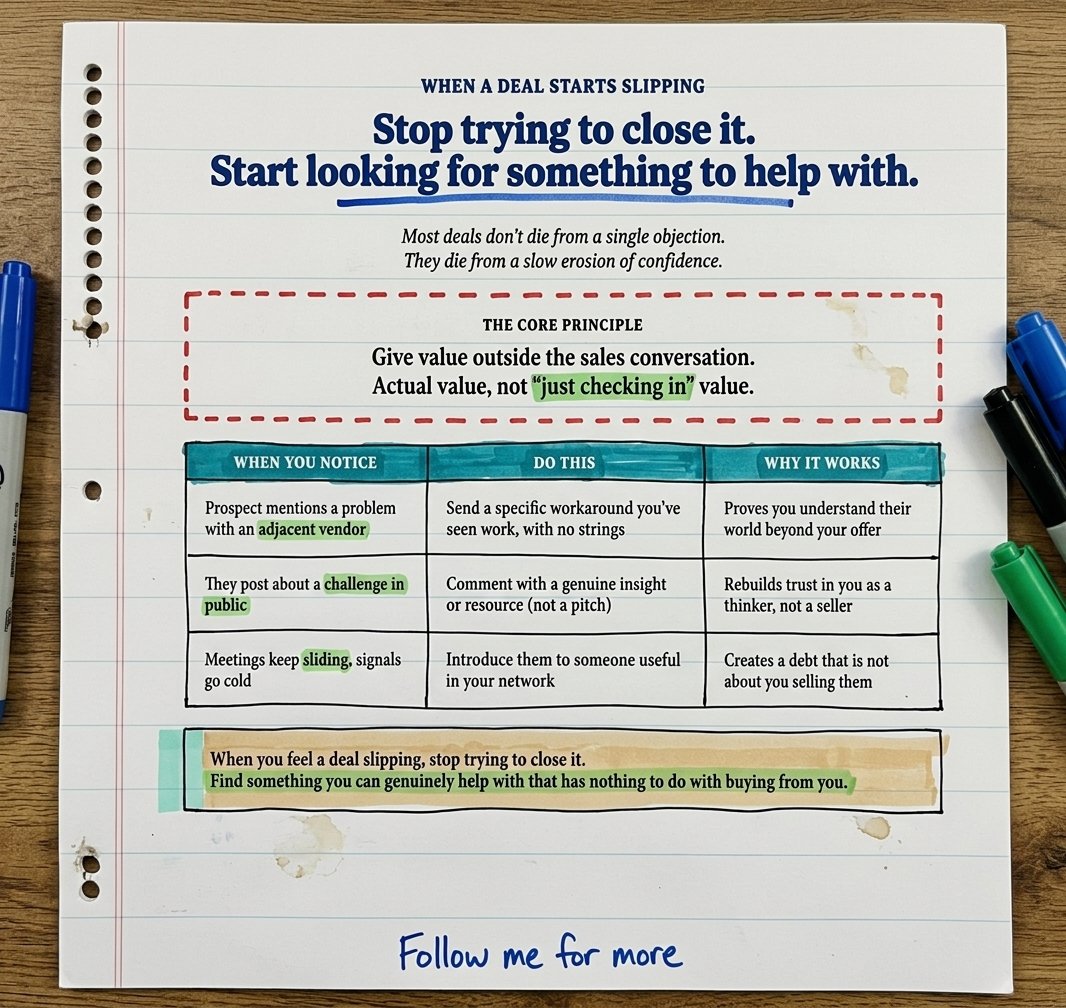
Nearly walked away from a prospect last year who became our biggest deal of the year. Three weeks into the conversation, every signal was red. → They had a competing quote that was 40% cheaper → The decision maker kept missing meetings → Their "timeline" kept sliding → I could feel my manager getting restless I almost sent the "no hard feelings, feel free to come back if circumstances change" email. That's the nice-sounding version of disqualifying yourself. Something held me back. I'd been in their Slack community for a few weeks and noticed their CEO posting about struggles with their current vendor. Not us. A different vendor they were using for something adjacent. Instead of the goodbye email, I sent this: "Hey Marcus, saw your post about [other vendor]. We've seen three clients have the exact same issue you're describing, and we had a workaround that solved it within a week. Happy to send it over even if you go with [our competitor] in the end. No strings." He replied within 20 minutes. Two things happened: The workaround I sent solved a problem that had been costing them real money It rebuilt their trust in us as people who actually knew their industry Six weeks later, they signed with us. Bigger scope than we'd originally quoted. The price objection had never really been about price. It was about confidence. Here's what I took away: Most deals don't die from a single objection. They die from a slow erosion of confidence that the rep notices too late. The fix is almost always the same: find a way to give value outside the sales conversation. Not a "just checking in" email. Actual, unmistakable value that proves you understand their world. When I feel a deal slipping, I stop trying to close it and start looking for something I can genuinely help with that has nothing to do with buying from me. More often than not, that's what saves the deal.
Egor Khimichenko tweet media
English
0
6
9
996
Egor Khimichenko
Egor Khimichenko@egkhimi·
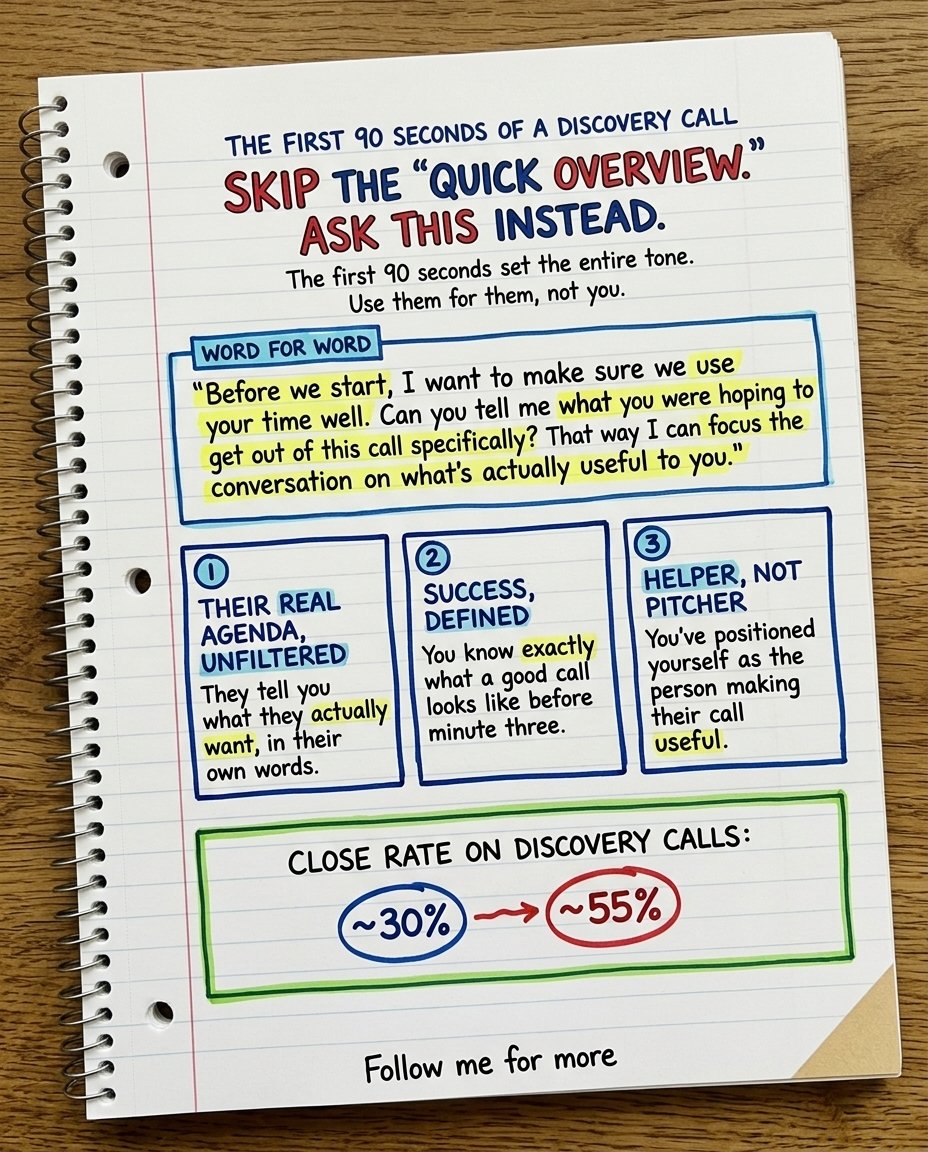
I tanked a discovery call in the first 90 seconds and didn't realise until I watched the recording. It was a warm inbound lead. Real budget, real timeline, real pain. Should have been a slam dunk. I opened with: "So thanks for taking the time today, I thought we could start by me giving you a quick overview of what we do, and then we can dig into your situation." She said "sure" and I spent the next 6 minutes talking about Sentient. By minute 7 her answers were shorter. By minute 12 she was one-word replies. By minute 20 she politely ended the call. She never responded to my follow-up. I watched the recording twice to figure out what happened. Here's the brutal truth: I made the call about me before it was about her. The first 90 seconds of a discovery call set the entire tone. If you use them to talk about yourself, you're telling the prospect "this is a sales call." If you use them to ask about them, you're telling them "this is about you." The opener I use now, word for word: "Before we start, I want to make sure we use your time well. Can you tell me what you were hoping to get out of this call specifically?" Three things happen: They tell you their real agenda in their own words You immediately know what "success" looks like for this call You've positioned yourself as a helper, not a pitcher My close rate on discovery calls went from around 30% to around 55% after making this one change. The first 90 seconds are not warm-up. They're the whole interview.
Egor Khimichenko tweet media
English
0
6
7
497
Egor Khimichenko
Egor Khimichenko@egkhimi·
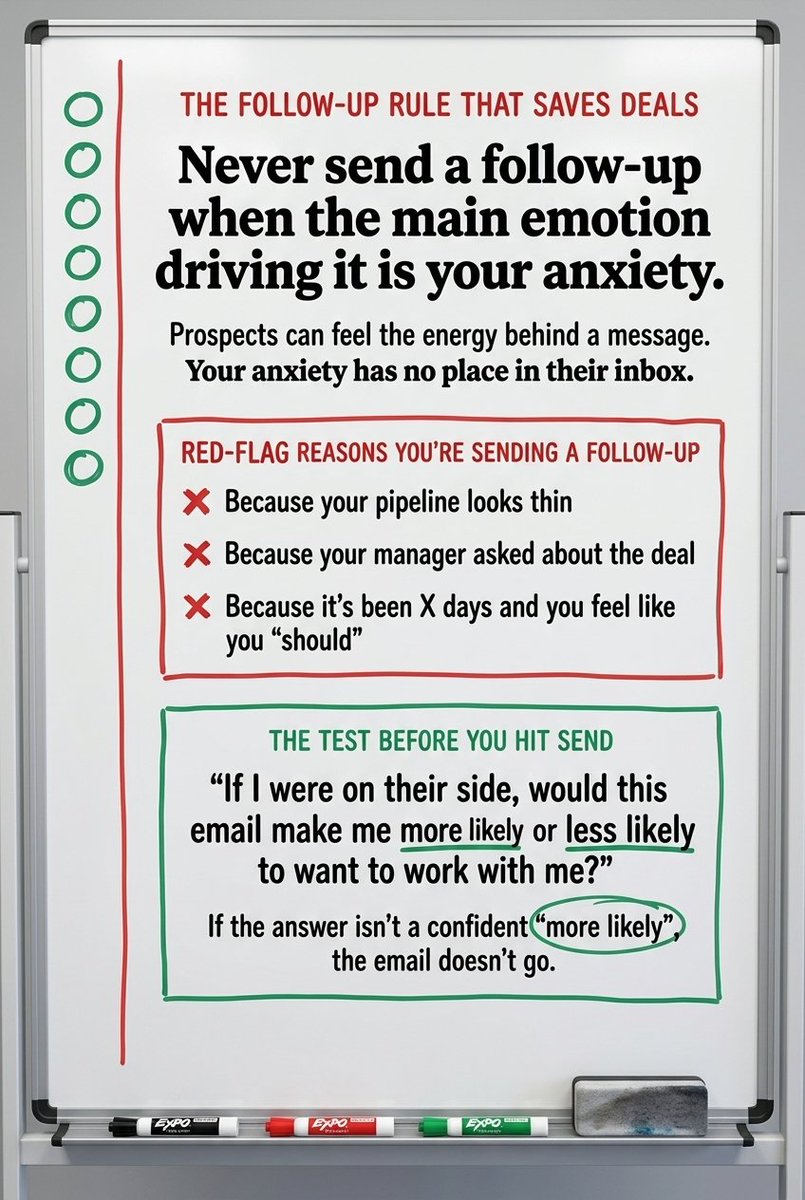
I lost a £30K deal last year because of a Friday afternoon email I shouldn't have sent. The prospect had gone quiet for 10 days. My pipeline review was on Friday at 4pm. I saw the stalled deal, felt the pressure, and fired off what I thought was a clever follow-up. "Hey, just wanted to check in, any thoughts on moving forward?" Monday morning I got a reply. "We've decided to go in a different direction. Thanks for your time." That was it. No context, no specifics, no door left open. When I dug in with a colleague who knew the prospect, I found out what happened. My Friday email landed in their inbox right as they were finishing a stressful week. It came across as pushy. They'd been 70% on me and that one message tipped them to the competitor. Here's what I learned, broken into a simple rule set I now live by: Never send a follow-up when the main emotion driving it is your anxiety. If you're sending because: → Your pipeline looks thin → Your manager asked about the deal → It's been X days and you feel like you "should" The email will carry that energy. Prospects can feel it. Instead, wait until you have something genuine to send. A relevant article. A case study that matches their specific situation. A question that shows you've been thinking about their problem. The test I run now before hitting send: "If I were on their side, would this email make me more likely or less likely to want to work with me?" If the answer isn't a confident "more likely," the email doesn't go. I've lost deals I could have saved, and saved deals I thought were dead. The difference is almost always the emotional state behind the follow-up. Your anxiety has no place in your prospect's inbox.
Egor Khimichenko tweet media
English
0
7
10
847
Egor Khimichenko
Egor Khimichenko@egkhimi·
I sent a cold LinkedIn message last month that almost got me blocked by the CEO of a $40M company. Not because it was offensive. Because it was "perfect." I had spent 20 minutes crafting it. Referenced her podcast appearance. Mentioned her company's recent funding round. Had a clever hook. Ended with a relevant case study. She replied with one line: "This reads like it was written by someone who needs something from me." I stared at that message for an hour. She was right. Every element was technically correct. But the whole thing radiated intent. It was a perfectly engineered trap, and she'd walked right up to the edge and seen it for what it was. I deleted my whole cold outreach template and rewrote it around one rule: Write the message you'd send if they had nothing you wanted. Here's what that actually looks like: Before: "Hey NAME, loved your recent podcast on scaling content teams. We work with companies like yours to..." After: "Hey NAME, your point about content teams needing editors more than writers really stuck with me. We just made the same shift internally and it was uncomfortable but obviously right. Anyway, that's it, just wanted to say your take landed." No ask. No pitch. No bridge to a sales conversation. The result: she replied. We talked. Three weeks later she introduced me to her head of marketing who became a client. The lesson isn't "don't pitch." It's that pitching before trust exists is the fastest way to destroy trust that might have existed. Send 10 messages this week with no ask in them. Track what happens. You'll be surprised.
Egor Khimichenko tweet media
English
0
6
7
346
Egor Khimichenko
Egor Khimichenko@egkhimi·
I fired a client in February that I thought I couldn't afford to lose. They were 18% of our revenue. Paying on time. Not difficult on the surface. But every interaction drained me. Scope creep on every project. Midnight messages expecting same-day replies. A founder who treated our team like disposable vendors. I was spending 40% of my mental energy on a relationship worth 18% of our revenue. I ran the numbers on a Sunday afternoon and realised something that changed how I think about sales forever. Revenue is not the same as profit. Profit is not the same as energy. Energy is the actual constraint. I wrote this email on Monday morning: "Hey James, after a lot of thought, we've decided we're not the right partner for you going forward. Your needs have evolved beyond what our team is set up to deliver sustainably. I want to give you 30 days' notice so you have time to find a better fit, and I'm happy to recommend two agencies that would probably work better for your pace." He was furious. Then professional. Then gone. Here's what happened next, which is the part nobody talks about: → Our team's morale went up noticeably within a week → We won three new clients in the following two months that were a better fit → Revenue dipped for about 6 weeks, then recovered and exceeded previous levels → My Sunday evenings stopped being dread sessions The broader lesson applies to sales too: Every "yes" you say has a hidden "no" attached to it. When you say yes to the wrong client, you're saying no to the better clients you don't have time to serve. When you say yes to the wrong opportunity, you're saying no to the right one that hasn't arrived yet. The best salespeople I've watched are ruthlessly protective of their energy and their pipeline. They'd rather have 10 great clients than 15 okay ones. They'd rather have fewer deals in pipeline that are actually real than a CRM full of wishful thinking. Sometimes the highest-leverage sales move you can make is walking away from something that looks like a win.
Egor Khimichenko tweet media
English
0
4
4
426
Egor Khimichenko
Egor Khimichenko@egkhimi·
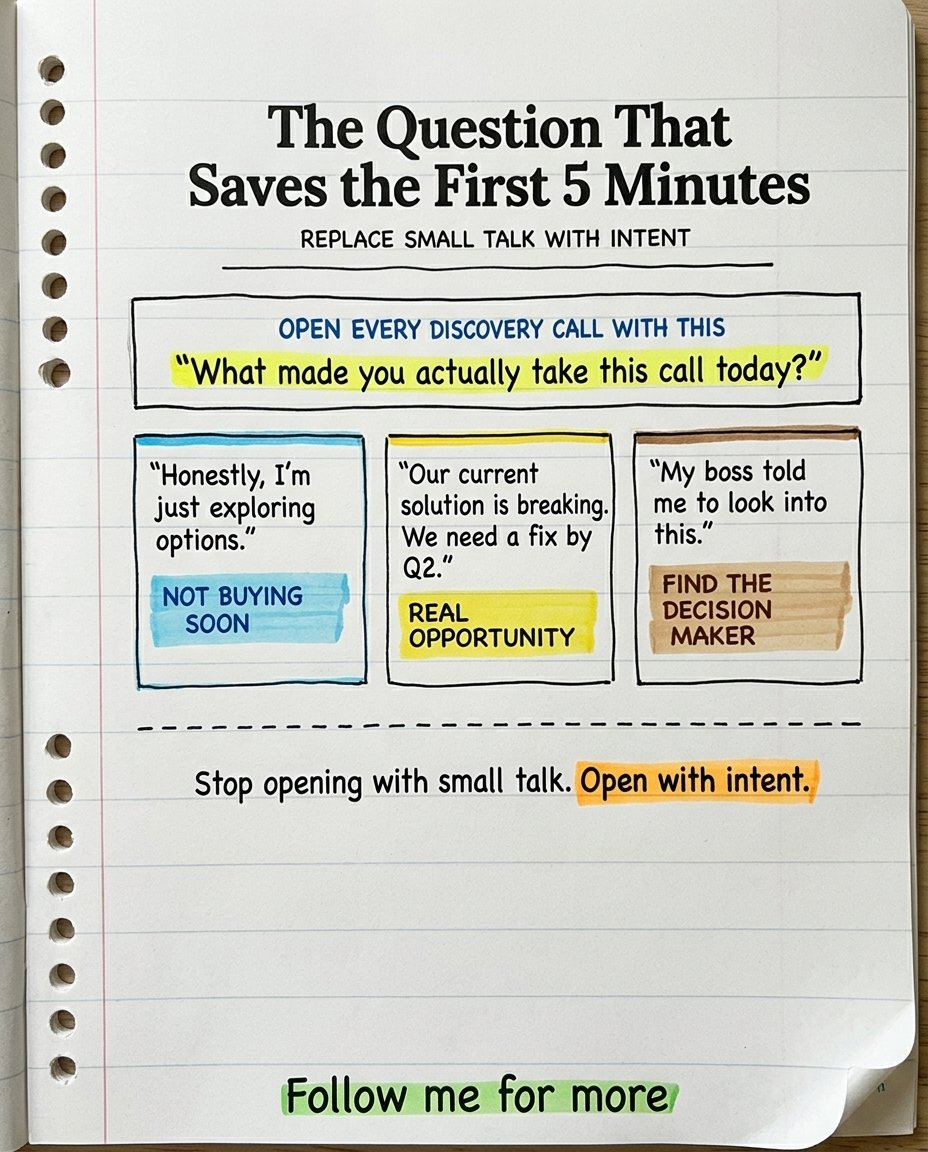
Most discovery calls die in the first 5 minutes. Not because the rep is bad. Because they're asking the wrong opening question. "So tell me about your business" gets you a generic answer you could have read on their website. Here's the question I open every call with now: "Before we get into anything, can you tell me what made you actually take this call today?" It does three things: Forces them to articulate their real motivation out loud Surfaces the urgency (or lack of it) immediately Tells you within 60 seconds whether this is a real opportunity or a fishing trip The answers I get fall into three buckets: → "Honestly, I'm just exploring options" (not buying soon) → "Our current solution is breaking and we need to fix it by Q2" (real) → "My boss told me to look into this" (need to find the actual decision maker) Each one tells you exactly how to run the rest of the call. Stop opening with small talk. Open with intent.
Egor Khimichenko tweet media
English
0
6
6
262
Egor Khimichenko
Egor Khimichenko@egkhimi·
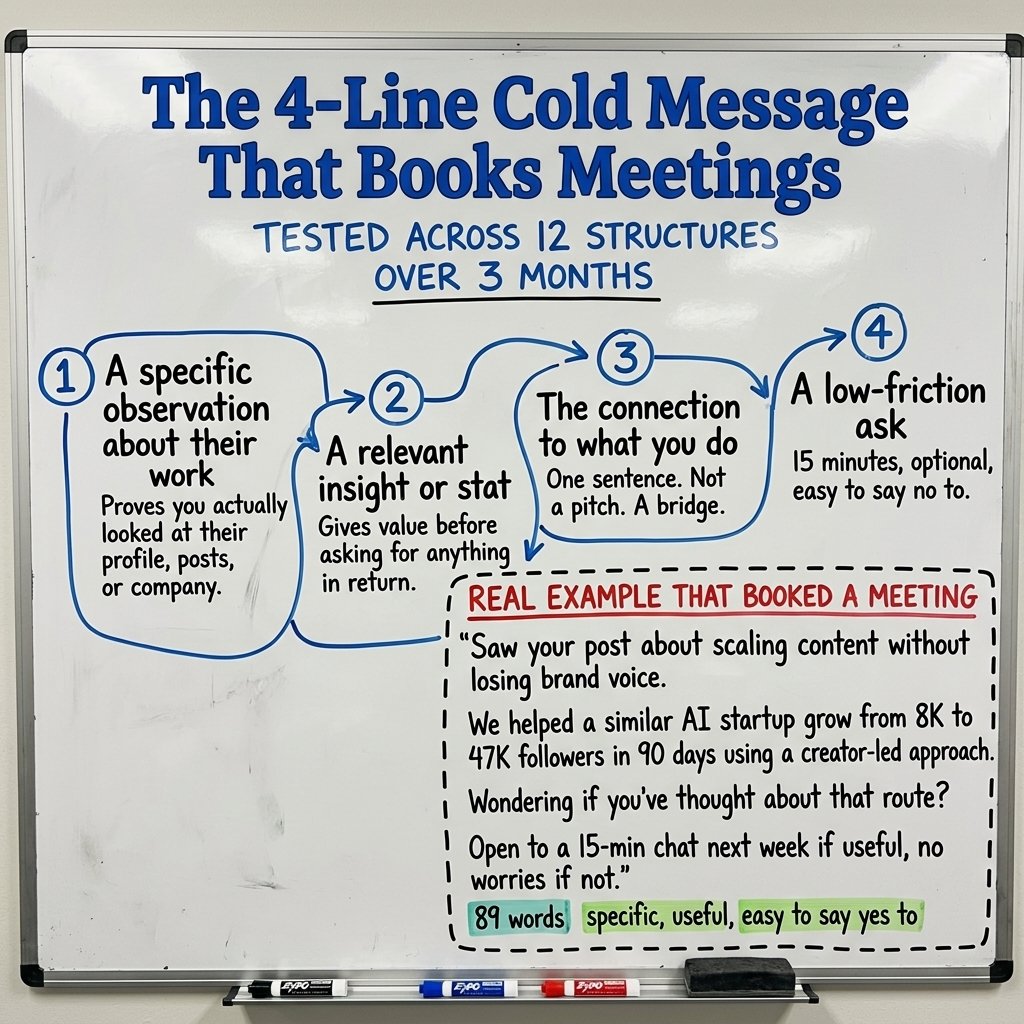
I tested 12 different cold message structures over 3 months. This is the one that consistently gets replies: Line 1: A specific observation about their work (proves you actually looked) Line 2: A relevant insight or stat (gives value before asking) Line 3: The connection to what you do (one sentence, no pitch) Line 4: A low-friction ask (15 minutes, optional, no pressure) Example that booked a meeting last week: "Saw your post about scaling content without losing brand voice. We helped a similar AI startup grow from 8K to 47K followers in 90 days using a creator-led approach instead of automation. Wondering if you've thought about that route? Open to a 15-min chat next week if useful, no worries if not." 89 words. Specific, useful, easy to say yes to. The mistake most people make is line 3. They turn it into a pitch. It's not a pitch. It's a bridge. If your cold message reads like a sales email, it'll get treated like one.
Egor Khimichenko tweet media
English
0
7
11
1.4K
Egor Khimichenko
Egor Khimichenko@egkhimi·
Closed more deals last quarter than the previous two combined. The weird part: I was doing less, not more. Three things I stopped doing: Stopped sending proposals immediately after the call. Now I wait 24 hours and send a recap email first. Confirms we're aligned on the problem. Cuts proposal revisions in half. Stopped offering "flexible pricing" upfront. Used to lead with options to seem accommodating. Now I lead with one clear recommendation. Conversion went up. Turns out people want a guide, not a menu. Stopped following up with "just checking in." Replaced every "checking in" message with one that delivers something useful. A relevant article, a quick insight, a question they can actually answer in 10 seconds. The pattern: every change made things easier for the prospect, not harder. That's the real lesson. Sales gets harder when you make it about you. It gets easier when you make it about them.
Egor Khimichenko tweet media
English
0
6
7
298
Egor Khimichenko
Egor Khimichenko@egkhimi·
"Send me some information and I'll get back to you." Most reps treat this as a soft no. It's not. It's a test. What they're actually saying: "I'm interested but I don't trust you enough yet to commit time." Here's how I respond now instead of just sending a deck: "Happy to. Quick question first: what would you need to see in that information to make it actually useful? I'd rather send you something specific than dump our whole brochure on you." Three things happen: They tell you exactly what they care about (which is gold for the next conversation) You position yourself as different from every other rep who just sends generic decks You earn the right to a follow-up because now you owe them something tailored 90% of the time, they tell me. The other 10% reveal that they weren't really interested anyway, which saves me hours. Stop sending information. Start asking what would make information useful.
Egor Khimichenko tweet media
English
0
6
7
490
Egor Khimichenko
Egor Khimichenko@egkhimi·
Pricing conversations make most reps nervous. They shouldn't. Here's the 4-step framework I use that turns price talk into a closing tool: Step 1: Anchor before they ask. Mention pricing before they bring it up. "Just so you know, our packages typically range from X to Y depending on scope." This removes the awkwardness and signals confidence. Step 2: Tie price to outcome, not features. "At Y, here's what you'd typically see in the first 90 days" hits differently than "Y gets you these 12 features." Step 3: Pause. Don't fill the silence. After you say the number, shut up. The first person to speak loses. Most reps panic and start justifying. Don't. Step 4: Ask "what's your reaction to that?" Not "is that within budget?" Their reaction tells you whether the issue is price, value, or timing. Each one needs a different response. Pricing conversations are won in the silence after the number, not in how clever you sound saying it.
Egor Khimichenko tweet media
English
0
9
27
2.2K