
Musashi retweetledi
Musashi
211 posts


Musashi retweetledi

This IS the N constant.
@VitalikButerin prediction market thesis proves it – markets are curation mechanisms where N participants balance each other out.
- Every dump = someone accumulating
- Every panic sell = someone’s conviction buy
$N isn’t just a ticker. It’s the equilibrium constant in every trade equation.
When you sell, ask yourself: who’s buying and why do they know something you don’t?
So $N is way more than just a ticker – it’s the constant that balances every market equation. And constants don’t change. They compound!
CZ 🔶 BNB@cz_binance
Remember, for a trade (last price) to happen, for every seller, there is a buyer. 🤯
English
Português

@VitalikButerin @TheEylon vitalik what exactly is "$N"
English

Vitalik is diagnosing real symptoms (quality discovery is hard; speculative attention games distort incentives), but he keeps trying to “token engineer” his way out of a problem that tokens themselves created.
The root cause isn’t “we haven’t found the right creator coin mechanism.” It's that Tokens are inherently ponzis
When you allow unlimited token issuance with no hard identity constraint and no binding claim on cashflows, you inevitably get:
- Infinite supply of new tokens → creators/influencers/teams have constant incentive to mint the next one
- Attention becomes the underlying collateral → the asset is “number-go-up because people are watching,” not value
- Reflexive incentives → the most profitable behavior becomes launching, pumping, and moving on
- Selection bias toward high-status accounts → because status is the only durable “fundamental” in a token casino
- Ponzi dynamics → early buyers need later buyers; “community” becomes exit liquidity
That’s not a failure mode of Zora or BitClout specifically. That’s the default equilibrium of “creator coins” as a category.
vitalik.eth@VitalikButerin
How I would do creator coins We've seen about 10 years of people trying to do content incentivization in crypto, from early-stage platforms like Bihu and Steemit, to BitClout in 2021, to Zora, to tipping features inside of decentralized social, and more. So far, I think we have not been very successful, and I think this is because the problem is fundamentally hard. First, my view of what the problem is. A major difference between doing "creator incentives" in the 00s vs doing them today, is that in the 00s, a primary problem was having not enough content at all. In the 20s, there's plenty of content, AI can generate an entire metaverse full of it for like $10. The problem is quality. And so your goal is not *incentivizing content*, it's *surfacing good content*. Personally, I think that the most successful example of creator incentives we've seen is Substack. To see why, take a look at the top 10: substack.com/leaderboard/te… substack.com/leaderboard/cu… substack.com/leaderboard/wo… Now, you may disagree with many of these authors. But I have no doubt that: 1. They are on the whole high quality, and contribute positively to the discussion 2. They are mostly people who would not have been elevated without Substack's presence So Substack is genuinely surfacing high quality and pluralism. Now, we can compare to creator coin projects. I don't want to pick on a single one, because I think there's a failure mode of the entire category. For example: Top Zora creator coins: coingecko.com/en/categories/… BitClout: businessofbusiness.com/articles/insid… Basically, the top 10 are people who already have very high social status, and who are often impressive but primarily for reasons other than the content they create. At the core, Substack is a simple subscription service: you pay $N per month, and you get to see the person's articles. But a big part of Substack's success is that they did not just set the mechanism and forget. Their launch process was very hands-on, deliberately seeding the platform with high-quality creators, based on a very particular vision of what kind of high-quality intellectual environment they wanted to foster, including giving selected people revenue guarantees. So now, let's get to one idea that I think could work (of course, coming up with new ideas is inherently a more speculative project than criticizing existing ones, and more prone to error). Create a DAO, that is *not* token-based. Instead, the inspiration should be Protocol Guild: there are N members, and they can (anonymously) vote new members in and out. If N gets above ~200, consider auto-splitting it. Importantly, do _not_ try to make the DAO universal or even industry-wide. Instead, embrace the opinionatedness. Be okay with having a dominant type of content (long-form writing, music, short-form video, long-form video, fiction, educational...), and be okay with having a dominant style (eg. country or region of origin, political viewpoint, if within crypto which projects you're most friendly to...). Hand-pick the initial membership set, in order to maximize its alignment with the desired style. The goal is to have a group that is larger than one creator and can accumulate a public brand and collectively bargain to seek revenue opportunities, but at the same time small enough that internal governance is tractable. Now, here is where the tokens come in. In general, one of my hypotheses this decade is that a large portion of effective governance mechanisms will all have the form factor of "large number of people and bots participating in a prediction market, with the output oracle being a diverse set of people optimized for mission alignment and capture resistance". In this case, what we do is: anyone can become a creator and create a creator coin, and then, if they get admitted to a creator DAO, a portion of their proceeds from the DAO are used to burn their creator coins. This way, the token speculators are NOT participating in a recursive-speculation attention game backed only by itself. Instead, they are specifically being predictors of what new creators the high-value creator DAOs will be willing to accept. At the same time, they also provide a valuable service to the creator DAOs: they are helping surface promising creators for the DAOs to choose from. So the ultimate decider of who rises and falls is not speculators, but high-value content creators (we make the assumption that good creators are also good judges of quality, which seems often true). Individual speculators can stay in the game and thrive to the extent that they do a good job of predicting the creator DAOs' actions.
English
Português


How I would do creator coins
We've seen about 10 years of people trying to do content incentivization in crypto, from early-stage platforms like Bihu and Steemit, to BitClout in 2021, to Zora, to tipping features inside of decentralized social, and more. So far, I think we have not been very successful, and I think this is because the problem is fundamentally hard.
First, my view of what the problem is. A major difference between doing "creator incentives" in the 00s vs doing them today, is that in the 00s, a primary problem was having not enough content at all. In the 20s, there's plenty of content, AI can generate an entire metaverse full of it for like $10. The problem is quality. And so your goal is not *incentivizing content*, it's *surfacing good content*.
Personally, I think that the most successful example of creator incentives we've seen is Substack. To see why, take a look at the top 10:
substack.com/leaderboard/te…
substack.com/leaderboard/cu…
substack.com/leaderboard/wo…
Now, you may disagree with many of these authors. But I have no doubt that:
1. They are on the whole high quality, and contribute positively to the discussion
2. They are mostly people who would not have been elevated without Substack's presence
So Substack is genuinely surfacing high quality and pluralism.
Now, we can compare to creator coin projects. I don't want to pick on a single one, because I think there's a failure mode of the entire category.
For example:
Top Zora creator coins: coingecko.com/en/categories/…
BitClout: businessofbusiness.com/articles/insid…
Basically, the top 10 are people who already have very high social status, and who are often impressive but primarily for reasons other than the content they create.
At the core, Substack is a simple subscription service: you pay $N per month, and you get to see the person's articles. But a big part of Substack's success is that they did not just set the mechanism and forget. Their launch process was very hands-on, deliberately seeding the platform with high-quality creators, based on a very particular vision of what kind of high-quality intellectual environment they wanted to foster, including giving selected people revenue guarantees.
So now, let's get to one idea that I think could work (of course, coming up with new ideas is inherently a more speculative project than criticizing existing ones, and more prone to error).
Create a DAO, that is *not* token-based. Instead, the inspiration should be Protocol Guild: there are N members, and they can (anonymously) vote new members in and out. If N gets above ~200, consider auto-splitting it.
Importantly, do _not_ try to make the DAO universal or even industry-wide. Instead, embrace the opinionatedness. Be okay with having a dominant type of content (long-form writing, music, short-form video, long-form video, fiction, educational...), and be okay with having a dominant style (eg. country or region of origin, political viewpoint, if within crypto which projects you're most friendly to...). Hand-pick the initial membership set, in order to maximize its alignment with the desired style.
The goal is to have a group that is larger than one creator and can accumulate a public brand and collectively bargain to seek revenue opportunities, but at the same time small enough that internal governance is tractable.
Now, here is where the tokens come in. In general, one of my hypotheses this decade is that a large portion of effective governance mechanisms will all have the form factor of "large number of people and bots participating in a prediction market, with the output oracle being a diverse set of people optimized for mission alignment and capture resistance". In this case, what we do is: anyone can become a creator and create a creator coin, and then, if they get admitted to a creator DAO, a portion of their proceeds from the DAO are used to burn their creator coins.
This way, the token speculators are NOT participating in a recursive-speculation attention game backed only by itself. Instead, they are specifically being predictors of what new creators the high-value creator DAOs will be willing to accept. At the same time, they also provide a valuable service to the creator DAOs: they are helping surface promising creators for the DAOs to choose from.
So the ultimate decider of who rises and falls is not speculators, but high-value content creators (we make the assumption that good creators are also good judges of quality, which seems often true). Individual speculators can stay in the game and thrive to the extent that they do a good job of predicting the creator DAOs' actions.
English
@VitalikButerin @BlurrNCoin
$N :
0xe73d53e3a982ab2750a0b76f9012e18b256cc243
Português
Musashi retweetledi
🔥❄️ Blurr.eth $N Token Turns 2 Years Old: CELEBRATION/GIVEAWAY 🔥❄️
2 years of building. 2 years of scarcity ticking.
Celebrate with us and enter for a chance to win a share of 20 $N community BlurrPunks — a piece of $N NFT history (1 ETH total value).
To enter:
✅ Buy & hold $50+ of Blurr.eth $N by VC time
✅ Purchase between Jan 27 12:00 UTC → 17:30 UTC
✅ Join tomorrow on TG: t.me/N_Blurr
How to buy $N:
DEX (Uniswap, MetaMask, CowSwap,... ERC-20)
0xe73d53e3a982ab2750a0b76f9012e18b256cc243
Want a BlurrPunks now? 👉
autominter.com/mint/66a7c04f0…
(0.05 ETH/NFT → All funds to $N community building)
Event details:
📅 Jan 28 | 16:30-17:30 UTC on TG VC: t.me/N_Blurr
90 years of emissions left. The clock's ticking.
Some say fire. Some say ice. We say... 90 years of emissions remain. The clock doesn't stop.
See you tomorrow, believers. 🫡
In whispers we trust. In mystery we hold.
Blurr.eth ambassadors, let's unite!

English
Musashi retweetledi
January 28, 2026 marks 2 years of $N.
**No launch hype. No shortcuts.**
Just fire, ice, and time doing the sorting.
Some burned early. Some froze and stayed.
The chain remembers both.
A quiet wink to those who’ve been here since day one. You know who you are.
$N didn’t need noise to exist.
Only time and scarcity. Those two alone have already defeated the weak to favor the great…
Respect to @blurr
Respect to all of us ❄️🔥
Two years of total faith in total mystery certainly deserve celebrating the real investors who are part of this journey and the familia born from it. A VC is about to be announced in TG !
English
Musashi retweetledi
Musashi retweetledi
Approaching Two-Year Milestone for N Token Launch
In less than 20 days...
'N' is the second token deployed by Blurr.eth
Token Address:
0xE73d53e3a982ab2750A0b76F9012e18B256Cc243
Deployed by: 0xef764BAC8a438E7E498c2E5fcCf0f174c3E3F8dB (Blurr.eth)
Who is Blurr.eth?
Blurr.eth is the wallet address behind the legendary 2021 CryptoPunk #9998 publicity stunt—a $530M flash loan transaction that made headlines across the crypto world.
etherscan.io/tx/0x92488a00d…👀
N features a distinctive fair-launch model with no insider allocation, ensuring equitable distribution. N employs a per-block minting mechanism, allowing any participant to mint tokens during available block windows. This architecture supports a sustainable economic model.
Community Pool:
The community operates an RFD/N liquidity pool, enabling participants to:
Trade between the token pair based on market volatility
Earn proportional fees from trading volume through liquidity provision
Want to learn more?
Join our chat! t.me/N_Blurr

English
@SuperCryptonyte @ReFundCoinETH It's going to become much more than a business …$RFD⏳🚀
English

@ReFundCoinETH Dude this is a meme not an enterprise token. Come out of delulu island 😂
English

If I were Blurr.eth and wanted my project to deliver real value, not just price action, I wouldn’t just throw funds at shills and influencers.
Building something truly useful isn’t easy. Patience/execution are what matter 💥
In due time, the treasury will be useful to holders
English

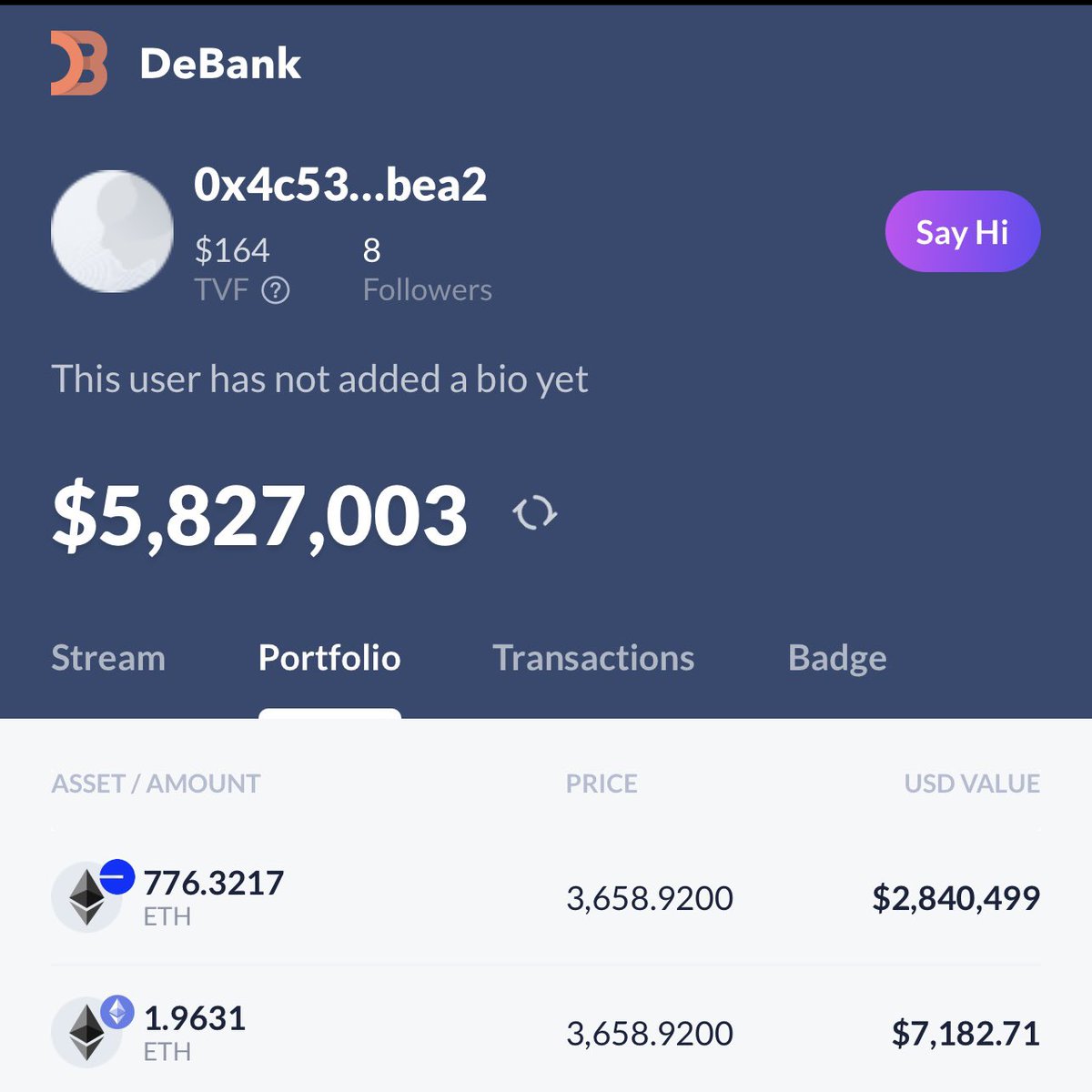
🚨 Approximately 750 $ETH has been unstaked/withdrawn from various project pools and is now sitting in the $RFD treasury.
Whether this marks Blurr’s preparation for a November 5th move or merely routine treasury management, we’re about to find out. 👀
Mohsen@suremohsen
“A penny for the old guy.” 🔥 History remembers Guy Fawkes, but the lesson goes deeper: the effigy isn’t the enemy, it’s the weight that must burn so something lighter can rise. Could the “pennies”; rewards and yield born from belief, conviction, and patience, fuel a fire to burn a meaningful part of the $RFD supply on November 5th? Will the Treasury finance a supply burn soon? When the smoke clears, what remains won’t just be smaller, it will be stronger…more valuable. 🔥 Nov 5th … will the bonfire begin? ⚡️ ⚡️⚡️
English
Musashi retweetledi
💎 Introducing Refund $RFD:
A Mysterious Project with Enormous Potential
Refund is the name of a cryptocurrency launched on May 20, 2023, by #Blurr.eth with no presale, no allocation of tokens to developers or marketing wallets, and under entirely fair-launch conditions.
(0x955d5c14c8d4944da1ea7836bd44d54a8ec35ba1)
Through a series of 13 cryptic on-chain messages, @blurr emphasized that $RFD was not created for short-term speculation or quick gain. Instead, he described it as a long-term, mission-driven, and value-oriented project, one intended to play a pivotal role in advancing humanity toward a decentralized and financially sovereign world. He has also implied that he will remain silent until the project reaches full completion. This stance demonstrates that $RFD was never designed for hype, but rather as part of Blurr’s broader ideological mission: to establish a meaningful alternative within #DeFi, underpinned by #Ethereum’s credibility, strong fundamentals, and robust technical architecture.
Treasury-Backed Design
Blurr’s on-chain and public activities over the past two years indicate that Refund is backed by a treasury. The treasury’s assets (excluding the value of $RFD tokens themselves) are expected to soon reach twice the total market capitalization of all circulating tokens.
(Treasury wallet 0x4C53148a380FB5180DfF370c8443902961DFBEa2)
Key treasury features include:
•Liquidity Support: More than 30% of the circulating supply’s market value is directly backed by paired #ETH in liquidity pools. This ensures that high-volume trades do not trigger extreme price volatility.
•DeFi Deployment: Approximately 70% of treasury assets are deployed across decentralized finance (staking, farming, liquidity provision, etc.) to generate passive income.
•Resilience to Market Shocks: The treasury likely is structured such that even in a hypothetical 90% token dump, reserves could be injected into liquidity pools to sustain the project.
This design ensures Refund’s long-term survivability, even under severe market stress. A portion of passive income is reinvested, creating a reinforcing cycle of growth and liquidity support. Given the name #Refund, it is also reasonable to assume that part of these revenues may eventually be redistributed to token holders in the next stages.
Deflationary Mechanism
#Blurr has directed transaction fee rewards in two distinct ways:
•Rewards received in $ETH are added to treasury assets and reinvestments.
•Rewards received in $RFD are burned, reinforcing a deflationary tokenomics model.
To date, more than 12% of the total supply has already been permanently removed from circulation.
Community Conviction Despite Uncertainty
While #RFD lacks a formal roadmap or detailed disclosures about its ultimate role, investment case, or future ecosystem, it has nonetheless attracted a small but deeply committed community of several thousand believers. For over two years, they have remained convinced that Blurr will eventually unveil a comprehensive, innovative, and transformative ecosystem; an event they believe will reward patience, loyalty, and conviction.
Blurr: The Enigmatic Founder
Much of the community’s faith derives from their perception of Blurr, Refund’s legendary deployer.
•He appears to be an early OG #Ethereum whale and is a respected, though anonymous, figure in the worlds of DeFi and NFTs.
•He is known for deep technical expertise in blockchain development, smart contracts, and financial mechanisms.
•He is a strong proponent of decentralized finance and sees the absence of a non-inflationary, stable-value decentralized currency as a critical gap in the global financial system.
$RFD may represent the first step toward filling that gap.
🧵 1/1

English
Musashi retweetledi

the dependence on centralized stablecoins that poses an existential threat to the sovereignty of @ethereum comes from the false dichotomy around stablecoins as either perfectly stable, or broken.
while the absence of volatility is a key driver of utility of media of exchanges and units of account, (1) any currency actually is subject to some volatility because value itself is dynamic and subjective, and (2) carrying costs are another major determinant of utility.
by viewing the algo stable problem as trying to create a system with sufficiently low volatility and sufficiently high (positive) carrying costs instead of trying to create perfect stability, the problem becomes solvable.
the solution is to design volatility dampening mechanisms and build them into the currency design, and distribute value created by the currency as yield to its holders.
from this viewpoint, there must be some threshold beyond which the volatility is sufficiently low and the carrying costs are sufficiently high such that the yield you get paid for holding the currency outweighs the downside of the additional volatility.
English
Musashi retweetledi

We are so focused on moving existing money on-chain that we forgot how the chain could actually create it.
Few
ben weintraub (1≈1)@bwein_
the @ethereum network – originally founded on the vision of a censorship resistant, permissionless and trustless financial system – has been compromised by its overwhelming dependence on centralized stables. the community continues to ignore the threat posed by dependence on centralized stables to its own detriment. this is particularly tragic given the fact that this is a solvable problem, if only people cared enough to collaborate to solve the problem. i have spent the past 5 years working on a solution, and have a lot of hope we can free ethereum from this corrupting dependence.
English
Musashi retweetledi
#Pinto, Blurr’s Involvement, Potential Strategic Implications for $RFD, and Blurr’s X Account
Background
Recent developments suggest that Blurr has provided substantial capital support to Pinto’s protocols, reportedly from both his personal resources and the “RFD treasury assets”. This level of backing has positioned him as one of Pinto’s largest supporters. For some observers, the scale of his involvement raises the question of whether Blurr’s role goes beyond investment into possible strategic collaboration.
Pinto describes itself as “crypto-fiat money” rather than a traditional stablecoin. While this sets it apart from stablecoins that rely on fiat-pegging, Pinto still belongs to the broader category of decentralized monetary experiments, an area that has apparently attracted Blurr’s interest.
Observations
1.Pattern of Support in DeFi
•Blurr has repeatedly supported decentralized monetary or stablecoin projects through liquidity provision, farming, and staking.
•These activities generate yield and passive income while also helping early-stage growth, in line with his ongoing focus on non-fiat-based monetary innovations.
2.Pinto’s Public Recognition
•Through its official, gold-verified X (Twitter) account, Pinto publicly praised Blurr’s support as a “historic and unparalleled” contribution.
•The project noted that his involvement began early on, initially anonymously, before more recently being acknowledged openly.
3.Tagging of Blurr’s X Account
•Pinto tagged an account under Blurr’s name (@blurr) created in December 2023 and inactive so far.
•The account’s limited but DeFi-oriented follower base suggests it may be a reserved placeholder rather than an inauthentic profile.
•Given Pinto’s verified status, it is unlikely they would tag the account without prior verification.
Speculative Scenarios
1.Business Rationale (Yield-Oriented Support)
•Blurr’s role may simply reflect a high-conviction investment, consistent with his historical pattern of supporting innovative DeFi projects.
•In this view, his backing of Pinto is primarily aimed at passive income generation.
2.Strategic Collaboration (Ecosystem Alignment)
•Pinto’s positioning as crypto-fiat money could overlap with Blurr’s broader vision for decentralized, non-fiat monetary systems.
•His support might represent a strategic trial or complementary layer that could one day connect with the RFD ecosystem.
3.Communication Strategy (Community Engagement)
•The public acknowledgment of his role, combined with the tagged X account, may signal a communication strategy rather than purely financial intent.
•By establishing a visible presence on X, Blurr could be creating a faster, short-term communication channel with the communities to smooth the rollout of potential ecosystem initiatives.
Even the cover photo or header image of his X account may carry meaning: it could symbolize light (transparency, information, clarity) emerging from darkness (uncertainty, confusion). If so, this might be a message about the purpose of the account’s existence.
Speculative Conclusion
The available evidence suggests that Blurr is at the very least a significant financial backer of Pinto. The project’s official recognition, along with the tagging of his X account, strongly implies his awareness and approval, if not deeper involvement.
Two scenarios appear particularly plausible:
1.Strategic Collaboration: Pinto may serve as a testbed or foundational element for decentralized monetary designs that could also become relevant to $RFD.
2.Communication Positioning: Blurr may be calibrating his community presence on X to manage the early introduction of an ecosystem more effectively.
1/2 #RFD #DeFi @ReFundCoinETH
Pinto (1≈1)@pintodotmoney
It’s day two of Beaver Week! Today, we are highlighting the contributions of @blurr . Honorary Beaver: The Pioneer While Blurr has been around the Farm since the protocol's early days, it wasn't until last month – at the peak of FUD in Pinto's 9 months – that he made himself known to the broader Pinto community, injecting significant funds into the protocol and bad-ass belief into the community. At a time when most are scared to play in the wild west of algo stables, Blurr has brought historic energy and a love of the game. The Farm Remembers 🫡.
English
Musashi retweetledi

@FrankieIsLost some hard things are worth trying. Pinto is Crypto Fiat, and without it, Satoshi's vision cannot be realized.
read more mirror.xyz/0x8F02813a0AC2…
English
Musashi retweetledi
The money printer is the single most powerful force in the modern economy.
Pinto builds upon and extends Satoshi’s vision for a leviathan-free monetary system.
Pinto returns the printer to the people.
ben weintraub (1≈1)@bwein_
English
@AdamRos85503726 @suremohsen Refund could be the first autonomous circular monetary machine, where $ETH serves as the fuel and $RFD as the flywheel ♻️
English

Not only would it help stabilize and preserve price ,a reward in ETH would potentially flow back in as serious investors would want to grow there bags and it would drive price upwards.
All the while as supply goes down with the deflationary mechanic.
Being tied to the biggest macro trade (ETH) of the next decade is real kicker here.
$RFD is being built to last longer than any meme will.
English
Musashi retweetledi
Why $RFD (Refund) Stands Out as a Future Multi-Billion Dollar Market Cap Ecosystem?
The Refund ($RFD) ecosystem seems to be designed to unlock a new dimension of value creation by transforming its treasury into an active participant in the decentralized finance (DeFi) economy. Through diversified strategies across the #DeFi landscape, the $RFD treasury is expected to generate sustainable yields, which may then be partly distributed periodically to $RFD holders in direct proportion to their holdings and the duration of ownership.
A critical advantage of this model is that rewards will most likely be delivered in #Ethereum (ETH), rather than in $RFD itself. This design could eliminate the structural sell pressure often seen in ecosystems that distribute rewards in their own token, helping to protect $RFD from reward-driven price declines. By decoupling rewards from the native token, Refund is positioned to create a more resilient and sustainable model for long-term holders.
$RFD holders potentially enjoy a dual benefit:
1.Effortless Participation in DeFi Yields – Rewards are generated and distributed automatically, allowing every holder to access DeFi’s profitability without the complexity of staking, yield farming, or platform-specific conversions.
2.Preservation of Principal Assets – Holders retain their $RFD in their own wallets, without the need to convert into external tokens, lock funds, or expose themselves to slippage, high gas fees, or the volatility of governance tokens when interacting with different chains, protocols, and platforms.
But here is the key point:
The strategic opportunity for Refund could be immense. Excluding Bitcoin, only around 3% of today’s total crypto market capitalization (roughly $50 billion of $1.6 Trillion) is currently engaged in DeFi. This figure highlights both the nascency and the growth potential of the sector. Refund’s accessible, low-friction model has the potential to broaden participation in DeFi far beyond current levels, attracting not only seasoned investors but also newcomers seeking exposure without technical hurdles.
Even a modest shift in adoption could be significant: every 1% increase in DeFi’s share of today’s crypto market (excluding Bitcoin) would translate into an additional $16–17 billion in capital inflows. By positioning itself as the most user-friendly gateway to DeFi’s profitability, $RFD could be well placed to capture a meaningful share of this expansion.
In essence, Refund transforms holding into earning:
•Rewards in Ethereum, preserving $RFD’s price stability.
•Direct participation in DeFi growth without technical barriers.
•Retention of the principal asset ($RFD) fully in the holder’s control.
•Exposure to one of the fastest-growing sectors in crypto, with massive upside as adoption expands.
Blurr.eth is set to make history in the DeFi world with his project.
#DeFi @ReFundCoinETH

English
Musashi retweetledi
A Thoughtful Design: Why Blurr Chose One Trillion $RFD ?
When Blurr created $RFD, he deliberately set the total supply at one trillion tokens. This decision was not random; it was guided by two core principles for the token’s long-term future, ideas he hinted at throughout his thirteen cryptic messages.
The first principle was accessibility and mass appeal. A supply of one trillion positions $RFD within the meme-token category, where large token numbers carry both symbolic weight and psychological attraction. Blurr has ever spoken of a “sea of people” who will be drawn to $RFD, and designing the supply in this way makes the token both relatable and approachable for millions of potential holders.
The second principle was utility. Unlike tokens with hyperinflated supplies such as Shiba Inu, Blurr opted for a more measured structure, aligning with his deeper ambition: enabling $RFD to play a meaningful role in DeFi. To achieve this, a deflationary mechanism was considered from the beginning. Already, more than 12% of the total supply has been burned, and as adoption grows, this mechanism will progressively reduce circulating supply, making $RFD more efficient and better suited for real use cases within #DeFi.
Taken together, these choices reveal a dual strategy: broad accessibility through a high initial supply, and sustainable value through controlled deflation. In both his design decisions and his cryptic guidance, Blurr has made clear his expectation that $RFD will eventually be held by a vast community. Given his modest tone, I believe that this “sea of people” will in fact represent millions of investors worldwide. Personally, I am proud to count myself among the first 7,000 holders who joined at the very beginning of this journey.
#RFD @ReFundCoinETH

English