luis
20 posts



luis retweetledi

I think Chinese and open source models are being overrated in terms of their revenue impact on OpenAI and Anthropic
First, our latest Ramp AI Index shows Anthropic extend its gains in enterprise (42% of businesses use it). OpenAI is flat. DeepSeek at 0.3% of businesses.

English
luis retweetledi



luis retweetledi

What were the incentives that drove a bunch of major financial institutions and large companies to band together and create their own stablecoin? Here's my best guess...
To answer that, it helps to step back and look at the business model behind stables. A core revenue line for stablecoins is earning the float: by default, whoever issues the stablecoin gets to hold the reserves in short-term treasuries and earn the yield on those treasuries.
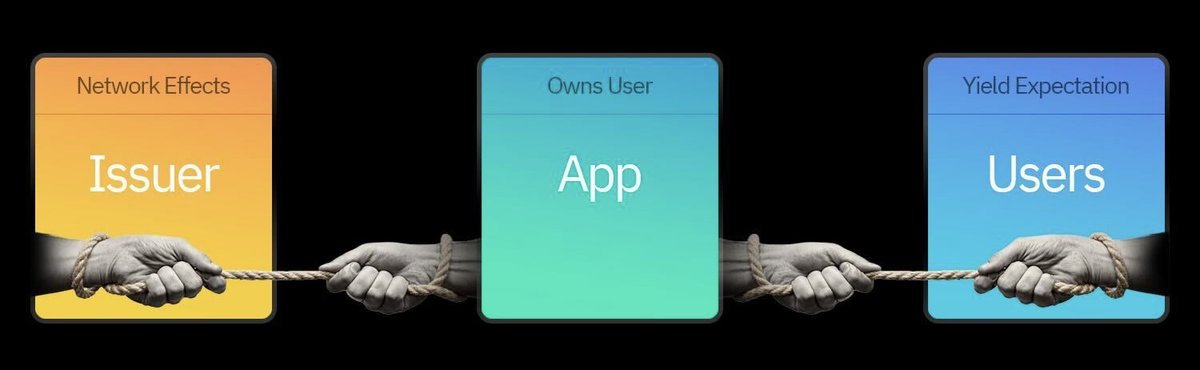
I wrote an article recently (see the next tweet) about a silent tug of war that's broken out between stablecoin issuers, applications, and users. Everyone wants a cut of the float.
The application's pitch to the issuer is essentially: "We own the users. We direct them to your stablecoin. Give us a cut of the yield, or we'll just use a different stablecoin." As a result, applications have been able to capture more and more of the yield. Famously, Coinbase negotiated this with Circle.
As an aside, users have slowly started demanding yield from the applications too (and we see this play out with Coinbase's user rewards as well).
But here's the catch for apps in the current market structure: to get that yield from issuers, applications have to go and negotiate for it rather than getting it out of the box. That's a hassle, and they might not even get the terms they want. So more recently, a lot of applications have started launching their own stablecoins (often with service providers), so the applications can capture the issuance revenue, the float, themselves.
The problem with that approach is interoperability. One of the biggest benefits of something like USDC is that it's widely accepted everywhere. You can move it between platforms and everyone takes it; tons of users already hold it. But when an application spins up its own stablecoin, you lose that. So a lot of companies are now trying to solve that interoperability problem, and any company launching its own stablecoin then needs to choose a provider for it, only adding more complexity.
So logically, many apps think: what if a bunch of us joined a consortium and issued one shared stablecoin? You'd get a yield-sharing agreement out of the box. You'd get composability too, since moving the coin between issuers just works. And every app in the consortium earns the float by default, with no negotiation required. For an app, that's arguably better than going to an issuer and fighting for terms.
This isn't to say the consortium model is going to work. There's a real risk of too many chefs in the kitchen: too many competing incentives, with certain applications onboarding more volume or holding more on platform than others, deals getting recut, and so on. So I'm not necessarily saying this is the structure that wins. But I do think it directionally shows where the incentives point.
Open Standard@openstandard
Introducing Open USD: a stablecoin built for the internet economy, designed by the businesses growing it. joinopenstandard.com/blog/introduci…
English
luis retweetledi

Every year we get our consortium style initiative around a stablecoin, we have seen this with Diem, Global dollar and now Open USD. While the set of players here is obviously potent, I remain highly skeptical any of these initiatives can hit scale.
A few thoughts on OpenUSD:
1. Liquidity and the cold-start problem. USDC and USDT have massive network effects across exchanges, payment processors, and brokers. This is always repeated but it's true, there are no BTC/sofiUSD pairs to trade on any of these exchanges or markets. These are not stableocin market makers and participants are willing to hold in size, as you can’t really use them anywhere.
The fair counter is that crypto markets will be far smaller than remittances or equities/bonds. Probably true, I suspect in the medium term, but those markets are still converging on the same stablecoins. Hyperliquid just struck a massive deal with USDC/Coinbase. Every tokenization initiative so far is built around the incumbents too.
2. A consortium of 500 rivals has no precedent for working. The pace of decision-making across 500 competitors is going to be glacial. Not everyone gets a board seat at Open Standard I imagine, so what happens when decisions cut against some of the players? Circle and Tether ship whatever they want, whenever they want, with zero commitment to anyone.
3. Regulatory and antitrust risk at scale. Circle and Tether are willing to absorb enormous pressure, they have being doing so for years. They hold hundreds of licenses they can use to arbitrage markets, Yes GENIUS act gave a lot of breathing room and clarity, but oversees, this is not the same story. The moment this gets hard under regulatory pressure, I think a lot of these partners just walk away. And a bloc of the largest banks and card networks jointly issuing money is an obvious antitrust target.
4. The "socialist" economics starve the issuer. Passing reserve revenue back to partners sounds great in practice, but what does Open Standard actually operate on? Little to no retained capital. People forget Circle doesn't just have marketplace/exchange partnerships; it funds a whole web of rebates across on/off ramps, stablecoin settlement, OTC desks, and more, with each deal being somewhat bespoke depending not he partner. Who funds that at Open Standard? Who decides which deals, on what terms, especially when the counterparty is a rival of an existing member?
Circle GAAP Opex for 2025 were 900M USD, if you strip out one time cost and IPO related cost, its adjusted OPEX is closer to 500M annually. Let’s say open Standard gets 25 bips, which is what other consortium did, At 10B of supply, open standard is making 25M a year… You don’t fund much with that…. You need to become huge very quickly.
5. The announcement is basically a giant LOI. Read the quotes: BlackRock calls it "a constructive step," BNY "looks forward to exploring ways to support," others say it's "interesting." Meanwhile the partners are backing rivals: Stripe owns Bridge and has its own stack, Coinbase is wedded to USDC, banks are building their own deposit tokens, and the card networks support every token out there. They'll hedge across all of them. Distribution only matters if it's exclusive — and it clearly won't be.
6. The "mint/redeem fees are a problem" claim is wrong. In practice every large institution minting and redeeming through Circle and Tether already gets big rebates. The real cost of moving money is FX, not mint/redeem and there's no moat there, because anyone can just match free mint/redeem.
All in all: one to monitor, but I'm deeply skeptical that an organization that looks like a DAO of 500 companies can move fast enough to matter long term. Who decides go-to-market? Capital allocation? Anything?
Ultimately this reminds me of the DAO experiment. The pitch was identical: no single owner, "neutral" governance, aligned incentives, decisions made collectively for the good of the network. In practice DAOs almost universally failed at the thing that actually matters: shipping. Governance turned into endless forum debates and token-weighted voting where nothing decisive got done, capital sat idle because no one could agree how to deploy it, and the projects that won were the ones with a clear owner willing to move fast and take risk. "Owned by everyone" almost always means accountable to no one. Open Standard is a DAO of competitors that are not really committed to anything, and I'd bet on the two operators who can ship unilaterally over a committee that has to ask 500 rivals for permission.
Open Standard@openstandard
Introducing Open USD: a stablecoin built for the internet economy, designed by the businesses growing it. joinopenstandard.com/blog/introduci…
English


Keep hearing about this, but don’t fully understand where it brings significant utility (solving a problem that doesn’t exist?). On agentic finance side, do we really need sub second rebalancing?
Refreshing read on actual traction.
jessy@13yearoldvc
English
luis retweetledi