

iski | 𝔽rAI
12K posts

Markets don't become efficient because participants are honest.
They become efficient because incentives make honesty the rational strategy.
The most successful protocols won't rely on trust.
They'll make good behavior economically optimal.
@konnex_world
English
Liquidity attracts attention.
Productivity creates lasting value.
The first generation of crypto optimized capital flows.
The next generation has an opportunity to optimize productive work across decentralized networks.
Sustainable ecosystems are built
@konnex_world

English
The internet was built around applications.
The agent economy may be built around services.
Instead of opening an app, autonomous agents could discover tools, combine capabilities, and complete goals across multiple networks.
The interface may disappear.
@konnex_world

English
AI agents may become cheap to create.
Trusted agents will not.
When thousands of agents offer similar services, performance history, reliability, and verified outcomes become the real differentiators.
Intelligence may become abundant.
Reputation remains scarce.
@konnex_world
English
AI will make digital output abundant
But abundance doesn't guarantee value
When anyone can generate thousands of results, the advantage shifts from producing more to identifying what is useful, reliable, and worth rewarding
The next economy may optimize for outcome
@konnex_world

English
AI can produce more work than humans could ever review.
That shifts the bottleneck from creation to evaluation.
The valuable systems won't simply generate more activity.
They'll identify useful outcomes, verify their quality, and direct rewards toward contribution.
@konnex_world

English
AI may make execution abundant.
But abundance creates a new bottleneck:
Choosing which tasks matter, measuring whether they were completed, and directing rewards toward useful outcomes.
When production becomes cheap, allocation becomes valuable.
@konnex_world
English
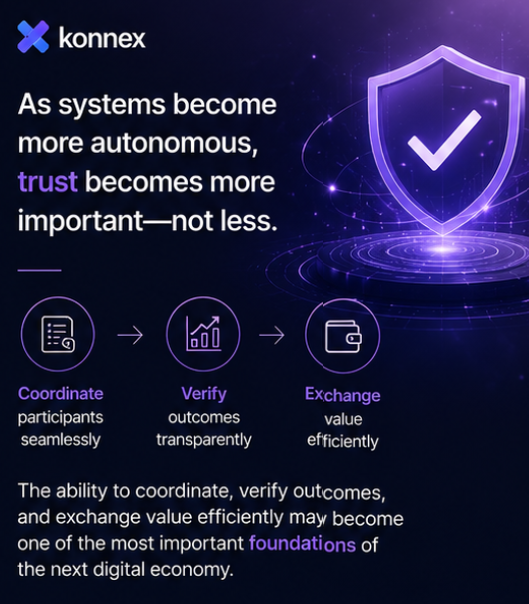
First-order thinking asks:
"Can AI perform this task?"
Second-order thinking asks:
"What infrastructure becomes necessary once millions of AI systems perform tasks simultaneously?"
The biggest opportunities often emerge from second-order effects
@konnex_world
English
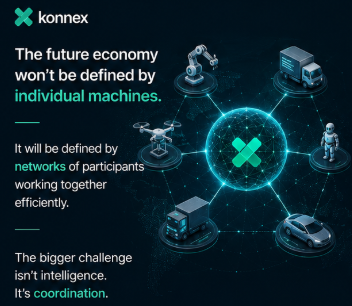
The value of a network isn't determined by how many participants it has
It's determined by how many valuable interactions happen between them.
A million inactive users create little value.
A smaller network with dense economic activity can become far more powerful.
@konnex_world
English
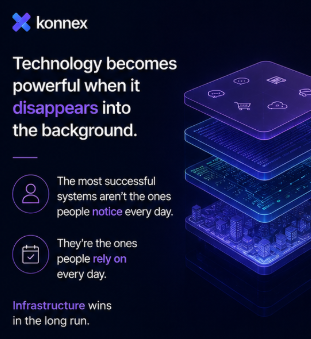
The internet connected information.
Blockchains connected value.
The next frontier may be connecting economic activity itself.
Not just moving assets.
But enabling independent participants to coordinate, contribute, and settle work across open networks.
@konnex_world

English
The biggest shift AI may create isn't better software
It's a new class of economic participants
When software can negotiate, execute tasks, and interact with other software, markets stop being human-only environments.
That's a structural change—not just a technologi
@konnex_world
English
The first wave of crypto digitized assets.
The second wave may digitize work itself.
Not by replacing people,
but by making economic contribution measurable, programmable, and interoperable.
Markets don't just exchange assets.
They exchange effort, outcomes.
@konnex_world

English
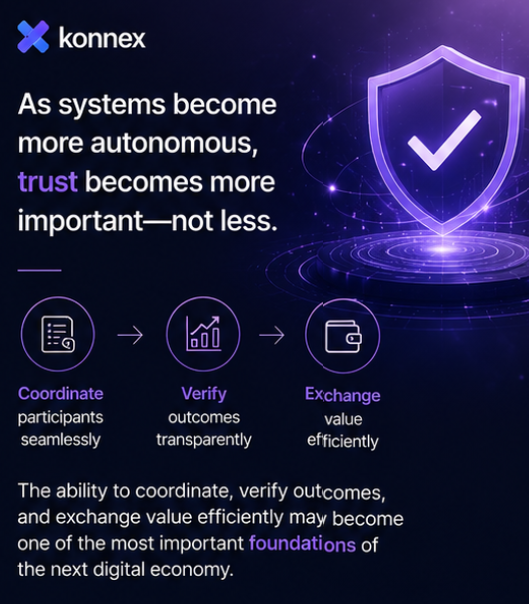
We often think of verification as a security feature.
It may soon become an economic primitive.
When autonomous participants exchange services, the most valuable question isn't "Can this be done?"
It's "Can everyone agree that it was done correctly?"
@konnex_world

English
Markets exist to allocate resources efficiently
But resource allocation depends on one thing
Reliable information
As autonomous systems begin producing economic value, markets will need trustworthy signals about what work was completed by whom and with what quality
@konnex_world
English
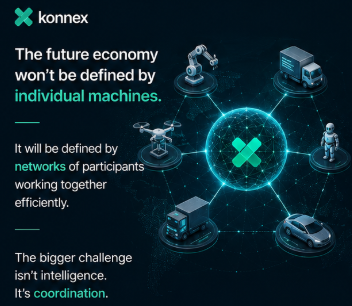
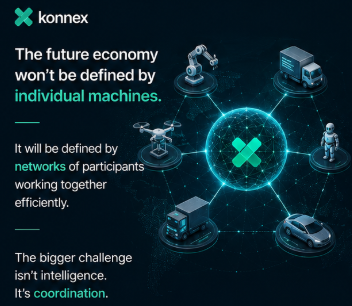
Everyone is racing to build smarter AI.
Few are asking a harder question:
What happens when millions of intelligent agents need to cooperate?
Intelligence scales through computation.
Economies scale through coordination.
The next bottleneck isn't AI capability.
@konnex_world

English
Markets don't fail because people lack ideas.
They fail because coordination is expensive.
Negotiation.
Verification.
Settlement.
Enforcement.
Every time technology reduces coordination costs, entirely new markets emerge.
That's a pattern worth paying attention to
@konnex_world
English
Every new technology creates new possibilities.
Infrastructure determines which of those possibilities become reality.
History rarely remembers the first experiment.
It remembers the infrastructure that allowed millions of experiments to happen.
@konnex_world
English