Spirit

81 posts

Spirit banner
Spirit

Spirit

@equitydecode

I break down how global events, human behaviour, and market psychology actually move money and shape the future. Subscribe to stay ahead.

Katılım Nisan 2026
20 Takip Edilen5 Takipçiler
Spirit
Spirit@equitydecode·
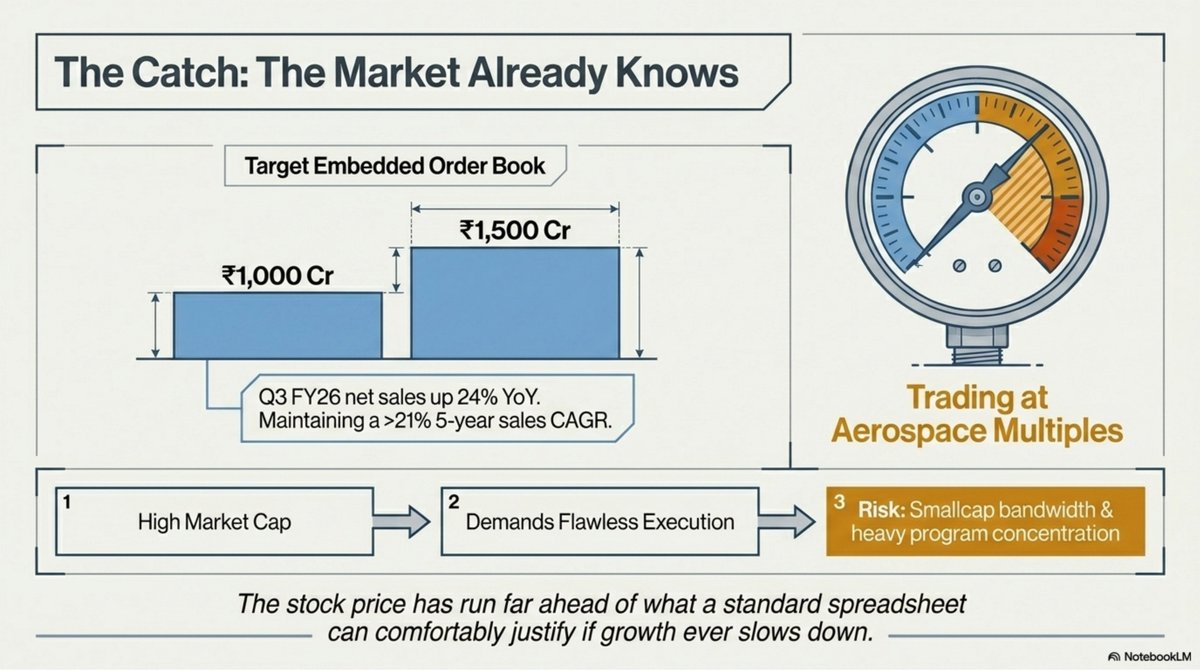
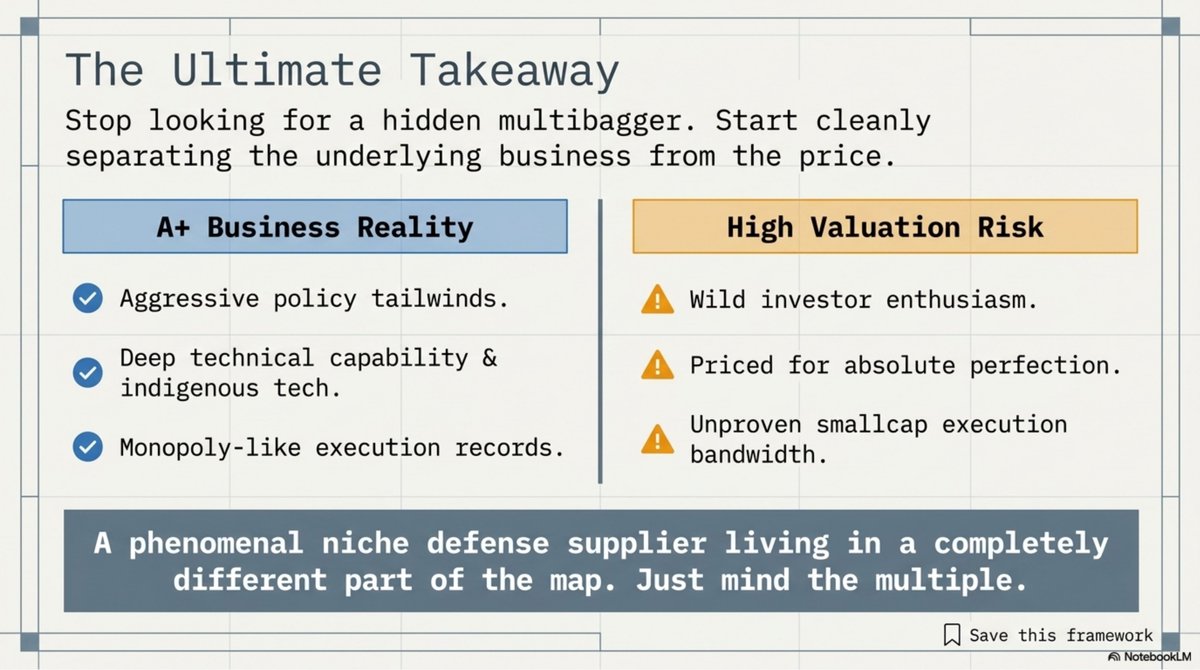
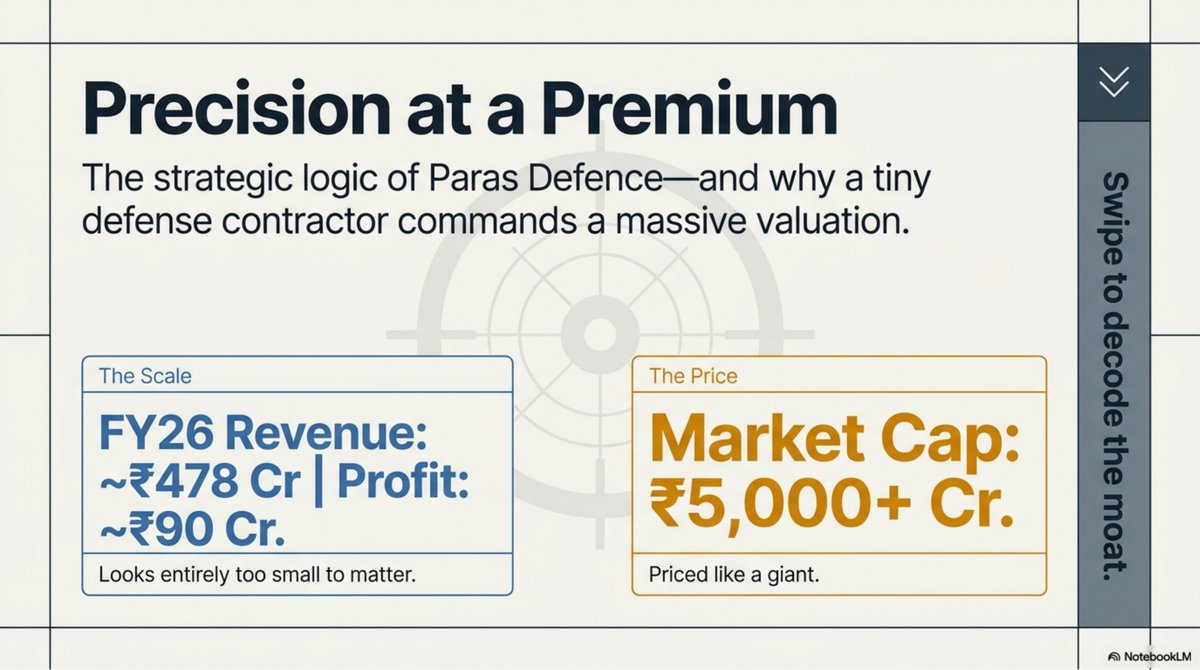
Paras Defence is exactly the kind of company that looks too small to matter right up until you actually read the numbers. This is Day 9/100 of Decoding the Defence Sector For FY26, they reported about ₹478 crore in revenue and roughly ₹88 to ₹90 crore in profit. That is not public sector scale and it is not supposed to be. The company lives in a completely different part of the map spanning space optics, defense electronics, heavy engineering and electromagnetic pulse protection solutions. They sell capability, not volume. Look at their structure today in May 2026. This is one of the few Indian players building indigenous submarine periscopes, hyper spectral cameras for space and turnkey EMP protection. Those are not brochure items. They are mission critical components where failure gets people fired. Qualification cycles are long and replacement options are limited. That creates a moat built entirely on who else can actually do this. The Q3 FY26 results showed net sales of ₹106.35 crore, up 24% YoY. That full year revenue run rate implies a business scaling aggressively while staying profitable. Management guides the order book to eventually cross ₹1,000 crore. For a sub ₹500 crore revenue base, that is serious embedded demand, not just hope. But here is the catch. The markets already know this. At a market cap above ₹5,000 crore, Paras screens as very expensive, with some trackers slapping a sell label purely on valuation. That does not make it a bad business. It just means the stock price moved ahead of what a spreadsheet can justify if growth ever slows. Although Paras sits at a brilliant intersection. The state wants self reliance, DRDO wants domestic partners and foreign OEMs refuse to hand over crown jewel tech. That tension pushes work toward specialized firms with demonstrated execution. The risk is not relevance. The risk is investors paying aerospace multiples for a company still holding smallcap execution bandwidth and heavy program concentration. Yes, Paras is a small company, but the logic around it is massive. This is exactly what a niche defense supplier looks like when policy tailwinds, technical depth and investor enthusiasm collide. Your job is to separate the business quality from the multiple. Found this interesting? Follow @equitydecode for more such insights. Join our Community Channel for FREE on WhatsApp: whatsapp.com/channel/0029Vb… Check my deep dives on various topics on Substack. spicapitalresearch.substack.com Also if you are on insta (of course you are), Follow me on Insta. instagram.com/spicapitalrese… Note: This is not investment advice. Please consult a SEBI-registered financial advisor before making any investment decisions. #Substack #Finance #Valuation #Invest #Money
Spirit tweet mediaSpirit tweet mediaSpirit tweet mediaSpirit tweet media
English
0
0
1
56
Spirit
Spirit@equitydecode·
I was reading through the @SpaceX S1 and realised I needed to write about the crucial details most people might miss. If you are already on X, you will see the filing is widely being read merely as a document about rockets, @Starlink and artificial intelligence. Underneath the surface, it is actually a profound document about raw power. It reveals exactly who holds it, how tightly they grip it,and how incredibly hard it will be for anyone else to pry even a fingertip under the lid. Texas, rather than California, is the new center of legal gravity here. The first quiet but profound choice is jurisdiction. SpaceX is going public as a Texas corporation with its registered office at 1 Rocket Road in Starbase, instead of Hawthorne, California, where so much of its engineering history sits. This might sound purely cosmetic, but it absolutely is not. Texas incorporation means local corporate law and state courts become the primary venue for any future disputes over governance, fiduciary duties, and shareholder rights. It firmly aligns the corporate center of gravity with Elon Musk’s physical and political base in Austin and Starbase, moving far away from California’s highly litigious, plaintiff friendly ecosystem. That specific choice sits right alongside the dual listing reference to Nasdaq and the newly formed Nasdaq Texas, reinforcing that the company desperately wants its legal, regulatory and symbolic home base to be in the Lone Star State. For a founder who has publicly railed against California regulators and institutions for years, this is no accident. It is a massive structural bet on a much friendlier jurisdiction. This is a controlled company by design rather than accident. While almost everyone noticed this will feature dual class stock, far fewer have actually internalized what SpaceX is telling the market. This will operate as a controlled company under standard Nasdaq rules, and management fully intends to use every exemption that status allows. In practice, @elonmusk will hold a majority of the voting power through high vote Class B shares. As long as he maintains that majority, he effectively controls the board, even dictating the seats nominally elected by Class A shareholders. As a controlled entity, SpaceX can legally opt out of strict Nasdaq requirements for independent directors alongside fully independent compensation and nominating committees. Dual class structures are certainly common across the tech sector. What is far less common is a founder who already controls multiple major entities like SpaceX, xAI, and X signaling well in advance that he intends to keep the exact same freedom of motion in public that he currently enjoys in private. You are never just buying a growth story here. You are actively signing up for a governance regime intentionally tilted completely away from any minority shareholder influence. Then we have the ultimate corporate nesting doll regarding @xai , @X , and raw valuation power. Remember that xAI was founded in 2023, and X Holdings eventually ended up underneath it. Then in February 2026, SpaceX acquired xAI, bringing the social media platform right along with it. By the time this IPO hits, the SpaceX you are buying is no longer just rockets and satellites. It is rockets, a global internet provider, a frontier AI lab, and a social platform all stacked inside a single cap table under one man. What is structurally important here is not just corporate synergy. It is absolute pricing power over related party deals. The staggering $1.25 trillion USD figure attached to the xAI acquisition was never discovered in any open market. It was simply the outcome of a transaction between entities that Musk already controlled on both sides. Post IPO, future intra group transactions like licensing X user data to xAI, selling launch capacity internally, or sharing Starlink infrastructure will still be shaped by one single decision maker whose incentives and time horizons may not match those of minority public shareholders. The S1 talks about X as a foundational distribution and data engine for Grok, hinting at a highly asymmetric relationship. One asset owns the user data, another uses it to train models, and a third asset now owns them both. If regulators challenge this data sharing, or if Musk decides to prioritize one platform’s economics over another, public shareholders will have no contractual veto. They will simply have to live with the consequences. Control is not just about voting rights but it is also about who gets the best slices of the financial pie and exactly when they get them. Buried deep in the S1 is a reference to a Directed Share Program, with the percentage and eligible groups heavily redacted for now. While reserving shares at the company’s request is a standard underwriting mechanism, it matters deeply in this specific context. The ecosystem insiders spanning employees, key partners, and Musk adjacent investors will likely get first round access at the IPO price long before the broader market allocation. External reporting also suggests SpaceX will allow some early share resales before the typical six month lock up expires through highly structured liquidity programs. Combine those two facts and a very clear picture emerges. Insiders and early backers have privileged access on the way in and extra flexibility on the way out, while new public investors are locked into whatever governance regime exists on day one. There is one more subtle checkbox to notice. SpaceX is classified as a non accelerated filer and explicitly not an emerging growth company. Choosing to reject EGC status lets them avoid the optics of baby company disclosures. Meanwhile, staying out of the large accelerated filer bucket provides a bit more flexibility on reporting timelines and internal control requirements than a standard mega cap would typically face. This is pure optimization at the margins. It is legally conservative enough to reassure big institutions, yet flexible enough to avoid the tightest filing burdens. In a company where the CEO has consistently shown a taste for pushing against regulators, even small degrees of reporting slack are highly non trivial. Put all this together and the actual governance story looks incredibly stark. You have Texas law, Texas courts, and a Texas headquarters. You have dual class super voting shares controlled by a founder running multiple intertwined businesses. You have formal controlled company status with the explicit intent to use every single exemption. You have a nested web of related parties where valuations and inter company economics are set entirely inside the ecosystem rather than by arms length markets. Finally, you have directed share programs quietly privileging insider entry and exit points. That does not automatically make this a bad investment today in May 2026. It just means the S1 is brutally honest about exactly who will run this experiment and on whose terms. If you buy this IPO, you are not just betting on rockets, Starlink, or Grok. You are betting that a highly centralized power structure, built deliberately to resist outside pressure, will keep allocating your capital in ways that compound value faster than cleaner, more conventional names in each vertical ever could. The question is no longer whether Musk will control SpaceX post IPO. The S1 has already answered that definitively. The real question is whether you are comfortable owning a stock where the most important decisions will be made down in Starbase, rather than in the boardroom you nominally help elect. Found this interesting? Follow @equitydecode for more such insights. #elon #spacex #starlink #xai #valuation #finance
Spirit tweet media
English
0
1
1
47
Spirit
Spirit@equitydecode·
A recent Barron's piece backed by S&P Global Market Intelligence data shows exactly how aggressively the ultra wealthy are changing their investment playbook today. Looking back at the full year of 2025, family offices deployed $12.9 billion USD in direct deals across 158 transactions. That is a 123% jump YoY and the highest level seen since 2021. Crucially, this capital completely bypassed traditional private equity and venture capital funds, flowing straight into operating companies and hard assets. Where is all this money actually going? Two specific hotspots stand out right now. The first is minerals and mining. Family offices are heavily buying into critical minerals and infrastructure tied to electrification and energy transition supply chains. These are long duration asset plays carrying massive strategic and geopolitical upside. The second is telecom and media, where capital is pouring into spectrum heavy businesses offering recurring cash flows and deep pricing power. Geographically, North America captured about half of that capital at roughly 6.5 billion dollars. However, families are actively diversifying into Europe and the Asia Pacific region to escape US-centric risk and overly rich valuations. Why bypass the funds? The underlying themes are pretty obvious. Families want direct control over governance, timing and exits. They are deeply frustrated with the endless fees layered into traditional fund structures and they firmly believe they can underwrite concentrated, long term risk far better than diversified institutions. Legal and advisory firms are now scrambling to build bespoke platforms to help these offices source and operate direct deals, especially in highly complex sectors like mining. For anyone watching the smart money, the signal is incredibly clear. The ultra wealthy are officially trading fund exposure for direct strategic ownership and that fundamental shift carries serious implications for private equity fundraising and deal competition over the next cycle. Found this interesting? Follow @equitydecode for more such insights. 👉 Join our Community Channel for FREE on WhatsApp: whatsapp.com/channel/0029Vb… 👉 Check my deep dives on various topics on Substack. spicapitalresearch.substack.com 👉 Also if you are on insta (of course you are), Follow me on Insta. instagram.com/spicapitalrese… #PrivateMarkets #DirectInvesting #InstitutionalInvesting #Finance #Investing #FamilyOffice #UltraHighNetWorth #WealthManagement #Telecom #Minerals
Spirit tweet media
English
0
0
0
11
Spirit
Spirit@equitydecode·
@elonmusk Am I the only one who thinks it looks like aliens?
English
0
0
1
19
Spirit
Spirit@equitydecode·
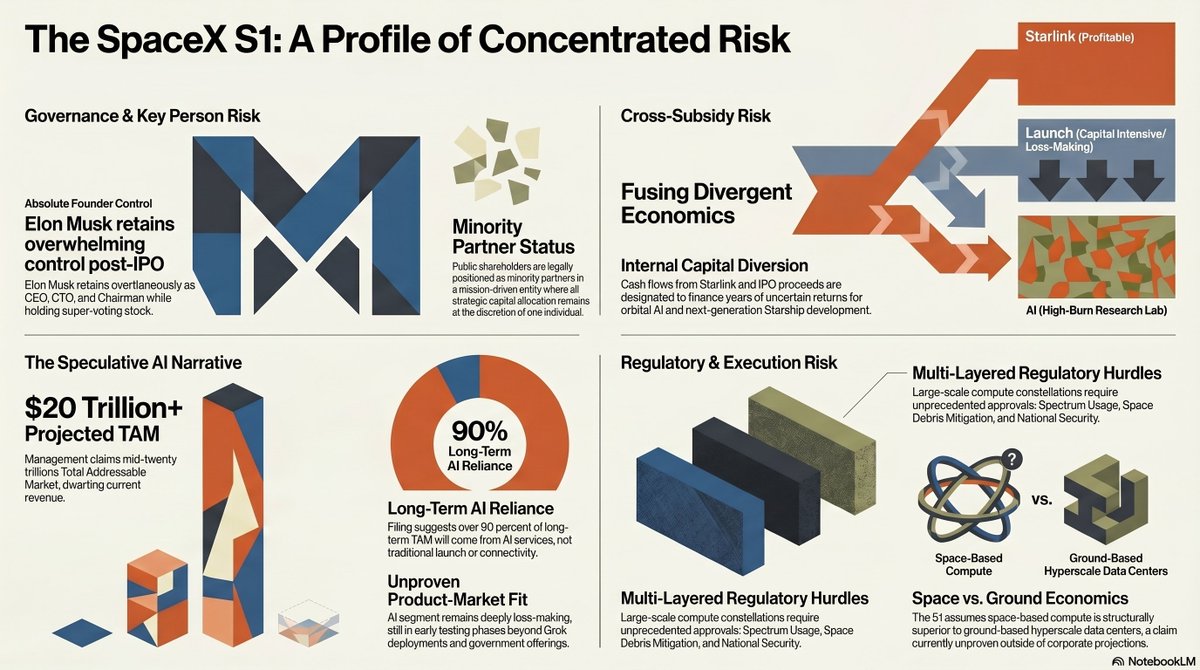
Every great growth story comes with risk factors, but the SpaceX S1 packs several that are unusually concentrated. This is Part 3 of Decoding @SpaceX IPO The first is governance and key person risk. This remains Elon Musk's company in every relevant way. The filing makes clear he will serve as CEO, CTO, and chairman, holding super voting stock that leaves him with overwhelming control post IPO. That means public shareholders are effectively minority partners in a mission driven, founder controlled entity where strategic capital allocation across launch, Starlink, and AI rests primarily on one person's judgment. The second is cross subsidy risk. The combined entity fuses three businesses with entirely different economics and maturity curves. Starlink is already profitable at the segment level. Meanwhile, launch remains structurally capital intensive and currently loss making because of Starship. AI currently operates as a high burn, negative EBITDA frontier research lab wrapped in early stage monetization. In practice, this means Starlink's cash flows alongside the IPO proceeds are set to finance years of highly uncertain returns from orbital AI and next generation rockets. Third, the AI narrative itself introduces a massive layer of speculative risk. Management leans on total addressable market figures reaching into the mid twenty trillion dollar range for AI and related services, claiming that over 90 percent of its long term TAM could come from AI rather than launch or connectivity. Those numbers completely dwarf today's actual revenue contributions and sit against an AI segment that is deeply loss making and still testing product market fit beyond its early Grok deployments and government offerings. Finally, the orbital AI and millions of satellites vision brings regulatory and execution risk to another level. Powering large scale compute constellations in orbit requires regulatory approvals across spectrum, space debris, safety, and national security. It also blindly assumes that the economics of space based compute will remain structurally superior to ground based hyperscale data centers, which has yet to be proven outside corporate slide decks. For public investors evaluating this today in May 2026, these are not abstract risks. They are the exact difference between a durable cash flow compounder and a perpetual capital raise machine Found this interesting? Follow Shubham Singh for more such insights. 👉 Join our Community Channel for FREE on WhatsApp: whatsapp.com/channel/0029Vb… 👉 Check my deep dives on various topics on Substack. spicapitalresearch.substack.com 👉 Also if you are on insta (of course you are), Follow me on Insta. instagram.com/spicapitalrese… #SpaceX #IPO #Finance #Linkedin #TSLA
Spirit tweet media
English
0
0
1
21
Spirit
Spirit@equitydecode·
A few years ago, buying beauty products meant relying on a local shop or a mall counter. But Today in 2026, the purchase journey starts directly in our social feeds, completely breaking the old physical retail moats. I just published a deep dive into how this shift from a push to a pull model made @MyNykaa possible. Many investors treat Nykaa like a generic ecommerce platform, which completely misses their true value. The real magic lies in their inventory led beauty business, where private labels are never just side projects. They are a profound margin architecture that significantly lifts profitability. While their fashion segment is cyclical and headline valuation ratios look absurd, their core beauty engine is proving real operating leverage alongside durable earnings power. With giants like Reliance and Tata aggressively entering the space, the true battle is now entirely about who owns the premium discovery layer. If you want to look past the misleading metrics and understand the actual unit economics of the Indian beauty boom, give the full piece or the podcast version a read or listen. open.substack.com/pub/spicapital… Found this interesting? Follow @equitydecode for more such insights. #Nykaa #Investing #Finance #IndianRetail #BusinessStrategy
Spirit tweet media
English
1
0
1
15
Spirit retweetledi
Elon Musk
Elon Musk@elonmusk·
ZXX
7.9K
20.6K
219.8K
51.1M
Spirit
Spirit@equitydecode·
Day 32/100 of Equity Decoded By Spirit Newsletter The China Plus One narrative dominates global finance, but the reality presented in glossy investor decks looks completely different from the actual situation on the factory floor. India has undeniably secured the broader narrative victory, yet the underlying data reveals Vietnam is quietly securing a massive share of the actual production facilities. Procurement officers do not care about grand geopolitics because their survival depends entirely on supply chain density, acceptable defect rates and whether a crucial shipment leaves the port perfectly on schedule. Vietnam has spent the past decade making itself operationally inevitable for export manufacturers, while India remains busy navigating complex state level administrative bottlenecks. Despite this stark operational gap, capital markets are aggressively pricing Indian manufacturing equities at 40x to 70x times forward earnings. Delusional investors are treating a brutal three year vendor qualification cycle as if it delivers immediate free cash flow. If you want to look past these glaring valuation mismatches to understand who is genuinely winning the global reshuffle and where the real strategic edge for India actually lies, read the full breakdown. open.substack.com/pub/spicapital… Found this interesting? Follow @equitydecode for more such insights. #SupplyChain #Manufacturing #Investing #Geopolitics #Finance
Spirit tweet media
English
0
0
0
6
Spirit
Spirit@equitydecode·
What's harder for you in stock markets right now? A) Finding good businesses B) Buying them at good prices C) Holding through volatility D) Avoiding behavioral traps Vote + reply why. I'll share insights from my research in replies. #Finance #Investing #AMA
English
0
0
0
7
Spirit
Spirit@equitydecode·
Strip away the grand mission statements and the @SpaceX 's S1 admits something incredibly blunt. SpaceX is still a loss making company at the consolidated level despite its enormous scale. For 2025, they generated roughly 18.7 billion dollars in revenue but still posted an operating loss in the mid single digit billions. In the first quarter of 2026 alone, they lost nearly 2 billion dollars from operations on just under 4.7 billion dollars of total revenue. On an adjusted basis, management leans hard on EBITDA and Segment Adjusted EBITDA to project a much healthier picture. However, those specific metrics are by definition calculated after backing out some very real economic costs. Once you disaggregate the numbers, the overall pattern becomes even starker. The Connectivity segment driven by Starlink is the absolute profit engine, throwing off billions in segment operating income and even more in adjusted EBITDA. Meanwhile, the Space segment containing the launch and Starship business that most people still associate with SpaceX is entirely loss making on a segment basis. Massive Starship research and development alongside heavy infrastructure build outs completely swamp their current launch economics. Then we have AI. The division now wrapped around the acquisition of xAI and its Grok models booked close to 3.2 billion dollars in revenue in 2025. Yet, it burned through more than 6 billion dollars in segment operating losses that same year, followed by nearly 2.5 billion dollars in operating losses in just the first quarter of 2026 alone. Layered directly on top of this is capital expenditure. Throughout 2025, total capex surpassed 20 billion dollars, with roughly 12.7 billion dollars of that massive sum attributed to AI alone. The balance was split between launch infrastructure and the growing Starlink constellation. That capex trajectory is definitely not a one off event. The filing explicitly discusses deploying orbital AI compute, gigawatt scale power in space and potentially millions of new satellites starting in 2028. Each of those ambitions implies massive multi year capex waves. For investors evaluating this IPO, the core numeric truth is incredibly simple. This is not a free cash flow story right now. It is a heavily scaled, loss making platform where a single profitable segment like Starlink heavily subsidises both next generation launch systems and a remarkably expensive AI bet. Whether that proposition actually looks attractive depends entirely on your personal belief in the massive optionality those loss making segments ultimately create. Found this interesting? Follow @equitydecode for more such insights. 👉 Join our Community Channel for FREE on WhatsApp: whatsapp.com/channel/0029Vb… 👉 Check my deep dives on various topics on Substack. spicapitalresearch.substack.com @elonmusk #FinancialAnalysis #Valuation #Finance #Investing #SpaceX
Spirit tweet media
English
0
0
0
5
Spirit retweetledi
digital ghost
digital ghost@vibeeval·
200 yıllık biyoloji kitabı bir hafta sonunda öldü. birisi oturmuş, hücreleri 3d gezdiğin bir app yapmış. video oyunu gibi. nöronu döndürüyorsun, aksonun içine giriyorsun, organeli tek tek ayıklıyorsun. > arayüz: gpt image 2 > kod: gemini 3.5 flash iki model. bir hafta sonu. matbaanın 1450'den beri yapamadığı şey. birkaç yıla okullarda standart bu olacak. bizimkiler hala "tablet mi defter mi" tartışıyor. oğlum çocuk hücreyi elinde çeviriyor artık. sen neredesin?
Türkçe
67
396
2.4K
176.4K
Spirit
Spirit@equitydecode·
@commiepommie Watt a thrill! Who knew EVs could drift this hard? ⚡
English
0
0
1
189
James Wood 武杰士
James Wood 武杰士@commiepommie·
Who said EVs aren't fun to drive? Xiaomi YU7 GT. 🇨🇳
English
57
76
539
19.5K
Elon Musk
Elon Musk@elonmusk·
T-zero is currently 5:30 Texas time
English
5K
16.1K
128.8K
9.3M
Spirit
Spirit@equitydecode·
Think about what Lockheed Martin actually sells. Yes, it builds aircraft. But what it really sells is the design ownership. They hold the intellectual property, the system architecture and the technical authority over what goes into each platform upgrade across a forty year service life. The companies manufacturing components for those platforms are technically also in defence, yet their return profile is entirely different. This is Day 8/100 of Decoding the Defence Sector This distinction between an original equipment manufacturer and a supplier is the most important structural variable in Indian defence investing. It gets glossed over constantly in sector coverage that treats every defence company as part of the exact same investment theme. Hindustan Aeronautics Limited is a true OEM. While imperfect and still import dependent on engines and certain avionics, it remains an OEM nonetheless. It owns the design for the LCA Tejas, the LCH Prachand and the Advanced Light Helicopter. That design ownership generates a massive captive revenue stream of upgrades, modifications, spares, and maintenance across platforms flying for decades. The Ministry of Defence cannot simply switch vendors for a platform HAL designed. That is a very real moat, even if the operating efficiency behind it leaves room for improvement. Bharat Electronics Limited sits in an interesting middle zone. For specific radar and electronic warfare systems developed with DRDO, BEL holds meaningful design authority. For other products built under licence or in collaboration with foreign partners, it acts more like a Tier 1 supplier with captive demand but limited pricing power and no upgrade revenue stream of its own. GRSE and Cochin Shipyard build strictly to Navy specifications. They are builders rather than designers. Their competitive advantage is construction capacity and quality execution, not intellectual property. DCX Systems primarily assembles cable harnesses and integrates electronic systems. This is an incredibly valuable and growing business, but it carries a completely different margin ceiling. Knowing which side of this line a company sits on must be step one in any defence sector analysis. Everything else, from multiples and order books to growth rates, naturally follows from there. Found this interesting? Follow @equitydecode for more such insights. Join our Community Channel for FREE on WhatsApp, Link in Bio #finance #linkedin #investing #defence #AI #algorithm
Spirit tweet media
English
0
0
0
2
Spirit retweetledi
まだ面白い
まだ面白い@madaomoshiroi·
ソニーが開発したマイクロサージェリーロボットがトウモロコシの粒を縫合する様子が凄すぎる
日本語
49
620
3.5K
659.3K
Spirit
Spirit@equitydecode·
3M India just announced a ₹506 per share dividend, and the market reaction has been overwhelmingly positive. But if you look closely at the Q4 numbers, where profits jumped 202% YoY to ₹215 crore and the stock rallied over 3%, there is a much deeper capital allocation play happening here. Let's look at the actual payout history. Since FY22, they handed out an ₹850 special dividend in November 2022, followed by ₹685 in FY24, ₹535 in FY25, and now this ₹506 in FY26. That is over ₹2,500 per share extracted in just four years from a stock trading above ₹33,000. We should not mistake this for standard shareholder generosity. The US parent company controls roughly 75% of the Indian arm. These special dividends act as a highly tax efficient pipeline to move cash straight from India back to Minneapolis. Minority shareholders get a cut, but the parent company is entirely driving this bus. Keep in mind the broader restructuring that began when 3M globally spun off Solventum back in 2024. The Indian operations remain highly profitable today in May 2026. Yet, multinational parents face immense pressure to optimize capital for their US shareholders. In that environment, the Indian subsidiary functions heavily as a cash cow rather than a core growth engine. The parent company gets to extract maximum cash while keeping the Indian operations liquid and listed. If domestic growth eventually slows down or if headquarters suddenly requires heavy capital for AI transitions in the US, we have to wonder what the next step is. Are we looking at a future delisting, a strategic sale, or just years of continued extraction? The headline numbers look fantastic and the yield is certainly attractive for retail investors holding the stock right now. However, you have to decide if you are comfortable holding an asset where the primary objective seems to be repatriating capital rather than compounding domestic growth. Found this interesting? Follow @equitydecode for more such insights. 👉 Join our Community Channel for FREE on WhatsApp: whatsapp.com/channel/0029Vb… 👉 Check my deep dives on various topics on Substack. spicapitalresearch.substack.com 👉 Also if you are on insta (of course you are), Follow me on Insta. instagram.com/spicapitalrese… #Finance #Dividends #MNCIndia #ValueInvesting #Linkedin
Spirit tweet media
English
0
0
0
46
Spirit
Spirit@equitydecode·
Most people think of logistics simply as trucks moving boxes, but as we look at the landscape in 2026, it is actually the ultimate leverage play on India's massive GDP ambitions. I recently dug into how this sector truly operates and here is what most are getting wrong - The Cost Myth: We are no longer stuck at 13% to 14% logistics costs. Primary data shows it has already dropped to 7.97 percent of GDP. - The Valuation Trap: Applying the same EV/EBITDA multiple to a heavy asset port and a light asset tech delivery network is a massive category error. - The Rail Advantage: Dedicated Freight Corridors are making rail freight nearly six times cheaper than road transport, completely changing our structural bottlenecks. A quick heads up that I am not SEBI registered, so please do not take this as investment advice. Always consult your financial advisor! Check out the full breakdown in the link below to see how smart capital is positioning itself in this space. spicapitalresearch.substack.com/p/the-invisibl… Found this interesting? Follow @equitydecode for more such insights. #Finance #x #investing #supplychain #valuation #Investing
English
0
0
0
5
Spirit
Spirit@equitydecode·
Part 1: The day the SpaceX S1 dropped On May 20, SpaceX finally delivered what public markets had been anticipating for over a decade. They filed an S1 with the SEC and opened a rare window into the inner economics of the most hyped private company on the planet. Almost overnight, a business that thrived in the shadows of private capital and secondary trades transformed into a regulated story stock. They are now forced to translate grand dreams of Mars colonies and orbital artificial intelligence into mundane line items, distinct segments, and clear risk factors. The headline narrative is actually quite simple. SpaceX today is no longer just a launch company. It has evolved into a vertically integrated conglomerate spanning three massive pillars. You have reusable rockets in the Space segment, a global satellite internet network through Starlink and a bleeding edge AI stack anchored by their acquisition of xAI and its flagship Grok model. This is not a pure play infrastructure story, nor is it a pure play software or AI narrative. It is a highly capital intensive hardware, connectivity and compute ecosystem all stapled together under one cap table and one man's vision. What this filing does for the very first time is split that massive vision into three distinct profit and loss streams. Space remains the original core, but it is still in heavy investment mode with Starship development completely dominating capital expenditures. Meanwhile, Starlink has quietly become the absolute workhorse. It is a recurring revenue machine boasting tens of billions in annual sales, strong segment profits and the massive cash flows needed to fund everything else. Finally, the newest AI limb is both the largest incremental cash sink and the least proven revenue engine, even though it is heavily pitched as the ultimate gateway to a multi trillion dollar addressable market. Seen through that specific lens, the S1 is not just a ticket to what might become the largest IPO in history. It is a massive stress test to see if public markets are actually willing to underwrite a single vehicle that simultaneously operates like a deep tech defence contractor, a global telecom operator, and a frontier AI lab. Over the next three posts, I will walk you through the actual numbers, the structural red flags, and what this filing really asks of public investors. Found this interesting? Follow @equitydecode for more such insights. @elonmusk #SpaceXIPO #Markets #Investing #SpaceEconomy #Finance #IPOs
Spirit tweet media
English
0
0
0
8