Equity Scientist

1.1K posts

Equity Scientist

Equity Scientist

@equityscientist

Scientist (Drug discovery) | Business Analysis | Value Investment | Financial Behaviour| NISM certified Research Analyst !!!

Pune, India Katılım Mart 2012
1.2K Takip Edilen206 Takipçiler
Equity Scientist retweetledi
Cosmos Archive
Cosmos Archive@cosmosarcive·
A solitary neuron in vitro, its growth cone extending through the void in a precise, almost poignant search for synaptic connection Even at the cellular level, the imperative to connect is fundamental.
English
9
33
123
6.8K
Equity Scientist retweetledi
Physics & Astronomy Zone
Physics & Astronomy Zone@zone_astronomy·
To think that we aren't just going "to the Moon," but rather traveling to meet it at an exact point in space... changes everything. ​It all comes down to orbital mechanics: arriving at the precise location, at the precise moment. ​One tiny error... and it simply doesn't happen
English
713
5.5K
34.5K
3M
Equity Scientist
Equity Scientist@equityscientist·
Many billionaires follow this practice worldwide! Middle class is net taxpayer w.r.t their income!
English
0
2
3
453
Equity Scientist retweetledi
Deep Psychology
Deep Psychology@DeepPsycho_HQ·
This experiment explains why people stop trying. > Why do people suddenly stop trying, even when success is right in front of them? A famous psychological concept called Learned Helplessness helps explain this. In one demonstration, a predator fish was placed in a tank with smaller fish separated by a transparent barrier. Each time it tried to attack, it hit the invisible wall. After many failed attempts, the predator eventually stopped trying. Then the scientists removed the barrier. The smaller fish swam freely in front of the predator, but it never attacked again. Its brain had already learned that trying was useless, even though the obstacle was gone. > Humans can fall into the same mental trap. Repeated failures can teach the brain that effort leads nowhere, creating invisible barriers in our own minds. But the hopeful part is that the brain works both ways. The same ability that can train us to give up can also train us to persist. With new attempts, small victories, and repeated positive outcomes, the mind can relearn that effort leads to progress. The same mechanism that once held us back can become the force that pushes us forward.
English
21
152
509
46.5K
Equity Scientist
Equity Scientist@equityscientist·
Are these telecom generators E100 compatible?
English
0
0
1
13
Equity Scientist
Equity Scientist@equityscientist·
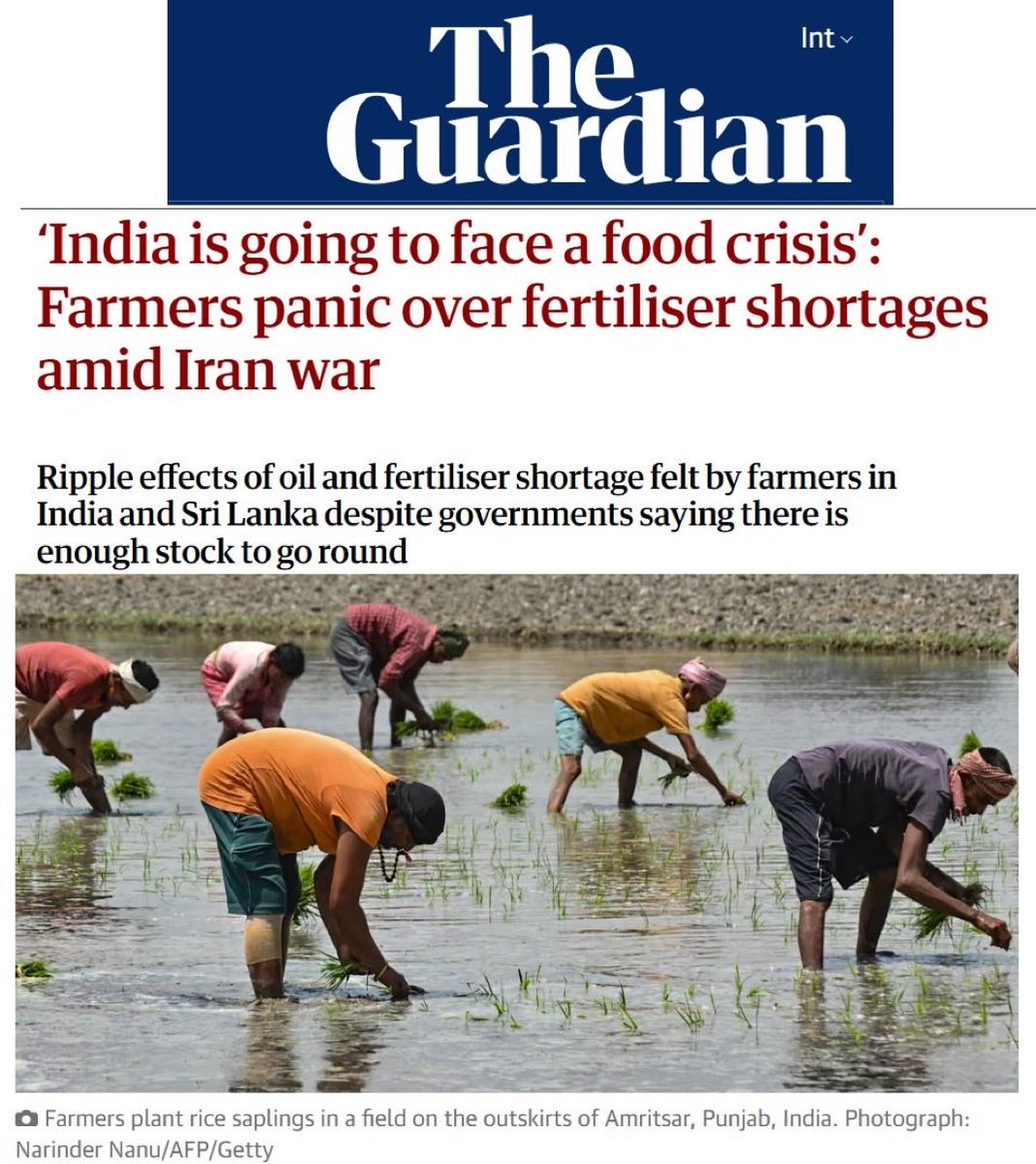
USA 🇺🇸 asked to sell its agricultural products in India 🇮🇳 during tariff negotiations.
Equity Scientist tweet media
English
0
0
0
17
Equity Scientist
Equity Scientist@equityscientist·
Self reliance is very important although sometimes economically not beneficial! World also got lesson regarding Rare earth minerals.
World Data Analysis@World_Data_A

🇮🇳 India’s fertilizer puzzle: subsidies, localization, and structural bottlenecks For India, fertilizer is no longer just a farm issue, it is now tied to LNG dependence, fiscal costs, and food security ! India knows fertilizer dependence could eventually become a constraint on its growth story. Yet policy progress still appears slower than the strategic importance of the issue. This may be just as important as manufacturing productivity or digital services, because a large share of India’s population still ultimately depends on agriculture for income and food security ! Chart 1) Subsidy burden remains structurally high. The top-right chart is striking: * total fertilizer subsidy rises from roughly ₹70,000 crore in FY2019 * peaks above ₹2.4 lakh crore in FY2023 * remains close to ₹1.6–1.9 lakh crore through FY2027 estimates Important: Support for indigenous urea remains the largest component at roughly ₹85–95k crore, while imported urea support fluctuates around ₹20–35k crore depending on global price conditions. A smaller but still important share comes from recovery payments, which account for roughly 5–10% of the total subsidy pool in recent years. 2) Imported LNG dependency is the real vulnerability. The bottom-left chart explains the core risk. Domestic gas use in fertilizer production falls from roughly: ~43% in FY2019 to ~15% by FY2024–26 At the same time, imported LNG rises toward ~85%. This is the real bottleneck: India’s fertilizer system is increasingly linked to global LNG price volatility. Actually, this is not only a farm subsidy issue. It is also an energy import risk problem. 3) The left chart shows a clear structural trend: omestic gas use in India’s fertilizer sector falls steadily from around 43% in FY2019 to nearly 15% by FY2024–26, while imported LNG rises to almost 85%. This means fertilizer production is becoming increasingly exposed to global LNG volatility. 4) Price spread keeps the subsidy trap alive. The bottom-right chart shows why localization is urgent. The spread between domestic gas and spot LNG: * jumps above $20/MMBtu in FY2022 * peaks near $22.5 in FY2023 * still remains elevated into FY2027 estimates This gap directly feeds the subsidy bill. As long as India relies on expensive spot LNG, the government is effectively absorbing imported energy volatility through fertilizer subsidies. Source: @ieefa_institute by @PurvaJain31

English
1
0
1
55
Equity Scientist retweetledi
Lukas Ekwueme
Lukas Ekwueme@ekwufinance·
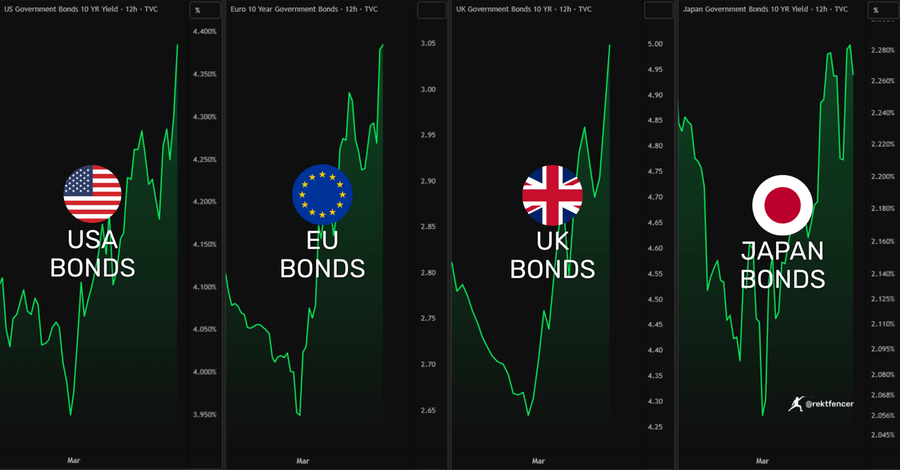
Bond yields are surging... right when we can’t afford it. After the world printed record amounts of money during the lockdowns, we saw a historic surge in yields. Now we have entered the next inflationary crisis. But this time, there is no real ammo left to fight it. With debt-to-GDP levels at ~100%, raising interest rates further would directly threaten the solvency of governments... which leaves financial repression as the only viable path. Keeping interest rates below inflation and thereby inflating the debt away to a more manageable level. This is exactly how the US reduced its WWII debt, which was at similar debt-to-GDP levels. Sustained inflation, especially during the 70s, pushed debt-to-GDP from ~120% down to ~30%, which then allowed Volcker to raise rates to ~20% and finally kill inflation. First you inflate the debt away, then you fight inflation... We are at the inflation stage.... position accordingly.
Lukas Ekwueme tweet media
English
27
127
540
27.5K
Equity Scientist retweetledi
Barchart
Barchart@Barchart·
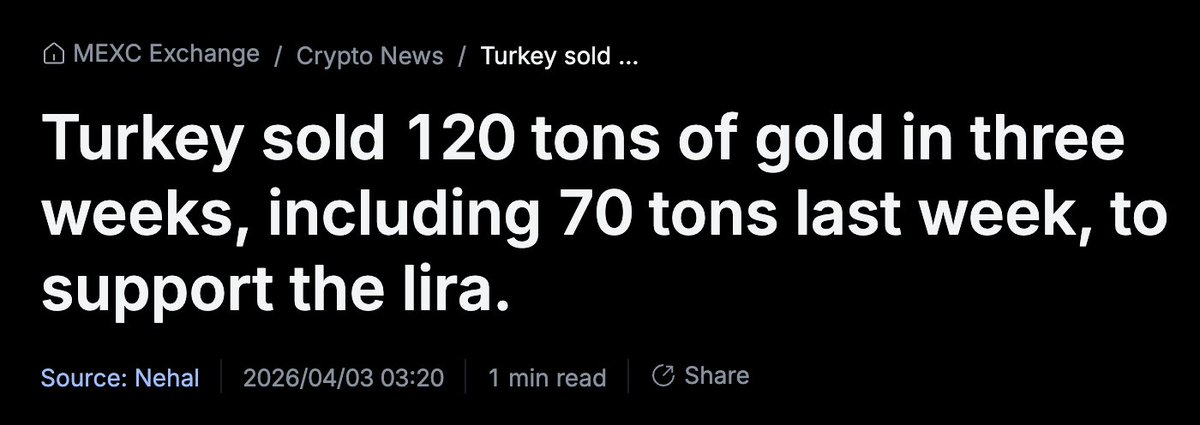
Turkey dumped 120 tons of Gold over the last 3 weeks to support their currency, and the Turkish Lira still fell to an all-time low 🇹🇷📉 Ouch! 🤦‍♂️
Barchart tweet media
English
79
220
1.4K
83.9K