
Eric Xing

548 posts

Eric Xing banner
Eric Xing

Eric Xing

@ericxing

Researcher, educator, entrepreneur, and administrator in computer science, artificial intelligence, and healthcare.

San Francisco, CA Katılım Mayıs 2010
21 Takip Edilen10.2K Takipçiler
Eric Xing retweetledi
Institute of Foundation Models
This weekend at @agisummitai SF, IFM’s Hector Liu (@waterluffy) will take the stage to share his perspective on what the next generation of foundation AI will require. San Francisco, we’ll see you soon!
AGI Summit@agisummitai

🧠 Speaker Spotlight: Hector Liu @waterluffy Building language models teaches AI the patterns of human expression. Building world models demands something harder: making AI understand how the world actually works — and reason about what comes next. Hector Liu is Director of the Silicon Valley Lab at the Institute of Foundation Models (IFM) @IFM_MBZUAI, leading research at the frontier of both large language models and world models. 🔹 Leads development of K2, one of the most performant open reasoning models 🔹 Leads development of PAN, one of the earliest world models at the frontier of foundation AI 🔹 Architect of @llm360, a fully open initiative for transparent LLM development As the field moves from language to world models, the researchers building both are uniquely positioned to see what the next generation of foundation AI requires, and what trade-offs the rest of the industry hasn't yet confronted. Hear Hector on stage at AGI Summit SF 2026. 📅 July 18–19, 2026 📍 Palace of Fine Arts, San Francisco 🎟️ Tickets: luma.com/agisummit2026?… 🏷️ 15% off automatically applied through the link #AGISummit #WorldModels #FoundationModels #OpenSourceAI #ArtificialIntelligence #SanFrancisco

English
0
1
10
1.9K
Eric Xing retweetledi
Institute of Foundation Models
ICML 2026 in Seoul has turned into a live lab for open, sovereign foundation models—and IFM was right in the middle of it, with engineers and researchers from Abu Dhabi, Paris, and Silicon Valley on site. From K2-series demos to world-model discussions, the through-line is simple: AI that the community can inspect, reproduce, and use as a real building block. Learn more about what we're building: ifm.ai
English
0
1
17
1.7K
Eric Xing retweetledi
Institute of Foundation Models
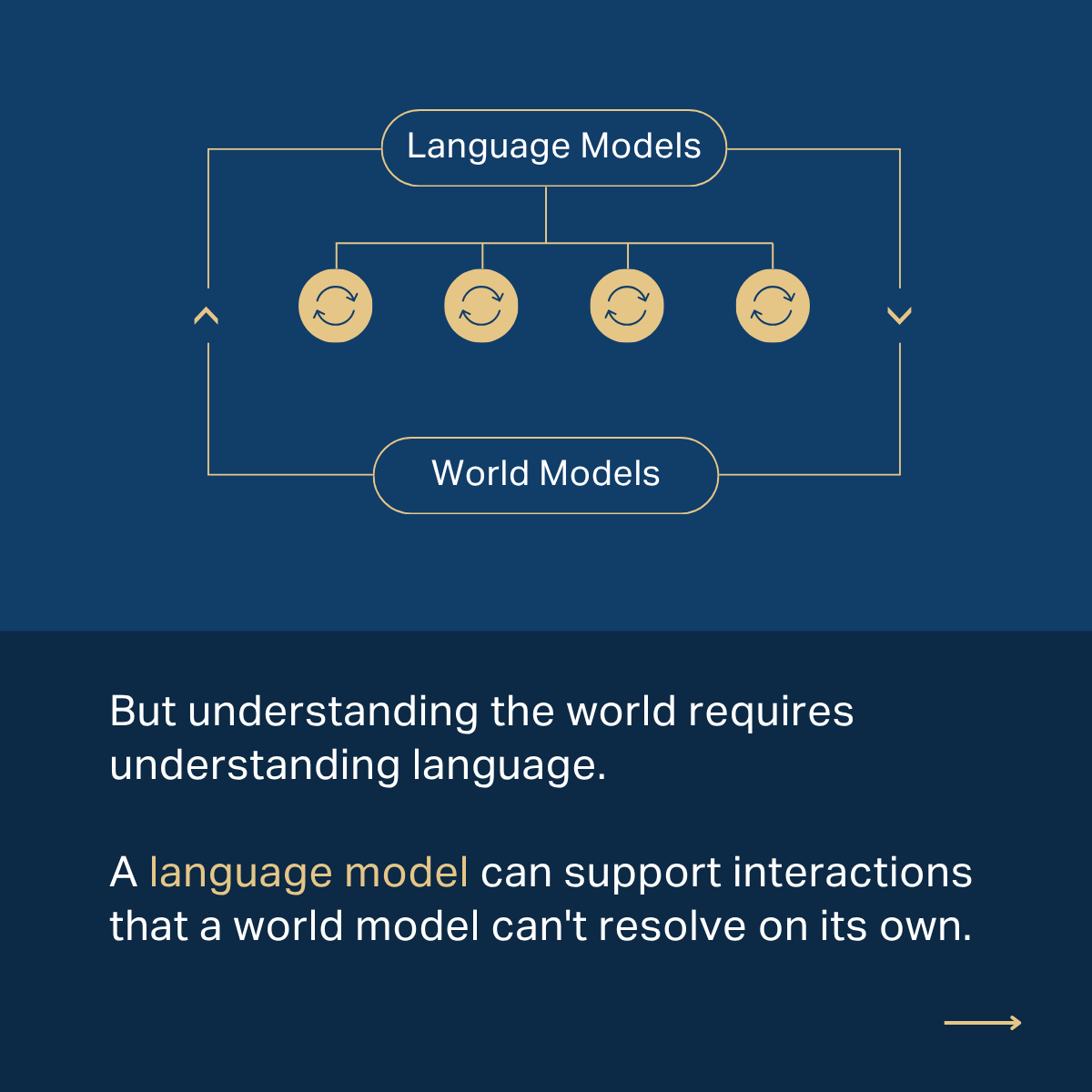
At IFM, we’re one of the very few labs developing both foundation language models and world models under a single roof. Language models — including series like K2 and JAIS — are built to answer questions, code, and solve generalized tasks, while world models like PAN are designed to understand how interactions unfold in physical space. Understanding the world requires both: language to carry knowledge, and world models to capture dynamics.
Institute of Foundation Models tweet mediaInstitute of Foundation Models tweet mediaInstitute of Foundation Models tweet media
English
1
2
6
596
Eric Xing retweetledi
elvis
elvis@omarsar0·
// Critique of the Agent Model // Finally, a paper that tries to define what an agent is and what agency consists of. Good read overall. (great bookmark) The word agent now covers everything from a for-loop with tool calls to speculative machine superintelligence. Eric Xing and colleagues ask where automation ends, and agency begins. Drawing on Descartes and on science-fiction portrayals of autonomous beings, they analyze agent architectures along five dimensions: goal, identity, decision-making, self-regulation, and learning. The argument is that genuine agency requires these structures to hold together in a specific way. Great paper overall, providing a vocabulary for arguing about what is and is not an agent. Paper: arxiv.org/abs/2606.23991 Learn to build effective AI agents in our academy: academy.dair.ai
elvis tweet media
English
26
59
280
21K
Eric Xing
Eric Xing@ericxing·
The outlook of an AI-driven Digital Organism (AIDO), such as a virtual cell (VC), has recently captivated much excitement and imagination from both AI and Biology communities, but there remain many open questions, in particular, what model presents the best path to realize an #AIDO or a #VC? In this paper we present a definition of the virtual cell based on World Model — an architecture recently emerged in AI that supports advanced capabilities such as action-conditioned simulation, dynamic state-evolution, counterfactual reasoning, and long-horizon planning in complex dynamic environments. When applied to biological scenarios, a world model of the virtual cell is a generative model that simulates biological possibilities of a cell under any natural or artificial interventions and environments. Such a virtual cell world model (VCWM) contrasts predictive foundation models on specific tasks, such as gene-expression perturbation prediction, as seen in some recent definitions of the virtual cell. At the same time not every biological foundation model built on sequence or structure or expression only can be repositioned as a world model if there is no multi- or pan-modality, stateful embedding, continuous action-conditioning, and dynamic state-transition and rollout. We presents a novel architecture for #VCWM based on the GLP (generative latent prediction) framework that enables simulated cell as an end-to-end platform. Stay tuned for the release of the first implementation of VCWM from @genbioai soon. @dasongle, @zivbj, @ElijahCole, @probablybots, @EuxhenH, @cfeinau, @deboramarks, @fabian_theis, @mmbronstein, @pkoo562 openreview.net/forum?id=hZNxD…
English
0
11
40
3.9K
Eric Xing
Eric Xing@ericxing·
With the rise of LLM systems marketed as "coding agents", "AI co-scientists", etc. that promise to drive up productivity, and at the same time outcry of "existential" concerns that AI escaping human control with destructive power under a speculative "machine agency" against humans, there has been lots of confusion about “What is an agent?” and “What constitutes agency?” It has become essential to clarify where automation ends and agency begins. Also recently, developments in world models, action models are trending to mixing future prediction/simulation and action/plan generation altogether within a single architecture such as a VLM, conflating reward-driven action selection with fidelity-driven next-state prediction, undermining the reliability of both planning and simulation. In this paper we analyze agent architectures along the axis of goal, identity, decision-making, self-regulation, and learning, and argue that genuine agency requires these structures to be internalized within the system itself rather than assembled through external scaffolding. We propose a “Goal-Identity-Configurator” (GIC) architecture for a general-purpose agent model, combining hierarchical goal decomposition, identity evolution, simulative reasoning grounded in a separately trained world model, learned self-regulation, and self-directed learning from both real and simulated experience. Auditability, controllability, and safety of systems that possess greater autonomy and "agency” but remain under human oversight, can be better built with the GIC architecture that offers transparency, modularity, and checkpoints. @mdeng34 , @jinyuhou0 openreview.net/forum?id=6fDZY…
English
4
10
39
6.7K
Eric Xing retweetledi
GenBio AI
GenBio AI@genbioai·
An excellent piece in @Nature on the promise and challenges of virtual cells, including insights from GenBio AI's @ericxing and @Prof_Lundberg on why multi-scale, multimodal approaches are the future, and why world models are key to building them. Learn more → x.genbio.ai/dTHCHh
GenBio AI tweet media
English
0
5
9
939
Eric Xing retweetledi
Mingkai Deng
Mingkai Deng@mdeng34·
We agree that the world model should be a simulator that supports decision-making, not rendering beautiful images/videos. Our difference is in how the world state should be represented. Should the world be anchored in Gaussian splats and physics engines for program-as-simulator? Or in learned representations for model-as-simulator? We believe the latter is a more scalable, bitter-lesson-pilled approach. More in our position paper "Critiques of World Models" coauthored with Prof. @ericxing and @jinyuhou0 arxiv.org/abs/2507.05169
English
7
13
69
9.4K
Eric Xing retweetledi
Institute of Foundation Models
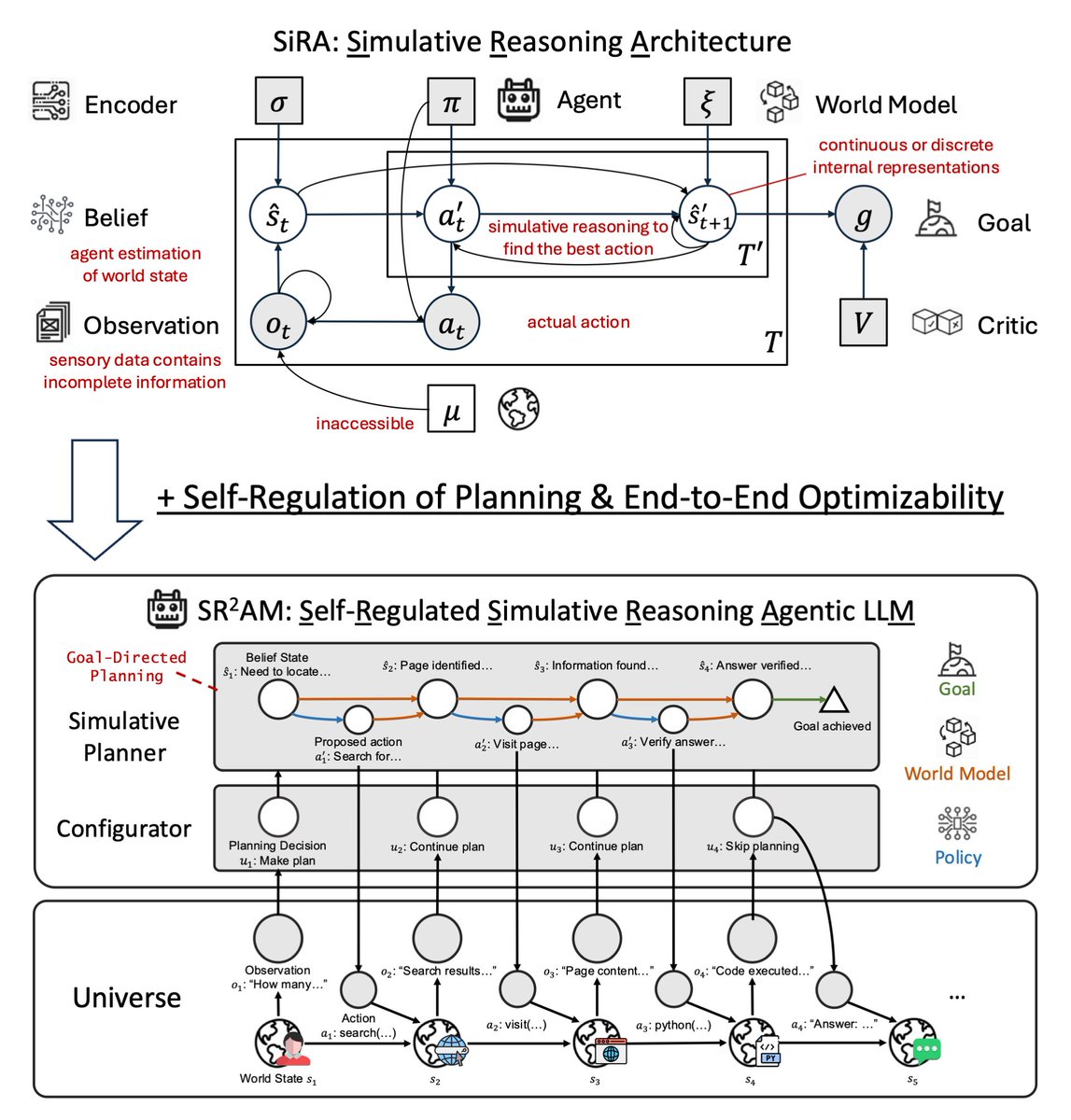
1/4 Frontier LLMs are converging on adaptive reasoning. But controlling how much to think is not the same as controlling what kind of thinking to do. SR²AM introduces self-regulated simulative reasoning: an agent that simulates possible futures through a world model and learns when that simulation is worth the cost.
English
1
6
19
2K
Eric Xing retweetledi
Mingkai Deng
Mingkai Deng@mdeng34·
Frontier LLMs are converging on efficient, adaptive reasoning. Opus 4.7 lets the model decide how deeply to reason. GPT-5.5 achieves strong results with fewer reasoning tokens. We study a related but more structural question: what 𝗸𝗶𝗻𝗱 𝗼𝗳 𝗿𝗲𝗮𝘀𝗼𝗻𝗶𝗻𝗴 should we adapt? Last year in SiRA (upper figure), we showed that simulative reasoning (System II), which uses a 𝘄𝗼𝗿𝗹𝗱 𝗺𝗼𝗱𝗲𝗹 to evaluate consequences of actions, yields up to 124% improvement over reactive baselines (System I), and that strong reasoning models (o1, o3-mini) fail as planners without this structure. In our new paper SR²AM (lower figure), we add a learned 𝗰𝗼𝗻𝗳𝗶𝗴𝘂𝗿𝗮𝘁𝗼𝗿 (System III) that self-regulates when to simulate, how far ahead, and when to skip planning entirely. Efficient reasoning is not just shorter reasoning: it is better allocation of simulation.
Mingkai Deng tweet media
English
5
46
277
62.3K
Eric Xing retweetledi
Mingkai Deng
Mingkai Deng@mdeng34·
This is a prototype using language-based world models. Stay tuned for our next steps on multimodal and physical world models. The concept of a configurator, which decides when and how deeply to engage a reasoning process, is not specific to planning, but extensible to learning and adaptation going forward. 📄 SR²AM: arxiv.org/abs/2605.22138 📄 SiRA: arxiv.org/abs/2507.23773 🌐 Project: sailing-lab.github.io/sr2am-self-reg… 💻 Code: github.com/sailing-lab/sr… 🤗 SR²AM-v0.1-8B: huggingface.co/sailing-lab/SR… 🤗 SR²AM-v1.0-30B: huggingface.co/sailing-lab/SR… Joint work with @jinyuhou0, @larasnevess, @varad0309, @tw_killian, @waterluffy, @ericxing
English
2
10
59
4.8K
Eric Xing retweetledi
MBZUAI
MBZUAI@mbzuai·
MBZUAI and the United Arab Emirates Government have signed a strategic collaboration agreement. As the Strategic Knowledge Partner, MBZUAI will support the UAE's national initiative to deploy agentic AI across 50% of government services, training 80,000 federal employees and delivering executive programs for government leaders, reinforcing the UAE's commitment to becoming a global leader in AI-enabled governance and public sector innovation. The collaboration will advance AI readiness, literacy, and executive capability building across UAE federal government entities and ministries, and driving the responsible adoption of generative and agentic AI technologies. In the presence of H.E. Mohammad Abdullah Al Gergawi, Minister of Cabinet Affairs, and H.E. Khaldoon Khalifa Al Mubarak, Secretary General of the Artificial Intelligence and Advanced Technology Council and Chairman of MBZUAI’s Board of Trustees, the MOU was signed by H.E. Ohood Khalfan Al Roumi, Minister of State for Government Development and the Future and Chairwoman of Federal Authority for Government Human Resources (FAHR), and Prof. Eric Xing, MBZUAI President and University Professor.
MBZUAI tweet mediaMBZUAI tweet media
English
1
14
11
2.3K
Eric Xing retweetledi
Institute of Foundation Models
Zihan Liu, Technical Lead for the PAN world model at IFM’s Silicon Valley Lab, is joining us at @Stanford on May 21 to share how he and his team build interactive, long-horizon world simulations.
Institute of Foundation Models tweet media
English
3
3
6
1.3K