Esmat Sarafraz

429 posts

Esmat Sarafraz banner
Esmat Sarafraz

Esmat Sarafraz

@esarafraz

A sometime researcher and always genetics enthusiast, studying genetics of flowering time @UTAS_ 🌱🧬💻Alum. @UnivOfTehran

Australia Katılım Haziran 2019
619 Takip Edilen383 Takipçiler
Esmat Sarafraz retweetledi

Sophien Kamoun
Sophien Kamoun@KamounLab·
We’re celebrating the Persian new year, based on the calendar developed in the 11th c by the renowned Persian mathematician and astronomer Omar Khayyam 🪐 Happy new year and best wishes of peace and prosperity!

Sophien Kamoun tweet mediaSophien Kamoun tweet mediaSophien Kamoun tweet media
English
1
7
81
5.7K
Esmat Sarafraz retweetledi
Yara
Yara@KikiYang1227020·
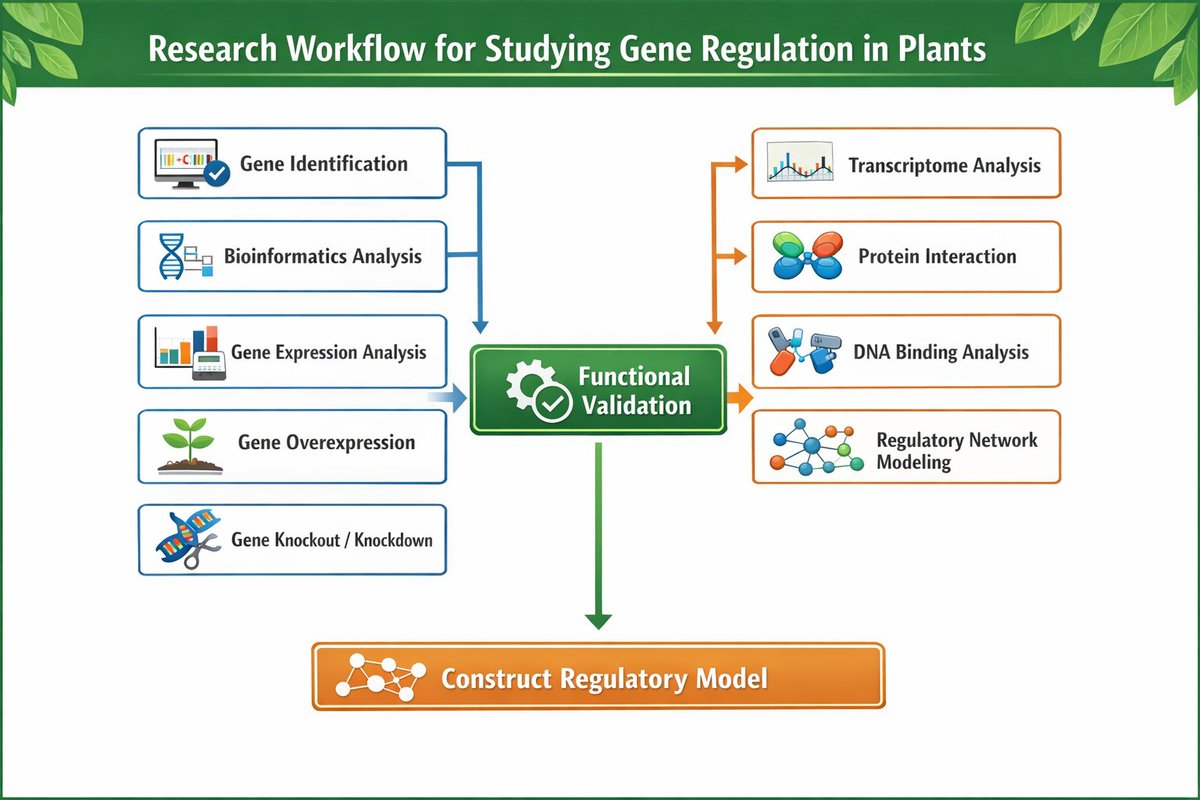
🌱 Studying plant gene function? This article introduces a practical workflow for exploring gene regulation in plants.If interested, take a look or save for later! 🔗 ybiohub.com/%E7%94%9F%E7%8…
Yara tweet media
English
0
16
46
2.6K
Esmat Sarafraz retweetledi
Joachim Schork
Joachim Schork@JoachimSchork·
ANOVA (Analysis of Variance) is a powerful statistical method used to compare the means of two or more groups. It helps to determine if there are significant differences among the group means. When applied correctly, ANOVA can provide clear insights into the variations within your data. ✔️ Uncover Hidden Patterns: ANOVA allows you to detect differences in group means, helping you understand the underlying patterns in your data. ✔️ Informed Decision-Making: By identifying significant differences, ANOVA supports more informed decisions based on data analysis. ✔️ Efficiency in Testing: ANOVA can test multiple groups simultaneously, saving time and reducing the risk of Type I errors. ❌ Misinterpretation Risk: If assumptions like normality or homogeneity of variances are not met, ANOVA results may be misleading. ❌ Complexity in Large Data Sets: Handling large data sets or multiple variables can complicate ANOVA, requiring careful management to avoid errors. 🔹 R: Use the aov() function for performing ANOVA, and ggplot2 for creating insightful visualizations like density plots to represent the distribution of groups. 🔹 Python: Utilize the statsmodels package to conduct ANOVA and seaborn or matplotlib for creating density plots and other visual aids. In the attached visualization, a density plot is shown based on three groups (A, B, and C). Such a density by group plot is a useful complement to ANOVA as it enhances your understanding of the group distributions and the assumptions underlying the analysis. In this example, the plot shows different variances among the groups, suggesting we should assess if ANOVA is appropriate or if its assumptions are violated. For those interested in diving deeper into Statistical Methods, including ANOVA, check out my online course on Statistical Methods in R. This course covers this and many other related topics in detail. Click this link for detailed information: statisticsglobe.com/online-course-… #database #Python #RStats #DataAnalytics
Joachim Schork tweet media
English
4
136
761
42.8K
Esmat Sarafraz retweetledi
PeaSoybean USask
PeaSoybean USask@PeaSoybeanUSask·
FRONTIERS IN PLANT SCIENCE Legumes for Global Food Security, Volume III This Research Topic is currently accepting articles. Manuscript Summary Submission Deadline 30 May 2026 Manuscript Submission Deadline 29 September 2026 frontiersin.org/research-topic… @tom_warken40864
English
0
1
0
77
Esmat Sarafraz retweetledi
Sophien Kamoun
Sophien Kamoun@KamounLab·
More unsolicited advice for early career researchers: 8. Just do it! Just keep moving, keep taking initiative, and good things will follow. It’s the only sensible way to spend our limited time on this planet and value life. Nothing great ever came from sitting on the sidelines—you don’t score goals by watching the match (apologies for the football metaphor). Get on the pitch and make things happen. kamounlab.medium.com/7-random-unsol…
English
8
18
77
10.6K
Esmat Sarafraz retweetledi
Legume Hub
Legume Hub@LegumeHubEU·
🔍BOKU University team in #LegumeGeneration uses digital phenotyping to spot tiny soybean differences our eyes can’t see — revealing drought tolerance, nitrogen fixation, pigment levels & growth. 💡This helps breeders select stronger, more resilient varieties. #legumebreeding
Legume Hub tweet media
English
0
1
0
75
Esmat Sarafraz retweetledi
Lee Hickey
Lee Hickey@DrHikov·
We found genetic regions in mungbean that create a dilemma: They make mungbean more productive, but reduce productivity of the following wheat crop. Classic evolutionary trade-off playing out in agriculture. 🧵
Lee Hickey tweet media
English
1
4
17
652
Esmat Sarafraz retweetledi
Joachim Schork
Joachim Schork@JoachimSchork·
Creating publication-ready plots in R is easier than ever with ggpubr. This extension for ggplot2 simplifies the process of generating clean and professional graphics, especially for exploratory data analysis and reporting. The attached visual, which I created using ggpubr, demonstrates its versatility. It includes a density plot with group comparisons (upper right), a boxplot with statistical significance annotations (lower left), and a grouped bar chart (lower right). These examples showcase how ggpubr helps streamline the creation of informative and visually appealing plots, perfect for presentations and publications. If you’d like to learn how to create publication-ready visualizations with ggpubr and other tools, join my online course, Data Visualization in R Using ggplot2 & Friends. In this course, you’ll learn how to design polished graphics like these step-by-step! More info: statisticsglobe.com/online-course-… #ggplot2 #R4DS #RStats #Python #tidyverse #DataViz #statisticsclass #DataVisualization #Rpackage
Joachim Schork tweet media
English
2
29
183
7.2K
Virginia Tech Translational Plant Sciences Center
Dr. Yuan Zeng was recently awarded a @USDA_NIFA grant from the Crop Protection and Pest Management program to improve prediction accuracy in order to optimize current fungicide programs on field crops. Congratulations!
Virginia Tech Translational Plant Sciences Center tweet media
English
1
0
5
276
Esmat Sarafraz retweetledi
Cornell University
Cornell University@Cornell·
Autumn leaves and McGraw Tower: A sight that so many Cornellians have seen and loved over the years.
Cornell University tweet media
English
2
13
125
4.6K
Esmat Sarafraz retweetledi
Joachim Schork
Joachim Schork@JoachimSchork·
In my opinion, ggplot2 is by far the best tool for visualizing your data! Built on the Grammar of Graphics, it offers a structured, powerful approach for creating insightful and visually compelling plots that elevate data storytelling. Whether you’re working with simple visuals or complex, multi-layered charts, ggplot2 provides the flexibility and control needed at any skill level. Here’s why ggplot2 stands out: ✔️ Structured Approach: ggplot2 organizes visuals through layers, making it easy to add elements like titles, labels, colors, and themes. This layered design simplifies the process of building, customizing, and refining your plots. ✔️ Complete Customization: Control every aspect of your plot—from scales and fonts to colors and legends—allowing you to tailor visuals precisely to your data insights. ✔️ Broad Applications: From bar charts and line plots to scatter plots and maps, ggplot2 supports a wide range of visualization types, making it adaptable to any data set. ✔️ Scalable for All Data Sizes: Effortlessly handle data of any size, from small samples to large-scale data, while maintaining high performance. I’ve created a tutorial that dives deep into ggplot2: Video: youtube.com/watch?v=Cl9yE_… Website Tutorial: statisticsglobe.com/ggplot2-r-pack… If you’re interested in exploring ggplot2 and advanced visualization techniques in R further, consider joining my course, "Data Visualization in R Using ggplot2 & Friends!" Check out this link for more details: statisticsglobe.com/online-course-… #statisticians #Python #DataViz #Rpackage #R4DS #RStats
YouTube video
YouTube
Joachim Schork tweet media
English
1
41
305
14.6K
Esmat Sarafraz retweetledi
Joachim Schork
Joachim Schork@JoachimSchork·
Correlation matrix plots are a powerful tool for understanding relationships between variables, but they can become overwhelming with larger data sets. Here’s an example of how to make these plots easier to interpret by displaying only the most relevant parts, created using the corrplot package in R. ❌ In the first image, all correlations are displayed, regardless of significance. This can lead to a cluttered and confusing visualization, where non-significant correlations crowd the space, making it harder to identify meaningful patterns. ✅ In the second image, only the significant correlations are shown, resulting in a much cleaner and more readable plot. By removing the non-significant values, the important relationships stand out clearly. This approach is especially useful for larger data sets, where showing all correlations can make the plot difficult to interpret. Want to learn more about statistical techniques such as correlation matrix plots? My Statistical Methods in R course covers such topics in more detail! More details are available at this link: statisticsglobe.com/online-course-… #DataAnalytics #datastructure #programmer #Statistical
Joachim Schork tweet media
English
2
20
140
6.1K