

ES Moriarty
28.9K posts

ES Moriarty
@esmoriarty01
Like so many others, I must say retweets do not equal endorsements. “Another day of great plans foundering on the harsh shoals of reality”
Chapel Hill, NC Katılım Nisan 2015
1.2K Takip Edilen222 Takipçiler

Can you name ONE movie for Sean Connery that is NOT Indiana Jones and the Last Crusade 1989, The Rock 1996, or James Bond Franchise'?

English
ES Moriarty retweetledi

The tiny number of blacks and Hispanics achieving elite-level MCAT scores demonstrates the impossibility of the best medical schools being able to fill their de facto race quotas with only high-level applicants. There simply aren't enough smart blacks and Hispanics to go around.

English
ES Moriarty retweetledi

Good
Eric Daugherty@EricLDaugh
🚨 JUST IN: Stephen Miller lays it out PERFECTLY Imagine a "native Minnesotan who works as a lineman...worried about his ability to support for and provide his family." "And then imagine that he has a neighbor who's a SOMALI REFUGEE who arrived two years ago and has a Mercedes and NO financial stress and no worries at all in the entire world and never seems to ever go to work at all because he just went to an office in the state, lied on a piece of paper, and got unlimited free money forever for life!" "THAT is the system that is being run and that is the corruption that this task force under the leadership of the Vice President is going to demolish." @StephenM
English
ES Moriarty retweetledi

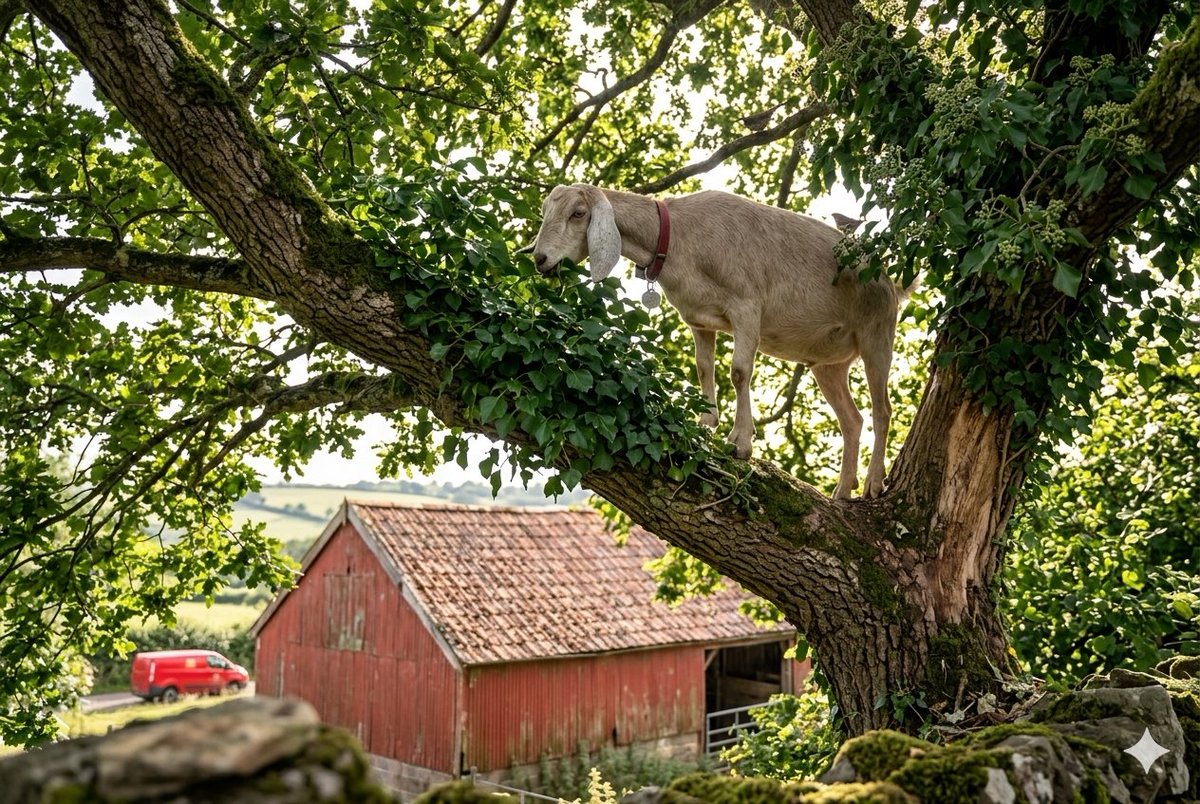
Keith's Thursday, as reconstructed from Dave's log, two of Steve's complaints, and the account of Martin the postman.
6:00am - Keith was in the oak tree on the south boundary. The oak has a low fork at 1.8 metres from a wall, accessible if you are willing to balance on the wall cap and jump. Keith was willing. He was eating lichen from the bark junction, which had been causing moisture retention in the wood. The oak's bark junction is now lichen-free. Dave did not know Keith could get into the oak. Dave is reconsidering his risk model.
7:15am - Keith was in the road. Fourteen minutes. He ate the rank grass verge on the east side, came back through the gate by whatever means he uses, and was in the south field by 7:30am. Martin the postman arrived at 7:17am and found Keith in the road. Martin called Dave. By the time Dave reached the road Keith was back in the field. Martin confirmed: "He just walked back through the gate." The gate was latched when Dave arrived. Dave added a column.
9:30am - Keith returned to the south bank knotweed. Now at 8%.
11:00am - Keith was back in the oak. This time the upper branch, where ivy was growing up the trunk. He ate the ivy stems from the base upward, leaving the upper flowering and berrying sections intact. This is conservation guidance: maintain the October nectar source and the winter thrush berry supply, clear the climbing stems. Keith was doing it because the ivy stems are edible from the base. The thrushes will be fine.
Steve's first complaint of the day arrived at 1pm. Subject: "Keith in my apple tree." Dave looked at the south boundary. Keith was in the oak. Dave looked at the oak. Dave added a column.
2:30pm - South bank. Knotweed and the north margin thistle. Methodical afternoon.
4:00pm - East ditch. Regrowth since last season, now cleared. Dave's log: "He found it himself. I hadn't mentioned the ditch."
5:30pm - Barn roof ridge. Western lichen section: done.
Steve's second complaint arrived at 5:45pm. Subject: unspecified. Dave has not read it yet.
Dave's log, evening: "Oak tree twice. Road. Knotweed. Thistle. Ditch. Roof. Two Steve complaints. One Martin incident. He has a list. The list is longer than the farm."
English
ES Moriarty retweetledi

ES Moriarty retweetledi

And to think that plumbers and electricians and welders and pipe fitters and fabricators and coating specialists and scaffolders and marine engineers and shipyard laborers built this technological marvel.
You know what's missing from this list?
Ass-clown late night comedians. Don't see them this list.
PortHarcourt Sailor@GodsgreatG
This is the inside of an LNG cargo tank on a modern LNG carrier. It may look like a metallic maze, but every layer is carefully engineered to safely contain gas at -162°C. Most modern LNG ships use the Gaztransport & Technigaz membrane system, where the tank is built directly into the ship’s hull using a layered containment system rather than separate spherical tanks. In the heart of this system is the primary containment. This is the layer that directly holds the LNG. It is made from thin corrugated materials such as stainless steel or Invar (a nickel-steel alloy). The corrugated design is critical because it allows the material to expand and contract under extreme cold without cracking or failing. It’s a cryogenic material because LNG is extremely cold. Behind this sits the insulation system, which is what is most visible in the image. These are prefabricated insulation boxes made from materials like reinforced polyurethane foam or perlite-filled panels. Their role is to minimize heat entering the tank and maintain the extremely low temperature required to keep the gas in liquid form. Next is the secondary containment system, which acts as a backup safety layer. In the unlikely event that the primary barrier fails, this layer prevents the LNG from reaching the ship’s hull. It is typically made from composite materials such as Triplex, combining aluminum foil and fiberglass for strength and impermeability. There is also a secondary layer of insulation that adds further thermal protection and structural support, ensuring stability throughout the voyage. All these layers sit against the ship’s inner hull, which is shielded from the extreme cold. Without this protection, the hull steel would become brittle and unsafe. In simple terms, the primary barrier holds the LNG, the secondary barrier provides backup protection, and the insulation keeps everything cold and stable. What you’re looking at is not just a tank, but a highly engineered cold containment system that makes global LNG transportation possible.
English
ES Moriarty retweetledi

The best science still comes from people who care more about truth than credit.
English
ES Moriarty retweetledi

If you're in North Carolina-
-Lowered personal income tax from 7.75% to current 3.99%
-School Choice
-Elimination of military pension tax
-Medicaid Expansion (I'm not for this)
-Corporate tax cuts which caused NC to jump from 44th to top 4 in business c rankings after reforms
-Balanced the budget and has saving reserve/rainy day fund of approximately 3.7 Billion
Nick2Lit@smith14_d
@MargoinWNC I’m just curious as to what the Republican Party has done to help NC residents, over the last decade in power?!
English
ES Moriarty retweetledi

You are warmly invited for a daily scripture break.
Proverbs 3: 34-35,
"He mocks proud mockers but shows favor to the humble and oppressed. The wise inherit honor, but fools get only shame."
God cherishes the humble, oppressed, and wise.
Peace and be prepared.
English
ES Moriarty retweetledi

🧵🚨 MAJOR BREAKING: A $15+ MILLION DOE contractor and NoKings protest organizer with active nuclear security contracts is on camera recommending a color revolution "how-to" 🚨🚨
His name is Steven A. Cash. Former CIA officer (Balkans, Clinton era). Under Biden: Senior Advisor to the Undersecretary at DHS Intelligence & Analysis.
The day after Trump's 2016 election, Cash co-founded "The Steady State" — a network of more than 340 former intelligence community officials who decided Trump was an "existential threat".
When Biden won, the threat was gone. Cash went into Biden's DHS. His own words: "we disappeared."
Then Trump won again. "Suddenly the existential threat was back." The Steady State reactivated and is now a planning partner with NoKings. In the clip below, their meeting recommends "Bringing Down a Dictator" — the Otpor documentary about toppling Milošević — as "a how-to."
Meanwhile, Cash's company Deck Prism LLC holds $15+ million in Department of Energy contracts. Almost every one: sole-source or non-competed. One is for the National Nuclear Security Administration — our nuclear weapons program — justified because "disclosure would compromise national security."
His FEC records: 20+ donations over 20 years. 100% Democratic. Zero Republican. Including $1,001 to Kamala Harris on August 4, 2024, while his NNSA nuclear contract was active.
I have the USAspending receipts, the FEC filings, and him on camera twice.
As always, patience as I pull together the thread. 👇
English
ES Moriarty retweetledi

America Can’t Heal From The Russia Hoax Because Mueller And His Ilk Faced No Accountability
thefederalist.com/2026/03/26/ame…
English
ES Moriarty retweetledi

One of the biggest problems in society today is that we no longer share a common set of basic facts. Without that, you cannot have a healthy discourse, or really any discourse at all. Too many people either do not know basic facts or have been led to believe things that simply are not true.
In real life, almost no one knows that the Russia collusion plot was cooked up by the Clinton campaign, or that there is a transcript proving Flynn did not lie, or that the Ukraine impeachment scam began the morning after Mueller’s train wreck testimony because they needed a new hoax, or that Fauci demonstrably sent money and technology to the Wuhan lab for them to create deadly coronaviruses. The list goes on and on.
And yet, in polite society, you are still treated like a crank for knowing these things rather than repeating the approved version of events. That is a very big problem. So until there is at least some agreement on basic, provable facts, there is no real point in debating anything. If the inputs are garbage, the outputs will be too.
The Federalist@FDRLST
America Can’t Heal From The Russia Hoax Because Mueller And His Ilk Faced No Accountability thefederalist.com/2026/03/26/ame…
English
ES Moriarty retweetledi

Six weeks after September 11, 2001, twelve American soldiers were quietly loaded onto a helicopter in Uzbekistan and flown over the Hindu Kush mountains in the dead of night.
No tanks. No armored vehicles. No air support waiting on the ground.
Just twelve Green Berets, over a hundred pounds of gear each, and a mission that their own commanders privately doubted any of them would survive.
They landed in a remote Afghan village called Dehi, in the pitch black, surrounded by a country they barely had maps for.
And then someone handed them horses.
Not metaphorically. Actual horses — Afghan stallions, tough as nails and famously difficult to control. Wooden saddles covered in carpet scraps. Stirrups so short their knees rode up around their ears.
Captain Mark Nutsch, who'd grown up on a cattle ranch in Kansas and competed in collegiate rodeos, became trail boss on the spot. For the other ten men on his team — Operational Detachment Alpha 595 of the 5th Special Forces Group — the learning curve was immediate and unforgiving. The first words one of his sergeants learned in Dari were: "How do you make him stop?"
They had linked up with General Abdul Rashid Dostum, a Northern Alliance warlord who controlled thousands of fighters and knew this territory like the back of his hand. The deal was simple: the Americans would call in precision airstrikes from horseback. Dostum's cavalry would do the charging. Together, they would take Mazar-i-Sharif — a Taliban stronghold of 250,000 people — and crack open northern Afghanistan.
Military planners had estimated it would take two years.
Task Force Dagger gave ODA 595 three weeks.
For 23 days of nearly continuous combat, the Horse Soldiers lived like men from a different century. They ate what the Afghans ate. They slept on the ground in freezing mountain passes. They rode trails so narrow and sheer that one wrong step meant a thousand-foot drop. Staff Sergeant Will Summers started the mission at 185 pounds. He left Afghanistan five weeks later weighing 143.
The Taliban had tanks. Soviet-era armor, antiaircraft guns, fortified positions dug into the mountains. Against this, twelve Americans on horseback radioed coordinates to aircraft circling invisibly above, and watched the positions erupt.
On November 9, 2001, they rode into the kind of moment that people are not supposed to experience in the modern world.
Nutsch and his team joined hundreds of Dostum's horsemen in a thundering cavalry charge across an open plain — directly into entrenched Taliban lines. Under fire. At a gallop. Calling in close air support between strides.
It was the first cavalry charge of the 21st century.
It was also the last.
The next day, Mazar-i-Sharif fell. The Taliban's northern stronghold collapsed. Within weeks, the regime itself began to unravel — a domino effect that started with twelve men and borrowed horses in the mountains.
All twelve of them came home.
Zero American fatalities. Against a fortified enemy that outnumbered and outgunned them at every turn.
Today, across from Ground Zero in New York City, there is a bronze statue — sixteen feet tall — of a Special Forces soldier on horseback, rifle across his lap, looking west. It honors ODA 595 and the teams who rode with them.
Most Americans walk past it every day without knowing the story.
Now you do.

English
ES Moriarty retweetledi

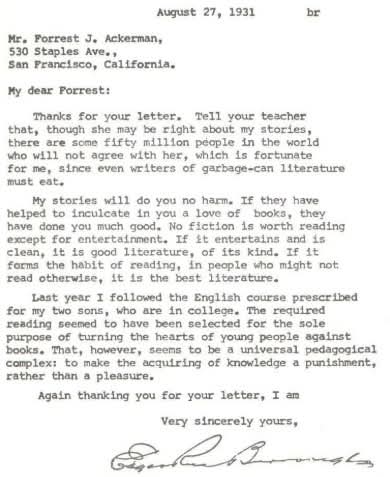
In 1931, 14-year-old Forrest J. Ackerman wrote a letter to Edgar Rice Burroughs, author of Tarzan and the John Carter of Mars series, informing him of an argument he had with his teacher regarding Edgar's books. Burroughs replied...
Burroughs’ reply defended popular fiction in direct terms. He argued that reading anything engaging is better than not reading at all, and that entertainment can serve as a gateway to lifelong reading habits. He also criticized rigid school reading lists, noting that forcing material on students often turns reading into obligation rather than curiosity.
Ackerman would go on to become one of the most influential figures in science fiction fandom, editor of Famous Monsters of Filmland, literary agent to authors like Ray Bradbury, and a key organizer of early sci-fi conventions.
Burroughs, best known for creating Tarzan (1912) and the Barsoom/John Carter series, was one of the highest-paid writers of his era, with his works translated into dozens of languages and adapted into film, radio, and comics.
Ackerman preserved this letter for decades, and it became a widely cited example in debates about “high” vs. “popular” literature, often used to argue that genre fiction plays a critical role in building readers.
© Reddit
#archaeohistories
English
ES Moriarty retweetledi
Across all medical schools, about 1 in 4 enrolled black/Hispanic medical students had a below-average MCAT score.
Only 3% of white/Asian students did.
A vast preferential treatment exists in admissions to almost every med school. Three schools isn't even the iceberg tip.

The New York Times@nytimes
Breaking News: The Trump administration is investigating the admissions policies of three major medical schools, taking aim at the heart of scientific authority in the U.S. nyti.ms/4bC7Ivu
English
ES Moriarty retweetledi

Conservatives have this sort of fetish for total political suicide because they’ve all been brought up to view the actual exercise of power with tyranny, which is the very thing they’re all struggling against.
They’ve become almost totally attached on an emotional level to the act of resisting power rather than wielding it. The modern Right WANTS to be the embattled and doomed rebel faction rather than face the responsibility of ruling.
As long as we are losing, we can imagine ourselves to be principled. We get to LARP as Cato the Younger. But the moment power is actually available to us, everything becomes unbearable and we crash out for a multitude of reasons.
Now we have to decide who is in and who is out, what institutions have to be demolished, what laws have to be abolished, and what enemies have to be destroyed. We also have to decide what costs are worth bearing to make it all happen.
And when those type of questions pop up in a very real way, many on the Right just completely self-sabotage themselves because there’s never been a scenario in their minds where their side ever gets to win and has to rule.
English
ES Moriarty retweetledi
America was nearly lost to a cabal of NGOs, think tanks, foundations, specialty media organizations, compromised mainstream media organizations, quasi-governmental organizations and all other manner of other well-funded (often with taxpayer dollars) players dedicated to preserving extra-governmental controls over the average American, all outside the scope of what Americans vote for.
The men and women behind these organizations claim to want to benevolently advance public policy, when in reality their singular purpose is to maintain and grow the nefarious personal power they have achieved. Above all else they must defend their fiefdoms, the good of the nation be damned.
When reformers try to undo any part of this cabal, those reformers are inevitably smeared, libeled, slandered and threatened. The goal is to prevent them from engaging in that necessary reform by intimidating them into silence.
Food for thought.
English
ES Moriarty retweetledi
Activist: "A plant-based food system would use seventy-five percent less land."
Farmer: "Land suitable for arable crops, yes."
Activist: "All land."
Farmer: "Three-quarters of the world's agricultural land is too steep, too wet, too cold, or too arid for crops."
Activist: "Technology..."
Farmer: "Cannot move a mountain. Cannot lower annual rainfall. Cannot extend the frost-free season."
Activist: "The study is peer-reviewed."
Farmer: "The study modelled land as if it were interchangeable. It isn't."
Activist: "You're disputing the findings."
Farmer: "I'm standing on a Cumbrian fell in October. The fell is disputing the findings."
Activist: "That's anecdotal."
Farmer: "So is every peer-reviewed study that's never left a spreadsheet."

English
ES Moriarty retweetledi

From C.S. Lewis's essay, "Tolkien's Lord of the Rings:"
"The value of the myth is that it takes all the things we know and restores to them the rich significance which has been hidden by ‘the veil of familiarity’. The child enjoys his cold meat (otherwise dull to him) by pretending it is buffalo, just killed with his own bow and arrow. And the child is wise. The real meat comes back to him more savoury for having been dipped in a story; you might say that only then is it the real meat. If you are tired of the real landscape, look at it in a mirror. By putting bread, gold, horse, apple, or the very roads into a myth, we do not retreat from reality: we rediscover it. As long as the story lingers in our mind, the real things are more themselves. This book applies the treatment not only to bread or apple but to good and evil, to our endless perils, our anguish, and our joys. By dipping them in myth we see them more clearly. I do not think he could have done it in any other way."
English
ES Moriarty retweetledi

MECK GOP statement on Aaron Marin withdrawing from D-1 Meck Commish race after shots were fired into his house:
Aaron Marin stepped forward to serve his community and was met with targeted violence against his home and threats against his family. No citizen should face intimidation for seeking public office. We stand with Aaron and his family and we respect his decision to put their safety first.
Let us be clear. This is what happens when law and order breaks down. When political participation is met with fear and violence, democracy itself is under attack. We strongly condemn those responsible and we expect law enforcement to identify them and bring them to justice.
Mecklenburg County cannot continue down a path where candidates are forced out of races because they fear for their lives. That is not politics. That is intimidation. That is unacceptable.
If Mecklenburg County is to have a healthy electoral process, it must first be safe. Safe for candidates. Safe for families. Safe for voters. Without safety, there is no real choice, no real debate, and no real democracy.
Our mission has always been to provide the people of this county with meaningful choice and open dialogue. That mission is impossible when violence replaces discourse.
Due to the statutory deadline for filing having already passed, replacing a candidate presents significant challenges. However, we will make every effort within the bounds of the law to identify and support a qualified replacement candidate for District 1.
This situation is a wake up call. Law and order must be restored. Political violence must be confronted directly. Mecklenburg County must once again become a place where citizens can step forward to serve without fear.
We thank Aaron Marin for his courage and his willingness to serve. We will continue working to ensure that future candidates can do so safely and that democracy in Mecklenburg County is protected.
In Liberty,
Kyle Kirby
Chairman, Mecklenburg County Republican Party
English