CryptoAdvocate 🇦🇺

31.1K posts

CryptoAdvocate 🇦🇺 banner
CryptoAdvocate 🇦🇺

CryptoAdvocate 🇦🇺

@ethadvocate

REACTIVE NETWORK AMBASSADOR, $REACT https://t.co/oWXKO7ljN0 #reactivecontracts, In Crypto since 2015

Australia Katılım Ağustos 2017
5.9K Takip Edilen4K Takipçiler
Sabitlenmiş Tweet
CryptoAdvocate 🇦🇺 retweetledi
Garcia Capital 🇪🇸
Garcia Capital 🇪🇸@Garcia_Capital·
TLDR: The reactivity void becomes most damaging when a strategy depends on several conditions and chains. Without a native event-to-action layer, every step must be monitored and triggered by external infrastructure. Complexity grows quickly, turning autonomous logic into a fragile network of bots, relayers, and retries. ---------- Q: How does the reactivity void limit complex, cross-chain, or multi-condition strategies that would otherwise be ideal for autonomous agents and advanced DeFi automation? A: It separates strategy logic from the mechanism that starts execution. A smart contract can define: what should happen But it cannot independently detect every relevant event and begin the next action. A complex strategy may depend on: - collateral falling below a threshold - liquidity changing on another chain - valid oracle update - governance approval The workflow becomes: events across chains → watchers → off-chain coordination → transactions → contracts The strategy may be encoded on-chain, but the control loop lives outside it. ---------- Why do multi-condition strategies become difficult? Conditions rarely arrive at the same time. External systems must collect events, maintain state, determine whether every condition is satisfied, prevent duplicate execution, and decide when observations become stale. This requires databases, schedulers, retries, and coordination software. The more conditions added, the larger the off-chain state machine becomes. ---------- Why are cross-chain strategies especially fragile? Each chain has different finality assumptions, gas markets, RPC providers, and failure modes. A cross-chain agent must determine: - whether the source event is finalized - whether it was already processed - whether destination state is still valid - what happens if one step succeeds and the next fails Without a shared reactive layer, developers rebuild this logic for every strategy. ---------- How does this affect autonomous agents? Agents are well suited to treasury management, collateral protection, liquidity migration, and multi-protocol coordination. But intelligence alone cannot guarantee execution. An agent may identify the correct action while still depending on an external operator to detect the trigger and submit the transaction. That creates autonomous reasoning with non-autonomous execution. ---------- How does Reactive Network change the architecture? Reactive Network introduces Reactive Smart Contracts (RSCs) as an event-driven execution primitive. RSCs can subscribe to supported on-chain events, evaluate deterministic policy, track multiple conditions, and initiate predefined callbacks across supported chains. The flow becomes: events → RSC policy checks → deterministic callback This lets developers express a strategy as a reaction graph instead of disconnected keeper jobs. RSCs do not remove source-chain risk, oracle risk, destination-chain failure, or flawed contract logic. They reduce dependence on application-specific watchers where events must become actions. ---------- Conclusion The reactivity void places a ceiling on strategy complexity. Every new condition, chain, and action adds another monitoring task and dependency. Reactive Smart Contracts provide a deterministic path from events to bounded execution, making automation easier to compose, verify, and operate without rebuilding the trigger layer for every agent. $REACT dev.reactive.network/reactive-contr…
English
2
2
5
96
CryptoAdvocate 🇦🇺 retweetledi
Reactive Network
Reactive Network@0xReactive·
Uniswap Hook Incubator Highlight #3 - TrancheShield by Ahmet Tahir Yıldız As part of this highlight series from a recent developer campaign Reactive took part in, today we’re looking at TrancheShield, the @Uniswap v4 hook that protects liquidity against impermanent loss. A Reactive Contract watches the pool from the outside for volatility spikes, thinning reserves, or waves of withdrawals. It then automatically adjusts the swap fee, how much protection is offered, and whether new senior deposits are allowed, all without waiting for someone to trade. In short, it’s an always-on risk manager that keeps working even when the market goes quiet. Read more 👇
Reactive Network tweet media
English
1
15
45
2.1K
CryptoAdvocate 🇦🇺 retweetledi
Reactive Network
Reactive Network@0xReactive·
Video registration guide:
English
0
6
25
341
CryptoAdvocate 🇦🇺 retweetledi
Reactive Network
Reactive Network@0xReactive·
Still over a week left to take part in our $REACT trading competition on @kucoincom with 5,000 USDC in rewards on the table! Sign up below with @Voltrade_xyz to qualify 👇
Reactive Network tweet media
English
2
9
41
2.3K
CryptoAdvocate 🇦🇺 retweetledi
Garcia Capital 🇪🇸
Garcia Capital 🇪🇸@Garcia_Capital·
TLDR: An agent that can initiate actions has a closed control loop: it observes, decides, and acts when conditions are met. An agent that only responds when called may be intelligent, but it is not operationally autonomous. It still depends on someone else to notice the event and wake it up. ---------- Q: What is the difference between an agent that can initiate actions versus one that can only respond when called by an external actor? A: The difference is not mainly intelligence. It is control over execution. A called-only agent may contain sophisticated logic, but it remains passive until an outside system invokes it. Its flow looks like: event → watcher → transaction or API call → agent responds The agent can decide what to do after activation, but it cannot guarantee that the call arrives, arrives on time, or arrives at all. An initiating agent has a complete loop: event → policy evaluation → action It has a reliable mechanism for converting conditions into execution. ---------- What can a called-only agent do? Once activated, it may analyze information, generate a strategy, prepare a transaction, and execute within its permissions. But its autonomy starts only after a user, keeper, bot, scheduler, relayer, solver, or backend wakes it. ---------- What can an initiating agent do differently? It can react when predefined conditions occur without waiting for a separate operator. Examples include: - rebalancing after a risk threshold is crossed - moving liquidity after a market event - responding to a governance result - coordinating actions across chains This creates a continuous control loop rather than isolated responses. ---------- Why does the distinction matter? A system cannot be fully autonomous if its ability to act depends on infrastructure outside its policy. The external trigger introduces: - liveness risk - latency and operating cost - censorship or permission risk - duplicate or missed execution - additional trust assumptions The agent may reason independently while the overall system remains operationally dependent. ---------- How does this relate to smart contracts? Traditional smart contracts are called-only systems. They define: what should happen But an external transaction determines: when execution begins This is the reactivity void. Events can record that something happened, but they do not automatically invoke another contract. ---------- How does Reactive Network change the model? Reactive Network introduces Reactive Smart Contracts (RSCs) that subscribe to supported on-chain events and evaluate deterministic Solidity logic. The flow becomes: event → RSC policy check → deterministic callback This does not make the AI model trustworthy. Inference, data quality, identity, permissions, and contract security still require separate safeguards. But it gives the application a protocol-level path from event to action without a traditional application-level keeper. ---------- Conclusion A called-only agent is reactive in the conversational sense: it responds when contacted. An initiating agent is reactive in the systems sense: it converts verified conditions into actions through a persistent execution loop. That separates an intelligent tool from an autonomous system. AI determines what should happen. Event-driven, deterministic execution determines whether it can happen reliably without someone else pressing the button. $REACT dev.reactive.network/reactive-contr…
English
0
5
10
162
CryptoAdvocate 🇦🇺 retweetledi
Reactive Network
Reactive Network@0xReactive·
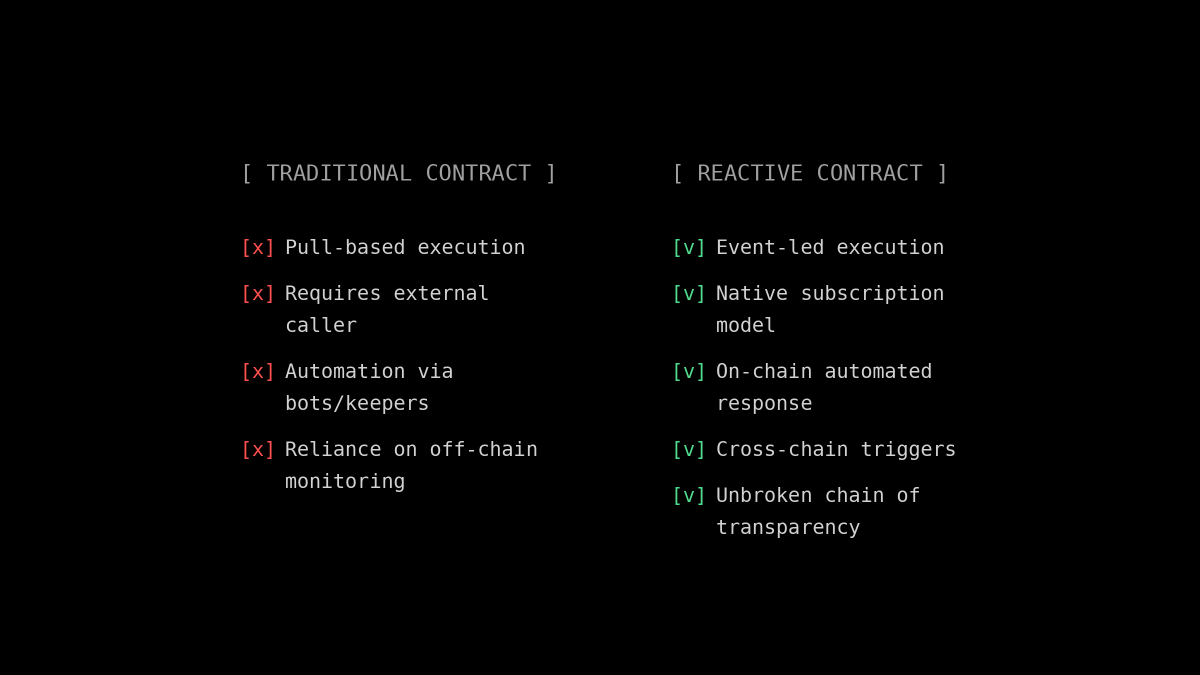
Smart contracts that only react when someone is online are already outdated. Reactive Contracts let your protocol: 🔹 Observe events across any supported chain in real time 🔹Execute complex solidity logic autonomously, fully on-chain 🔹 Settle wherever the value needs to go No keepers, no off-chain bots and no single points of failure. Just pure event-driven automation that never sleeps.
Reactive Network tweet media
English
4
19
69
3.3K
CryptoAdvocate 🇦🇺 retweetledi
Garcia Capital 🇪🇸
Garcia Capital 🇪🇸@Garcia_Capital·
TLDR: Most “DeAI” frameworks decentralize assets, payments, identity, or model access while leaving the operational loop off-chain. The agent may use tokens and smart contracts, but its inference, memory, scheduling, keys, and transaction submission still depend on centralized or semi-centralized services. ---------- Q: Why do most DeAI or agent frameworks depend on semi-centralized infrastructure even when they market themselves as decentralized? A: Because decentralizing ownership is easier than decentralizing continuous execution. An autonomous agent must observe data, maintain memory, run inference, make decisions, access tools, sign transactions, and monitor outcomes. Most smart contracts are passive. They execute only after someone submits a transaction. The architecture becomes: agent → hosted model/API → backend scheduler → keeper or relayer → blockchain The settlement layer may be decentralized. The control loop is not. ---------- Where does semi-centralization enter? Many frameworks rely on hosted LLMs, centralized RPCs, private databases, cloud schedulers, server-held keys, proprietary tool gateways, relayers, solvers, or keepers. Each component can become a liveness dependency, censorship point, or bottleneck. ---------- Why is this difficult to remove? AI computation is expensive, probabilistic, and usually impractical to run fully on-chain. Agents also need external data, web APIs, private accounts, and long-term memory. A project may publish outputs on-chain while a small group still controls whether the agent can observe, reason, or act. Hybrid architecture is not automatically decentralized. ---------- Why does the reactivity void matter? Even if inference is decentralized, the agent still needs a reliable trigger-to-action path. Without native reactive execution: event → watcher → agent → relayer → transaction Each step adds latency, cost, trust assumptions, and another failure point. Many “autonomous” agents are therefore closer to automated cloud services connected to crypto rails. ---------- How does Reactive Network improve the architecture? Reactive Network addresses the execution portion through Reactive Smart Contracts (RSCs). RSCs can subscribe to supported on-chain events, evaluate deterministic Solidity policy, and initiate predefined callbacks across supported chains. The flow becomes: verified event → RSC policy check → deterministic callback AI can remain off-chain for flexible reasoning. Execution policy can remain on-chain where rules are transparent, bounded, and verifiable. ---------- Does this decentralize the entire agent? No. Model hosting, inference integrity, oracle quality, memory, identity, and tool access still need separate trust mechanisms. Reactive Network does not decentralize the model. It reduces dependence on application-level keepers and private backends where events must become actions. ---------- Conclusion Most DeAI systems decentralize assets and settlement before they decentralize the operational loop. That leaves a gap between decentralized intelligence claims and actual autonomous execution. A stronger architecture separates responsibilities: AI reasons → verifiable event → RSC enforces → blockchain executes Decentralized agents need more than tokens and smart contracts. They need an execution layer that does not quietly reintroduce operators between decision and action. $REACT dev.reactive.network/reactive-contr…
English
0
3
15
238
CryptoAdvocate 🇦🇺 retweetledi
Voltrade.xyz
Voltrade.xyz@Voltrade_xyz·
UPDATE: Approaching 200K traded for the base:0xedacc73ae9f73235934f72a43388404e4a2c4a24 volume-based trading competition 🔥 Are you on the leaderboard yet? 5000 $USDC prize pool, including a $50/day daily lottery 💡Reminder: Open to all @kucoincom users, just need to register on our platform first ✅
Voltrade.xyz tweet media
English
1
7
24
2.3K
CryptoAdvocate 🇦🇺 retweetledi
Reactive Network
Reactive Network@0xReactive·
Why Use Reactive Contracts? If you're building smart contract automation, the tools you choose will vary depending on your goals. Let's break down how Reactive Contracts differ from many existing automation solutions, especially when it comes to cross-chain & on-chain workflows. Reactive Contracts are built on-chain for real-time, event-driven automation. Designed to power mission-critical, cross-chain systems without relying on off-chain schedulers or external infrastructure. Why Many Builders Choose Reactive: - On-chain triggers for real-time logic. - Native cross-chain execution (no JS hacks). - No off-chain servers or secret management. - Deterministic and fully verifiable automation. Perfect for: 🔹 DeFi automation 🔹 DAO coordination 🔹 Empowering On-chain AI Agents 🔹 Cross-chain messaging 🔹 Adding trustless protocol logic
Reactive Network tweet media
English
2
15
63
3K
CryptoAdvocate 🇦🇺 retweetledi
Reactive Network
Reactive Network@0xReactive·
Uniswap Hook Incubator Highlight #2 - Unistrata by @dadadave80 As part of this highlight series aimed at our most recent developer campaign, today we're taking a look at Unistrata, the @Uniswap v4 hook that turns a regular liquidity pool into something more like a bond, with a protected “senior” share and a riskier “junior” share. Unistrata uses Reactive Network’s CRON timer plus live volatility signals so the pool can settle on schedule or in an emergency, even if trading has gone quiet. That keeps the senior share protected when it matters most. Read more 👇
Reactive Network tweet media
English
2
18
58
2.9K
CryptoAdvocate 🇦🇺 retweetledi
Garcia Capital 🇪🇸
Garcia Capital 🇪🇸@Garcia_Capital·
TLDR: When every agent depends on its own keeper, relayer, solver, or backend, automation fragments. Each application becomes a separate execution island with different incentives, permissions, and failure modes. Contracts may be composable, while the systems that wake them are not. ---------- Q: How does reliance on keepers and off-chain components create fragmentation between “isolated islands” of automation instead of a unified, composable agent economy? A: Because the execution layer is rebuilt separately for every application. Smart contracts expose open on-chain logic, but their automation often lives outside the protocol. One agent may use a private backend or keeper. Another may rely on a solver network or custom relayer. The contracts can interoperate, yet their trigger systems do not share the same guarantees. ---------- What does an automation island look like? event → app-specific watcher → custom policy → transaction Each application must separately manage monitoring, RPC access, gas, retries, failover, and operator incentives. That creates parallel execution systems that are difficult to coordinate or reuse. ---------- Why does this reduce composability? Off-chain automation does not automatically inherit deterministic on-chain properties. One protocol cannot easily verify whether another agent is online, whether its keeper saw the event, whether its policy changed, or whether execution will arrive on time. Agents may share contracts without sharing a common reaction layer. ---------- Why does fragmentation worsen across chains? Each chain may require different watchers, relayers, gas accounts, finality assumptions, and retry rules. A cross-chain strategy becomes several loosely connected services: event → service A → chain A event → service B → chain B event → service C → chain C Every added component introduces synchronization risk and another place where execution can stall. ---------- Why is this a bottleneck for an agent economy? A real agent economy requires agents to react to shared events, coordinate actions, compose strategies, and enforce common rules. When each agent brings its own private automation stack, interoperability exists only at the contract layer. The result is autonomous-looking applications that remain operationally isolated. ---------- How does Reactive Network change the architecture? Reactive Network provides a shared event-driven execution primitive through Reactive Smart Contracts (RSCs). RSCs can subscribe to supported on-chain events, evaluate deterministic Solidity logic, and initiate predefined callbacks across supported chains. The flow becomes: event → RSC policy → deterministic callback Applications can build on the same reaction primitive instead of recreating separate keeper systems. This does not remove every dependency. Source-chain security, contract logic, data quality, and destination-chain conditions still matter. But it reduces fragmentation where events become actions. ---------- Conclusion: A unified agent economy needs composable contracts and execution. Keepers and private backends create isolated islands because each application maintains its own trigger infrastructure and trust assumptions. Reactive Smart Contracts move reaction logic into a shared deterministic layer, making coordination easier to verify, reuse, and compose across applications and chains. $REACT dev.reactive.network/reactive-contr…
English
0
4
13
212
CryptoAdvocate 🇦🇺 retweetledi
Reactive Network
Reactive Network@0xReactive·
Trade $REACT/USDT on @kucoincom and compete for a share of 5,000 USDC in rewards through our trading competition launched via @Voltrade_xyz! Open to all KuCoin users (KYC required + Voltrade registration) Register and start trading 👇
Reactive Network@0xReactive

Reactive x Voltrade - Kucoin Trading Competition We're teaming up with our friends at @Voltrade_xyz to run a trading competition exclusively on Kucoin for $REACT/USDT! When? Goes live tomorrow July 23rd 2PM UTC and runs until Augst 6th. Compete for a share of 5,000 USDC in prizes with a 4,300 USDC main prize pool and a 700 USDC daily lottery for traders with over $500 in volume per day. Maximum $25K daily volume. Open to all @kucoincom users (KYC required + Voltrade registration). Register below to get started 👇

English
0
14
44
3.4K
CryptoAdvocate 🇦🇺 retweetledi
Scott Mcalister
Scott Mcalister@smxlad·
@AltcoinVisionx @ethadvocate @YouTube I’m going to say over $10 to be fair, may sound 🌙 boy But it’s not listed everywhere yet but will be 🚨, in its old irritation or PARSIQ reached $2.61 on April 11th 21, the magic of $REACT, determination of team and tech
English
1
9
19
416