Ethplorer
334 posts

@ethplorer
Ethereum tokens explorer, free API, charts, tops. Top-notch search! Portfolio tracking for any address or tx with tags and notes. Notifications to email, TG


Everyone talks about $ETH dominance. But the data tells another story. According to @ethplorer: • ETH-only whale holdings → $189B • Including ERC-20s + stables → $426B That means 58% of capital is outside $ETH. Altseason isn’t speculation, it’s already in whale portfolios. Top wallets breakdown 👇 ethplorer.io/rich-list

Interesting data from @ethplorer after publishing an Aggregated Ranking of Ethereum addresses. Looking only at ETH holdings, the largest wallets control about $189B. But once ERC-20 tokens and stablecoins are included, that number jumps to roughly $426B. One detail stands out: around 58% of the capital held by top addresses isn’t in ETH itself. Even more surprising: when comparing the lists, the Top-1,000 wallets change significantly, with barely half of the addresses overlapping. Which suggests something important: The effects of altseason aren’t just visible on price charts, they’re reflected directly in how capital is distributed across Ethereum wallets.

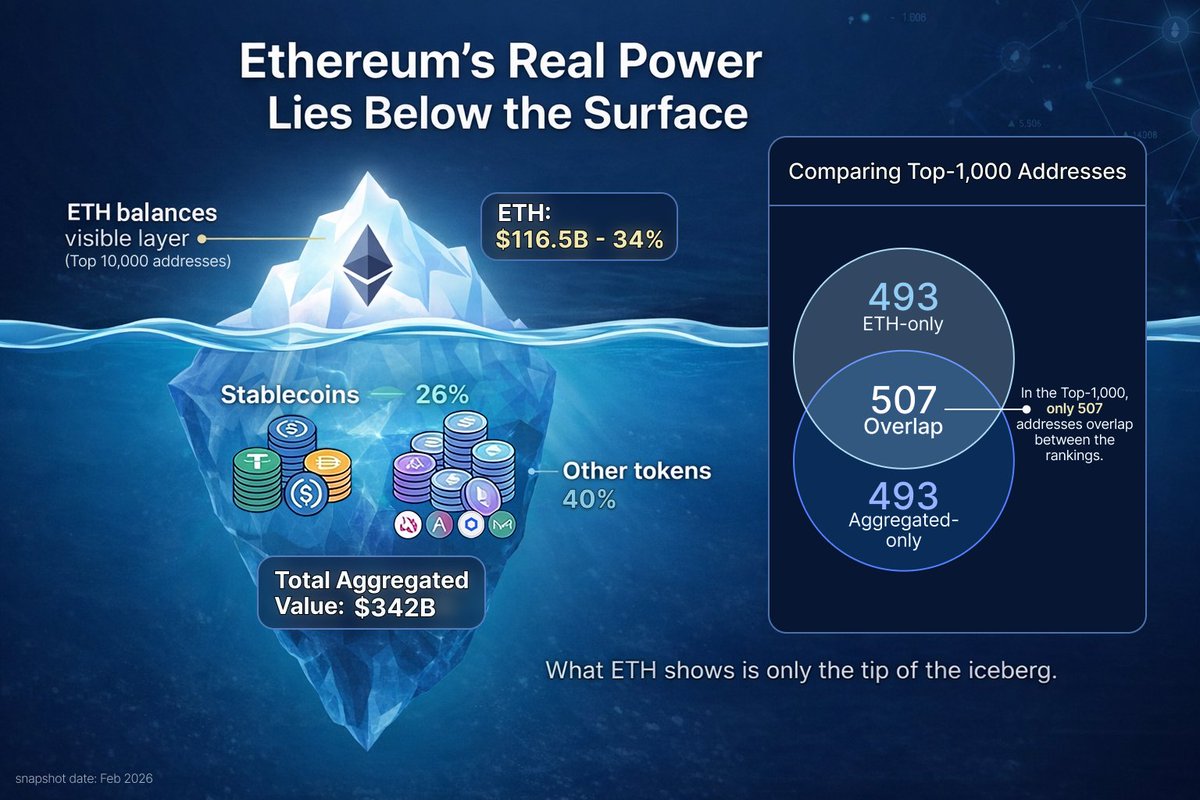
Research from @ethplorer, based on a recently published Aggregated Ranking of Ethereum Addresses based on totalBalanceUsd, which includes ETH, ERC-20 tokens, and stablecoins valued in USD, completely changes how we view Ethereum dominance and concentration. Most rankings only measure ETH balances, under that view, top addresses hold about $116.5B. But when you include ERC-20 tokens and stablecoins, the number jumps to $342B, that’s almost 3× more than visible capital. Even more important: 70% of top-holder capital sits outside ETH. This isn’t just a small adjustment in measurement, more than half of the Top-1,000 addresses change once tokens are included. Only 493 wallets overlap between ETH-only and aggregated rankings. That means many of the largest economic players on Ethereum don’t even show up if you only track ETH balances. On top of that, smart contracts now control close to 28% of top-holder capital. The system has shifted from individual whales holding ETH to protocol-controlled structures managing diversified token balances. Altseason didn’t necessarily play out through explosive price charts, it happened quietly, through balance-sheet expansion and capital redistribution across tokens. Partnered up with the team to spread the word!


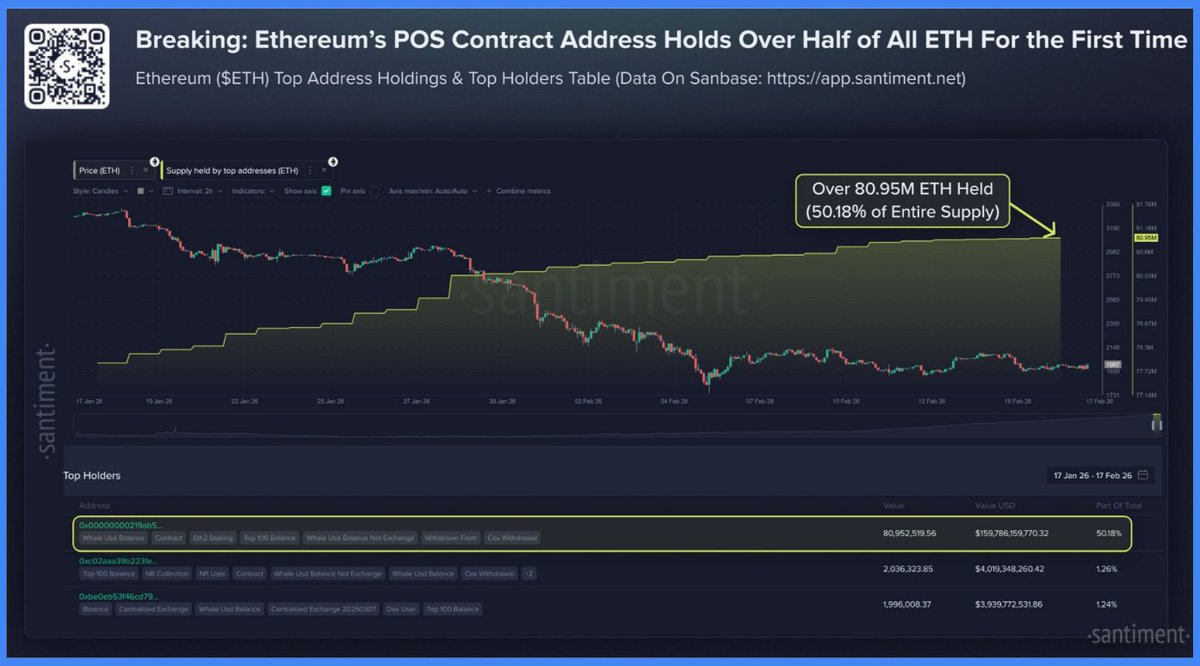
🤑 BREAKING: Ethereum's proof-of-stake contract address now holds over half of Ethereum's supply for the first time in the coin's 11-year history. 🔐 There is often confusion about how this proof-of-stake address works. Think of it as a one-way vault that temporarily locks $ETH to help secure the network. When someone stakes ETH, it gets sent into this contract and is removed from normal circulation, meaning it cannot be spent or traded while it is staked. Later, when a validator leaves and withdraws, the ETH is released back into circulation as newly issued coins on Ethereum’s main network, rather than being pulled back out of the vault itself. As a result, the existing supply can often differ based on whether only pre-burned or total post-burned coins are being counted. 📈 As staking continues to increase in popularity, expect that this address will continue its ascension, particularly when trading slows down during bear cycles. 🧐 Note that the calculation of 50.18% relies on ETH issued historically before burns, as only about ~120M Ethereum currently exist on the network.