
eucrta
88 posts


eucrta
@eucrta
Bridging European institutions and the Western Balkans to advance democracy.
Bruxelles Katılım Şubat 2025
248 Takip Edilen114 Takipçiler
The 🛠️lets users explore different election📆scenarios and understand the legal deadlines tied to them, including when elections would need to be called, and when resignations would be required. An accessible way to make 🇷🇸’s complex electoral procedures easier to follow. (🧵/2)
English
'So… when exactly could elections in Serbia take place?' At this point, Serbian political analysis resembles weather forecasting mixed with sports betting.
So our @CRTArs colleagues embraced the chaos and built this:
crta.rs/en/when-will-t…
(🧵/1)
English
eucrta retweetledi

‼️ SAZNAJEMO: N1, Nova S i drugi biće prodati vlasnicima Euronews-a, a ugovor tek treba da se potpiše.
United Group planira da proda medijski biznis za svega 30 miliona evra, pokazuje finalna verzija ugovora.
⬇️ Šta još znamo o ovoj prodaji? ⬇️
raskrikavanje.rs/vlasnici-euron…
eucrta retweetledi

Some additional information re: the departure of Bosnia and Herzegovina’s High Representative Schmidt.
I have spent the past day or two speaking with sources in the U.S. and Europe about Schmidt’s departure, or what the Europeans largely refer to as his ‘ouster’. Out of respect for my interlocutors, I will be purposefully vague about some aspects of this conversation, and you should understand each of these points to be my condensed conclusions from several different strands of data.
Schmidt, personally, was and remains categorically unpopular. He was disliked by virtually every relevant capital, and so essentially no one is sad to see him go.
However, the consensus view in Europe is that Schmidt’s departure is nevertheless almost entirely the result of American pressure, and that the same is the product of a multi-level deal that has been made with the secessionist authorities in Banja Luka, and that this has the blessing of Moscow too. Schmidt himself is expected to gesture at the U.S. pressure campaign at the UNSC, as the FAZ reporting from yesterday already hinted at.
I first heard about the possibility of an Italian or a Brit being tapped to succeed Schmidt about a month ago (cf. my post from April 17). The name @IstragaB published today, Antonio Zanardi Lendi, is accurate but there are a few caveats. He is said to be the U.S.’ own candidate, as in, the Americans have tapped him for the role. His former posts in Belgrade and Moscow are said to be significant to the U.S. It is unclear if the rest of the PIC Steering Board will go in for his nomination at all though, and if they do not, the U.S. is expected (as reported) to push for Louis Crishock, the Brcko Supervisor, to act as a kind of pro tempore High Representative. That is a sub-optimal outcome for the U.S. because it is not entirely clear whether an interim High Representative could fully realize Washington's preferred agenda (see below).
Why is the U.S. pushing this course, and why now? Based on all my conversation to date, including those going back to 2025 and late 2024, here is what I believe the state of play is:
1. The U.S. clearly made an agreement with Dodik last year, which he paid several million dollars of Bosnian public monies through his network of American lobbyists and influencers since November 2024 to secure. His major concession to Washington was that he, in effect, accepted his removal from office. In exchange, the U.S. lifted its sanctions vs. him and his entire regime.
2. That, indirectly, also opened the path to U.S. commercial diplomacy with Banja Luka, which as a broad objective is clearly the Trump administration’s chief ‘view’ of the transatlantic relationship. Still more specifically with respect to Southeast and East-Central Europe, the U.S. wants to become the dominant LNG supplier to the region, and the continent, as the EU (and EU-adjacent) decoupling from Russia gas dependency becomes permanent.
3. The primary expression of that project in Bosnia is the Southern Interconnector (SIC) pipeline, which the U.S. has seized as its flagship initiative in the country, even though it was conceived, and initially funded, as an EU project. Dodik, through his direct ties to the Croat nationalist HDZ, effectively greenlit the project as part of his broader deal with the U.S. (i.e. he and Covic agreed to lift their political blockade). Thereafter there was significant synergy between the U.S., on the hand, and Dodik and Covic, on the other, that it should not just be an American firm that realized the project, but a firm that had significant access in Washington. Hence, AAFS Ltd, a company with no known projects or employees, operated by the brother of Michael Flynn (who is also Dodik’s registered lobbyist) and Pres. Trump’s personal lawyer Jesse Binnall.
4. Now, AAFS is officially a special-purpose vehicle (SPV), i.e. a shell company. But from where or whom it is drawing its funds to finance the construction of a c. $250 million pipeline is unclear. Especially because the chatter among advocates of the firm is that they claim to want to start digging this year and have the thing essentially up and running by next year. A fantastical notion, to say the least but the key unresolved question is: where is this money coming from? Because it is not the EU, and as far as we can tell, it is also not the U.S. government, nor BiH (at least not initially; it will pay off the eventual debt, obviously).
5. Still, the next step(s) are basically clear: the main assignment of the next High Representative will be to midwife a new state property law to clear the path for the start of SIC construction. I am told a draft law already exists and that it is understood to be very favorable to Dodik and Covic. The absence of that law to date has been the major hurdle to beginning SIC construction, and it is also the last major condition for closing the OHR. The U.S. thus essentially sees that as a package deal: build SIC, close OHR.
6. If this all seems a bit rushed, it is in part because there is concern within the administration about the November mid-terms with respect to the recent passage of the Western Balkans Democracy and Prosperity Act. That legislation provides, although indirectly, Congress with the tools to mount significant pressure on the administration with respect to sanctions and could potentially derail the relationship with Dodik under a Democratic-controlled Congress. Hence, the need to get shovels in the ground ASAP.
7. The prevailing mood among the Europeans is one of alarm but also shellshock. While relations with Washington have, obviously, been strained, Bosnia and the Western Balkans continued to be an area of shared interest. Now, the Europeans increasingly view this U.S. effort in Bosnia as an essentially ‘anti-EU’ push. But they also lack a coherent or united counterstrategy. Absent a major turnaround in Brussels (e.g. sanctions vs. Dodik) – which is unlikely given Croatia’s alignment with him and Covic – the U.S. is expected to succeed in creating new facts on the ground. The one additional wildcard might be Berlin’s willingness to push-back on the U.S. but the Merz government is weak and likely lacks either the will or capacity to do so.
Summa sumarum: This is perhaps the most significant fracture in U.S.-EU policy towards Bosnia since 1995. Those who claimed Schmidt’s appointment was ‘illegitimate’ are going to have a heck of a time explaining whatever comes next. The decision by authorities in Sarajevo to not risk physically arresting Dodik – despite tacit international support for the same at the time – has backfired in extraordinary fashion and resulted in his political rebirth after his near political termination. The UNSC session tomorrow may give us hints of the scale of the transatlantic rapture in the country, but even if it does not, expect significant twists and turns in the coming days all the same.
English
eucrta retweetledi

“Biće izbora u junu.”
“Ne, na jesen.”
“Možda svi zajedno.”
Pošto je politički život postao kladionica, evo alata koji računa šta je zapravo moguće po zakonu.
crta.rs/kad-ce-izbori/
eucrta retweetledi

Ko je Nikola Vučurević koji je špijunirao studente u Briselu i slao fotografije Informeru: Šef kancelarije AP Vojvodine i sin bivšeg predsednika Privredne komore
nova.rs/vesti/politika…
eucrta retweetledi

🆕 Serbia
Chair @EP_HumanRights @MounirSatouri declares
"I strongly condemn yesterday's surveillance of Serbian students speaking in @EP_HumanRights and the attack on them in the press." (1/2)
English
Big day at work for Nikola Vučurević, head of the AP Vojvodina office at Serbia’s Mission in Brussels
Not diplomacy, not citizens' interests
Just roaming outside the European Parliament taking secret photos of Serbian students for Informer like an unpaid intern for regime media

English
eucrta retweetledi


eucrta retweetledi

Poenta igranke oko Mrdićevog zakona i Ven. komisije nije i ne može biti samo vraćanje zak. rešenja na staro, već i ništavost svih pravnih posledica nastalih njegovom primenom.
To mora da bude i zahtev EK @MartaKosEU za dalje isplate iz Plana rasta jer u suprotnom šteta ostaje!
There is a saying: anything said before ‘but’ / ‘međutim’ is diplomacy, the words after that međutim is the actual point.
Američka ambasada@USEmbassySerbia
Konstruktivan sastanak između ambasadora SAD pri NATO-u @USAmbNATO Metjua Vitakera i predsednika Vučića @avucic o pokretanju nove ere u odnosima 🇺🇸 i 🇷🇸. Cenimo ulogu Srbije u regionalnoj stabilnosti i radujemo se zajedničkoj vežbi Srbije i @NATO-a u maju. Međutim, ambasador Vitaker je bio jasan: odbrambena i bezbednosna saradnja Srbije sa nepouzdanim partnerima stvara dugoročnu stratešku zavisnost koju je teško razgraditi i komplikuje buduću saradnju. Za moderno partnerstvo okrenuto budućnosti, strateški pravac Srbije mora biti usklađen sa Zapadom. Bezbednost zavisi od izbora pravih partnera.
English
eucrta retweetledi

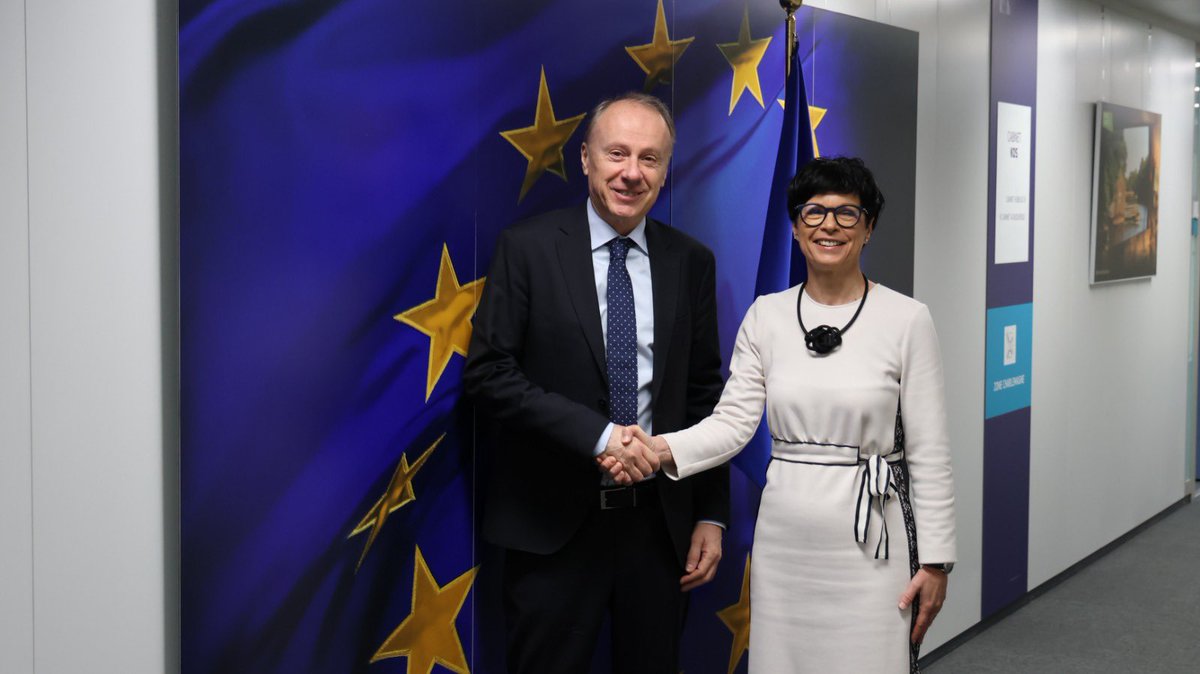
Glad to welcome Rector of the University of Belgrade Vladan Đokić in Brussels today.
Universities must remain places of critical thinking and open debate, free from any forms of intimidation.
I greatly value his commitment to defending the autonomy and dignity of the University of Belgrade.
It matters for Serbia’s democratic and European future.
English
eucrta retweetledi

EXCLUSIVE: Serbia faces losing up to €1.5 billion in EU funding as the European Commission weighs pulling the plug over democratic backsliding and the country’s close ties with Russia.
politico.eu/article/serbia…
English
eucrta retweetledi

What happened yesterday in Belgrade is not just unacceptable — it is dangerous. A university raided without warning. No clear legal basis. Cameras ready, humiliation staged. As Rector Vladan Đokić said, this was never about investigating a tragedy: it was about sending a message — “look what happens to those who refuse to stay silent.”
But another message broke through. While police entered one door, thousands of students arrived at another. Not organised. Not intimidated. Not silent. Because they understood what is at stake: if a university can be targeted, no citizen is safe.
Our Secretary General Sandro Gozi was clear: “A power that sends police into a university because the rector stands with students is a power that fears freedom, fears accountability and fears the truth.”
This is a turning point. Not only for Serbia — for Europe. Silence now would mean acceptance.
English
eucrta retweetledi
Widespread incidents of violence, threats and voting irregularities - what the observer mission of the Council of Europe has witnessed during the Serbian local elections is unacceptable.
Free and fair elections are fundamental in democracies, especially for EU candidate countries like Serbia.
We call on the competent national authorities to ensure swift and transparent investigation of the reported incidents, and to hold perpetrators accountable.
English
eucrta retweetledi

While Aleksandar Vučić hailed the local elections as a "democratic holiday," independent watchdogs reported widespread fraud, gang intimidation, and a bizarre PR campaign led by conservative U.S. podcasters.
occrp.org/en/news/violen…
English