eugenefds

4.1K posts

eugenefds banner
eugenefds

eugenefds

@eugenefds

Indie Hacker

Calgary, for now Katılım Kasım 2016
882 Takip Edilen284 Takipçiler
eugenefds
eugenefds@eugenefds·
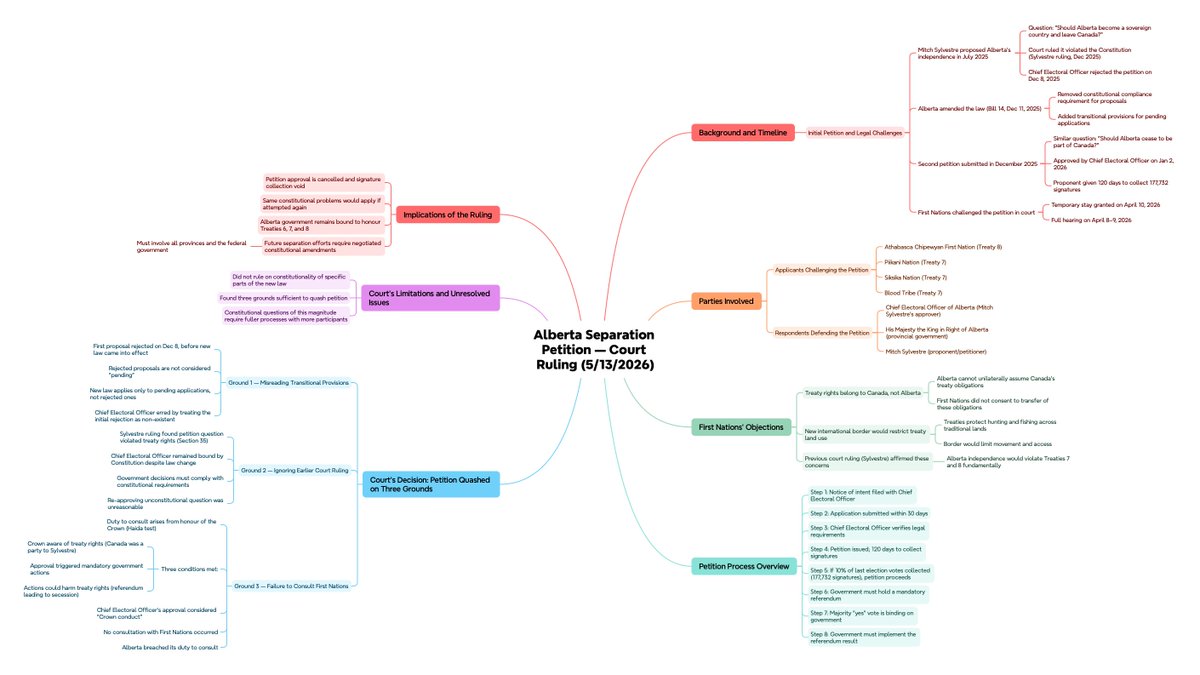
Here's a visual summary of the ruling where the judge threw out the Alberta Independence Petition. Link to the reasoning: canlii.org/en/ab/abkb/doc…
eugenefds tweet media
English
1
0
1
27
eugenefds
eugenefds@eugenefds·
@lee_w_794 Thanks Lee. I'm trying to see how AI can help make law more accessible.
English
1
0
0
10
eugenefds
eugenefds@eugenefds·
A province tried to engineer its own exit from Canada by rewriting the rulebook mid-game. The first peoples of that province showed up in court and said no. Today, the court agreed. 17/17
English
0
0
0
15
eugenefds
eugenefds@eugenefds·
So where does this leave things? Sylvestre can try again. Alberta can try to legislate again. But the constitutional problems haven't gone anywhere. Any path to separation still runs directly through the treaties — and through the First Nations who hold them. 16/
English
1
0
0
17
eugenefds
eugenefds@eugenefds·
The judge was careful here. She said: we're not deciding today whether Alberta's new law is unconstitutional. That question is bigger than this case. Other communities would need to be heard. But the three reasons above are enough. The petition approval is cancelled. 15/
English
1
0
0
18
eugenefds
eugenefds@eugenefds·
Ground 3: the Crown never consulted the First Nations. Not once. The duty to consult isn't optional. It's grounded in the honour of the Crown. And approving this petition triggered that duty the moment it set separation in motion. 14/
English
1
0
0
9
eugenefds
eugenefds@eugenefds·
Ground 2: you can't just pretend the court never ruled. The earlier decision was still the law. The Chief Electoral Officer is bound by the Constitution whether or not the government removes a specific rule reminding him of that. 13/
English
1
0
0
14
eugenefds
eugenefds@eugenefds·
Ground 1: the legal sleight of hand didn't work. The "transitional provisions" were meant to revive pending applications. But Sylvestre's first proposal wasn't pending — it had been formally *rejected*, three days before the new law came into force. You can't transition a corpse.
English
1
0
0
9
eugenefds
eugenefds@eugenefds·
The court granted a temporary pause on the petition while the case was heard. Then in April 2026, both sides argued it out. On May 13th — today — the judge delivered her answer on three separate grounds. The petition is dead. Let's go through each one. 11/
English
1
0
0
9
eugenefds
eugenefds@eugenefds·
And there's something even more visceral. The treaties guarantee First Nations the right to hunt and fish across their traditional lands. An international border between Alberta and Canada wouldn't just be a political line. It would cut directly through those treaty territories.
English
1
0
0
9
eugenefds
eugenefds@eugenefds·
Here's why. The treaties aren't with Alberta. They're with Canada. If Alberta becomes a separate country, those treaty obligations don't automatically follow. Alberta can't unilaterally inherit a nation-to-nation relationship it wasn't party to. 9/
English
1
0
0
9
eugenefds
eugenefds@eugenefds·
Four First Nations went to court immediately. The Athabasca Chipewyan (Treaty 8) and the Blackfoot Nations — Piikani, Siksika, and Blood Tribe (Treaty 7). Their argument: this process, if it succeeds, doesn't just threaten their rights. It destroys them. 8/
English
1
0
0
9
eugenefds
eugenefds@eugenefds·
Under Alberta's law, if he got those signatures, the government wouldn't just *consider* a referendum — it would be *legally required* to hold one. And if the yes side won? The government would be *required* to implement the result. The machinery of separation would be in motion.
English
1
0
0
9
eugenefds
eugenefds@eugenefds·
Within 24 hours of the new law passing, Sylvestre was back. New application, almost identical question. The Chief Electoral Officer reviewed it, ticked the boxes, and on January 2, 2026, officially launched the petition. Sylvestre had 120 days to collect 177,732 signatures. 6/
English
1
0
0
9
eugenefds
eugenefds@eugenefds·
But here's where it gets interesting. The day *before* that ruling came down, Alberta's government quietly introduced a bill in the legislature. A bill that would delete the constitutional compliance requirement entirely. 4/
English
1
0
0
9
eugenefds
eugenefds@eugenefds·
Six days later, the bill passed. The rule saying "your petition can't violate the Constitution"? Gone. And buried in the fine print: a clause saying Sylvestre's old, rejected application would be treated as if it had *never existed*. A legal do-over. 5/
English
1
0
0
9
eugenefds
eugenefds@eugenefds·
The rules at the time said any petition had to comply with the Constitution — including the parts protecting Indigenous rights. So the question went to court first. Bad news for Sylvestre: the judge said his proposal would shred Treaties 7 and 8. Petition rejected. 3/
English
1
0
0
9
eugenefds
eugenefds@eugenefds·
🧵 A citizen tried to break up Canada. A province changed its own laws to help him. And today, a court said: not so fast. Here's the wildest constitutional story you'll read this year. 1/
English
1
0
1
33
eugenefds
eugenefds@eugenefds·
His name is Mitch Sylvestre. In July 2025, he filed a petition asking Albertans a simple question: should Alberta leave Canada and become its own country? Under Alberta law, if he got enough signatures, the government would *have* to hold a referendum. 2/
English
1
0
0
9