

finkle
7.3K posts

🚨Tomorrow i will post about Small cap i discovered this weekend🚨
it meets all 7 requirements
(1) Profitable ✅
(2) Debt free✅
(3) Cash rich✅
(4) Growing in double digit✅
(5) Detached stock price from reality✅
(6) Low price to sales compared to industry✅
(7) Heavy insider and institutional ownership✅
Final writing is under process
Stay Tuned...
English

@evano7 I covered $CODX since last Tuesday at $1.70 bro.
x.com/PlayBookTrades…
PlayBookTrades 🎯@PlayBookTrades
$CODX Co-Diagnostics Develops Ebola Assay Strategy Following Recent Global Outbreak Alert. $1.70+ could provide nice trade opportunities if market continues to flow the Ebola themed stocks.
English


I highly suggest if you’re new that you dig into filings and learn how why companies do what they do and how the timing works.
I made it known multiple times last week that I’m very confident $OTLK would overcome the FDA hurdle based on what I’ve seen in filings.
Today news 🙏
The Titan Traders@TT_stocks_
$OTLK Filing just came out, they have to be gearing up for FDA approval. No other way. I took a bunch more at .30 on this dip. sec.gov/Archives/edgar…
English
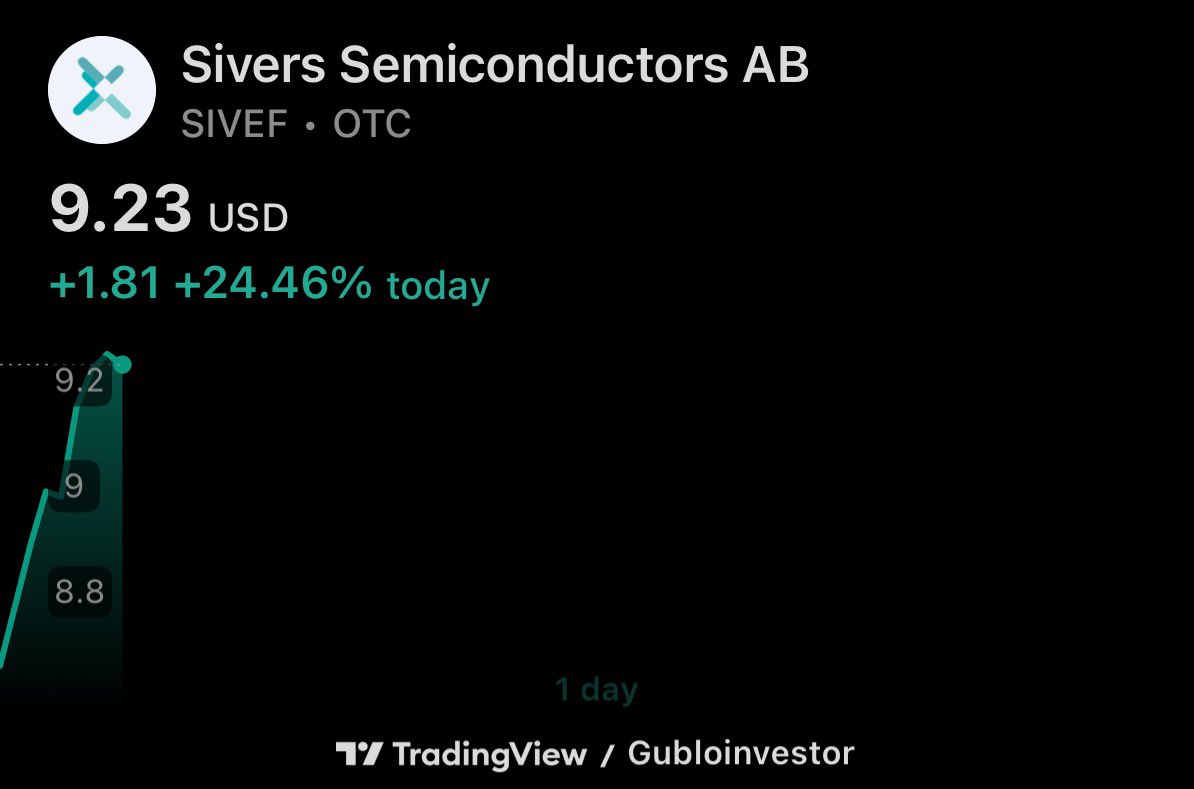
$SIVE is up 17% in Swedish market today.
If we see another 15% to 20% Tomorrow in Swedish market then $SIVEF can see possibly 35% to 40% Hike tomorrow.
$SIVEF closed 5% less than $SIVE adjusting price on Friday already.
We need 50% $SIVEF day tomorrow 😀
US market is closed today.

English

$SIVE is the largest beneficiary of brand new events this weekend:
1. Sivers new NASDAQ index inclusion (OMX Stockholm):
Both Vanguard and Blackrock are new passive inflows.
With ~$60M+ pure buying pressure inflow, into existing float, together with MSCI next week.
2. US Gov and Sweden sign agreement for joint tech collaboration.
$SIVE is one of the few CHIPS act recipients, and especially in Sweden.
And if you don’t remember, they received another $6.6M CHIPS act award last week.
Making $SIVE heavily supported + critical to the US government.
-
TLDR: New passive institutional inflow from your largest US institutions like Blackrock/Vanguard.
Compounded with US government backing into $SIVE. Over the weekend.
Beneficial for fundamentals (revenue/TAM from Pentagon supply chains) and inflow from Blackrock/Vanguard/MSCI/NASDAQ.
Extremely bullish.


English

@babyfolio I initiated a good position in $BLDP last week. The $BE announcement was a massive tailwind.
They also have partnerships with CAT and MSFT
Also they’re a local Vancouver company (where I live so I gotta support local)
x.com/traderjon01/st…
💸 Jon 💸@traderjon01
$BLDP $4.12 - huge player in the AI Data center and Robot theme. Let me explain: They have a partnership with $VRT since 2024. They cleared proof-of-concept testing at Vertiv's facility in Delaware, Ohio, and has been validated globally (including sites in Denmark and Italy). It is designed to scale seamlessly from 200kW to multiple megawatts, targeting the high-density power demands driven by AI. They are now out of the R&D/testing phase and actively marketing the prefabricated power modules to hyperscalers and colocation data center operators. And now in commercial deployment stage! Ballard proved its utility in tech infrastructure by collaborating with Caterpillar $CAT and Microsoft $MSFT . They successfully ran a multi-day, 1.5 MW hydrogen fuel cell backup test at a Microsoft data center, demonstrating that PEM (proton-exchange membrane) fuel cells can safely handle severe, uninterrupted 48-hour data center workloads. Robots / automation: 🤖 Ballard’s fuel cells are regularly integrated into heavy warehouse robotics, automated guided vehicles (AGVs), and fuel-cell forklift fleets. Hydrogen-fueled automated units can refuel in minutes, allowing robotic fleets to achieve near 100% continuous uptime.
English

$FCEL genuinely looks like a potential 10x in the making.
Feels similar to buying memory before the AI/data center explosion really kicked in.
They’re positioned in one of the hottest parts of the energy stack right now:
Behind-the-meter power generation for data centers.
What makes this interesting:
• No air permits needed
• Fewer regulatory bottlenecks
• Massive demand tailwinds from AI/DC power needs
Current market cap:
~$1.2B
If execution is there, I honestly think this could grow into a $20B company over time and potentially have a move similar to what $BE had.
I'm long.
English


Damn wtf happend to her? Is she sick?
Annie Agar@AnnieAgar
still better catch rate than jerry jeudy
English
This week has been full of surprises but ABSOLUTELY INSANE. I called;
Called $TDIC at $1.73. Hit $34.80 for 1911%.
Called $AEHL at $0.80. Hit $6.35 for 693%.
Called $QUCY at $0.60. Hit $4.92 for 720%.
Called $POET at $5.20. Hit $25.70 for 394%.
Called $AIIO at $2.00. Hit $9.20 for 360%.
Called $SATL at $2.80. Hit $9.90 for 253%.
Small caps day trading, when done well, is a huge gold mine.
Most people don’t know about how it works and I’m here to break it down week by week.
In the video below, I discuss about;
• Pros and Cons of trading a small cap Chinese stock.
• How do daily gaps help identify trade entries.
• Does news actually matter in small caps?
Remember that nobody wins 100% of the time, me included.
The business of small caps day trading isn’t about winning all the time but more so having bigger winners than losers.
Plus you’re able to achieve huge % gains in a short period of time, sometimes even within a day!
Who wants more? 🔥🔥🔥
English
$QUCY
Do you guys remember when I gave this to you at $0.70 yesterday?
We never once looked back from yesterday.
Just made a cool move 467% move to $3.97 highs today. 🔥
Do you guys understand to ride trend now if it doesn't break down? 💸

PlayBookTrades 🎯@PlayBookTrades
$QUCY Quantum Cyber N.V. Secures Exclusive Autonomous Drone Platform as Trump Administration Seeks $55 Billion for Drone Warfare. Gave nice accumulation entries at $0.62 earlier and we got a beautiful move! $0.62 -> $0.887 so far. 🔥 With this amount of volume being traded on the day, 371 million shares, definitely worth a watch for the rest of the day. Current structure to remain bullish needs to stay above $0.70/0.62 area. $0.93+ for further expansion! Trade around these levels provided. 🚀
English

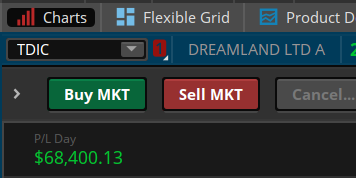

I’ve only seen this setup 1 time in 6 years 👀
I’m putting $250k in this SINGLE stock
Very similar to $PENG that made millionaires
$100 → $100,000 overnight
$300 → $300,000 in a single day
This is the third time.
Comment “Trade” and I’ll send it.
(Must be following to DM)

English