🚨 Google has sounded the quantum alarm 🚨
Today, they released groundbreaking progress towards breaking crypto using a quantum computer.
TLDR - Existing cryptography is dead. Mempool attacks are real. We must migrate to post-quantum now.
Thread 🧵
🚀 New Plonky3 release just dropped.
This is probably our most impactful and ambitious release so far:
- MUCH faster lookups
- High-arity folding
- N-ary Merkle trees + Merkle caps
- Major Poseidon2 optimizations
- Poseidon1 support
- And many more…
Let’s break it down 👇
1/ Jolt now supports zero-knowledge 🧵
This makes Jolt suitable for privacy applications — no SNARK recursion, no "wrapping", no sacrifice of transparency. Marginal increase in proof size (~3 KB). Prover time is essentially unchanged.
a16zcrypto.com/posts/article/…
Some things happening in the Nethermind formal verification team this week:
- @fastreedsolomon and I are kicking off formalisation of STIR and WHIR IOPPs as part of ArkLib (github.com/Verified-zkEVM…)
- Developing an augmented version of Certiplonk that scales better, we're currently using it to prove the soundness of an implementation of the Poseidon 2 hash in Plonky3 (github.com/NethermindEth/…)
- We have proved that probability spaces, PSp, are indeed instances of discrete camera by following the proof described in the Lilac separation logic paper. This is an important milestone in embedding the resource model of Bluebell in Iris Lean, as the model of Bluebell is (essentially) defined to be a permission algebra on top of the ordered resource algebra PSp. (github.com/Verified-zkEVM…)
- Implemented a computable implementation of Lagrange interpolation as part of the ArkLib project (github.com/Verified-zkEVM…).
JUNE 2028.
The S&P is down 38% from its highs. Unemployment just printed 10.2%. Private credit is unraveling. Prime mortgages are cracking. AI didn’t disappoint. It exceeded every expectation.
What happened?
citriniresearch.com/p/2028gic
Introducing EVMbench—a new benchmark that measures how well AI agents can detect, exploit, and patch high-severity smart contract vulnerabilities. openai.com/index/introduc…
AI can make work faster, but a fear is that relying on it may make it harder to learn new skills on the job.
We ran an experiment with software engineers to learn more. Coding with AI led to a decrease in mastery—but this depended on how people used it.
anthropic.com/research/AI-as…
Dropping the main programming for Pop-X Kuala Lumpur (Feb 5–8)!
📢Hackers, researchers, builders, founders, marketers👇
A wave of exciting talks + side-events submitted and will be woven into the full Pop-X week (Feb 4–11).
✋ Applications still open: luma.com/7c81mjzl
Today marks an inflection in the Ethereum Foundation's long-term quantum strategy.
We've formed a new Post Quantum (PQ) team, led by the brilliant Thomas Coratger (@tcoratger). Joining him is Emile, one of the world-class talents behind leanVM. leanVM is the cryptographic cornerstone of our entire post-quantum strategy.
After years of quiet R&D, EF management has officially declared PQ security a top strategic priority. Our journey began in 2019, with the "Eth3.0 Quantum Security" presentation at StarkWare Sessions. Since 2024, PQ has been central to the @leanEthereum vision. The pace of PQ engineering breakthroughs since then has been nothing short of phenomenal.
It's now 2026, timelines are accelerating. Time to go full PQ:
→ PQ ACD: Antonio Sanso (@asanso) kicks off a bi-weekly All Core Devs PQ transactions breakout call next month. These sessions focus on user-facing security, covering dedicated precompiles, account abstraction, and longer-term transaction signature aggregation with leanVM.
→ PQ foundations: Today we are announcing a $1M Poseidon Prize to harden the Poseidon hash function. We are betting big on hash-based cryptography to enjoy the strongest and leanest cryptographic foundations. Check out our other $1M PQ initiative, the Proximity Prize.
→ PQ devnets: Multi-client PQ consensus devnets are live! Shoutout to pioneers @zeamETH, @ReamLabs, @PierTwo_com, @geanclient, @ethlambda_lean, as well as established consensus teams Lighthouse, Grandine, and soon Prysm. This incredible teamwork is coordinated by @corcoranwill via weekly PQ interop calls.
→ PQ workshops: Building on last year's PQ workshop in Cambridge (see photo), the EF is hosting another 3-day PQ event in October. Top experts from around the world will convene. In addition, a PQ day is set for March 29 in Cannes just ahead of EthCC.
→ PQ FV and AI: Last week Alex Hicks (@alexanderlhicks) ran a specialised maths AI for 8 hours, at a $200 cost. It one-shotted a formal proof one of the hardest lemmas in the foundations of hash-based snarks. Mind-blowing. Applied cryptography will never be the same.
→ PQ roadmap: A comprehensive breakdown of the EF's proposed PQ strategy will be shared soon™ on pq[.]ethereum[.]org. The roadmap targets a full transition in coming years with zero loss of funds and zero downtime. Stay tuned :)
→ PQ education: The ZKPodcast (@zeroknowledgefm) is producing a 6-part video series on Ethereum's PQ strategy. EF Enterprise Acceleration is also preparing material for enterprises and nation-states. Finally, Ethereum is now represented on the PQ advisory board that Coinbase announced yesterday.
Believe in something. Believe in PQ security.
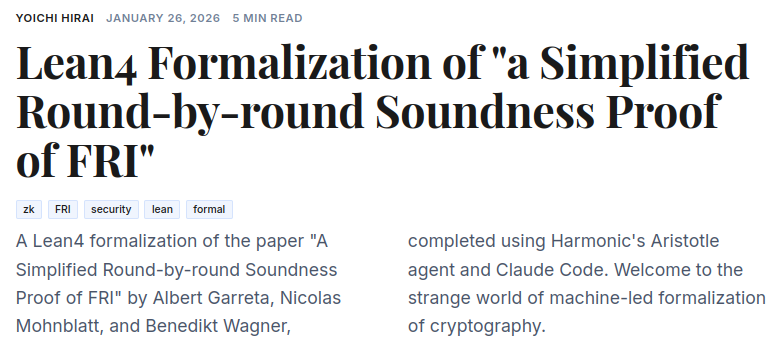
We formalized FRI soundness in Lean, using @HarmonicMath and Claude Code.
- FRI analysis by @nico_mnbl and collaborators
- turned into a Lean proof by @pirapira
🔥
Happy new year🎄
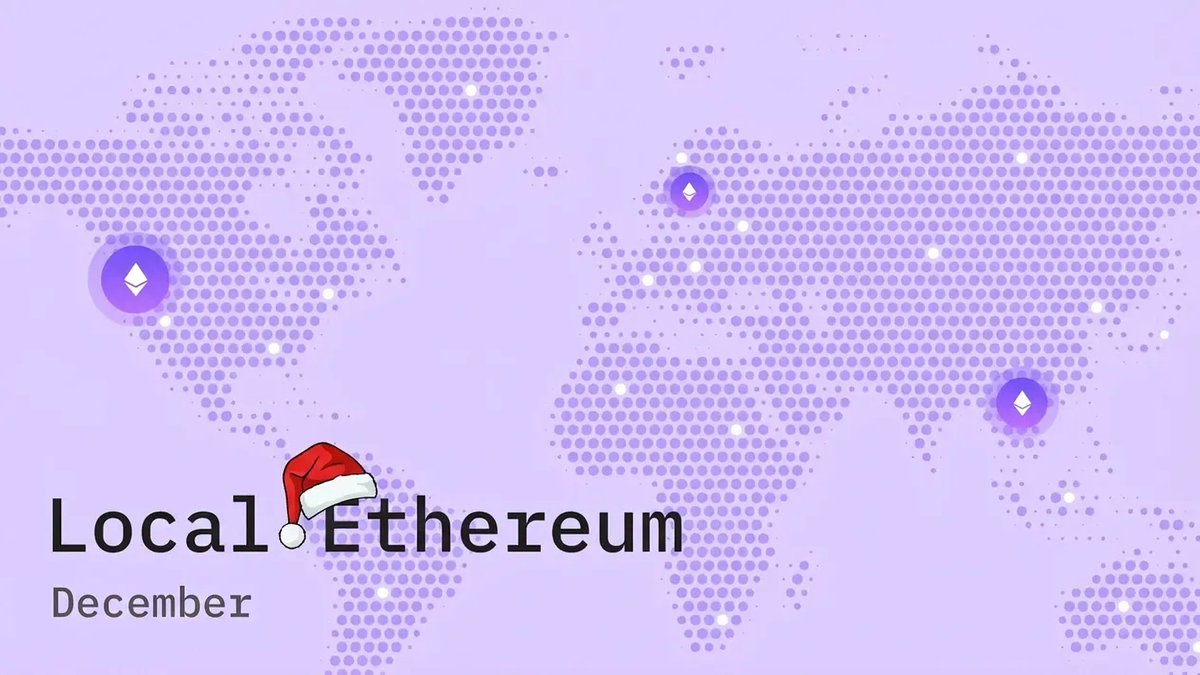
Dec 2025 in Ethereum:
- AI agents from Japan found protocol bugs @NyxFoundation
- JPMorgan launched a tokenized money-market fund on Ethereum
- The new Ethereum hub opened in Lagos @Web3Bridge
Excited to see what builders ship next.✨
localethereum.substack.com/p/local-ethere…
1/2 As of Q3 2025, the fastest client-side-feasible ZK-SNARK (@aztecnetwork's Barretenberg) is ~4x faster than the fastest *ZK* VM (@ligero_inc's Ligetron). The fastest non-ZK SNARK (@IrreducibleHW's Binius64) is ~36x faster than the fastest non-ZK VM (@KakarotZkEvm's Cairo-M).