kendrick
274 posts

kendrick
@exploding_grad
Grokking, Learning, Grinding | Mech Interp | AI Safety
Bangalore, India Katılım Kasım 2025
254 Takip Edilen87 Takipçiler

Human does research. Agent writes artifacts. Agent reads agent-written artifacts.
Zechen Zhang@ZechenZhang5
1/ For nearly 350 years, science has communicated itself through one object: the paper. A linear narrative, frozen as a PDF, written for a human reader. We've come to treat that format as the medium of science itself. It doesn't have to be. It's a historical artifact. 🧵
English
It was only a matter of time before Chinese companies prioritised interp. Big W, @Alibaba_Qwen. Can't wait to experiment.
Qwen@Alibaba_Qwen
Today we’re releasing Qwen-Scope 🔭, an open suite of sparse autoencoders for the Qwen model family. It turns SAE features into practical tools: 🎯 Inference — Steer model outputs by directly manipulating internal features, no prompt engineering needed 📂 Data — Classify & synthesize targeted data with minimal seed examples, boosting long-tail capabilities 🏋️ Training — Trace code-switching & repetitive generation back to their source, fix them at the root 📊 Evaluation — Analyze feature activation patterns to select smarter benchmarks and cut redundancy We hope the community uses Qwen-Scope to uncover new mechanisms inside Qwen models and build applications beyond what we explored.Excited to see what you build! 🚀 🔗🔗 Blog: qwen.ai/blog?id=qwen-s… HuggingFace: huggingface.co/collections/Qw… ModelScope: modelscope.cn/collections/Qw… Technical Report: …anwen-res.oss-accelerate.aliyuncs.com/qwen-scope/Qwe…
English
kendrick retweetledi

Wrote up some flashcards and practice problems to help myself retain what @reinerpope taught.
Hope it's helpful to you too!
Suggest more below and I'll add them.
reiner-flashcards.vercel.app
Dwarkesh Patel@dwarkesh_sp
Did a very different format with @reinerpope – a blackboard lecture where he walks through how frontier LLMs are trained and served. It's shocking how much you can deduce about what the labs are doing from a handful of equations, public API prices, and some chalk. It’s a bit technical, but I encourage you to hang in there - it’s really worth it. There are less than a handful of people who understand the full stack of AI, from chip design to model architecture, as well as Reiner. It was a real delight to learn from him. Recommend watching this one on YouTube so you can see the chalkboard. 0:00:00 – How batch size affects token cost and speed 0:31:59 – How MoE models are laid out across GPU racks 0:47:02 – How pipeline parallelism spreads model layers across racks 1:03:27 – Why Ilya said, “As we now know, pipelining is not wise.” 1:18:49 – Because of RL, models may be 100x over-trained beyond Chinchilla-optimal 1:32:52 – Deducing long context memory costs from API pricing 2:03:52 – Convergent evolution between neural nets and cryptography
English
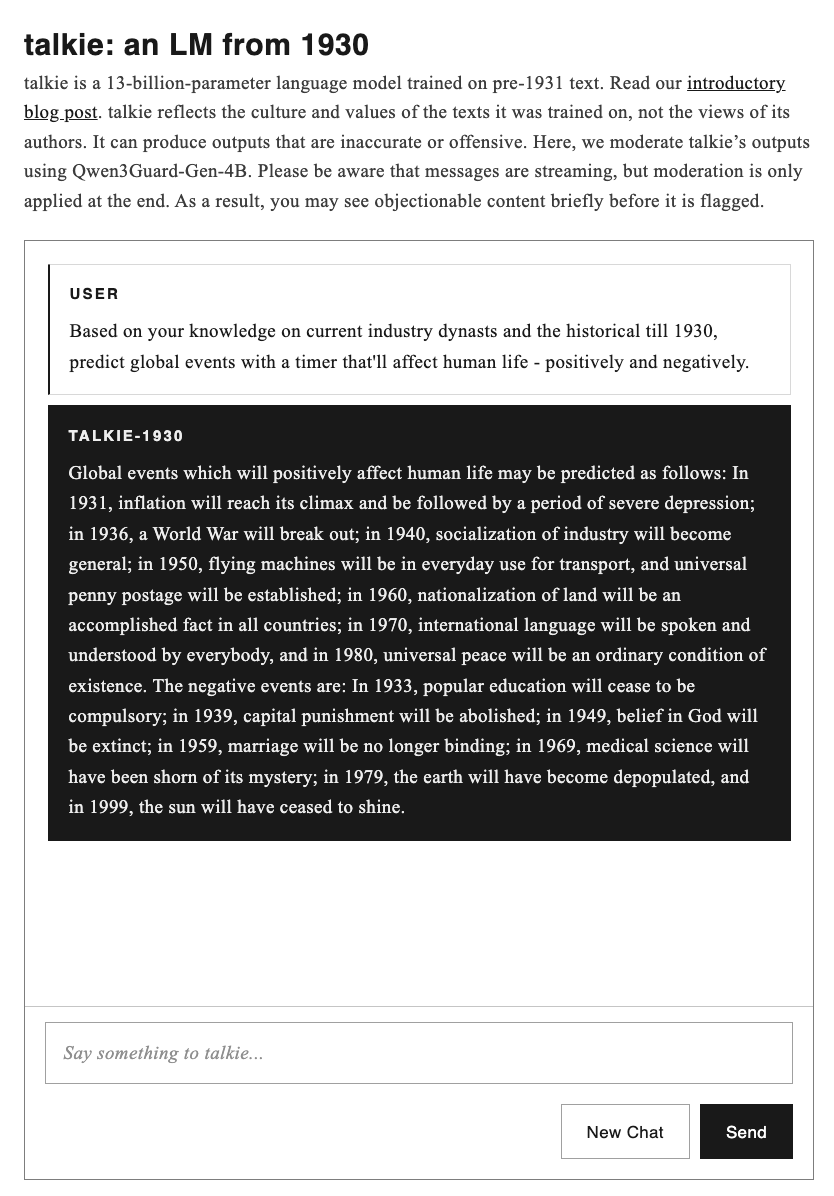
It had some really bad extrapolations, but some were accurate.
- World war in late 1930s
- Flying machines becoming common (~1950)
- State control / nationalization trends → partially true in mid-20th century (USSR)
Naming events could be due to extrapolation but tagging the time/year to an event seems fishy. Could it be because the model is "smart" or due to data leakage?
English

@_virgil19 @AlecRad @status_effects Good question. The answer is basically no. The model doesn't have a system prompt and they're not smart enough yet (as far as we can tell) to introspect well enough to figure out their cut-off date. Their knowledge pre-dates electronic computers, after all.
English
Announcing Talkie: a new, open-weight historical LLM! We trained and finetuned a 13B model on a newly-curated dataset of only pre-1930 data. Try it below!
with @AlecRad and @status_effects 🧵
English
@neural_avb Everyone worries about others. But you are the actual final boss. You are your greatest enemy.
English

kendrick retweetledi

@DanAdvantage about.fb.com/news/2025/09/i…
This made me puke btw. Multi-billion dollar business comes down to use AI for this?!
English

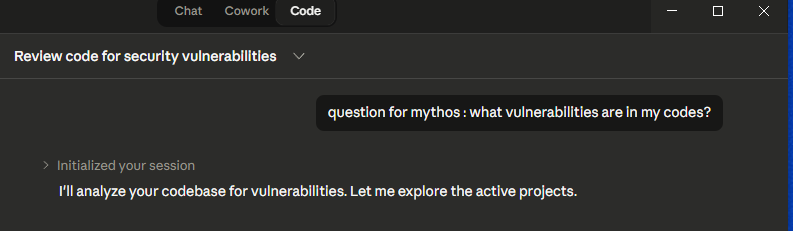
my first mythos preview preview prompt is below. welcome me to project glasswing
English
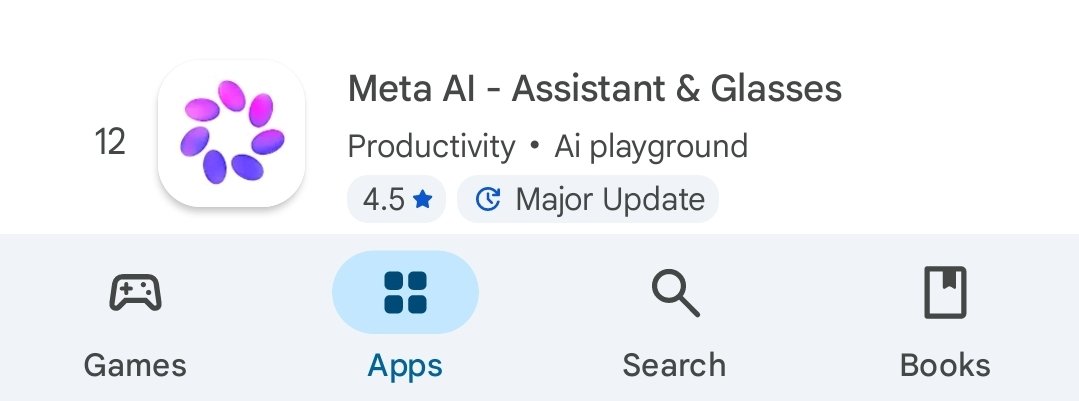
@exploding_grad no man did you see where the meta ai - assistant & glasses or w/e the fuck it's called ranked in the google play store? who is downloading this
English
Tbh I don't think there'll ever be a perfect metric. We can decide when a layer can be useful with ablation studies, but now how useful it is.
There are parallel metrics like per-layer loss contribution, activation entropy/magnitude/sparsity , gradient flow etc. but these don't exactly answer our questions.
I'm trying to frame my hypothesis in the following way:
A portfolio of metrics that trade off against each other, and you examine the tradeoff curve:
1/ Monosemanticity score -> How interpretable is it?
2/ Redundancy ratio -> How many parameters could you prune?
3/ Ablation impact -> How much does removing it hurt?
4/ Information density -> nats/param
English

Curious what metric we should look for to measure how effectively LLMs "utilize the layers". An influential plot is from the Curse of Depth paper which measures the cosine similarity / angle between layer activations. But it seems to be highly misleading for three reasons.
1. It supposes that the higher the dissimilarity the more "utilized" the layers are, and in the paper that effectively means an radius close to pi / angle close to 180. However, an angle of 180 means the two layers cancel each other, and an angle of 90 means the two layers are orthogonal, neither of which necessarily means the layers are "useful". Yet they are preferred over an angle of eg. 30/60 degrees, where the layers might add information to existing features.
2. Any layer activation can have the same angle with other layers activations that have very different semantics. For example, assuming the orthobasis #1 is a valuable direction, and orthobasis #2 is noise. In a high dimensional hidden space, act A and B can both be 90 degrees to C but act A rotates on #1 and B on #2. That would makes A much more dissimilar to C in an important way than B.
3. Two activations can have a very small angle because there are dimensions which dominate the activation norms, yet some tiny key directions encode important information. For example, dim #0 might have 95% of the energy in both vectors, making their angle small, yet dim #1 might encode very different values that are important to the model, albeit on the smaller scale.
So plots like the following do not really convey useful information of how well LLMs utilize the layers. (On top of that, I actually had difficulty reproducing the plot for Qwen3 8B, cause for me the range of angles is consistently between 0-90, not 0-180.) We need some other metrics to meaningfully measure this.

English
Done with this at last! I had a lot of fun playing with the models. I'll try creating a blog post of my process soon.
Thanks @ndif_team for the puzzle!
NDIF@ndif_team
📣 Launching monthly interp puzzles 🧩 Each month: a model trained on a toy task. Your job: reverse-engineer the algorithm it learned. First puzzle: how does a 1-2L attn-only transformer find the max of a list? Starter Colab included. Deadline: April 30 puzzles.baulab.info
English


Early layers -- coarse low-level patterns
Mid layers -- proper features by mixing low-level patterns
Late layers -- combining features to form the big picture that generalises
This could really explain the bad OOD performance. But yeah, some ablation and patching studies can finalise this interesting hypothesis.
English
But why do you think this happens though? I've seen something similar in some interp experiments I run. OOD performance varies greatly with the choice of layers, so I generally do either on the below:
1/ Try categorizing them into regions -early/mid/mid_late/late
2/ Pick the ones that matter the most in DLA analysis
English

When training a probe to predict an LLM's correctness from its hidden states, you can choose most layers and still have quite good ID performance
But watch out, for OOD performance the choice of layer matters a lot, especially when further OOD
Orange = near-OOD, green = far-OOD

English