

forest Franklin
6.3K posts
72% of entrepreneurs report mental health concerns including depression, anxiety, and substance issues, according to a UC Berkeley study of 242 founders. Yet most startup advice tells you to move fast, network constantly, and never show weakness. Laozi (Lao Tzu) wrote the honest version 2,500 years ago: I alone am different from everyone, and it's lonely.
Dao De Jing (Tao Te Ching) Chapter 20 is the most personal passage in the entire book. Laozi drops the philosophical voice and just describes how it feels to think differently:
"众人熙熙,如享太牢,如春登台. 我独泊兮,其未兆." Everyone is excited, like they're at a feast or climbing a terrace in spring. I alone am still, showing no sign.
"众人皆有余,而我独若遗." Everyone has more than enough. I alone seem to have lost everything.
"俗人昭昭,我独昏昏." Ordinary people are bright and sharp. I alone am dim and confused.
This isn't self pity. It's a description of what it actually costs to see things differently than the majority.
Solomon Asch's 1951 conformity experiments showed that people agreed with an obviously wrong answer 37% of the time when the rest of the group said it was right. In at least one trial, 75% of participants conformed. The social pressure to agree is so strong that it overrides what you can see with your own eyes. Laozi's "I alone" is the refusal to do that, and the data shows most people can't sustain it.
But the contrarians who hold their ground tend to win over time. Moscovici's minority influence research found that even a small consistent minority can shift group opinion in about 8% of cases, not by forcing agreement but by making the majority think harder. Warren Buffett built the most successful investment record in history by being "fearful when others are greedy and greedy when others are fearful." Renaissance Technologies' Medallion Fund averaged roughly 66% annual returns before fees over three decades by systematically betting against consensus.
I know this feeling from smaller stakes. There have been stretches where everyone around me was excited about a tool or a trend and I just couldn't see it. The temptation to join in is real because staying out feels like falling behind. But almost every time I followed the crowd against my own judgment, I regretted it. And almost every time I stayed with my own read, it worked out, even when it took longer than expected.
The FOMO economy runs on exactly the dynamic Laozi described. Everyone at the feast, everyone climbing the terrace. Social media FOMO affects roughly 60% of young adults according to recent surveys, driving compulsive checking, impulse purchases, and anxiety about missing out on experiences that turn out to be less fulfilling than they looked. The emerging JOMO movement (Joy of Missing Out) is basically Chapter 20 repackaged for the attention economy.
"我愚人之心也哉" — I have the heart of a fool. This line captures something the Dunning Kruger research quantifies: people with less knowledge tend to overestimate their competence, while experts tend to underestimate theirs. Laozi's "foolishness" is actually the mark of someone who has gone deep enough to realize how much they don't know. Tetlock's superforecasters, the top 2% of predictors in his research, consistently described themselves as uncertain and probabilistic rather than confident and definitive. Being "dim and confused" turns out to be a competitive advantage when everyone else is confidently wrong.
The chapter closes with the most important line: "我独异于人,而贵食母." I alone am different from others, and I value being nourished by the Mother. The "Mother" is the Dao, the source behind everything. Laozi isn't saying he's better than others. He's saying his nourishment comes from a different place: not from the crowd's approval, not from the feast, but from something quieter and deeper.
The commentator Wang Bi (226 to 249 CE) read this as the sage choosing substance over appearance, root over branch. Heshanggong read it as the cultivator who draws life from the Dao itself rather than from social performance.
Every generation has people who look dim because they're operating from a source the crowd can't see. The question is always whether you can tolerate looking foolish long enough for the results to speak.
Would you rather look smart by agreeing with everyone, or look foolish by following what you actually see, even when nobody else sees it yet?
#Daoism #IndependentThinking
English
Craigslist makes an estimated $300 to $690 million per year with roughly 50 employees and a website that hasn't changed since 1999. No app, no AI features, no redesign. Yet it still gets 105 to 140 million monthly users. Turns out, doing less on purpose can be more profitable than doing everything, and Laozi (Lao Tzu) made that argument 2,500 years before the first startup pitch deck.
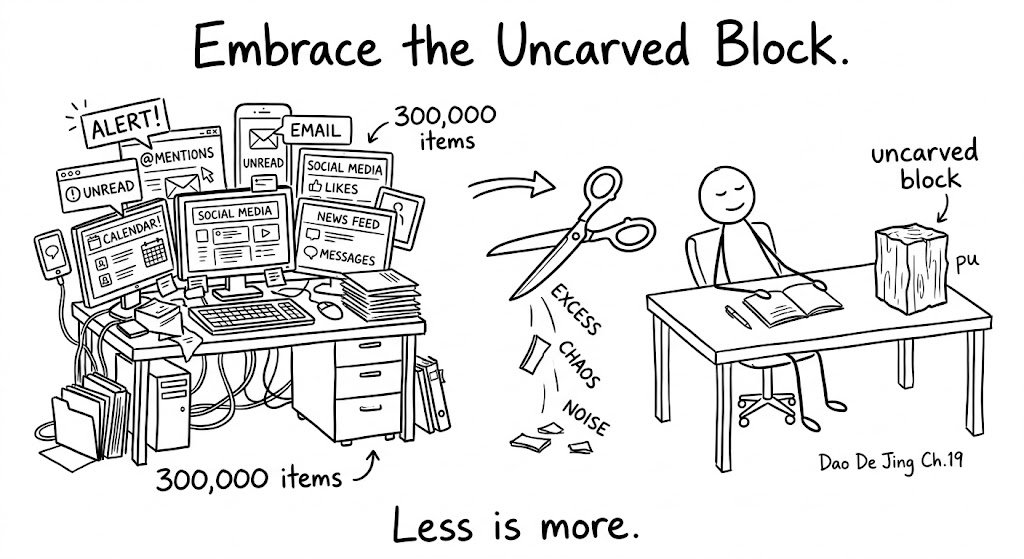
Dao De Jing (Tao Te Ching) Chapter 19 is one of the most confrontational passages in the entire book: "绝圣弃智,民利百倍." Abandon sagacity, discard cleverness, and the people will benefit a hundredfold. Abandon benevolence, discard righteousness, and the people will return to genuine compassion. Abandon skill, discard profit, and there will be no thieves.
Then comes the prescription: "见素抱朴,少私寡欲." Show plainness. Embrace the uncarved block. Reduce selfishness. Have few desires.
Laozi isn't against knowledge or goodness. He's against the performance of them. When cleverness becomes the goal instead of the tool, it produces hypocrisy. When profit becomes the measure of skill, it produces theft. Strip away the performance, and what's left actually works.
The average American household contains over 300,000 items. Homes have tripled in size over 50 years, and we still don't have enough room. The fast fashion industry alone accounts for roughly 10% of global CO2 emissions, more than aviation and shipping combined, while producing 92 to 120 million tonnes of textile waste annually. Items are worn 7 to 10 times before being thrown away. Laozi's "few desires" isn't philosophy anymore. It's environmental math.
The attention economy shows the same pattern. US adults spend 4 to 5 hours daily on their phones, unlocking them 96 to 205 times per day. Knowledge workers toggle between apps over 1,200 times daily and need 23 minutes to refocus after each interruption. One analysis estimated US social media distraction costs $650 billion annually in lost productivity. We built systems so clever they steal from us, which is exactly what "绝巧弃利,盗贼无有" warns about.
I cleared out half my tools and subscriptions last year and my output went up. Not because I was being philosophical about it, but because every tool I removed was one less thing competing for my attention. The uncarved block isn't about having nothing. It's about having only what actually matters.
A 5 day reduction in high dopamine digital stimulation restored motivation by 30% in a University of Zurich study. Cal Newport's Digital Minimalism research shows that intentional tech users report higher satisfaction and deeper focus than maximalists. Philip Tetlock's forecasting research found that generalist "foxes" who stay open and update their beliefs outperform specialist "hedgehogs" by 20 to 30%, because the specialists get trapped by their own cleverness. Abandoning expertise isn't the point. Abandoning attachment to expertise is.
Basecamp has been profitable for 25 straight years with zero debt, serving over 75,000 organizations in 166 countries. Their strategy: do less, charge fairly, stay small on purpose. No sales team, no discounts, no enterprise features nobody asked for. That's "show plainness, embrace simplicity" turned into a business model.
The commentator Wang Bi (226 to 249 CE) read this chapter as stripping away artificial labels that create their own opposites. Name "sagacity" and you create a market for fake wisdom. Name "benevolence" and you create a performance of kindness that replaces the real thing. Heshanggong took it practically: the ruler who displays simplicity and curbs desires restores the people's innate goodness without needing to lecture them about it.
Every system that tries to optimize everything eventually optimizes itself into fragility. The ones that survive are the ones that know what to leave out.
Would you rather keep adding complexity hoping something finally works, or strip back to what actually matters and let the rest go?
#Daoism #Minimalism
English
Volkswagen spent years marketing "clean diesel" while software in 11 million cars was cheating emissions tests. The total cost: $34.69 billion in fines and settlements. Turns out, the louder a company talks about its values, the more likely something is broken underneath. Laozi (Lao Tzu) explained why 2,500 years ago.
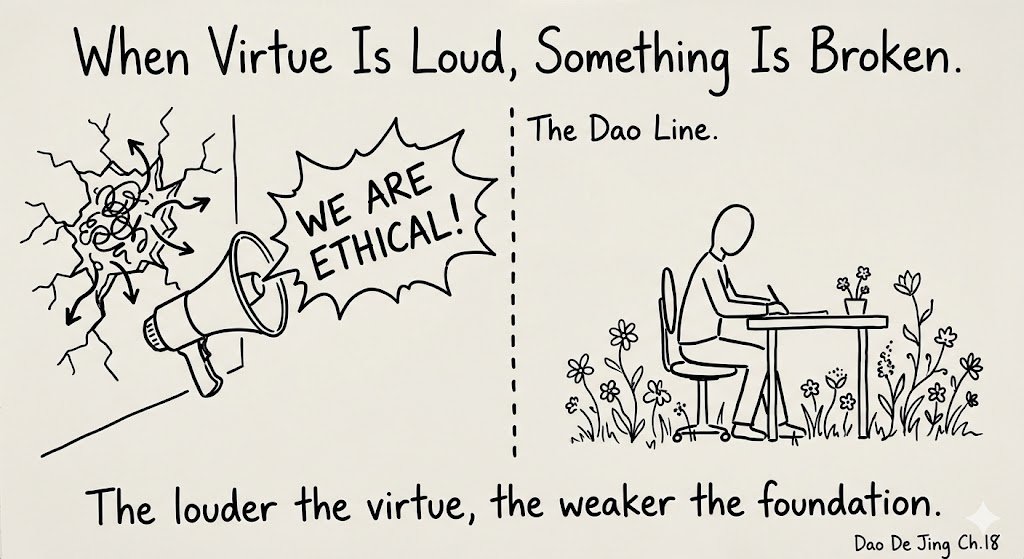
Dao De Jing (Tao Te Ching) Chapter 18 is only two sentences long, but it might be the sharpest observation in the entire book: "大道废,有仁义;慧智出,有大伪." When the great Dao is abandoned, benevolence and righteousness appear. When cleverness and intelligence emerge, great hypocrisy follows.
The second half makes it personal: "六亲不和,有孝慈;国家昏乱,有忠臣." When family relationships break down, filial piety and parental love become talking points. When the country falls into chaos, loyal ministers suddenly appear.
The point isn't that benevolence or loyalty are bad. It's that when you have to name them, advertise them, and build campaigns around them, it means they've already stopped being natural. Healthy families don't need to announce they love each other. Healthy companies don't need to spend millions proving they're ethical.
The data backs this up. RepRisk tracked 1,841 incidents of misleading corporate communication globally in 2024, with 56% being environmental greenwashing. High severity cases surged over 30%. Only 33% of investors rate ESG disclosures as high quality, and 85% say greenwashing is getting worse, not better. The louder the virtue, the weaker the foundation.
This pattern shows up everywhere. OpenAI's mission statement has changed six times in nine years, most recently removing references to "safely" while pursuing for profit restructuring and Pentagon contracts. Multiple safety team members left after accusing the company of prioritizing "shiny products" over caution. When a company needs to constantly rewrite its values, the values aren't the problem. The gap between words and actions is.
Goodhart's Law captures the same idea from economics: when a measure becomes a target, it ceases to be a good measure. Schools that teach to the test produce higher scores but worse thinkers. The Atlanta school district faced racketeering charges when teachers falsified results to hit performance targets. Hospitals penalized for readmissions under the HRRP reduced that specific number but saw post discharge mortality rise by over 0.5% for heart failure and pneumonia patients. The metric improved. The patients didn't.
I see a version of this in how people present themselves online. The couples who post the most about their relationship are rarely the happiest ones. The founders who talk the most about company culture usually have the worst retention. When something is actually working, you don't need to perform it.
The commentator Wang Bi (226 to 249 CE) explained it this way: explicit virtue emerges precisely because natural alignment has been lost. Naming goodness creates its opposite. "The most beautiful name is born of the greatest evil." Heshanggong compared it to medicine: you only need it when the patient is already sick. In a healthy society, nobody talks about loyalty because everyone already acts loyally.
The most trustworthy people rarely tell you how trustworthy they are.
This has practical implications. When you're evaluating a company, a leader, or even a relationship, pay less attention to what they say about their values and more attention to whether those values are visible without being announced. The organizations that actually live their principles don't need marketing budgets to prove it. The ones that spend the most on proving it are usually compensating for something.
Would you rather trust someone who tells you they're honest, or someone whose honesty you notice without them ever mentioning it?
#Daoism #VirtueSignaling
English
Costco's stock went from roughly $80 to $660 under a CEO most people can't name. Tim Cook took Apple from $300 billion to over $3 trillion without a single "one more thing" moment. Turns out, the best leaders are the ones you barely notice, and Laozi (Lao Tzu) ranked them that way 2,500 years ago.
Dao De Jing (Tao Te Ching) Chapter 17 lays out four levels of leadership in order from best to worst:
The best leaders? The people barely know they exist.
Next best? The people love and praise them.
Next? The people fear them.
Worst? The people despise them.
Then it adds: "功成事遂,百姓皆谓我自然." When the work is done and the task is complete, the people all say: we did it ourselves.
That last line is the whole point. The highest form of leadership doesn't feel like leadership. It feels like the outcome happened naturally.
Jim Collins studied 1,435 companies for Good to Great and found that all 11 that made the sustained leap were led by what he called Level 5 leaders: people who combined personal humility with fierce professional will. They deflected credit to their teams. Their companies delivered cumulative stock returns averaging 6.9 times the general market over 15 years. The flashier CEOs? They averaged 2.8 times. The invisible leaders literally outperformed the famous ones by more than double.
Craig Jelinek ran Costco from 2012 to 2023. He skipped most earnings calls, rarely gave interviews, and focused on paying employees well and keeping prices low. Revenue went from $105 billion to $242 billion. Jack Bogle built Vanguard on the principle that investors don't need a genius manager picking stocks for them. Index funds now consistently beat 80 to 95% of active managers over any 10 year period. Tim Cook never tried to be Steve Jobs. He focused on supply chains, ecosystem expansion, and quiet operational excellence. Apple's market cap grew tenfold.
The pattern is clear: leaders who make themselves unnecessary build things that last longer than leaders who make themselves the center.
The chapter also explains why lower levels of leadership fail: "信不足焉,有不信焉." When trust is insufficient, distrust follows. The 2026 Edelman Trust Barometer surveyed 33,000 people across 28 countries and found that trust in employers sits at 78%, while trust in government is at 53%. People trust what's close and visible over what's distant and loud. A longitudinal study by Griep and colleagues tracked 1,135 employees over two years and found that when leaders break psychological contracts, 87% of employees enter a "trust erosion" trajectory that directly hurts performance.
I've seen this play out in teams I've worked with. The managers who talked the least in meetings but listened the most consistently got better results. The ones who sent the most emails and scheduled the most check ins usually had the least engaged teams. Laozi described this as "悠兮,其贵言": unhurried, the leader values words sparingly. Not silence for its own sake, but signal over noise.
The commentator Wang Bi (226 to 249 CE) read this chapter as a portrait of the sage ruler who governs through non action: no visible deeds that invite praise, no force that invites fear. The people experience peace without knowing its source. Heshanggong emphasized naturalness: under the best ruler, things happen so smoothly that outcomes feel self generated, which is exactly what "百姓皆谓我自然" means.
Here's the uncomfortable implication. If you're a leader and everyone knows it, you might not be the best kind. The best leaders create conditions where good work happens without them having to be in the room. The worst leaders need constant visibility to maintain control.
Would you rather work for someone who makes you feel like you accomplished it yourself, or someone who makes sure you know they were responsible for your success?
#Daoism #Leadership

English
The S&P 500's Shiller CAPE ratio has a historical average of about 16 to 17 since 1881, yet it currently sits around 37 to 39. Every time it's climbed this high, it's eventually come back down. Turns out, a 2,500 year old Chinese text has a one line explanation for why ignoring this pattern ends badly: "不知常,妄作,凶." Not knowing the constant, one acts recklessly. Disaster.
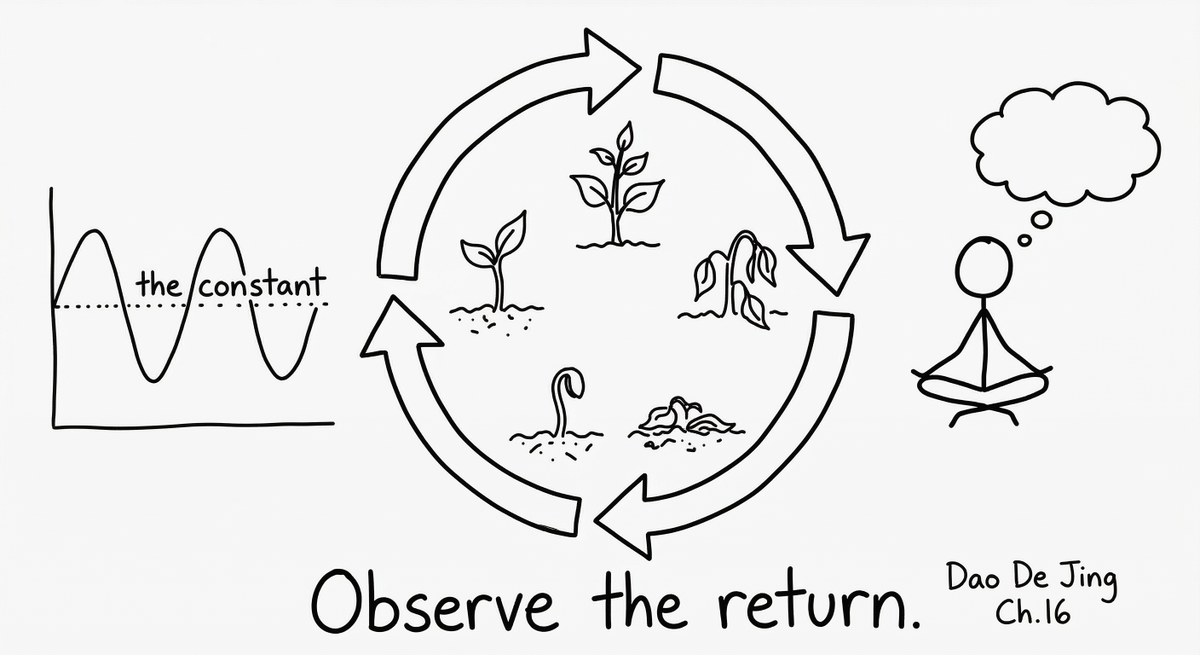
Dao De Jing (Tao Te Ching) Chapter 16 opens with one of the most direct instructions in all of ancient philosophy: "致虚极,守静笃." Attain the ultimate emptiness. Hold firmly to stillness. Then it explains why: "万物并作,吾以观复." Everything arises together, and from that stillness, I observe their return.
Laozi (Lao Tzu) is describing something every experienced investor, ecologist, and meditator already knows. Things go up. Things come down. Everything returns to where it started. The people who understand this pattern navigate life better than those who fight it.
The neuroscience of meditation maps directly onto "attaining emptiness." A 2004 study by Richard Davidson and Antoine Lutz at the University of Wisconsin published in PNAS found that long term Tibetan Buddhist meditators with 10,000 to 50,000 hours of practice produced sustained high amplitude gamma oscillations during meditation that far exceeded those of control subjects. Gamma power correlated with lifetime practice hours at r = 0.79. A 2011 fMRI study by Judson Brewer found that experienced meditators showed significantly reduced default mode network activation, the brain regions responsible for self referential thinking and mind wandering. Emptiness, in measurable terms, means quieting the parts of your brain that tell stories about yourself.
I use a version of this when I'm stuck on a problem. Instead of pushing harder, I step away. Every time I've forced clarity, the result was worse than when I let the answer surface on its own. That's "observing the return" in practice: stop stirring, and the water clears.
The market parallel is hard to ignore. Robert Shiller's CAPE data going back to 1881 shows that extreme valuations always revert toward the historical mean. The dot com peak hit about 44 in 2000 before crashing. Ray Dalio's Big Debt Cycles framework maps this over 75 to 150 year arcs: financial assets boom relative to real assets, then deleverage through defaults or currency devaluation. Markets always return to their root.
The chapter's sharpest warning is about what happens when you don't see the pattern. Enron's accounting fraud wiped out roughly $63 to $74 billion in market value and 20,000 jobs. WeWork peaked at a $47 billion valuation before collapsing into bankruptcy. FTX went from $32 billion to zero with an $8 to $10 billion customer shortfall. Every one of these was a case of "not knowing the constant and acting recklessly."
Things flourish in abundance, but each returns to its root. That's not just philosophy. The regenerative agriculture market, built on the principle that nutrients must cycle back into soil rather than being extracted, grew to roughly $10 to $12 billion in 2025 and is projected to reach $40 to $50 billion by 2035 at 14 to 16% growth annually. Industrial agriculture ignores the cycle and depletes. Regenerative farming follows it and endures.
The commentator Wang Bi (226 to 249 CE) read this chapter as revealing the deepest structure of reality: "We can observe the returning of all things through emptiness and quietude. Being arises from emptiness. Activity arises from tranquility." Stillness isn't passive. It's the vantage point from which you can see what's actually happening.
The chapter closes with a chain that connects personal awareness to lasting leadership: knowing the constant leads to tolerance, tolerance to impartiality, impartiality to true leadership, true leadership to alignment with nature, and alignment with nature to the Dao. The Dao endures. Follow it, and you endure without danger.
Every part of this chain has modern evidence behind it. Organizational behavior research shows ethical leaders who demonstrate fairness and tolerance build higher trust and lower burnout. Google's Project Aristotle found psychological safety, which requires tolerance of mistakes, was the top predictor of team performance. The pattern is the same whether you're running a meditation retreat or a Fortune 500: awareness of cycles produces better outcomes than fighting them.
The people who see the cycle ride it. The people who don't get crushed by it.
Would you rather keep pushing against the current because it's uncomfortable to be still, or learn to watch the pattern and move when it actually makes sense?
#Daoism #MarketCycles
English
Google studied 180+ teams and found that psychological safety was the single strongest predictor of team success, beating intelligence, experience, and individual talent. Yet most leadership advice still tells you to be bold, decisive, and fast. Laozi (Lao Tzu) had a different model 2,500 years ago: be cautious as someone crossing a frozen river.
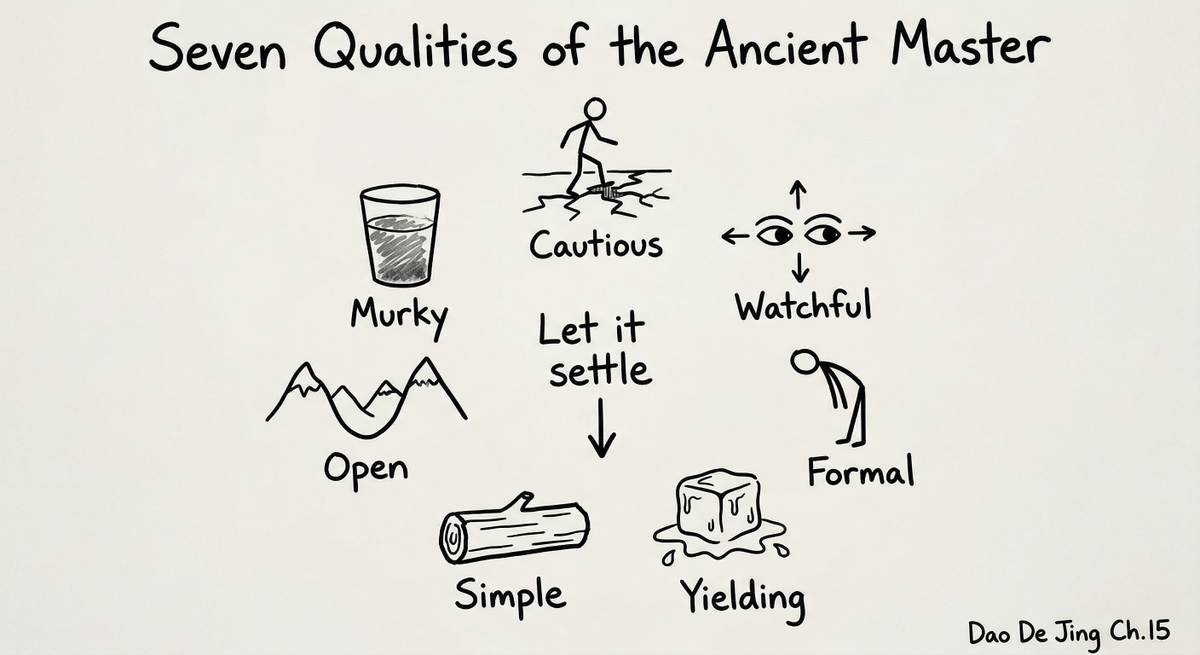
Dao De Jing (Tao Te Ching) Chapter 15 describes the ancient masters with seven metaphors. They weren't bold. They were careful. They weren't loud. They were murky, like muddy water that clears only when you stop stirring it.
Here are the seven: Cautious as crossing a frozen river in winter. Watchful as if fearing neighbors on all sides. Formal as a guest. Yielding as melting ice. Simple as uncarved wood. Open as a valley. Murky as muddy water.
That first one hits hardest for anyone making high stakes decisions. Google's Project Aristotle (2012 to 2016) analyzed over 180 teams using 35,000 data points and found that the teams where people felt safe admitting mistakes and asking questions were 43% more likely to hit their performance targets. Amy Edmondson's foundational 1999 research defined this as psychological safety: a shared belief that the team is safe for risk taking. The best leaders weren't the ones charging ahead. They were the ones testing the ice.
"Watchful as fearing neighbors on all sides" is basically how the best investors operate. Howard Marks made only five major market timing calls in 50 years, and he got them all right: the dot com bubble, the pre GFC leverage buildup, the post crisis buying window, and the pandemic lows. His firm Oaktree deployed $7.5 billion in distressed debt in three months during the financial crisis, generating outsized returns specifically because years of caution had preserved their cash. Warren Buffett's version: be fearful when others are greedy.
I notice this pattern in my own decision making. The times I've moved too fast on something, whether it's a project pivot or a tool adoption, are almost always the times I regret. The decisions that worked best were the ones where I waited, watched what was actually happening, and moved only when the path was clear enough to justify the risk.
The muddy water metaphor is backed by real neuroscience. A 2009 meta analysis by Sio and Ormerod reviewed 117 studies on the incubation effect and found a moderate positive effect (d = 0.29) for taking breaks during problem solving. The benefit was strongest when the break activity was undemanding, which lets your unconscious mind keep working. Matthew Walker's sleep research shows people are 30 to 50% more likely to solve insight problems after sleeping on them. Forced clarity doesn't work. You have to let the sediment settle.
The person who can sit with confusion long enough for it to resolve on its own will consistently outperform the person who demands answers immediately.
The chapter ends with a line that goes against everything modern business culture teaches: "保此道者不欲盈." Those who hold to this Dao do not seek fullness. Because they are never full, they can wear out without needing to be made new.
Patagonia took this literally. Their 2011 "Don't Buy This Jacket" campaign told customers the environmental cost of the product they were selling. They repaired over 100,000 garments in 2019 through their Worn Wear program. In 2022 they transferred ownership to a trust dedicated to fighting climate change. Revenue still grew roughly 30% after the campaign. Not seeking fullness turned out to be a better business strategy than chasing it.
Toyota's production system runs on the same principle. Kaizen means continuous small improvement, not radical redesign. Toyota vehicles routinely last over 300,000 miles because the system favors incremental durability over flashy reinvention. That's "wearing out without needing renewal" in industrial form.
The commentator Wang Bi (226 to 249 CE) read these seven metaphors as descriptions of subtle action: the sage never forces, always aligns with what's emerging naturally. Heshanggong took it more practically as instructions for internal cultivation: still the mind, empty desires, let turbidity settle through non action.
Every one of these metaphors describes the opposite of what gets rewarded on social media: caution instead of confidence, murkiness instead of clarity, simplicity instead of sophistication, openness instead of expertise. And yet the research keeps pointing in Laozi's direction.
Would you rather follow a leader who charges ahead with certainty, or one who tests the ice before asking you to step on it?
#Daoism #Leadership
English
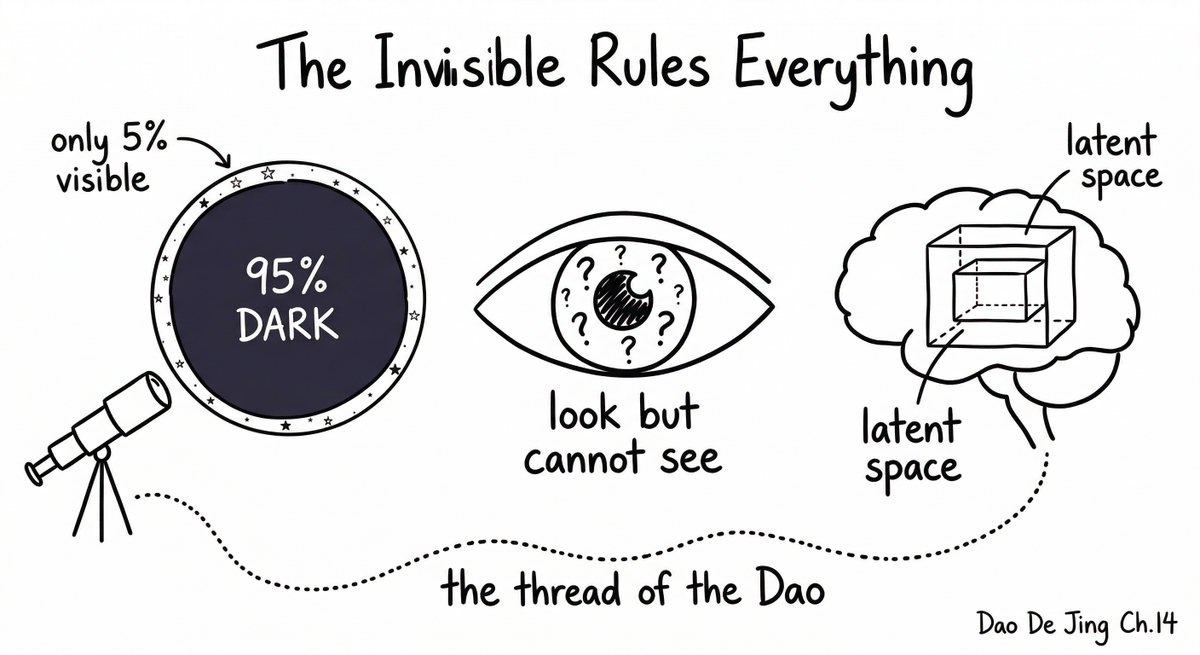
95% of the universe is made of dark matter and dark energy that we cannot directly detect, yet these invisible components shape how every galaxy forms. In March 2025, two major telescope projects released data that sharpened this picture dramatically. And reading those results, I kept thinking about a 2,500 year old Chinese text that described something strikingly similar.
Dao De Jing (Tao Te Ching) Chapter 14 opens with: "视之不见名曰夷,听之不闻名曰希,搏之不得名曰微." Look but cannot see it: invisible. Listen but cannot hear it: inaudible. Grasp but cannot hold it: intangible. These three merge into one.
Laozi (Lao Tzu) was describing the Dao, the underlying pattern behind everything. You can't pin it down with any single sense. And the harder you try to grab it directly, the more it slips away. The comparison to modern physics is interpretive, not predictive, but the parallel is hard to ignore.
The Dark Energy Spectroscopic Instrument (DESI) released its second round of cosmology results on March 19, 2025, analyzing baryon acoustic oscillations from over 14 million galaxies and quasars spanning 11 billion years. The finding: dark energy appears to be evolving over time rather than staying constant. The statistical significance ranged from 2.8 to 4.2 sigma depending on dataset combinations. That same week, ESA's Euclid space telescope released deep field data capturing 26 million galaxies in a 63 square degree preview, mapping dark matter halos through gravitational lensing effects.
The biggest forces shaping the cosmos are the ones no instrument can directly photograph. We infer them from how visible things bend and move.
This pattern repeats in AI. Neural networks make decisions through latent spaces: high dimensional representations inside hidden layers that no human can directly read. According to IBM, roughly 44% of organizations have reported negative consequences from AI use, with opacity as a contributing factor. Anthropic CEO Dario Amodei set a 2027 goal for reliably detecting most model problems, giving you a sense of how early we still are in understanding what these systems actually do internally.
I ran into this myself when trying to explain why a particular AI workflow produced better results than a manual approach. The honest answer was: I can't fully point to the reason. The useful patterns were embedded in something I couldn't directly inspect. That's not a failure. That's what working with complex systems actually feels like.
Michael Polanyi named this in 1966: "we know more than we can tell." In business, tacit knowledge is estimated to make up roughly 80% of what organizations actually know. Panopto research suggests about 42% of institutional knowledge is unique to specific individuals. When those people leave, the knowledge goes with them. Fortune 500 companies collectively lose billions each year from this kind of invisible knowledge drain.
The commentator Wang Bi (226 to 249 CE) read Chapter 14 as a lesson about the Dao's nature: it underlies everything but has no form you can categorize. Heshanggong took it more practically: if the Dao is invisible, you cultivate sensitivity to it by quieting your mind until you can sense the pattern without forcing it into words.
The chapter ends with what might be the most practical line: "执古之道,以御今之有,能知古始." Hold the ancient Dao to master what exists today, and you can know how it all began. In plain terms: timeless patterns explain present situations better than chasing the latest surface data. That's first principles thinking before anyone called it that.
The thread connecting a 2,500 year old verse about invisibility to a telescope mapping 14 million galaxies to a $20 billion knowledge management industry is straightforward: the most important forces in any system are usually the ones you can't directly measure. The people who accept that, and learn to work with patterns they can sense but never fully pin down, tend to navigate better than those who insist on seeing everything before they move.
Would you rather keep demanding proof you can point to before making a decision, or learn to trust the patterns that show up in results but resist explanation?
#Daoism #DarkEnergy
English
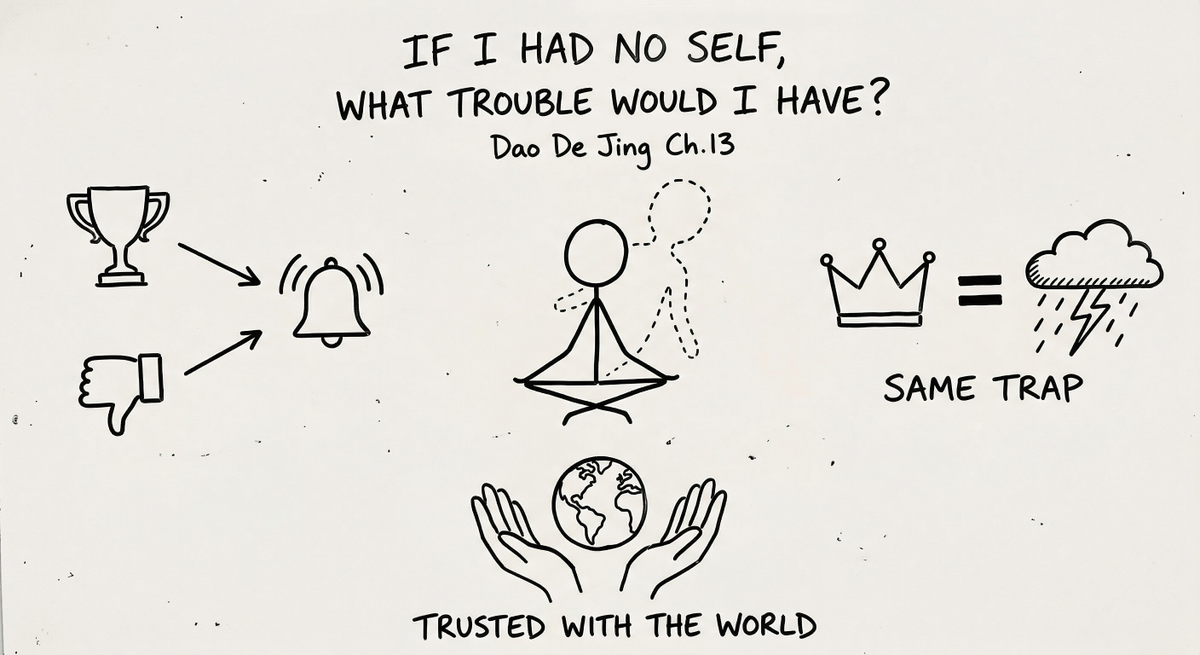
A 2025 survey of 542 North American creators by Creators 4 Mental Health found 62% reported burnout, 52% anxiety, and 65% obsession over content performance metrics. Turns out, Laozi (Lao Tzu) wrote about this exact pattern in Dao De Jing (Tao Te Ching) Chapter 13, roughly 2,500 years before the first notification bell existed.
The chapter asks a blunt question: "吾所以有大患者,为吾有身,及吾无身,吾有何患?" The reason I have great trouble is that I have a body, a self. If I had no self, what trouble would I have?
This sounds abstract until you watch someone panic sell during a market crash. The loss feels personal because they've fused their identity with the portfolio. It's not just money dropping. It feels like part of them is disappearing.
A 2004 meta analysis by Dickerson and Kemeny reviewed 208 lab studies and found that tasks combining social evaluation with uncontrollability produced the largest cortisol spikes of any stressor category, with an effect size of d = 0.93. The critical finding wasn't just that criticism stresses you out. It's that any situation where your social standing is being judged, positive or negative, triggers the same alarm system. Praise can spike cortisol too, because it raises the bar you now have to maintain.
Laozi described this with: "得之若惊,失之若惊." Gaining it startles you, losing it startles you. Honor and disgrace aren't opposites. They're the same trap, because both tie your inner state to someone else's judgment.
The commentator Wang Bi (226 to 249 CE) read this as political advice: a ruler who clings to favor invites chaos, because favor already contains the seed of disgrace. The other major commentator, Heshanggong, took a more practical angle: honor is precarious like standing on a cliff edge, and the fix is internal steadiness, cultivating your own stability so external swings don't knock you sideways.
Both arrived at the same place. The chapter concludes: "故贵以身为天下,若可寄天下." Only someone who cares for the world as carefully as their own body, without making it about ego, can be trusted with the world.
Jim Collins' research team studied 1,435 companies for Good to Great and found that all 11 that made the sustained leap were led by what he called Level 5 leaders: fierce professional will paired with personal humility. They credited their teams. Their companies delivered cumulative stock returns averaging 6.9 times the general market. The people who didn't chase personal glory built things that outlasted them.
The person who doesn't need the title is usually the one who deserves it.
I see this in my own workflow. The days I'm checking engagement numbers every hour are the days I produce the weakest work. It's not that metrics are useless. It's that when my identity gets tangled up in them, I start optimizing for the scoreboard instead of for the actual quality of what I'm making. Laozi's fix isn't "stop caring." It's "stop letting external scores define who you are."
Satya Nadella showed what this looks like at scale. When he took over Microsoft in 2014, the company culture was what he called "know it all." He shifted it toward "learn it all," driven partly by personal experience with empathy after his son's disability. Microsoft's market cap moved from roughly $300 billion to over $3 trillion. He wasn't building a monument to himself. He was removing the ego that was blocking the company from adapting.
So what does this actually give you?
Next time you feel a spike of anxiety after posting something or getting feedback, ask one question: is this about the situation, or is this about my identity being on the line? If it's the second one, that's the "great trouble" Laozi was pointing at. The trouble exists because you've made the outcome part of who you are. Separate those two things, and the trouble shrinks to its actual size.
In an era where 62% of creators are burning out and most leaders still optimize for personal legacy, Laozi's 2,500 year old advice is surprisingly practical: care deeply about the work, but stop fusing yourself with the results.
Would you rather lead by proving you deserve the position, or by forgetting you need to prove anything at all?
#Daoism #Leadership
English
82% of CEOs in a 2025 Wellhub survey of 1,500 leaders said wellness investments showed positive ROI, yet most of us still spiral after one piece of harsh feedback. Turns out, Laozi (Lao Tzu) diagnosed this exact glitch 2,500 years ago.
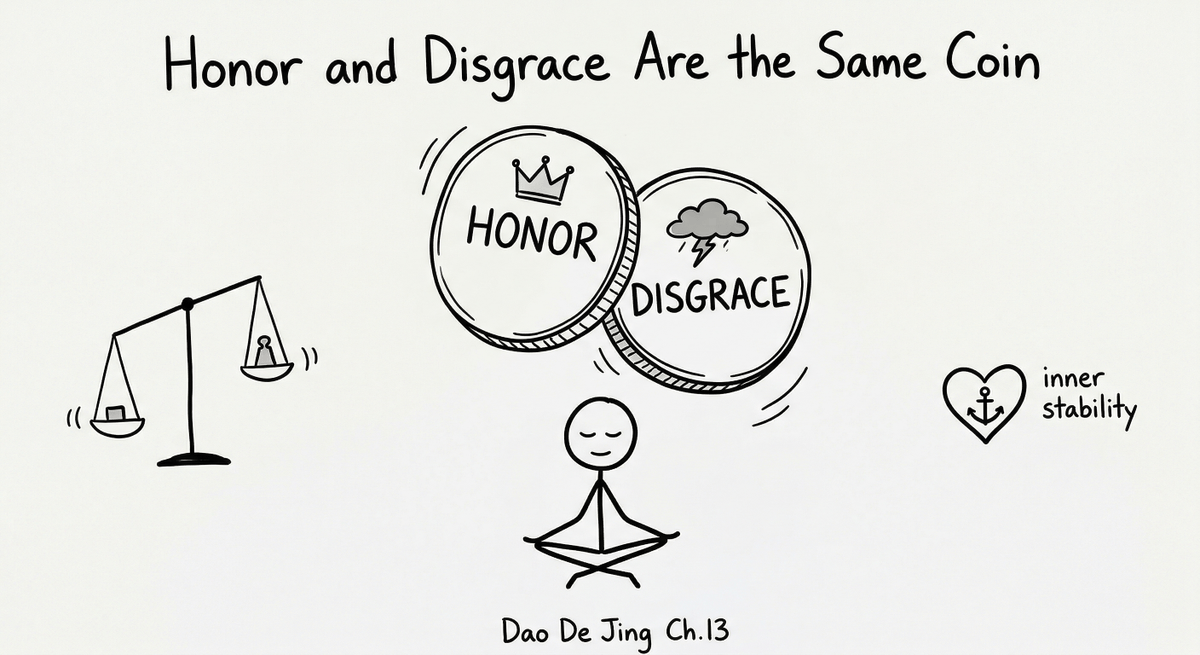
Chapter 13 of the Dao De Jing (Tao Te Ching) opens with: "宠辱若惊,贵大患若身." Honor and disgrace both shake you up. You treat big trouble like it's part of your body.
Plain English: we react the same way to praise and criticism because we've welded our identity to what others think. And the "big trouble" we fear? It only controls us because we can't separate who we are from what's happening to us.
This has real dollar signs attached. The global meditation market is estimated at $8.5 billion in 2026, projected to reach $20.4 billion by 2033 according to Coherent Market Insights. Corporate wellness spending hit an estimated $68 billion in 2025 and is projected to double to $138 billion by 2035 per Precedence Research. Billions of dollars flowing into solving a problem one ancient Chinese philosopher described in a single sentence.
Social media cranked this problem up to industrial scale. Every like is a tiny hit of "favor." Every ratio is a tiny hit of "disgrace." Your nervous system treats both the same way: alarm. That's literally what Laozi said. Not "one is good and the other is bad." Both are destabilizing because both make you dependent on someone else's opinion.
The commentator Wang Bi (226 to 249 CE) put it sharply: favor already contains the seed of disgrace. The moment you feel proud of a promotion, you've created the fear of losing it. They're not opposites. They're two sides of the same trap.
I noticed this in my own work. The weeks I obsessed over engagement numbers were the weeks I made my worst calls. Not because the data was wrong, but because I was playing to the scoreboard instead of focusing on the work itself. Laozi's fix isn't "stop caring." It's "stop letting external scores define who you are."
This applies directly to how people handle money. Anyone who's panic sold during a market dip knows the feeling: the loss felt personal, like something was being taken from you. That's "贵大患若身" in action. You treated the trouble as if it were your own body. Investors who learn to treat losses as information rather than identity threats tend to make calmer, better timed decisions.
When you can't tell where you end and your reputation begins, every piece of feedback feels like surgery without anesthesia.
Now, the honest pushback. Total detachment doesn't always work. If you're a doctor, your reputation directly affects patient trust. If you're a whistleblower, reputation can mean survival. Laozi wasn't prescribing apathy. He was drawing a line between protecting your integrity and protecting your ego.
Acceptance and Commitment Therapy (ACT) calls this "cognitive defusion," separating yourself from your thoughts about a situation. Cognitive Behavioral Therapy (CBT) works on reframing the situation itself. Epictetus wrote "it's not things that disturb us, but our opinions about things." Buddhism calls it non attachment. Different traditions, same diagnosis: the suffering comes from the fusion, not the event.
So what does this actually give you?
First, watch how you react to compliments. If praise makes you anxious about maintaining the standard, that's the signal that you've fused your identity with the outcome. Second, treat setbacks like weather: prepare for rain, but don't take it personally. Third, check where your self worth lives. If it's stored entirely in other people's opinions, you've outsourced your stability to strangers.
The $8.5 billion meditation industry is people collectively admitting they need help with what Laozi described. The solution probably isn't another app. It's a shift in where you locate your sense of self.
Would you rather spend your energy managing how others see you, or put it into work so solid that your reputation becomes a side effect?
#Daoism #EmotionalResilience
English
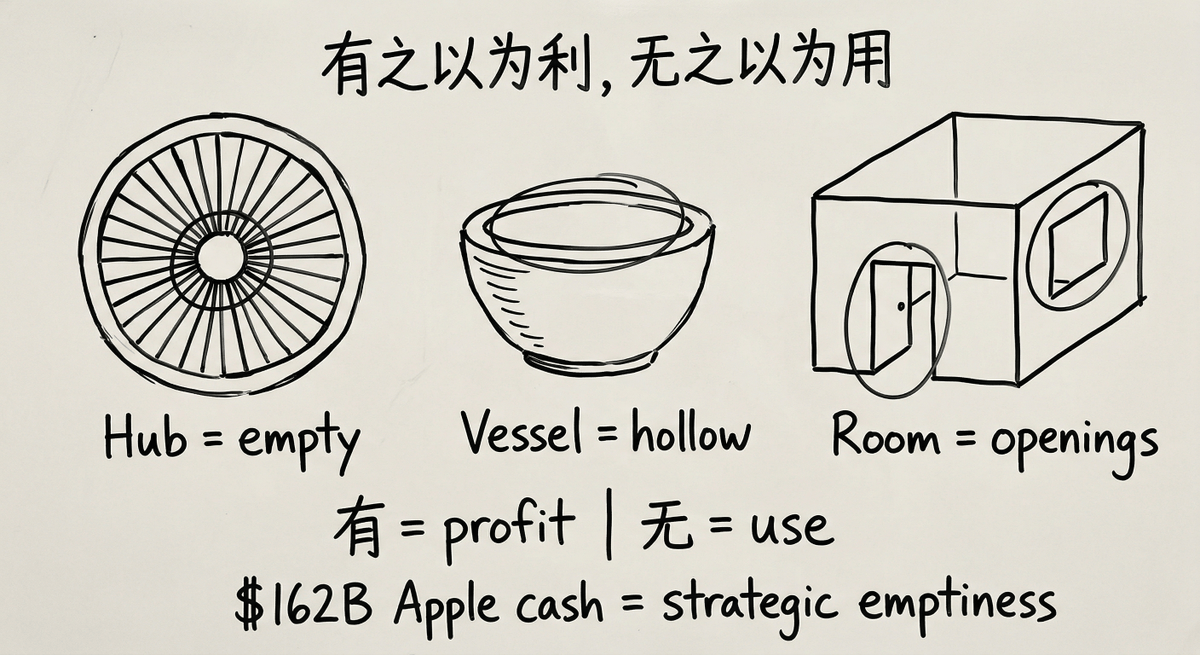
Apple held approximately $162 billion in cash and marketable securities as of early 2025 (Apple quarterly earnings). That cash does nothing. It produces nothing. It builds nothing. And it is the single most strategically valuable asset on Apple's balance sheet. The empty space is where the power lives.
The Daodejing Chapter 11 makes this point with three examples that are 2,400 years old and still the clearest explanation of why emptiness matters: "三十辐共一毂,当其无,有车之用。埏埴以为器,当其无,有器之用。凿户牖以为室,当其无,有室之用。故有之以为利,无之以为用。" Thirty spokes share one hub. It is the empty center that makes the wheel useful. Shape clay into a vessel. It is the space within that makes the vessel useful. Cut doors and windows for a room. It is the holes that make the room useful. Therefore, what exists serves for profit. What does not exist serves for usefulness.
I think about this chapter every time I look at my calendar. Atlassian's research estimates that unproductive meetings cost U.S. businesses $37 billion per year. The average knowledge worker spends over 60% of the workday on "work about work" rather than skilled work (Asana Anatomy of Work Index 2025). Bill Gates famously takes biannual "Think Weeks" where he isolates himself to read and reflect. The empty calendar is the productive calendar. A schedule without gaps is a wheel without a center: it looks complete, but it cannot turn.
Global commercial real estate exceeds $40 trillion in value (MSCI Real Estate estimates). What are you buying when you buy a building? You are buying the emptiness inside. The walls and floors exist. But the space between them is what you use. A data center is a room full of racks. The racks exist. But the empty slots are the capacity. Fill every slot and the data center is at maximum revenue but zero flexibility. The emptiness is the optionality.
Global internet bandwidth exceeded 1,300 terabits per second by 2025 (TeleGeography). Bandwidth is the emptiness of the information highway: the unused capacity waiting to carry data. Cloud computing sells empty compute cycles. AWS generated $128.7 billion in 2025 by renting out nothing: virtual machines that do not physically exist, running on shared hardware that is never fully occupied. The business model is the sale of emptiness.
Wang Bi (226 to 249 CE) read the three metaphors as a systematic demonstration: the hub, the vessel, and the room all show that physical form (you, being) provides the structure, but emptiness (wu, non-being) provides the function. Form is the container. Emptiness is the content. Heshang Gong connected it to self-cultivation: the body exists, but it is the empty mind that enables wisdom. Fill the mind, and it stops working, just as filling the vessel destroys its purpose.
Dieter Rams designed the most influential consumer products of the 20th century at Braun using one principle: "Weniger, aber besser." Less, but better. Apple's Jony Ive cited Rams as his primary influence. The iPhone succeeded not because of what it included but because of what it removed: the keyboard, the stylus, the complexity. The value was in what was not there.
My read: Chapter 11 is the most underappreciated insight in the Daodejing. Everyone builds for what exists. Almost no one designs for what does not. The wheel needs its hub. The vessel needs its hollow. The room needs its doors. The calendar needs its gaps. The balance sheet needs its cash. The network needs its unused capacity. What exists serves for profit. What does not exist serves for use. The empty space is not the absence of value. It is the source of it.
Do you design for what fills the space, or for the space itself?
#DaoDeJing #Design
English
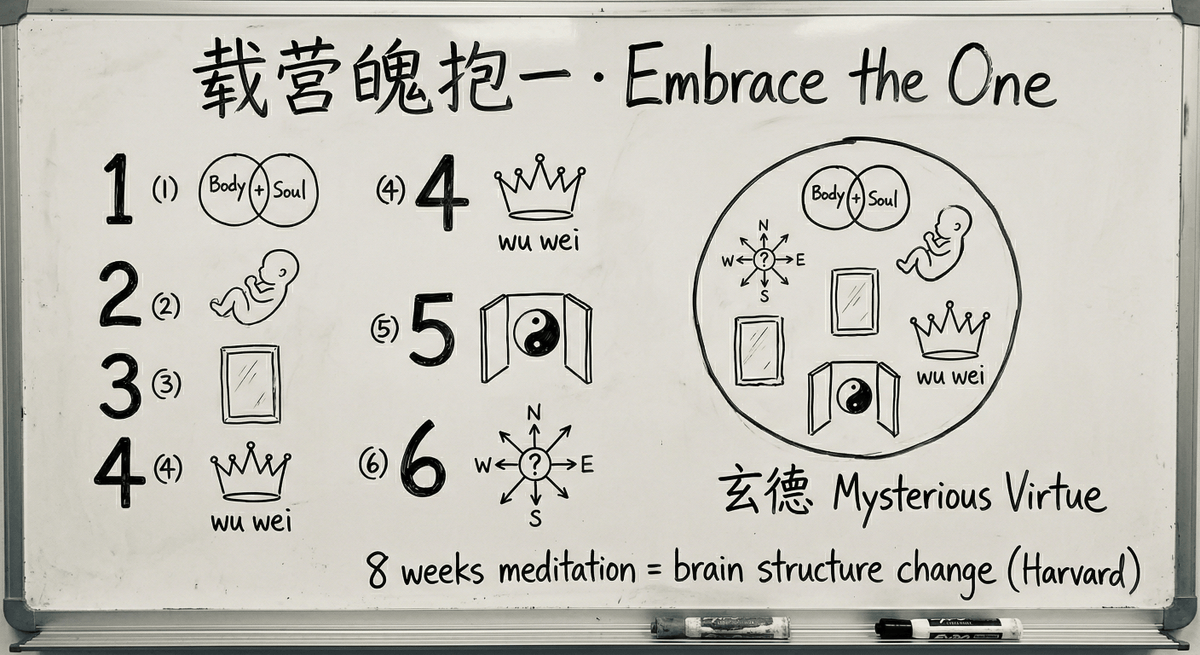
A 2011 Harvard study found that 8 weeks of mindfulness meditation physically changed the brain: increased gray matter density in the hippocampus (learning/memory), reduced density in the amygdala (stress/anxiety). The effect has been replicated across dozens of studies through 2025. You can measurably alter the structure of your brain by sitting still and paying attention to your breath.
The Daodejing Chapter 10 asks six questions that have haunted me since I first read them. Can you carry your soul and embrace the One without departing? Can you concentrate your breath and achieve the utmost softness, like an infant? Can you cleanse your inner mirror and leave it without flaw? Can you love the people and govern the state through non-action? Can the gates of Heaven open and close while you remain receptive? Can your understanding reach in all directions while you remain without cunning knowledge?
Each question is a test. And each one maps to something measurable.
The first question is about integration. Can body and mind stay unified? Csikszentmihalyi's research on flow states (Flow, 1990) documented the phenomenon: when attention, intention, and action align completely, performance peaks and self-consciousness disappears. Athletes call it being in the zone. Navy SEALs train it through box breathing (4 seconds in, 4 hold, 4 out, 4 hold). The Wim Hof Method has demonstrated under controlled conditions that conscious breathing techniques can modulate the immune system (PNAS 2014, Kox et al.). Integration of body and mind is not philosophy. It is physiology.
The second question is about softness. Can you become as soft as an infant? Over 500 million people worldwide practice yoga (Yoga Alliance/Ipsos 2025), the discipline whose name literally means "union" of body and mind. The breathwork apps market exceeded $200 million by 2025. Apple added respiratory tracking to the Apple Watch. The market is telling us that people are paying to learn what Laozi asked for free: whether they can achieve softness through breath.
The third question is about clarity. Can you clean the mirror of your mind? Cognitive behavioral therapy, the most empirically validated psychotherapy (Hofmann et al., 2012 meta-analysis: effective across 269 studies), works by identifying and correcting distortions in the mental mirror. The Daodejing asks whether you can do it completely. CBT says you can at least improve.
The fourth question is about governance. Can you govern without cunning? The Edelman Trust Barometer 2025 reports that trust in institutions globally sits at 61%, with the Nordic countries consistently at the top (75%+). The countries with the lightest-touch, most invisible governance systems produce the highest trust. The best building codes, food safety standards, and financial regulations are the ones you never think about. Governance through non-action means designing systems so well that intervention becomes unnecessary.
The fifth question is about receptivity. Can the gates open and close while you remain in the feminine, receptive mode? This is the valley spirit from Chapter 6 applied to the individual: receiving without grasping.
The sixth question is about knowing without cunning. This is the alignment problem. Anthropic's Constitutional AI and OpenAI's RLHF are both attempts to build systems that "understand in all directions" while remaining without deceptive knowledge. Alignment research funding exceeded $300 million in 2024 (Epoch AI estimates). The entire field exists because we built systems that know without wisdom, and now we are trying to make them wise without making them cunning.
The chapter closes with what Wang Bi (226 to 249 CE) called the "mysterious virtue" (xuan de): to give life and nurture without possessing, to act without relying on the action, to lead without dominating. Heshang Gong read it as the culmination of inner cultivation: each question builds from body to breath to mind to governance to transcendence.
My read: Chapter 10 is a diagnostic. It asks whether you have achieved integration at every level. Most people and most systems fail at the first question: keeping body and soul together without splitting apart. The ones that pass all six are the ones that last.
How many of these six questions can you answer yes to?
#DaoDeJing #MindBody
English
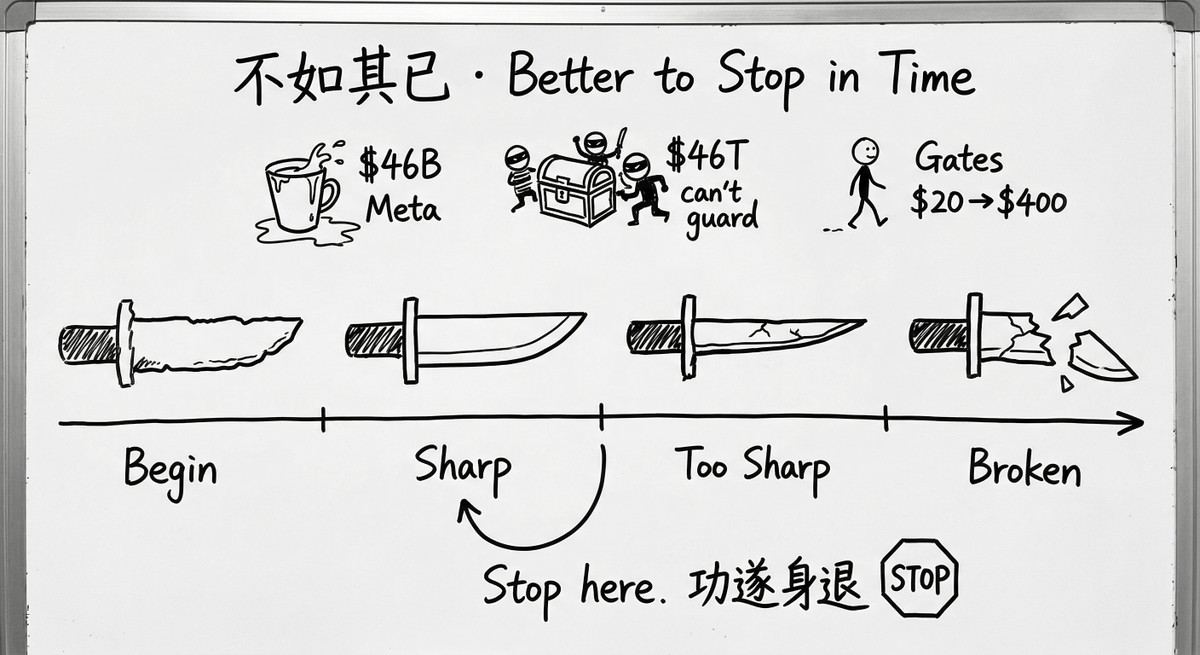
Meta spent over $46 billion on its metaverse division between 2020 and 2025 (Reality Labs cumulative losses, Meta earnings reports). The stock lost roughly 65% of its value in 2022 before Zuckerberg pivoted back to AI. He sharpened the blade until it broke. Boeing's 737 MAX was designed to squeeze maximum efficiency from an aging airframe. Two crashes killed 346 people. The edge did not last.
The Daodejing Chapter 9: "持而盈之,不如其已;揣而锐之,不可常保。金玉满堂,莫之能守。富贵而骄,自遗其咎。功遂身退,天之道也。" Hold and fill to the brim, and it will spill. Sharpen a blade too much, and it cannot last. Fill your house with gold and jade, and it cannot be guarded. Claim wealth and titles with arrogance, and you invite disaster. When the work is done, withdraw. This is the way of Heaven.
The founders who understood this are the ones whose companies survived them. Bill Gates stepped back from Microsoft's daily operations in 2008. The stock was around $20. By 2025, it was over $400. Larry Page and Sergey Brin left Alphabet's executive roles in December 2019. Google's market cap roughly doubled in the five years that followed. Jeff Bezos stepped down as Amazon CEO in July 2021. Jack Ma retired from Alibaba's chairmanship in September 2019. In each case, the founder withdrew when the work was done. The company continued to grow because the system no longer depended on the individual.
Contrast that with the ones who held on too long. Adam Neumann filled WeWork to the brim: $47 billion valuation built on losses exceeding 105% of revenue. The IPO collapsed. Travis Kalanick sharpened Uber's aggressive culture until it cut the company from the inside: a toxic workplace investigation forced his resignation in 2017. Elizabeth Holmes filled Theranos with the appearance of gold and jade: a $10 billion valuation backed by technology that did not work.
"Gold and jade cannot be guarded" maps directly to wealth concentration data. The top 1% of Americans hold roughly $46 trillion in wealth as of 2025 (Federal Reserve distributional data). FTX collapsed with an $8 billion customer shortfall. Mt. Gox lost approximately $460 million in Bitcoin in 2014. Every exchange that tried to hoard at scale eventually failed to guard what it held. The bigger the vault, the bigger the target.
The optimal stopping problem in mathematics formalizes what Laozi described: in a sequential decision process, there is a mathematically provable point at which continuing to search, optimize, or accumulate produces worse expected outcomes than stopping. The classic secretary problem (Lindley 1961) shows the optimal strategy is to reject the first 37% of candidates, then hire the next one that beats all previous. The optimal stopping point is not the end. It is the moment when additional effort generates negative returns.
Wang Bi (226 to 249 CE) read "gong sui shen tui" (when the work is done, withdraw) as the Dao's natural pattern: all things rise, complete their cycle, and return. Clinging to the peak violates the cycle and invites reversal. Heshang Gong connected it to bodily cultivation: overexertion depletes essence. The sage knows the work is done before others realize it has begun.
The Greeks called the failure to stop hubris. Nemesis followed. The pattern is consistent across cultures and centuries: the thing that refuses to stop at the natural point of completion does not grow further. It breaks.
My read: Chapter 9 is the most practical chapter in the Daodejing. It is not philosophy. It is risk management. Every system has a natural point of completion. Filling past that point causes spillage. Sharpening past that point breaks the edge. Accumulating past that point creates a target. The sage does not stop because he is tired. He stops because the work is done. And the proof is that everything he built continues without him.
Do you know when your work is done, or do you keep sharpening until the blade breaks?
#DaoDeJing #Timing
English
Google studied 10,000 managers over 10 years in Project Oxygen and found that the top 8 behaviors of great managers were all soft skills: being a good coach, empowering the team, expressing concern for wellbeing, being productive and results-oriented, communicating well, supporting career development, having a clear vision, and having technical skills to advise the team. Technical expertise ranked last. The best managers lead like water.
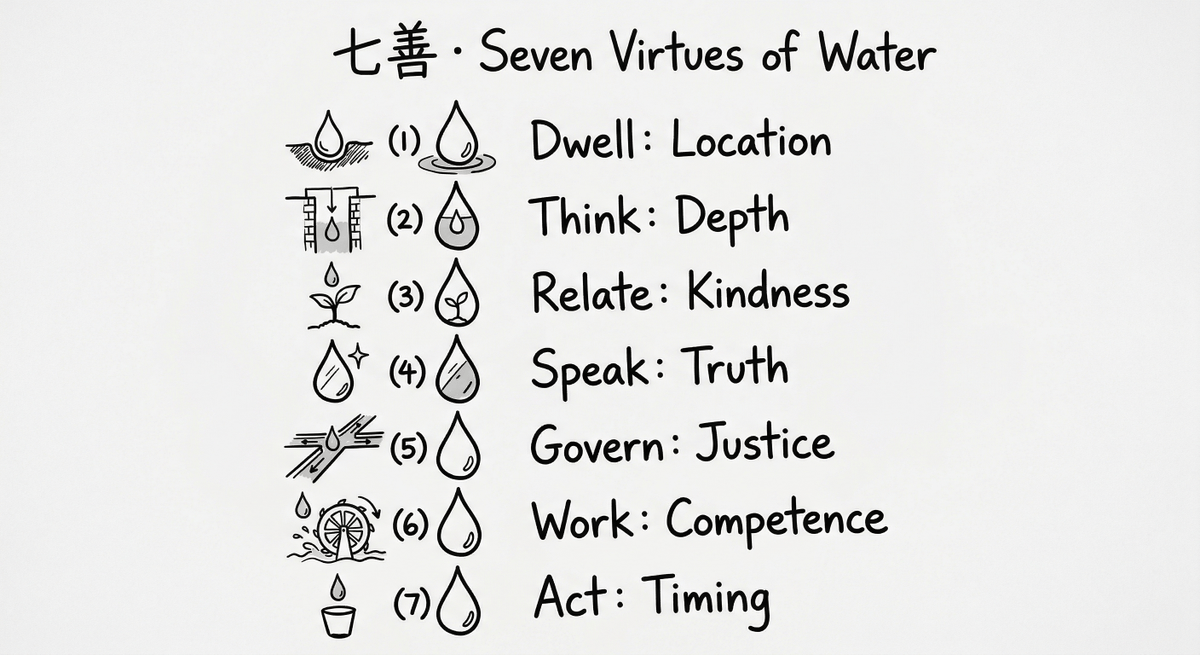
The Daodejing Chapter 8 lists seven virtues of water: "居善地,心善渊,与善仁,言善信,正善治,事善能,动善时。" In dwelling, be close to the land. In thinking, go deep. In dealing with others, be kind. In speech, be truthful. In governing, be just. In work, be competent. In action, be timely.
I have been mapping these seven virtues to everything I watch, and the pattern holds everywhere.
First: dwell close to the land. Where you build matters. Over 50% of U.S. venture capital flows to the San Francisco Bay Area, New York, and Boston combined (PitchBook 2024). Startup ecosystem clustering is not random. Water flows to the lowest ground, and value flows to where the conditions collect it. The decision of where to be is the first and most underrated strategic choice.
Second: go deep in thinking. Cal Newport's Deep Work (2016) documented that the ability to perform deep, focused work is becoming the most valuable skill in the knowledge economy. Microsoft's 2025 data shows workers face 275 notifications per day. The average uninterrupted work session has shrunk to 11 minutes (University of California Irvine research). Going deep is water's second virtue because the surface is where everyone fights. Depth is where the real work happens.
Third: be kind in dealing with others. Daniel Goleman's research on emotional intelligence showed that EQ accounts for roughly 80 to 90% of the competencies that distinguish top performers from average ones in leadership roles (Working with Emotional Intelligence, 1998). Kindness is not a weakness. It is the highest-leverage interpersonal skill.
Fourth: be truthful in speech. Ray Dalio built Bridgewater Associates into the world's largest hedge fund (roughly $168 billion AUM, 2025) on a culture of radical transparency. Every meeting is recorded. Every opinion is weighted by the speaker's track record. The system works because truthful speech eliminates the information asymmetry that destroys most organizations from within.
Fifth: be just in governing. The World Bank's Worldwide Governance Indicators consistently show that countries in the top quartile for rule of law and regulatory quality have GDP per capita 5 to 10 times higher than those in the bottom quartile. Justice is not abstract. It is the infrastructure that enables everything else.
Sixth: be competent in work. This is the least glamorous virtue and the most important. Water does not announce what it does. It just does it. Cal Newport calls this the craftsman mindset: focus on what you produce rather than what the world offers you. Competence compounds. It is the only virtue that cannot be faked.
Seventh: be timely in action. The S&P 500's best days and worst days often cluster within the same week. Missing just the 10 best days over a 20-year period cuts total returns by more than half (J.P. Morgan Asset Management, 2025 Guide to the Markets). Timing is not about predicting the future. It is about being present when the moment arrives. Water does not plan when to flow. It flows when the path opens.
Wang Bi (226 to 249 CE) read the seven virtues as the sage emulating water's nature: each virtue describes water finding the appropriate response to a specific context. Heshang Gong connected them to the cultivation of character: the seven goods are not rules to follow but qualities that emerge naturally when the self is aligned with the Dao.
My read: the seven virtues are not a checklist. They are a description of what happens when someone stops trying to be impressive and starts trying to be useful. Water does not perform its virtues. It simply does what is needed, where it is needed, when it is needed. That is what makes it close to the Dao.
Which of these seven do you practice, and which do you neglect?
#DaoDeJing #Leadership
English
Wikipedia has 6.8 million articles in English alone. It is the largest encyclopedia ever created. It benefits virtually every person with internet access. And it competes with no one. It charges nothing. It sells no advertising. It runs on donations and volunteer labor. A 2024 Harvard Business School study estimated the demand-side value of open-source software at $8.8 trillion globally. The most valuable things in the world are the ones that benefit everything and compete with nothing.
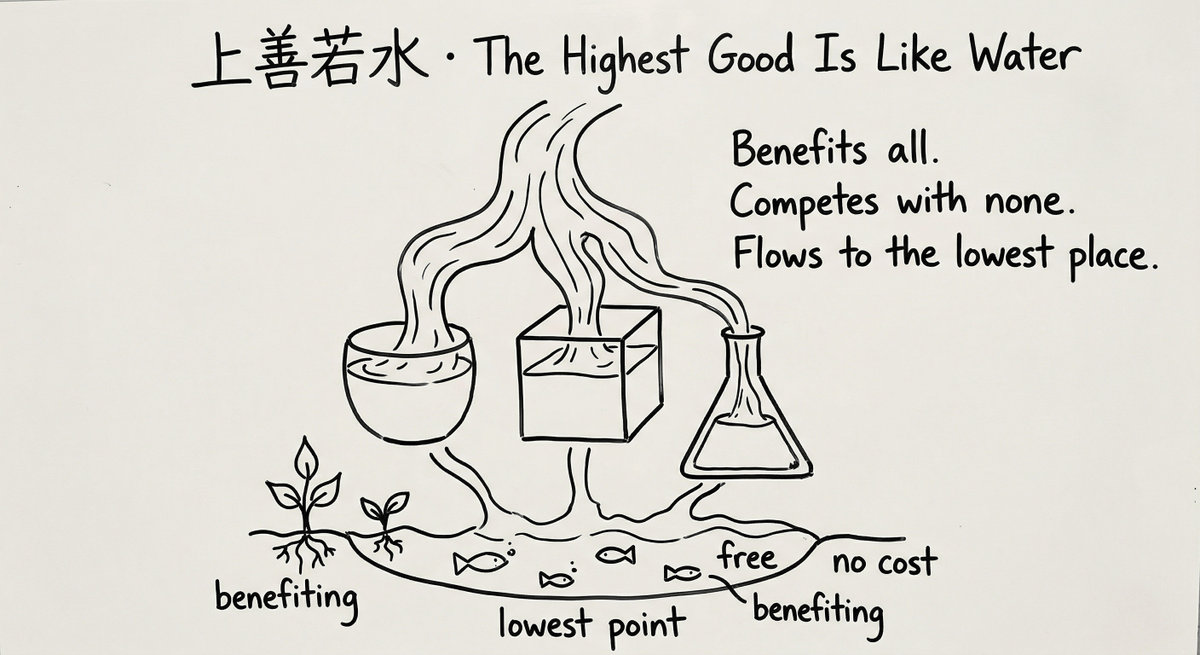
The Daodejing Chapter 8 opens with the most famous line in the text: "上善若水。水善利万物而不争,处众人之所恶,故几于道。" The highest good is like water. Water benefits all things and does not compete. It dwells in places that people disdain. Therefore it is close to the Dao.
This is not a metaphor. It is a description of how the most durable systems actually work. Water covers 71% of the Earth's surface. It makes up roughly 60% of the human body. The global water market exceeds $915 billion (Global Water Intelligence 2025). Yet water is among the cheapest resources on the planet. Adam Smith identified this in 1776 as the diamond-water paradox: the thing that is most useful is least expensive, while the thing that is least useful is most expensive. Water's value comes precisely from the fact that it does not behave like a scarce commodity. It flows to the lowest point. It fills every container. It benefits everything it touches without demanding anything in return.
I started thinking about this chapter differently after watching Netflix. In 2007, Netflix was a DVD-by-mail company. By 2013, it was producing original content. By 2025, it was entering gaming and live sports. Netflix adapts like water: it fills whatever container the market offers. It does not cling to a previous form. Reed Hastings said the company's culture is about "context, not control." The business that behaves like water does not compete in the conventional sense. It flows around obstacles. Roughly 94% of organizations reported using agile methodologies in some form by 2025 (State of Agile Report), the organizational version of learning to flow.
The investing parallel is direct. Buffett's most famous advice is to "be fearful when others are greedy and greedy when others are fearful." Water flows to the lowest point. The contrarian investor flows to the places everyone else avoids. The S&P 500 bottomed on March 23, 2020, during the COVID crash at around 2,237. By early 2025, it had more than doubled past 6,000. The investors who dwelled where others disdained captured the entire recovery. Water does not argue with gravity. It follows it.
Wang Bi (226 to 249 CE) read water as the closest earthly analogue to the Dao's virtue. Water does not strive. It does not claim. It benefits all things and settles in the lowest place, the place that everything else avoids. Heshang Gong connected it to the sage's conduct: the sage, like water, nourishes without taking credit, occupies the positions no one else wants, and by doing so comes closest to the Dao. Both commentators understood that water's power comes from what it does not do: it does not compete, it does not resist, it does not hold its shape.
Bruce Lee distilled it for a different audience: "Empty your mind. Be formless. Shapeless. Like water. You put water into a cup, it becomes the cup. You put water into a bottle, it becomes the bottle. You put water into a teapot, it becomes the teapot. Water can flow, or it can crash. Be water, my friend." Heraclitus said no one steps in the same river twice. The Japanese martial arts tradition calls it mizu no kokoro: mind like water, responding to whatever arrives without clinging to what came before.
My read: the highest good is not strong. It is adaptive. It does not compete because competition requires a fixed position, and water has no fixed position. It does not accumulate because accumulation requires holding, and water does not hold. It benefits everything because it flows to wherever there is a need. The systems that last, from Wikipedia to water itself, are the ones that serve without competing and dwell where others refuse to go.
Do you compete for the highest ground, or do you flow to the lowest?
#DaoDeJing #Adaptability
English
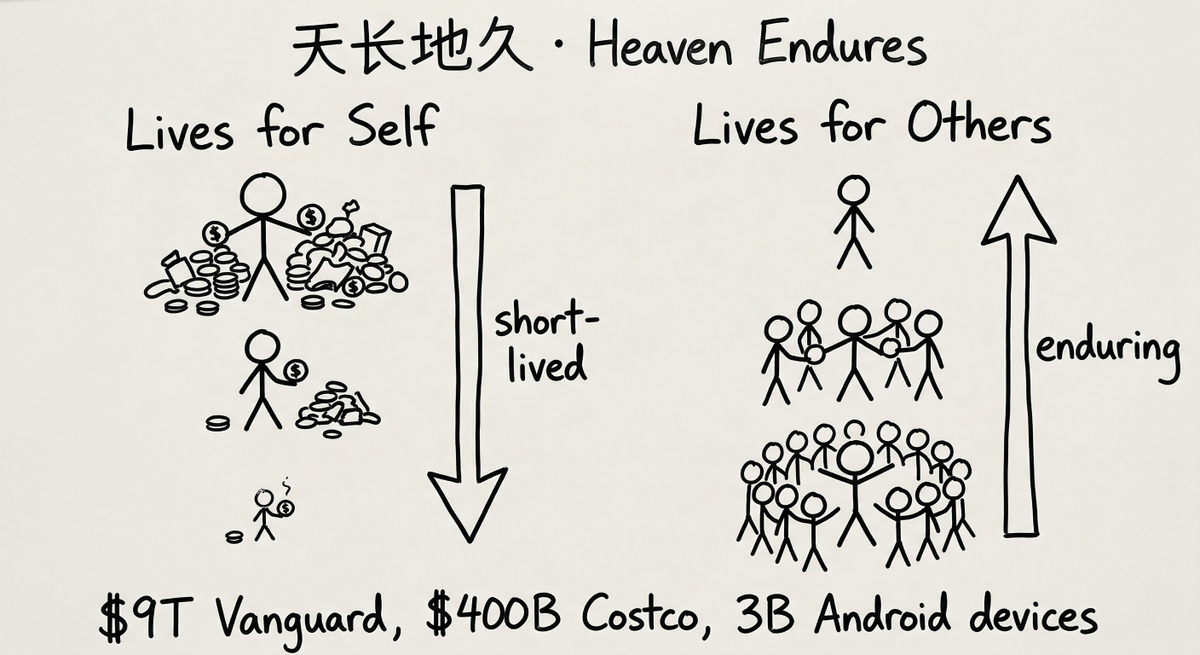
Vanguard manages over $9 trillion in global assets. It is the second largest asset manager on the planet. And it is owned by its own funds, which means it is owned by its investors. Vanguard has no external shareholders. It does not exist for itself. It exists for the people who use it. That structural selflessness is why it has lasted since 1975 and will likely outlast most of its competitors.
The Daodejing Chapter 7: "天长地久。天地所以能长且久者,以其不自生,故能长生。是以圣人后其身而身先,外其身而身存。非以其无私邪?故能成其私。" Heaven endures. Earth lasts long. The reason they can endure is that they do not live for themselves, and therefore they live long. The sage puts himself last and finds himself first. He puts himself outside and finds himself preserved. Is it not because he is selfless? Therefore he can fulfill himself.
Costco runs on the same principle. Its average markup is roughly 14%, far below the retail industry average of 50% or more. Costco spends less than 0.5% of revenue on traditional advertising. It pays its workers significantly above the industry median. The Kirkland Signature brand exists to give customers better products at lower prices, not to maximize margins. The result: Costco's market capitalization exceeded $400 billion by early 2026. The company that does not live for itself has lived longer and grown larger than nearly all its competitors.
Adam Grant documented this in organizational psychology. In Give and Take (2013), his research across industries showed that "givers" who consistently put others' interests first ended up in the bottom and the top of success distributions. The ones at the top were strategic givers: selfless but not self-sacrificing. They built networks of trust and reciprocity that compounded over time. The takers and matchers clustered in the middle. Laozi's insight is Grant's finding: selflessness, properly understood, is the most effective long-term strategy.
Android is the platform version. Google released it as free, open-source software in 2008. It now runs on over 3 billion active devices worldwide. By not charging for the operating system, Google built an ecosystem that generates billions in advertising and services revenue. AWS followed a similar path: Amazon's internal infrastructure became an external service in 2006. By serving others' computing needs, AWS became a $128.7 billion annual revenue business by 2025. The platform that does not live for itself captures the most value.
Biology confirms the pattern. Eusocial insects like leafcutter ants have survived for approximately 50 million years. Worker ants are functionally selfless: they do not reproduce, dedicating their lives to the colony. The colony endures because individuals do not live for themselves. Richard Dawkins' The Selfish Gene (1976) resolved the apparent paradox: genes that code for altruistic behavior toward kin survive longer in the gene pool. Selflessness at the individual level is selfishness at the genetic level. The gene puts itself last and finds itself first.
Wang Bi (226 to 249 CE) read this chapter as the sage governing through non-self-assertion. By not pushing himself forward, the sage encounters no resistance. By not clinging to self-preservation, the sage is naturally preserved by others. Heshang Gong connected it to longevity cultivation: the body endures when the self does not grasp. Both commentators saw the same paradox: selflessness is the highest form of self-interest.
My read: this is the most counterintuitive and most empirically supported idea in the Daodejing. The company that does not maximize its own margins outlasts the one that does. The platform given away for free captures more value than the one sold at a premium. The gene that codes for sacrifice survives longer than the gene that codes for hoarding. Heaven and Earth endure because they do not exist for themselves. Everything that lasts works the same way.
Do you build for yourself, or for everyone else first?
#DaoDeJing #Leadership
English
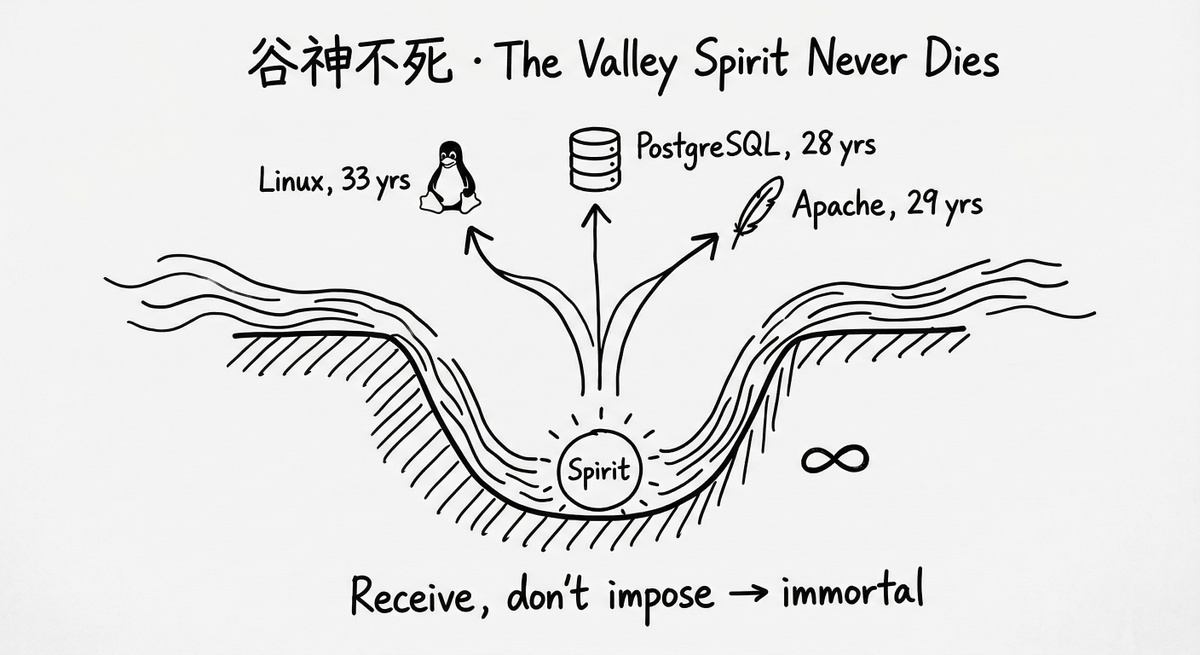
The Linux kernel turned 33 in 2024. PostgreSQL has been in continuous development since 1996. The Apache HTTP Server launched in 1995 and still powers roughly 30% of all active websites. These are valley spirits. They receive contributions from thousands of developers, absorb changes across decades of technological upheaval, and never die. The valley does not impose. It receives. And because it receives, it endures.
The Daodejing Chapter 6: "谷神不死,是谓玄牝。玄牝之门,是谓天地根。绵绵若存,用之不勤。" The valley spirit never dies. It is called the mysterious female. The gate of the mysterious female is called the root of Heaven and Earth. Continuous and unbroken, as if barely existing. Use it, and it is never exhausted.
I have been thinking about this chapter since I started tracking the API economy. Cisco and AWS estimate the API economy at roughly $14 trillion in value as of 2025. An API is a valley: it defines a receptive interface and waits. It does not push. It does not impose a use case. It accepts whatever request arrives and returns a response. Stripe processes over $1 trillion in payments annually through its API. Twilio handles billions of communication events. The platform that receives everything and directs nothing is the one that lasts.
The financial version is perpetual capital. The Harvard endowment exceeds $50 billion. The Yale endowment exceeds $41 billion. Both have outlived every individual who contributed to them by generations. The endowment model, formalized by David Swensen at Yale starting in 1985, treats capital as a valley spirit: it receives returns, reinvests, and never depletes. The source survives because it does not consume itself. Buffett's Berkshire Hathaway operates the same way: it rarely pays dividends, reinvests nearly everything, and compounds at roughly 19.7% annualized over 60 years. The capital never leaves the valley.
Biology has its own version. Turritopsis dorrhnii, the immortal jellyfish, can revert from its adult medusa form back to its juvenile polyp stage when stressed, theoretically cycling indefinitely. HeLa cells, derived from Henrietta Lacks in 1951, have been dividing continuously for over 70 years in laboratories worldwide, producing an estimated 50 million metric tons of cells. The womb is the original valley spirit: the source that generates without depleting, that produces without being consumed.
Wang Bi (226 to 249 CE) read "gu shen" (valley spirit) as a metaphor for the Dao's receptive, yielding nature. The valley is low, empty, and open. It receives all water that flows into it without effort or resistance. The "mysterious female" (xuan pin) is the generative principle: creation through receptivity rather than force. Heshang Gong connected it directly to cultivation of vital breath: the gate of the mysterious female is the root from which all life flows, sustained by continuous, effortless cycling.
The cross-cultural echoes are striking. Hindu philosophy calls it Shakti: the feminine creative power underlying all manifestation. Aristotle's material cause is the receptive substrate that receives form. Jung called it the anima: the unconscious feminine principle that generates creative insight. In Chinese cosmology, yin is not passive. It is generative. The valley does not act. It generates.
My read: Chapter 6 is a design manual for immortal systems. The things that last are the things that receive rather than impose. Open source outlives proprietary software because it accepts contributions from anyone. APIs outlive specific products because they define interfaces, not implementations. Endowments outlive donors because the capital stays in the valley. The valley spirit never dies because it never tries to be anything other than empty, open, and available.
Do you build systems that push, or systems that receive?
#DaoDeJing #SystemsThinking
English
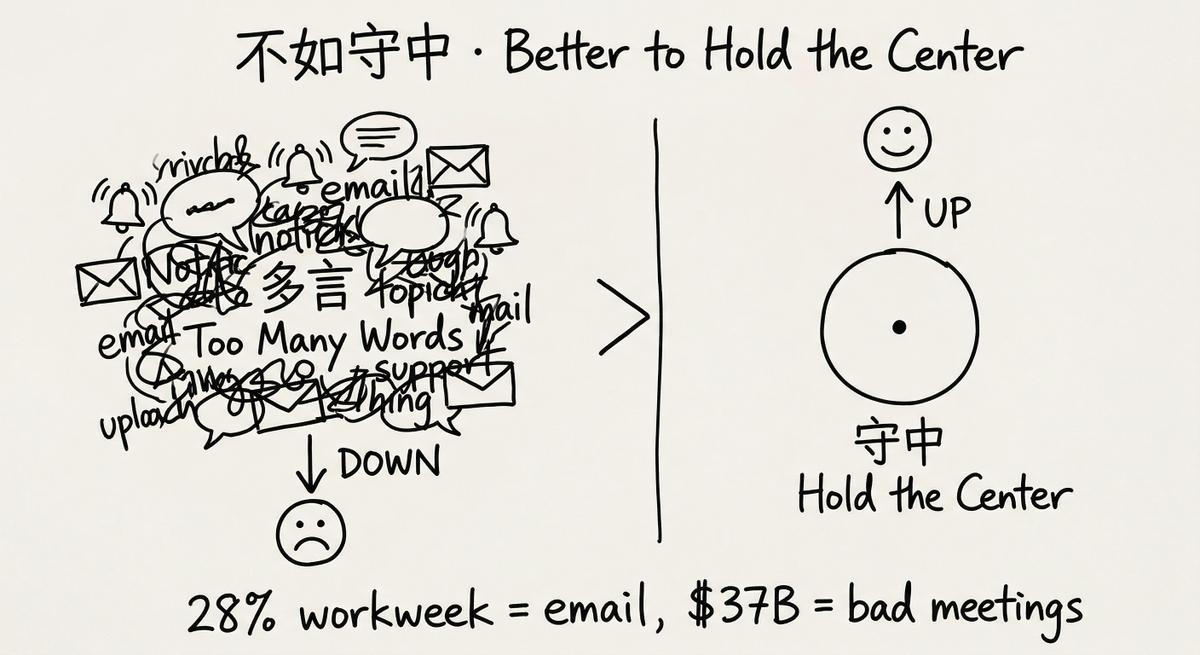
The average knowledge worker spends 28% of their workweek on email (McKinsey). Atlassian estimates that unproductive meetings cost U.S. businesses $37 billion per year. Microsoft's 2025 Work Trend Index found that workers face roughly 275 notifications per day. We are drowning in words. And the words are not working.
The Daodejing Chapter 5 closes with seven characters that cut through all of it: "多言数穷,不如守中。" Too many words exhaust themselves quickly. Better to hold to the center.
This is the line I think about most when I write. Hemingway called it the iceberg theory: the dignity of movement of an iceberg is due to only one eighth of it being above water. The strongest writing leaves most of the work below the surface. Amazon banned PowerPoint in 2004 and replaced it with six-page narrative memos. Jeff Bezos explained that the narrative structure forces clearer thinking. The memo is read in silence for the first 20 minutes of every meeting. Fewer words. More thought. The center holds.
Markets confirm this. Barber and Odean's landmark 2000 study in the Journal of Finance found that the most active individual traders underperformed low-turnover investors by roughly 7 percentage points annually. More trades, worse returns. Buffett's philosophy is the same principle applied to holding periods: "Our favorite holding period is forever." Berkshire Hathaway's roughly 19.7% annualized return over 60 years came from buying quality and then doing almost nothing. The investor who speaks least with the market, wins.
The AI industry is learning this lesson in real time. Early prompt engineering research showed that longer, more elaborate prompts often underperform shorter, more focused ones. OpenAI's own guidance emphasizes clarity and specificity over length. The token economy creates a direct cost for verbosity: every unnecessary word costs compute. Models that generate too many tokens burn money without adding value. The most effective AI systems are the ones that know when to stop talking.
The global data creation rate reached approximately 402.74 million terabytes per day by 2025 (Statista/IDC projections). Email volume hit 361.6 billion messages per day in 2024 (Radicati Group). Social media platforms generate billions of posts daily. The supply of words has never been higher. The demand for signal has never been more urgent. Information overload is not a metaphor. It is a measurable economic cost.
Wang Bi (226 to 249 CE) read "shou zhong" (holding the center) as the sage's practice of restraint. The sage does not multiply words because words, once spoken, commit the speaker and constrain future action. Silence preserves optionality. Heshang Gong connected it to the bellows metaphor earlier in the chapter: the bellows works because it is empty. Fill it with words, and the air stops flowing. The center holds by remaining unfilled.
The Japanese concept of ma (間) formalizes the same insight: the meaningful pause, the negative space in communication, is where understanding happens. Shakespeare wrote "brevity is the soul of wit" in Hamlet (1600). The principle is universal: restraint communicates more than excess.
My read: this is not advice about being quiet. It is a structural observation about how information degrades. Every additional word carries a cost. At some point, the marginal word subtracts value instead of adding it. The center is the point where you have said exactly enough. Holding it means knowing when to stop.
Do you add words until you run out, or do you stop when you have said enough?
#DaoDeJing #Communication
English
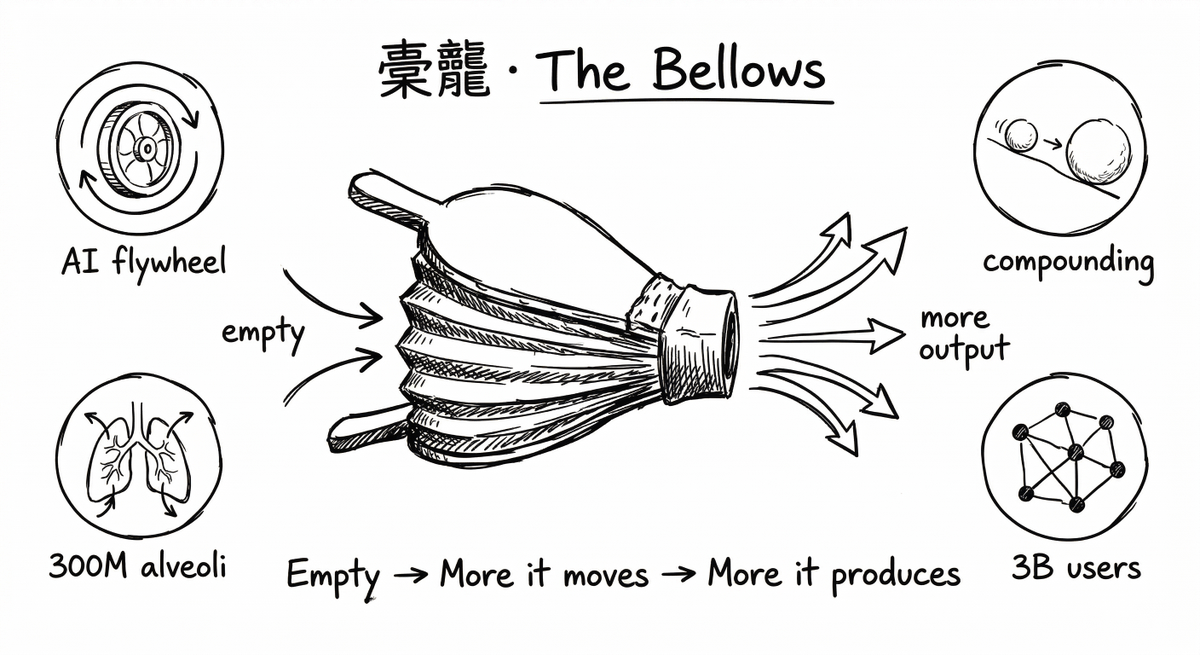
ChatGPT reached over 400 million weekly active users by early 2025 (OpenAI). The cost of inference per token dropped roughly 90% year over year between 2023 and 2025. The more people use the system, the more data it generates, the better the models become, the cheaper inference gets, the more people use it. The bellows pumps, and the air keeps coming.
The Daodejing Chapter 5 says: "天地之间,其犹橐龠乎!虚而不屈,动而愈出。" The space between Heaven and Earth is like a bellows! Empty yet never exhausted; the more it moves, the more it produces.
This is one of the sharpest metaphors in the Daodejing, and it describes the most valuable pattern in modern technology: the flywheel. Amazon documented its version on a napkin in 2001. Lower prices attract more customers. More customers attract more sellers. More sellers create more selection. More selection drives more customers. Jeff Bezos called it the flywheel effect. The mechanism is a bellows: the structure is empty, but the more it cycles, the more value it produces.
Network effects follow the same law. Metcalfe's law states that the value of a network grows proportionally to the square of its users. WhatsApp reached 3 billion users in 2025. YouTube serves 2.7 billion monthly active users. Each additional user makes the network more valuable for every other user without depleting the resource. The network is hollow. It owns no content. But the more it moves, the more it produces.
I have been thinking about this since I started tracking compound interest data. The S&P 500 has returned roughly 10% annualized over the past century. A dollar invested in 1925 would be worth over $13,000 in 2025, adjusted for reinvested dividends (Ibbotson Associates / Morningstar data). Buffett calls it the snowball: find a wet snowball and a long hill, and gravity does the rest. The hill is empty. The snowball grows because it moves.
Your body is a bellows in the most literal sense. The human lung contains approximately 300 million alveoli with a total surface area of about 70 square meters, roughly the size of a tennis court (American Lung Association). The heart pumps approximately 2,000 gallons of blood per day, roughly 100,000 beats without rest. Mitochondria produce an estimated 40 to 70 kilograms of ATP per day, recycling the same molecules thousands of times. The system is empty. It produces because it cycles.
Wang Bi (226 to 249 CE) read the bellows metaphor as the Dao's essential operating principle: emptiness generates. The space between Heaven and Earth is not inert. It is functional emptiness, like the hollow of a vessel or the void in a wheel hub. The output is inexhaustible precisely because the center is empty. Heshang Gong connected it to breath cultivation: the deeper the emptiness of the lungs, the greater the capacity for qi. Both commentators understood that production comes from void, not from fullness.
The opposite pattern is instructive. Systems that fill up stop producing. Bureaucracies accumulate process until they cannot move. Codebases accumulate technical debt until shipping slows to a halt. Empires accumulate territory until they cannot govern what they hold. The bellows works because it empties itself on every stroke. The moment it stays full, the air stops flowing.
My read: Laozi is describing a mechanical principle that applies to everything from lungs to markets to AI flywheels. The most productive systems are the ones that maintain emptiness at their center. They do not accumulate. They cycle. The bellows does not store air. It moves air. And the more it moves, the more it produces.
Do you build systems that accumulate, or systems that cycle?
#DaoDeJing #Compounding
English
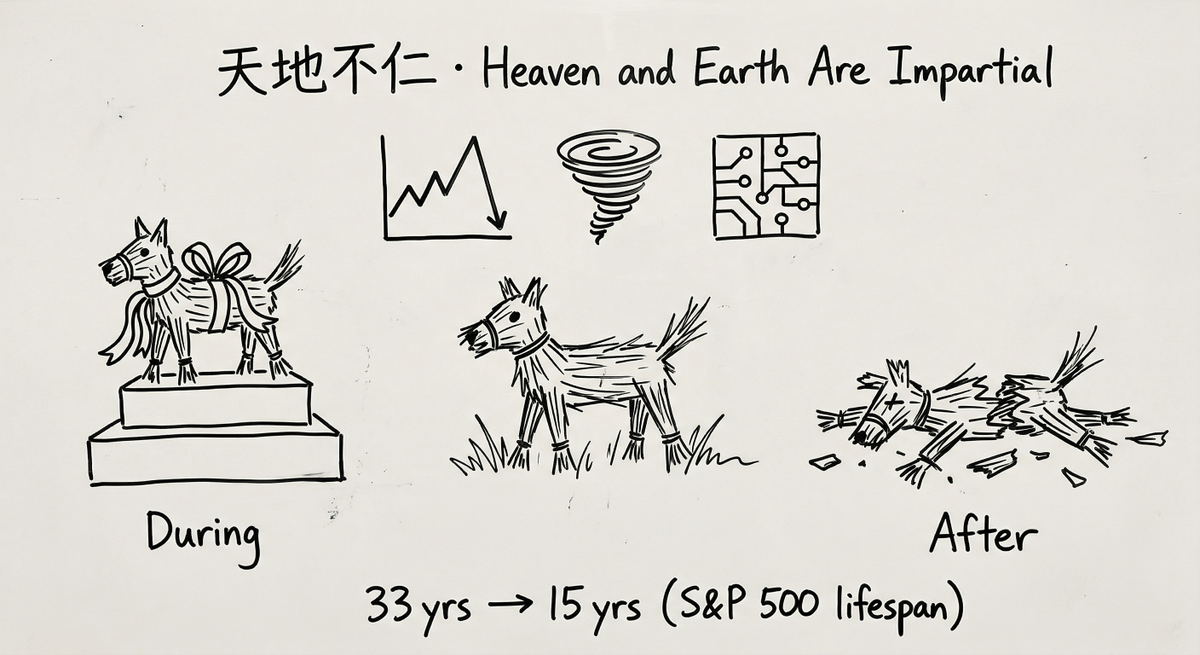
The average lifespan of a company on the S&P 500 has dropped from roughly 33 years in the 1960s to about 15 to 18 years today. Innosight projects that 75% of current constituents may be replaced by 2027. The market does not care about your brand, your mission statement, or your company culture. It treats every company the same way: useful until it is not, then discarded without sentiment.
The Daodejing Chapter 5 opens with the most misunderstood line in the text: "天地不仁,以万物为刍狗;圣人不仁,以百姓为刍狗。" Heaven and Earth are not benevolent; they treat the ten thousand things as straw dogs. The sage is not benevolent; he treats the people as straw dogs.
Most people read this as cruel. It is the opposite. Wang Bi (226 to 249 CE) explained that "bu ren" does not mean cruelty. It means the absence of selective favoritism. Heaven and Earth do not play favorites. They do not reward virtue or punish vice on human terms. They let things arise and perish according to their natures. The sage mirrors this by governing without bias, allowing natural processes to unfold. Heshang Gong made the same point: even the most exalted beings are treated as straw dogs, without expectation of gratitude or special status.
The straw dog metaphor has specific ritual context. In ancient Chinese ceremony, straw dogs were woven from grass, elaborately decorated, placed in ornate baskets with embroidered covers, and treated with utmost reverence during sacrifice. After the ritual, they were trampled, burned, or left to rot. Not because they were hated. Because their function was complete. Everything has its moment in the cycle. Attachment to the straw dog after the ritual is the error.
I started reading this line differently after watching how algorithms work. In 2019, Meta paid a $5 billion fine to the FTC, the largest privacy penalty in history at the time, for enabling Cambridge Analytica's unchecked data harvesting. The algorithm did not choose to harm anyone. It optimized for engagement without moral preference. A 2025 University of Washington study found that large language models favored male names 52% of the time versus 11% for female names in hiring simulations. The systems are not malicious. They are impartial in the worst sense: they inherit and amplify the biases embedded in their training data without caring about the outcome.
Nature confirms this at a different scale. In 2024, Munich Re recorded 393 natural disaster events globally, causing 16,753 deaths and $242 billion in economic losses. The first half of 2025 alone reached $131 to $135 billion in losses. The March 2025 Myanmar earthquake killed an estimated 4,500 people. These are what the insurance industry calls "acts of God": uncontrollable events that absolve human liability. Heaven and Earth are not benevolent. They do not target the wicked or spare the good. They treat all things as straw dogs.
Venture capital operates the same way. Roughly 90% of startups fail. Among VC-backed companies, 75% never return investor capital. First-time founders succeed about 18% of the time. The capital does not care about the founder's passion or the elegance of the product. It cares about returns. The companies that serve their function get funded. The rest get discarded.
The Stoics called this apatheia: freedom from emotional favoritism. The Buddhist equivalent is upekkha, equanimity toward all beings. Rawls formalized it as the veil of ignorance: design systems as if you do not know where you will end up in them. Adam Smith called it the impartial spectator. Every tradition that has thought seriously about fairness has arrived at the same conclusion: true impartiality looks like indifference from the outside.
My read: Laozi is not endorsing cruelty. He is warning against the illusion that the universe owes you something. The market, the algorithm, the earthquake, and the Dao all operate the same way. They do not hate you. They do not love you. They treat you as a straw dog: with full respect during your moment, and without attachment when the moment passes.
Do you build for a universe that plays favorites, or for one that does not?
#DaoDeJing #SystemsThinking
English