Fabian Wahl

620 posts

Fabian Wahl banner
Fabian Wahl

Fabian Wahl

@fabiwahl

Economic Historian @wu_vienna. Long-run regional and urban development, origin and consequences of regional culture, historical wars and conflicts

Vienna, Austria Katılım Temmuz 2022
689 Takip Edilen261 Takipçiler
Fabian Wahl retweetledi

Vincent Geloso
Vincent Geloso@VincentGeloso·
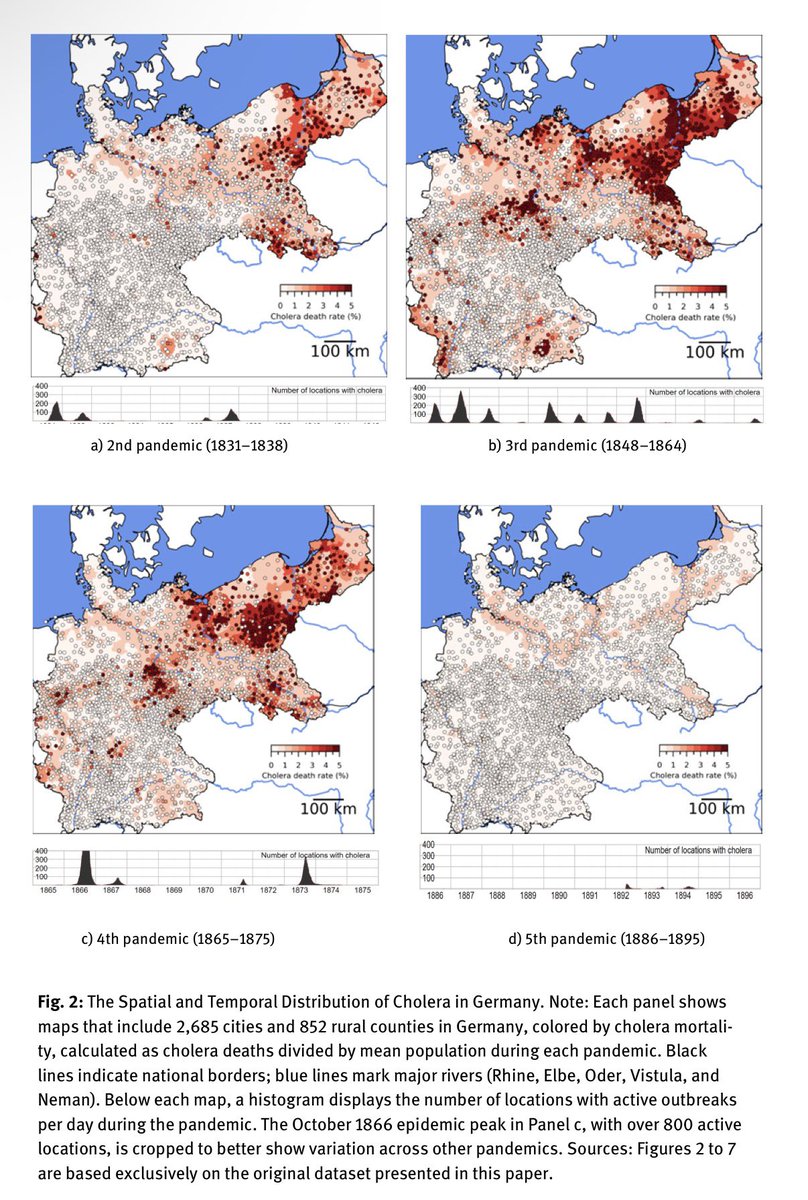
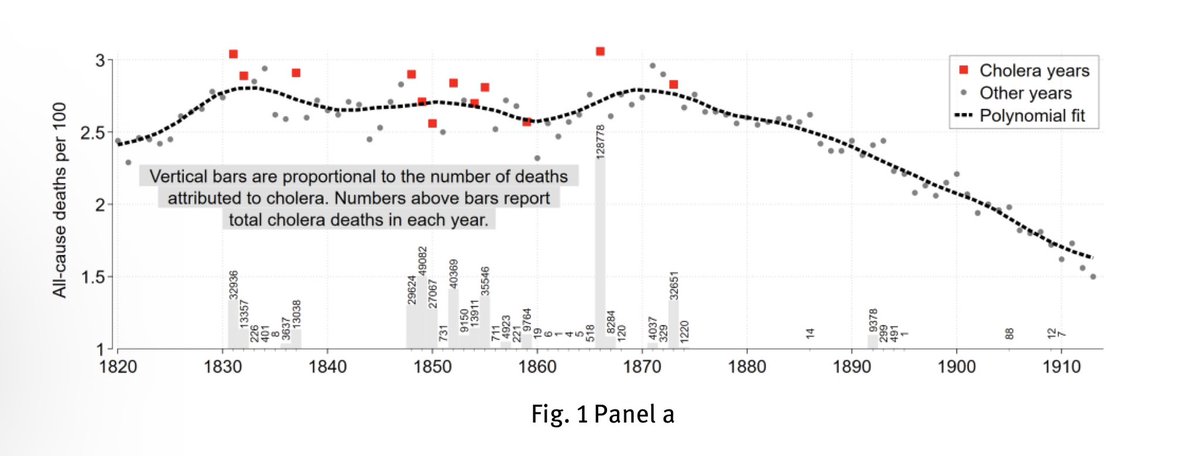
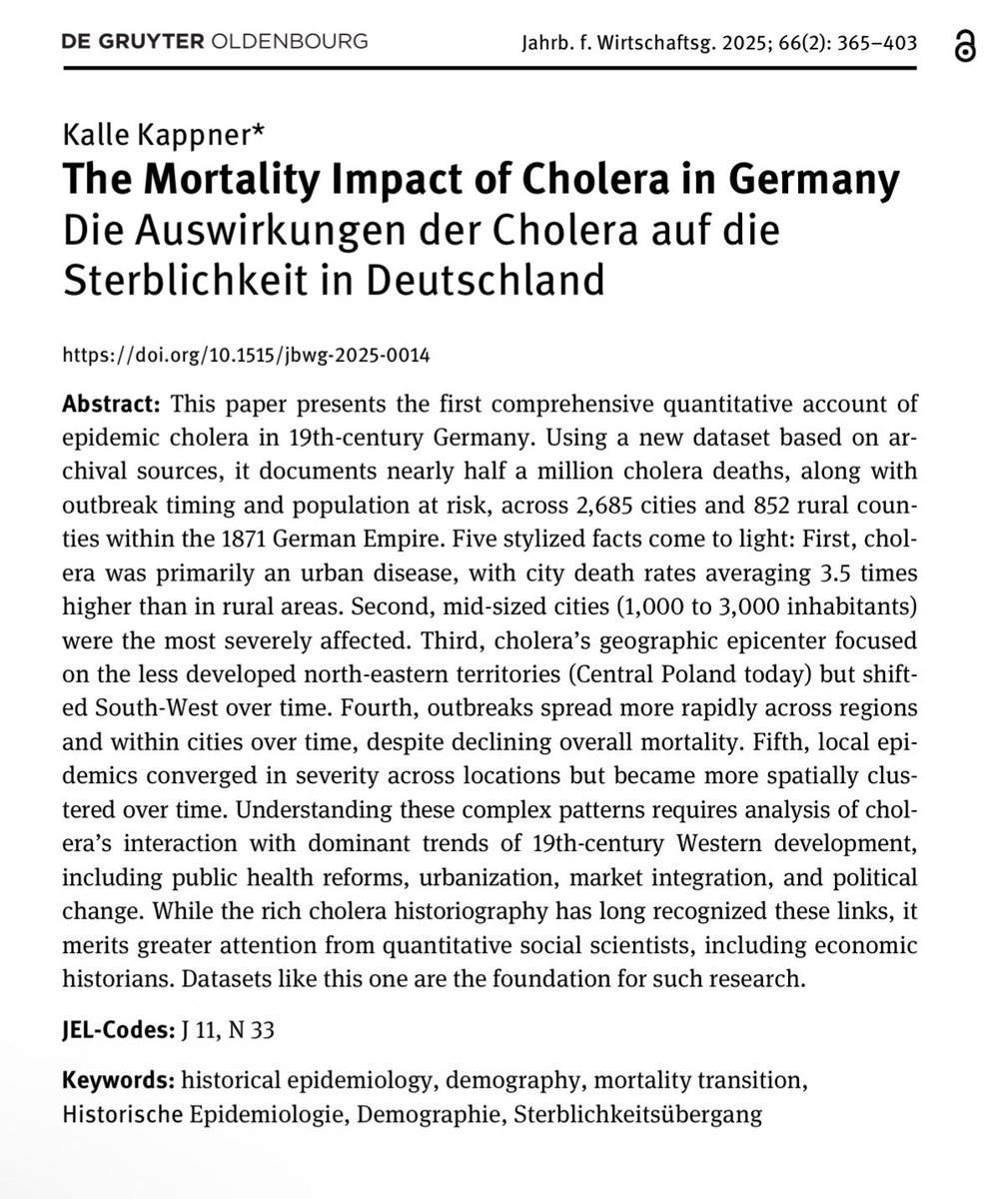
Really cool data and history of cholera in Germany over the 19th century A) big decline over time B) more clustering over time (concentration in few areas) C) surprising — less problematic in big cities and rural areas but most problematic in mid-sized cities Worth reading
Vincent Geloso tweet mediaVincent Geloso tweet mediaVincent Geloso tweet media
English
1
7
45
2.1K
Fabian Wahl retweetledi
Joachim Voth
Joachim Voth@joachim_voth·
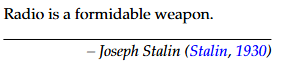
Can mass media facilitate political persecution in a dictatorship? Sultan Mehmood, Yaroslav Prokhorskoy, and I investigate this question looking at radio in Stalin's USSR in a new paper "Transmitting Terror".
Joachim Voth tweet media
English
3
14
92
9.4K
Fabian Wahl retweetledi
Julius Kölzer
Julius Kölzer@Julius_Ktxt·
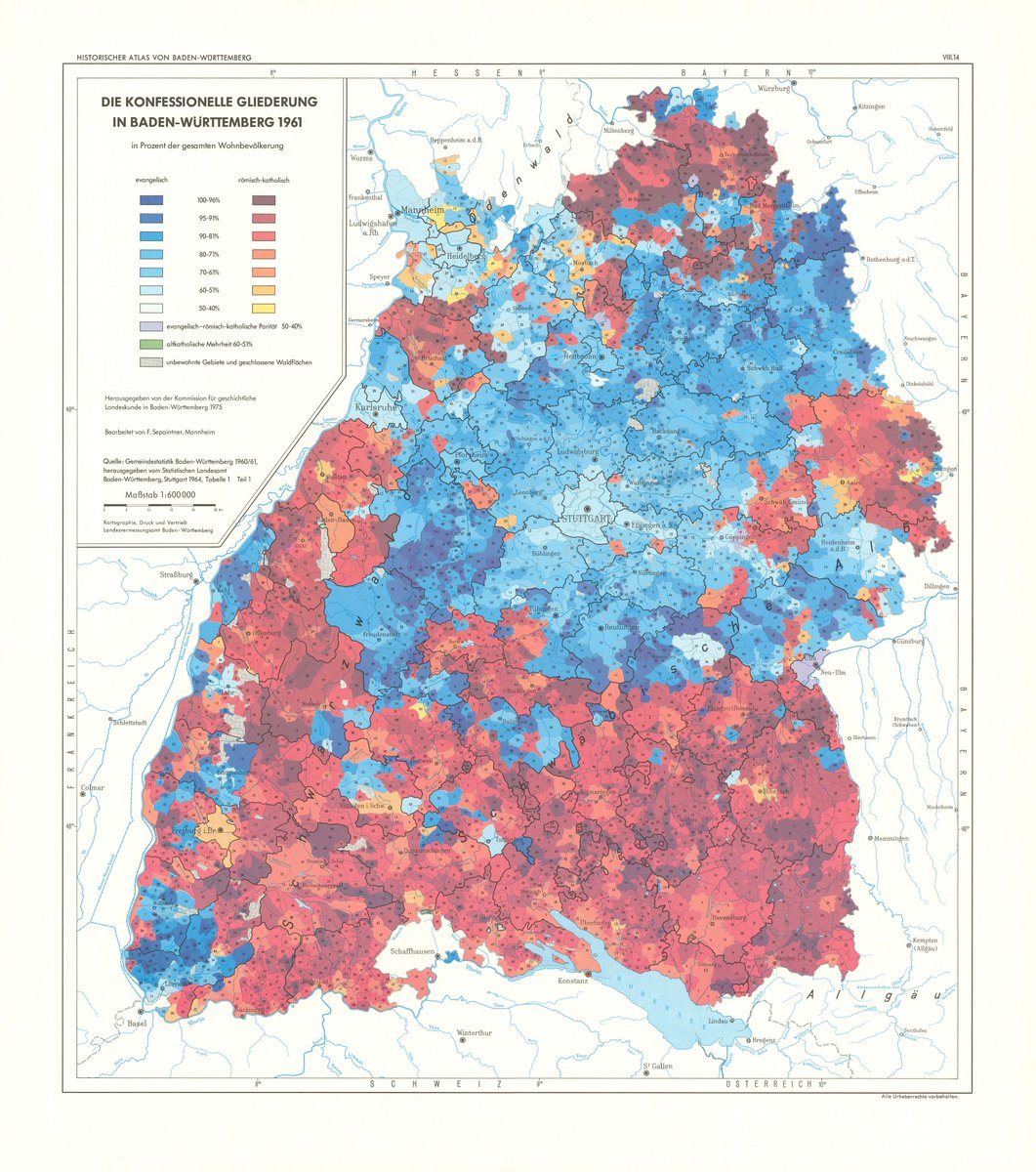
Today's episode in the series of beautiful maps
Julius Kölzer tweet media
English
10
43
498
30.7K
Fabian Wahl retweetledi
Nicholas Decker
Nicholas Decker@captgouda24·
Why You Should Write Your Own Essays Writing is thinking. That sentence is so short and plain that it barely seems worth saying, but it may be the most important claim in this essay. When you sit down to write—actually write, from the blank page, with no assistance beyond your own mind—you are not merely transcribing thoughts you already have. You are generating them. The resistance of the page, the demand that one sentence follow another in some defensible order, the necessity of making vague intuitions precise enough to survive contact with words: this is cognition of a kind that cannot be replaced. We are now several years into a period in which artificial intelligence can produce, on command, parsing and polished prose on virtually any topic. The output looks good. It is fluent, grammatical, and organized. It arrives with headers and transitions and topic sentences in all the right places. It has the aesthetic properties of competent writing. And this is precisely what makes it dangerous—not because AI-generated text is always wrong, but because the gap between looking right and being right is where intellectual life actually happens, and AI closes that gap from the wrong direction. Consider what a large language model actually does. It produces sequences of words that are, in a statistical sense, plausible given the words that preceded them. It is an extraordinarily sophisticated pattern-matching engine. When it writes an essay about, say, the causes of the First World War, it generates sentences that resemble what a knowledgeable person might write on the topic—but it arrives at those sentences through a process that has nothing to do with understanding the First World War. It has no model of the world. It has a model of text about the world, which is a very different thing. The result is prose that is often correct, sometimes subtly wrong, and occasionally complete nonsense delivered in the confident register of an encyclopedia entry. This creates an asymmetry that should trouble anyone who cares about the quality of their own thought. Generating plausible-sounding prose is cheap. Verifying that plausible-sounding prose is actually correct is expensive. If I hand you a well-formatted five-paragraph essay on monetary policy, you cannot assess its accuracy without already knowing a fair amount about monetary policy—at which point you scarcely needed the essay. The whole exercise collapses into a peculiar loop: the people best positioned to verify AI output are the people who least need it, and the people who most need it are least equipped to catch its errors. This is not a minor inconvenience. It is a structural problem that degrades the epistemic environment for everyone. And people do catch on. Not immediately, and not consciously, but they catch on. When a colleague, a student, or a writer begins producing text that is always fluent and never quite has a point—when every paragraph reads like a reasonable thing to say but the whole never accumulates into an argument that surprises or challenges or teaches—readers develop a kind of immune response. They begin to skim. They stop expecting to learn anything. The text begins to function as bureaucratic filler, something that exists to satisfy a formal requirement rather than to communicate. We have all experienced this with corporate communications and boilerplate legalese, and AI-generated prose is rapidly joining that category. It is writing that is optimized for the appearance of competence, and the more of it that floods the world, the less anyone trusts that any given piece of writing is worth their sustained attention. You should care about this even if you are not a professional writer. The ability to construct an argument on paper is the ability to construct an argument in your mind. When you outsource the writing, you outsource the thinking, and what you get back is not your thinking—it is a statistical average of how people have discussed similar topics in the past. It will not be wrong in interesting ways. It will not lead you somewhere you did not expect to go. It will not force you to confront the part of your argument that does not actually hold together. All the productive discomfort of real intellectual work is smoothed away, and you are left with a product that teaches you nothing about what you actually believe. There is a particular danger for students, but the problem extends well beyond education. Anyone who uses writing as a tool for reasoning—which should be everyone—faces the same temptation and the same cost. The executive who lets AI draft a strategic memo never discovers the contradiction between two of her stated priorities. The researcher who lets AI write the literature review never notices the gap in the existing work that could have become a paper. The citizen who lets AI compose a letter to a representative sends something that sounds like every other letter and vanishes into the noise. Writing badly, writing slowly, writing with effort and frustration and deleted paragraphs—this is not a flaw in the process. It is the process. The difficulty is where the value lives. A first draft that comes easily and reads smoothly has almost certainly skipped the hard part, which is the part where you figure out what you actually think and whether it survives scrutiny. If you are not struggling, you are probably not learning, and if you are not learning, then what, exactly, is the essay for? I am not making a Luddite argument. Tools are good. Spell-checkers are good. Access to information is good. But there is a difference between a tool that augments your capacity to think and a tool that substitutes for it. A calculator helps a mathematician work faster. A machine that generates proofs the mathematician cannot follow does not make the mathematician better—it makes the mathematician irrelevant. The question you should ask about any writing tool is: does this make my thinking sharper, or does it make my thinking unnecessary? If the answer is the latter, you should be alarmed, not grateful. Write your own essays. Write them poorly if you must. Write them slowly. Let them be difficult and frustrating and full of sentences you will later cut. What you produce will be yours—not in the sentimental sense, but in the epistemically meaningful sense that it will represent what you actually believe, tested against the rigorous and unforgiving demands of the written word. In a world filling rapidly with fluent, confident, empty text, that is worth more than you might think.
English
19
19
249
34.7K
Fabian Wahl retweetledi
Joachim Voth
Joachim Voth@joachim_voth·
It seems he didn't put much work into it, claiming we and the RAs hadn't really read the underlying stories... but apart from that, it gets the overall drift. Learn more here: cepr.org/multimedia/mea… or here: jvoth.com/alh.pdf
English
0
3
14
7.6K
Fabian Wahl retweetledi
Joachim Voth
Joachim Voth@joachim_voth·
How do you motivate workers? Leo Bursztyn, Ewan Racliffe and I have a new paper. We look at highly skilled 'workers' whose effort was near-impossible to monitor -- German fighter pilots in WW2.
Joachim Voth tweet media
English
25
73
675
84.3K
Fabian Wahl retweetledi
Joachim Voth
Joachim Voth@joachim_voth·
A while back, there was a lot of concern over spatial dependence in econ papers (bizarrely applied to persistence history papers). Did we all 'get it wrong'? How much should YOU really worry?
Joachim Voth tweet media
English
2
42
284
23.4K
Fabian Wahl retweetledi
Nicholas Decker
Nicholas Decker@captgouda24·
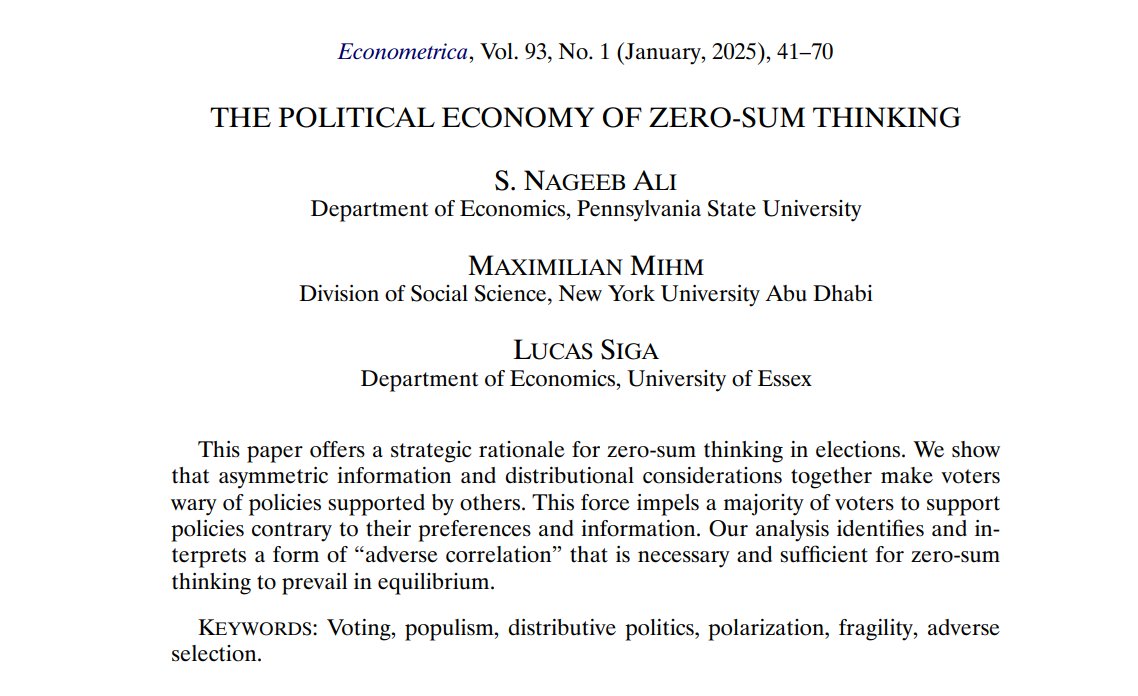
Why we so often behave as though the world is zero-sum when it isn't? This paper shows that even the slightest bit of asymmetric information is sufficient to cause us to go away from the optimal outcome, and lead to people to vote for things they don't want in expectation! 1/
Nicholas Decker tweet media
English
6
62
373
26.9K
Fabian Wahl retweetledi
Joachim Voth
Joachim Voth@joachim_voth·
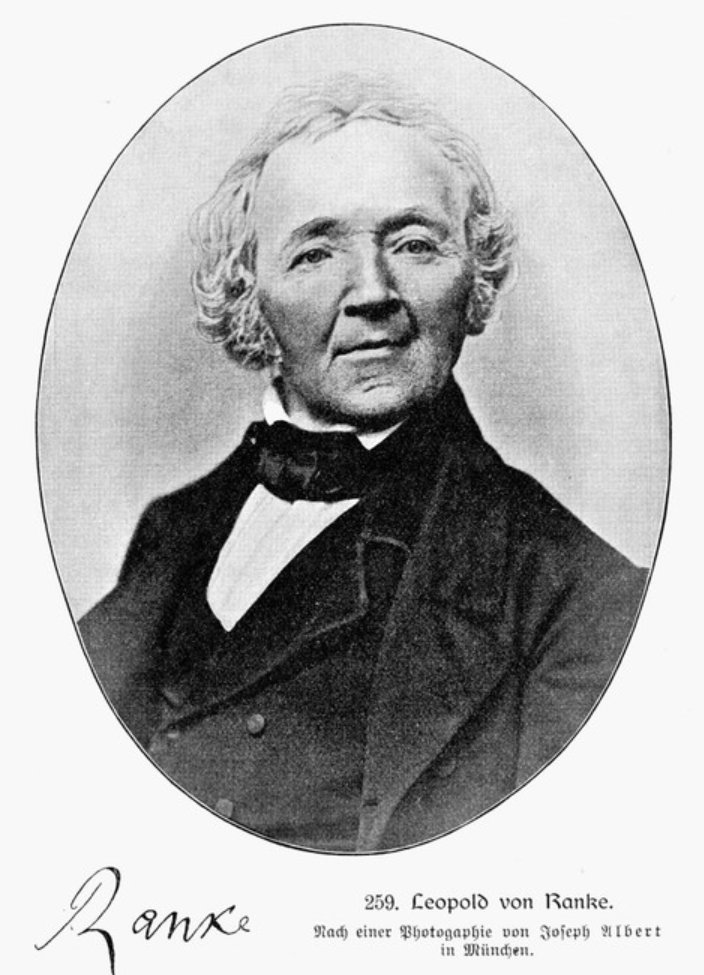
How did people in 1913 see the world? How did they think about the future? We trained LLMs exclusively on pre-1913 texts—no Wikipedia, no 20/20. The model literally doesn't know WWI happened. Announcing the Ranke-4B family of models. Coming soon: github.com/DGoettlich/his…
Joachim Voth tweet media
English
201
612
5.6K
559.7K
Fabian Wahl retweetledi
Joachim Voth
Joachim Voth@joachim_voth·
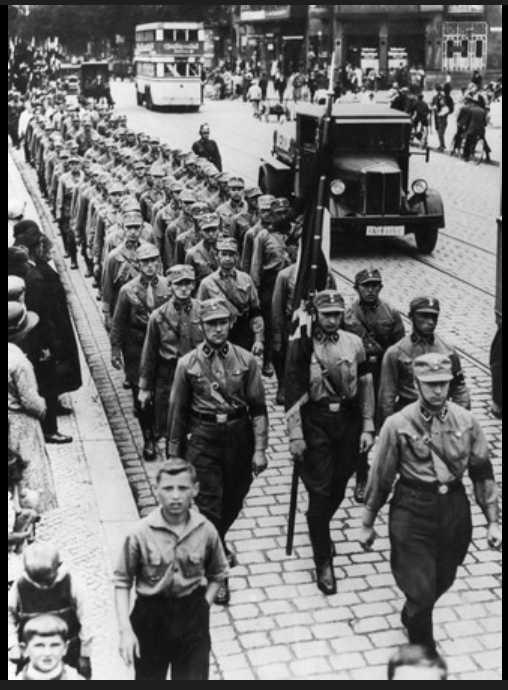
Can political marches, demonstrations, confrontations lead to political polarization? Together with @MarcelCaesmann (on the market this year!) @YanagizawaD @brunocaprettini , we examined ultra-granular data from 1932 Hamburg. There, we know where the Nazis staged marches,
Joachim Voth tweet media
English
1
11
27
4.5K
Fabian Wahl retweetledi
Martin Halla
Martin Halla@HallaMartin·
🚀 PhD Opportunity @ WU Vienna! #Economics #publicEcon #taxes The Doctoral Program in International Business Taxation (DIBT) invites applications from outstanding students in economics and related fields for its fully English-taught 3-year PhD program. This round we are advertising 1 funded PhD position — and we just secured funding for 10 additional doctoral positions for the next round (see shared post below). 🎉 🔎 Focus: public finance, international taxation, ESG & taxation, corporate tax incidence, minimum taxation, applied micro, theory welcome. 🌍 International cohort, research stay abroad, excellent microdata access. 💼 Funding: tuition waived + limited employment contracts (~€39k/year gross). 📚 Start: September 2026 📍 Vienna, Austria 🗓 Deadline: February 15, 2026 👉 Apply: lnkd.in/dHd28-Pf More info: wu.ac.at/dibt/about
English
0
4
7
955
Fabian Wahl retweetledi
Martin Halla
Martin Halla@HallaMartin·
Ich würde sagen: Wir haben ordentlich abgeräumt. 🎉 Von 7 #docfunds-Programmen des #FWF in ganz 🇦🇹 gehen zwei an die WU Wien. - PhD in Economics @WU_econ : €2,26 Mio. für 10 Doktorand:innen - Doktoratsprogramm Internationale Unternehmensbesteuerung (DIBT) : €2,55 Mio. für 10 Doktorand:innen ➡️ Damit erhält die WU 20 von 65 geförderten Stellen – und das Rektorat stockt zusätzlich auf. Großer Erfolg für unsere Nachwuchsforschung! 🙌 fwf.ac.at/aktuelles/deta…
Deutsch
0
5
34
2.6K
Fabian Wahl retweetledi
Joachim Voth
Joachim Voth@joachim_voth·
What's in a name? Names are chosen by parents, conveying their values -- Freyer and Levitt shows the effects of Black names, Fiszbein, Bazzi et al. show how naming becomes more individualistic on the American frontier. But how do we know? Why are names associated with a group?
Marcel Caesmann@MarcelCaesmann

In 1550, naming your son "Matthias" in Germany meant nothing. By 1650, it marked you as Catholic. How do arbitrary symbols become identity markers—common knowledge that organizes group boundaries? My JMP studies this in the Protestant Reformation. 🧵

English
1
4
37
7.1K
Fabian Wahl retweetledi
Marcel Caesmann
Marcel Caesmann@MarcelCaesmann·
In 1550, naming your son "Matthias" in Germany meant nothing. By 1650, it marked you as Catholic. How do arbitrary symbols become identity markers—common knowledge that organizes group boundaries? My JMP studies this in the Protestant Reformation. 🧵
Marcel Caesmann tweet media
English
1
23
65
12.3K
Fabian Wahl retweetledi
Jan Vogler
Jan Vogler@Jan_Vogler·
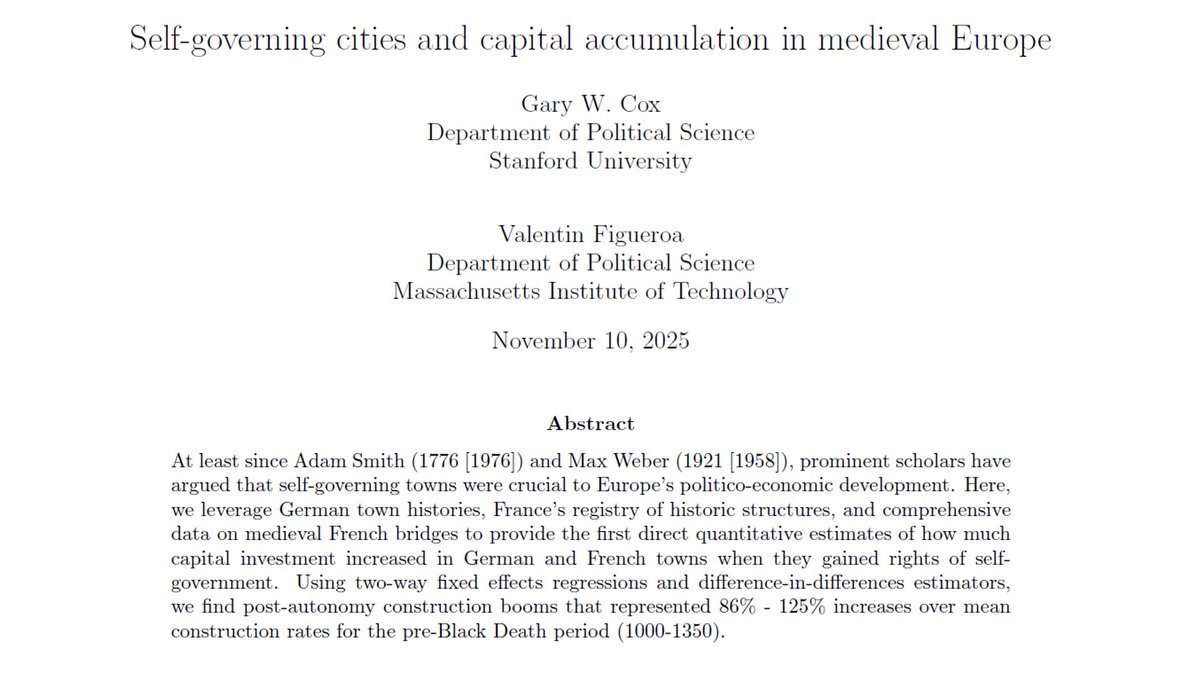
Today at the Virtual Workshop in HPE (6.30 PM CET, 12.30 PM ET): Gary Cox (Stanford) will present his paper (with Valentin Figueroa (MIT)) "Self-governing cities and capital accumulation in medieval Europe". Discussion by @fabiwahl Sign-up link for our list in the post below!
Jan Vogler tweet media
English
1
4
10
869
Fabian Wahl retweetledi
Philipp Heimberger
Philipp Heimberger@heimbergecon·
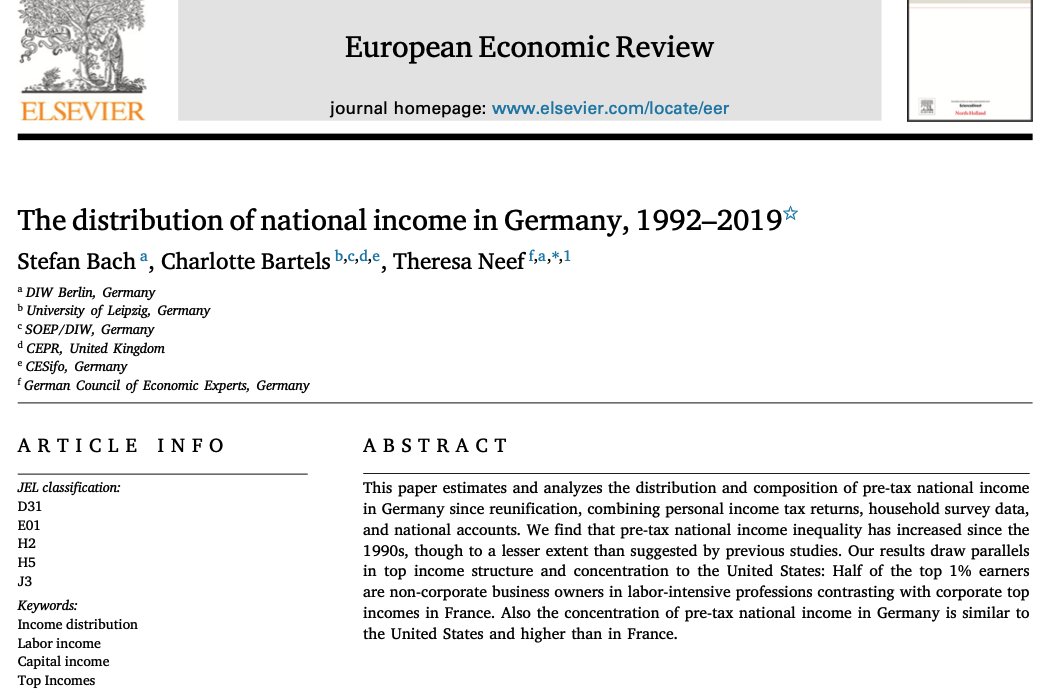
Economic growth in Germany since reunification has mostly benefited the middle and upper middle class up to the 99th percentile. Income inequality (pre-tax) in 🇩🇪 is similar to the 🇺🇸 and higher than in 🇫🇷. Inequality has increased, but less than previous studies suggest.
Philipp Heimberger tweet media
English
2
34
130
9.1K
Fabian Wahl retweetledi
Mohammad Atari
Mohammad Atari@MohammadAtari90·
New Special Issue now out in CRESP. Read our editorial with Joshua Jackson : “Historical psychology: How the events of yesterday shaped the minds of today.” There are 8 empirical papers in this collection, featuring diverse topics!
Mohammad Atari tweet media
English
1
10
31
11.3K