Sabitlenmiş Tweet
Fahima Zahir ✨
4.8K posts

Fahima Zahir ✨
@fahimaz
Tech Marketing. Music & Travels. Straight outta Kabul. 🤍🕊️ Likes/RT 🚫 endorsements. @ nutanix | Memento Vivere
💞💞💞 Katılım Aralık 2008
2.3K Takip Edilen1.2K Takipçiler
Fahima Zahir ✨ retweetledi

@nesliekinci @GallicaBnF @brooklynmuseum @AgaKhanMuseum @HSMOxford @RMGreenwich @sciencemuseum @KhaliliOnline @MuseeLouvre Discover more about Stars and the Art of Astronomy in Islamic History: baytalfann.com/post/stars-the….
English
Fahima Zahir ✨ retweetledi

Japanese author Haruki Murakami has a wonderfully bizarre writing practice.
He writes each book in English (his second language) before translating the second draft to Japanese.
When asked why, Murakami says, “Every language has its unique rhythm, its own essence. By translating my own work, I get to experience the story from two different perspectives.”
He goes on to say,
“Every line, every paragraph, I approach with the sensibility of both a writer and a translator. It allows me to bring out depth and layers I hadn’t seen in the first draft.”
Takeaway 1:
The modern world has an obsession with efficiency. We sacrifice thought, care, and craft at the altar of efficiency. There’s infinitely more writing and ‘content’ today than ever before, but how much of it really pulls you in and makes you think?
In Novelist as a Vocation, Murakami says, “One opposite of imagination is ‘efficiency.’”
Translating a book to another language as a second draft may be the least efficient process for getting words on paper. But if you’ve read Murakami, you can feel the thought he puts into each word.
Takeaway 2:
Write and edit in a different medium.
Murakami takes this to the extreme – different languages.
But even if you don’t speak two languages you can do this. I often write on my laptop and edit on my phone. You’ll notice nuances you wouldn’t if you stayed on the same medium.
Neil Gaiman does something similar. He often handwrites the first drafts of his books before doing the second on a computer.
Takeaway 3:
Every writer or artist has odd habits that might not work for anyone else.
Branson Sanderson writes best at 1am. Murakami drafts in English. Stephen King doesn’t use outlines.
There’s no way to know if these things are right for you than to sit down and try them. Do what works for you.
***
“If you only read the books that everyone else is reading, you can only think what everyone else is thinking.” – Murakami

English

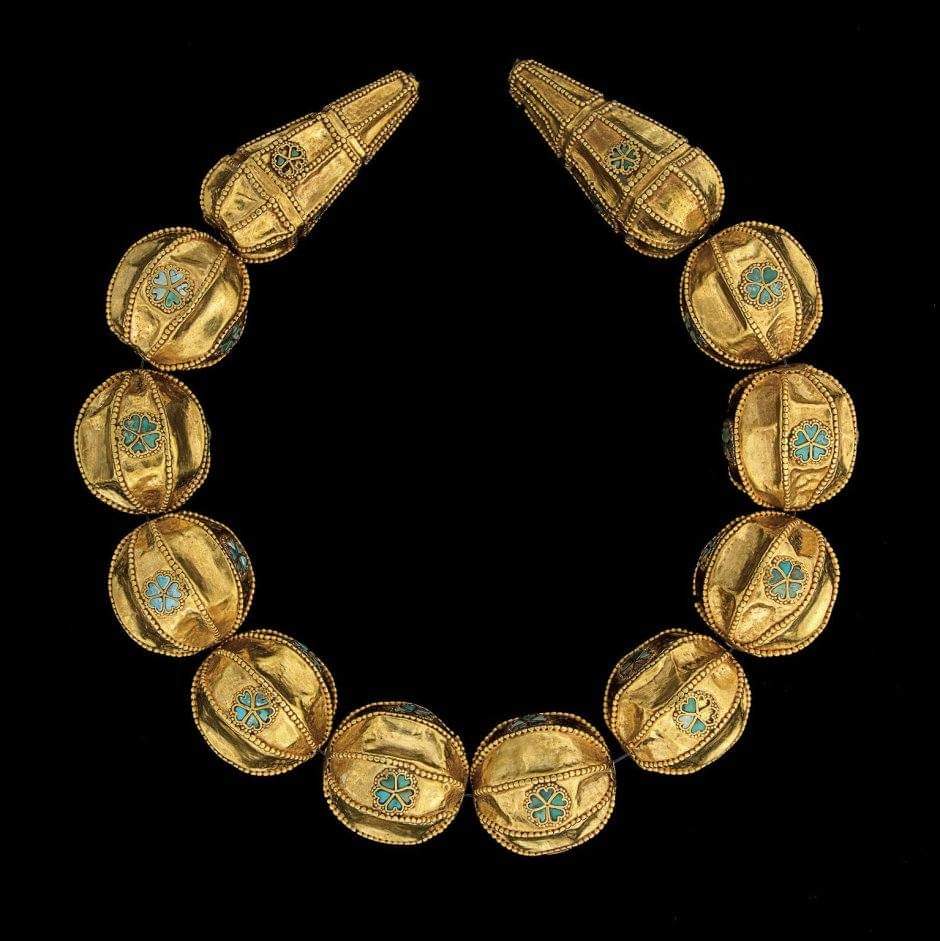
Gold Necklace (1st Century AD), from a tomb at Tillya Tepe (Golden Mound), an archaeological site, in Jowzjan province, near Sheberghan, Afghanistan.
Necklace belonged to the part of the Bactrian Gold Hoard (Collection of about 20,600 ornaments, coins and other kinds of artifacts, made of gold, silver, ivory, etc.), that were found in six burial mounds erected for five women and one man, with extremely rich jewelry, dated to around 1st Century BC - 1st Century AD.
In 1978, a group of archaeologists (Soviet-Afghan), under the leadership of Soviet archaeologist Viktor Sarianidi, who made a discovery in Afghanistan’s north that was to become one of most exciting finds of 20th Century. Digging in an area known as Tillya Tepe, which means “the Hill of Gold”, they unearthed the graves of several high-status nomads who had lived around 2,000 ago. They had been buried with an astounding number of precious objects; in fact, more than 20,000 artefacts were discovered, most of which were crafted from gold and semi-precious stones.
Often referred to as the “Bactrian hoard”, it was compared to the discovery of the treasures of Tutankhamun’s tomb in Egypt. The archaeologists discovered jewellery, weapons and ornaments revealing the influence of the many cultures that passed along the Silk Road.
One of the tombs was that of a male nomad, who was buried with weapons, jewellery and ornaments indicating high status as a leader and warrior. The other graves discovered belonged to women. Their costumes varied, which may have indicated that they were from different tribes, but it’s thought more likely that this may have reflected their social status. In all, 6 tombs were excavated, but no further research or excavation was able to be completed in the area. A seventh grave was discovered just before winter fell; it was carefully covered over to be investigated the following year, but in 1979 war broke out in Afghanistan and sadly the archaeologists couldn’t return.
These pieces have much in common with famous Scythian gold artifacts recovered thousands of kilometers west on the banks of Bosphorus and Chersonese. A high cultural syncretism pervades findings, however. Hellenistic cultural and artistic influences can be found in many of the forms and human depictions (from amorini to rings with depiction of Athena and her name inscribed in Greek), attributable to existence of Seleucid empire and Greco-Bactrian Kingdom in same area until around 140 BC, and continued existence of Indo-Greek Kingdom in northwestern Indian sub-continent until the beginning of our era. The artifacts were also intermixed with items coming from much farther, such as a few Chinese artifacts (especially Chinese bronze mirrors) as well as a few Indian ones (decorated ivory plates). This seems to be a testimony to richness of cultural influences in the area of Bactria at that time.
The hoard was thought to have been lost at some point in the 1990s, National Museum of Afghanistan having been looted numerous times resulting in a loss of 70% of the 100,000 objects on display. In 2003, however, it was found in secret vaults under the central bank building in Kabul. Since then, National Geographic Society has catalogued the collection, which appears to be complete – 22,000 objects. Also witnessing the re-opening were National Geographic Explorer and Archaeology Fellow Fredrik Hiebert and archaeologist who originally found hoard, Viktor Sarianidi.
Following an agreement between Afghan government and France, collection was evaluated and displayed internationally in an exhibition through the cooperation of several prominent museums and National Geographic Society. Objects were on display from 2007-2009, variously at Musée Guimet in Paris, National Gallery of Art in Washington DC, Asian Art Museum of San Francisco, Museum of Fine Arts in Houston, Metropolitan Museum of Art in New York.
National Museum of Afghanistan
#archaeohistories

English
Fahima Zahir ✨ retweetledi

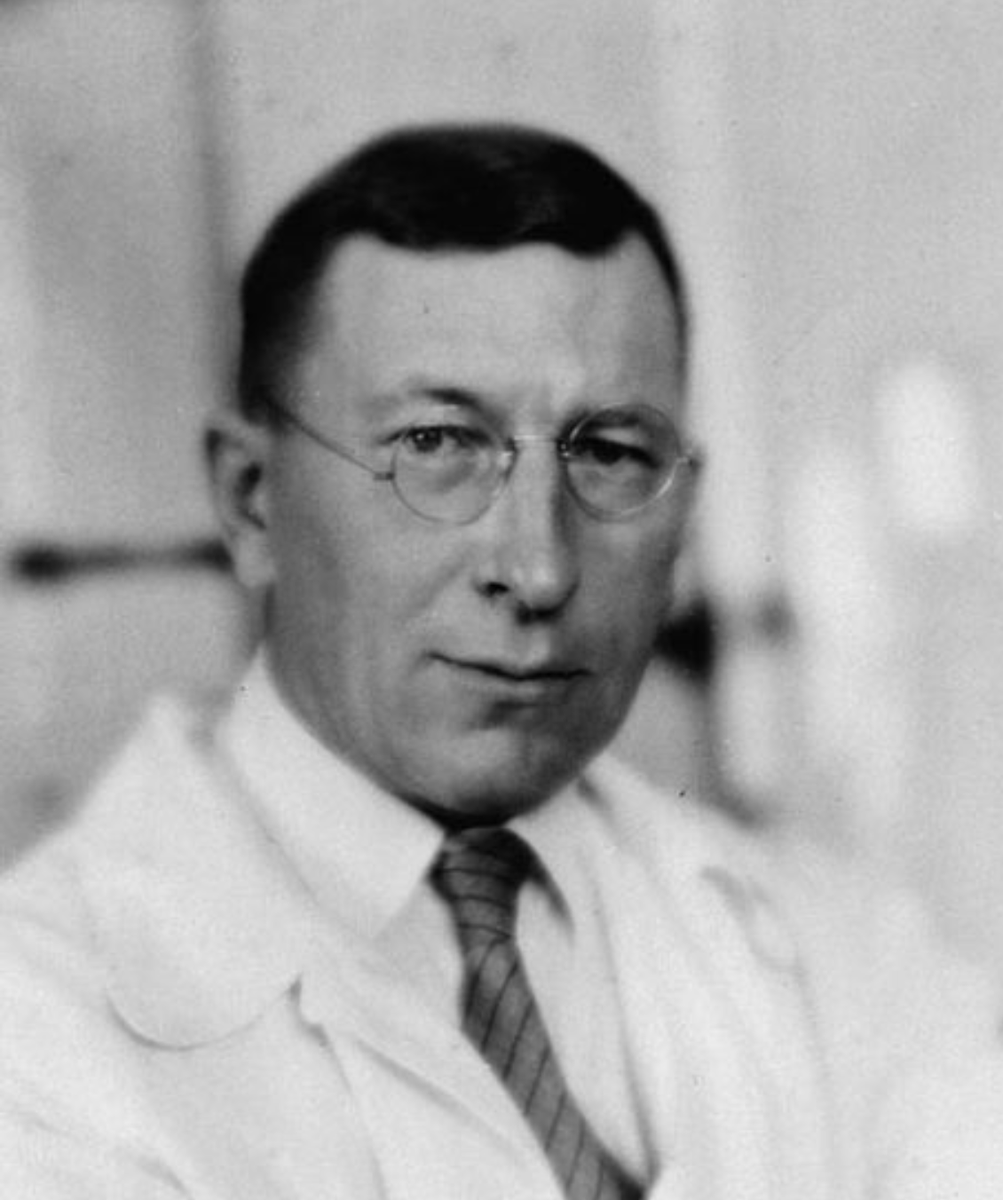
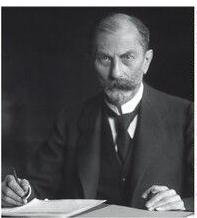
This is Sir Frederick Banting. He discovered insulin in 1923.
But he refused to put his name on the patent. Why?
Because Banting felt it was unethical to profit from a discovery that would save lives.
But pharmaceutical companies made huge financial offers to Banting for the patent, knowing they could make billions.
They even sweetened the deal, offering an insulin clinic, with Sir Banting in charge... a temping offer to almost doctor in his position.
Banting, however, said his discovery of isolated insulin was a gift to mankind. He felt this critical medicine should be available to everyone who needed it.
In 1923, Banting was just 31 years old when he was awarded the Nobel Prize.
Tragically, in 1941 while flying on a plane to personally protect scientific secrets from the Nazis, his plane crashed. He was killed.
Banting's co-inventors, in his honor, sold the patent for insulin to the University of Toronto for the appropriate sum they thought appropriate – one dollar.
Today, 30 million Americans with diabetes rely on his gift to mankind.
To honor Sir Frederick Banting, it should remain a gift to mankind.

English