KOG

3.2K posts

KOG

KOG

@faith00000007

JESUS IS LORD! RTs and likes are NOT endorsements

Katılım Aralık 2024
475 Takip Edilen67 Takipçiler
Sabitlenmiş Tweet
KOG
KOG@faith00000007·
🎯🎯🎯🎯🎯 We owe God our lives
KOG tweet media
English
0
0
0
381
KOG retweetledi
CSNTM
CSNTM@CSNTM·
#ManuscriptMonday Papyrus 93 is a single-fragment manuscript housed at the Instituto Papirologico in Florence, Italy. Dating to the 5th century, it preserves portions of John 13:15–17. View the image in our Digital Manuscript Collection: buff.ly/JJkfTRI
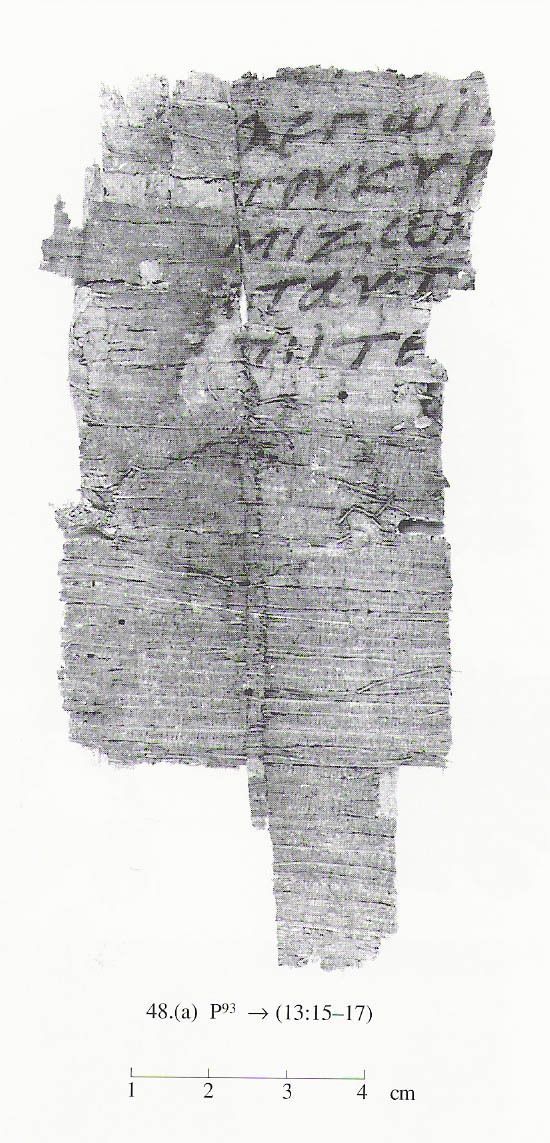
CSNTM tweet media
English
2
11
58
5.7K
KOG
KOG@faith00000007·
@lekan_olayinka1 The APC/current government has been complicit in this bl00dshed going on... But to AFFIRMATIVELY say "...Peter Obi would never permit this", almost as though there's a 100% GUARANTEE that he will end terror!sm, is thinking more highly of him we should Such trust is not even
English

2
0
1
513
Lekan Olayinka
Lekan Olayinka@lekan_olayinka1·
To those of you who compare Bola Ahmed Tinubu with Peter Obi on both a moral and intellectual level, this is what you are validating and endorsing. When people say Tinubu is a far better leader than Peter Obi, they normalize these kinds of actions. Because if Peter Obi would never permit this, yet Tinubu is said to be “far better” than him, then it becomes easier for people to overlook the atrocities happening under Tinubu’s leadership. This is why I resist those comparisons. There has been a psychological and political effort to elevate Tinubu to an illusory moral status, where he is no longer seen as responsible for these realities; simply by constantly comparing him with Peter Obi, a just man. That is the danger of propaganda: it conditions people to excuse what they would normally condemn. This is why I fight those who compare them. They have deployed pysops to elevate Tinubu to an illusory moral level, making him appear not responsible for this by comparing him to Peter Obi, a just man. This is the blood on your hands. All of you who support, vote, and indirectly endorse Tinubu, the blood of this nation is on your hands, and God will demand it from you.
Oyo Matters@Oyo_Matters

🚨 Mr. Oyedokun, Michael O, one of the teachers kidnapped in Oriire was just murdered, the video clip was bad. First picture below just before he was murdered and second picture when he was in his Sunday Best. He was a Mathematics teacher. The bandits that released the video clip in order to scare away the security operatives that are closing in on them.

English
10
162
285
18.4K
KOG
KOG@faith00000007·
@lekan_olayinka1 All of these are not pointers to the qualities you would look for when searching for a president that will change the system We hope but not blindly In the end, the Gospel of Christ is the only true solution to man's problems
English
0
0
0
7
KOG
KOG@faith00000007·
@lekan_olayinka1 The crisis in LP was actually a microcosm/smaller example of the crisis he will have to deal with as a president Sadly, we hardly find anything that shows leadership strength in how he handled it/spoke about it (blaming the ruling party, as though ev!l plays fair)
English
1
0
0
11
KOG retweetledi
larkfunding
larkfunding@larkfunding·
The support and resistance levels that actually hold are the ones created by volume Not arbitrary round numbers you drew manually 📊 Volume at price shows you exactly where institutions were active Those are the levels that get tested again and again Everything else is noise
English
0
2
19
380
KOG retweetledi
Kathy Lien
Kathy Lien@kathylienfx·
Hello Traders! 📉Stocks 🔻as Trump's return from China drives shifts focus on Iran 🇺🇸USD 🔻lower as yields retreat but watch for recovery 🇯🇵 JPY 🔻 PM considers endorsing budget to cushion economic blow 🇬🇧 GBP ⬆️ leads gains ahead of busy data week 🇦🇺AUD ⬆️ gains held back by weaker Chinese data 🇳🇿NZD ⬆️ stronger PMIs
English
0
5
21
1.2K
KOG retweetledi
Kathy Lien
Kathy Lien@kathylienfx·
🚨 YIELDS ARE SURGING. STOCKS ARE IN DENIAL 🚨 Mortgage rates at 7% A 50/50 shot at a Fed HIKE this year?! Iran headlines flying in every direction This is the setup traders can't afford to ignore this week Full breakdown inside
English
2
2
36
1.7K
KOG
KOG@faith00000007·
@yinksie_ because we expect from the earthly that which can only come from the heavenly So, yes, there should be circumspection in deciding who to marry, but vitally important is having expectations that are Christ-oriented Our true joy and satisfaction will always only be in Christ
English
0
0
0
11
KOG
KOG@faith00000007·
@yinksie_ Not a confidence that there'll never be problems in life, but a quiet super confidence that comes from having our hope in Christ alone, eternal and unfailing, not in what will pass away Really, our expectations, when distorted, inflated or selfish become traps + lead to despair
English
1
0
0
15
yinka
yinka@yinksie_·
the women in my mum's church talked about marriage today and it amazed me how casually they spoke about the possibility of infidelity and abuse. the fear of getting a beating is an actual motivating factor for many women in traditional marriage settings. nothing pushes them harder to adapt to reality and mature. and although religion can restrain, it doesn't necessarily prevent. i was inspired by the resilience of the women, but i won't say a part of me is not gutted by this reality i am surrounded by. i am mostly indifferent to marriage and romance. not like I can't enjoy those things, or that I don't have crushes and all those things. i do. a lot. i love romcoms too. but i have very little to sustain an imagination where marriage is an actual desirable reality where two people stay together, willing to love, cherish and honour each other. not just tolerate and uphold an institution for its prestige. of course, i know this sounds naive. look at the real world. life is tough. i don't disagree. i am just saying when i think about marriage, most of what i see is tiny bits of satisfaction baked into a general lifetime of meh and misery. you mature, you achieve, you change, but you learn that there's no person holding your personal cup of happy in themselves. it's just you learning to live with the human you have chosen. it's a lot like capturing a firefly. the fire dies out, now you have an insect that you must learn to love or at least live with. interestingly, here, sustaining a marriage for long is an achievement. but everyone understands if you try it out and it doesn't work out— well, understanding is relative, divorcees are not kindly treated, but at least there's some corporality. like battle scars. disfiguring but can also function as a badge of honour. i don't know what to make of this. it's all a little depressing. my conclusion would probably be that there's only one antidote to a bad marriage. and it's to never marry. but should you brave the possibility of one, at least, you do it with your eyes wide open.
English
1
0
1
91
KOG
KOG@faith00000007·
This is powerful 🔥 Worth taking heed to.
KOG tweet mediaKOG tweet media
Oloyede Olayinka@YinKysmileS

I think we can all agree that believers have always had disagreements on several doctrinal issues. And it is important to note that even our inspired brothers, the apostles, who saw, lived, and ate with the incarnate God, weren't exempt from these strong debates. Today, the most troubling thing in Christian online spaces is not simply that believers disagree, but the speed, confidence, and sometimes delight with which some Christians now tag others “heretics,” “false teachers,” “unsound,” or “outside the faith,” not always because the gospel has been denied, but because their theological system, denomination, or preferred teacher has been challenged. That is dangerous. Because Scripture commands discernment, yes. But it also condemns partiality, pride, slander, factionalism, and hypocritical judgment. Jesus said: “You hypocrite, first take the log out of your own eye, and then you will see clearly to take the speck out of your brother’s eye.” (Matt. 7:5) Paul warned: “Knowledge puffs up, but love builds up.” (1 Cor. 8:1) James also warned: “Not many of you should become teachers…” (James 3:1) And again: “Do not speak evil against one another, brothers. The one who speaks against a brother or judges his brother, speaks evil against the law and judges the law.” (James 4:11) This does not mean we cannot judge doctrine. We must. Paul told Timothy: “Take heed unto thyself, and unto the doctrine; continue in them: for in doing this thou shalt both save thyself, and them that hear thee.” (1 Tim. 4:16). Titus was told to “rebuke those who contradict” sound doctrine (Titus 1:9). John said to “test the spirits” (1 John 4:1). So the church must not become careless about truth. But biblical discernment is not the same as sectarian name-calling. A person is not automatically a heretic because he disagrees with our camp’s framework on election, spiritual gifts, baptism, communion, eschatology, church government, or secondary theological ordering. Heresy is not simply “a doctrine I strongly disagree with.” Heresy is a destructive departure from the apostolic gospel. The New Testament reserves its strongest condemnations for those who deny or corrupt the foundation: Another gospel (Gal. 1:6–9). Denial of Christ’s incarnation (1 John 4:2–3). Denial of the resurrection (1 Cor. 15:12–19). Denial of the Master (2 Pet. 2:1). Turning grace into sensuality (Jude 4). Works-righteousness as the basis of justification (Gal. 5:4). That is not the same as disagreement over every difficult doctrinal question. And here is where many of us must repent: We are often harsher on sincere believers outside our camp than we are on dangerous errors inside our camp. If a Catholic overstates tradition, Protestants shout “another gospel.” But if Protestants create celebrity cults around their own teachers, they call it “honoring sound men.” If a Pentecostal abuses prophecy, some Reformed voices shout “false teacher.” But if a Reformed voice teaches troubling determinism, many excuse it as “mystery.” If a charismatic preacher mishandles a text, he is mocked. But if a respected scholar bends “all,” “world,” or “whoever” until the words barely resemble their natural sense, it is called “deep exegesis.” If an Arminian seems to weaken sovereignty, he is condemned. But if a Calvinist presentation appears to weaken the sincerity of God’s universal call, many call it “high theology.” This selective outrage is not spiritual maturity. It is tribalism baptized in doctrinal language. Paul condemned party spirit in Corinth: “I follow Paul.” “I follow Apollos.” “I follow Cephas.” “I follow Christ.” Paul’s response was piercing: “Is Christ divided?” (1 Cor. 1:12–13) That question should haunt Christian Twitter. Is Christ divided? Then why do we behave as though our theological tribe owns Him? Why do some Pentecostals speak of cessationists as though they have no Spirit? Why do some Baptists speak of sacramental traditions as though nobody loved Scripture before them? Why do some Catholics and Orthodox speak as though Protestants are historical accidents? Why do some newly embraced theological converts treat their new doctrinal framework like enlightenment and everyone outside it like theological peasants? Why do some evangelicals behave as though church history began with their favorite conference? Every camp has blind spots. Arminianism has tensions around divine sovereignty, assurance, election, and the depth of human depravity. Calvinism has unresolved tensions around divine determinism, human responsibility, the universal gospel offer, and the meaning of texts like John 3:16, 1 Timothy 2:4, 2 Peter 3:9, Hebrews 2:9, and 1 John 2:2. Pentecostalism has produced deep hunger for the Spirit, but also excesses, emotionalism, and abuses of prophecy. Cessationism has defended the sufficiency of Scripture, but can sometimes functionally reduce the Spirit to doctrine alone. Catholicism preserves historic continuity and sacramental seriousness, but faces grave questions around Marian dogmas, papal authority, purgatory, and justification. Eastern Orthodoxy preserves ancient worship and mystery, but raises questions around icons, tradition, and authority. Baptists emphasize personal faith and Scripture, but have their own disputes over ecclesiology, baptism, and fragmentation. Lutherans, Anglicans, Methodists, Presbyterians, Charismatics, independents, all have strengths, all have weaknesses, all have histories of internal dispute. So if every theological weakness equals heresy, everyone becomes a heretic except the person speaking. That should terrify us. Because pride loves to turn conviction into superiority. The apostles themselves were not flawless in understanding from day one. Peter rejected the necessity of the cross and was rebuked sharply (Matt. 16:21–23). The disciples argued about greatness (Luke 22:24). They misunderstood the kingdom even after the resurrection (Acts 1:6). Peter later acted contrary to the truth of the gospel and Paul opposed him publicly (Gal. 2:11–14). Apollos was eloquent, fervent, and mighty in Scripture, yet incomplete in understanding until Priscilla and Aquila explained the way of God more accurately (Acts 18:24–26). The Jerusalem council involved “much debate” over a gospel-critical issue (Acts 15:7). This is Scripture showing us that growth, correction, and theological refinement are part of the life of God’s people. So why do we treat every imperfect formulation today as proof of rebellion? Why do we assume malice where there may be immaturity? Why do we assume deception where there may be limited understanding? Why do we assume heresy where there may be a brother who needs correction? Paul gives a different posture: “The Lord’s servant must not be quarrelsome but kind to everyone, able to teach, patiently enduring evil, correcting opponents with gentleness” (2 Tim. 2:24–25). That is not weakness. That is apostolic strength under the control of the Spirit. At the same time, Scripture gives no permission to tolerate deliberate gospel corruption. Paul did not gently dialogue with those preaching justification by circumcision as another gospel (Gal. 1:8–9). John did not treat denial of Christ as a minor interpretive difference (1 John 2:22–23). Jude did not normalize those who turned grace into sensuality (Jude 4). So we need categories. Not all errors are equal. Some errors are damnable. Some are dangerous. Some are serious but not gospel-destroying. Some are immature. Some are semantic. Some are inherited from tradition. Some are caused by limited knowledge of language, context, or history. This is where many online debates fail. They flatten everything. They make every disagreement an emergency. They make every correction a cancellation. They make every tradition outside their own camp suspicious. But Scripture teaches us to “rightly divide the word of truth” (2 Tim. 2:15). That requires patience. It requires context. It requires humility. It requires distinguishing between the foundation and the framework. The foundation is Christ: His deity. His incarnation. His sinless life. His atoning death. His burial. His bodily resurrection. His ascension. His exaltation. His lordship. His return. Salvation by grace through faith. The authority of Scripture. The call to repentance and faith. These are central. These are not negotiable. But many disputes happen not at the foundation, but at the framework level: How election works. How divine sovereignty relates to human responsibility. Whether gifts continue. If and how baptism should be administered. How communion should be understood. How church government should function. How prophecy should be regulated. How the millennium should be interpreted. How Israel and the church relate. These matter. But they do not all carry the same weight. A mature church knows how to contend without devouring. Paul said: “If you bite and devour one another, watch out that you are not consumed by one another” (Gal. 5:15). That describes much of online Christianity. We are often not defending the faith once delivered. We are defending our camps once discovered. Especially among some new theological converts, there is a common pattern: A person discovers a system. The system gives answers. The answers feel coherent. The person feels enlightened. Then everyone outside that system suddenly looks shallow, emotional, liberal, unserious, or unsound. That is not always maturity. Sometimes it is theological adolescence. Real maturity is slower. It knows that systems can help, but systems can also blind. It knows that church history matters, but church history is not inspired. It knows that confessions can be useful, but only Scripture is God-breathed (2 Tim. 3:16). It knows that teachers are gifts, but no teacher is lord over the conscience. Even Paul praised the Bereans because they tested his teaching by Scripture (Acts 17:11). If apostolic preaching was examined by Scripture, then Calvin, Wesley, Aquinas, Luther, Augustine, Chrysostom, contemporary pastors, Twitter theologians, and denominational traditions must all be examined by Scripture too. No camp gets immunity. No big name gets a pass. No circle should protect its own errors while exposing everyone else’s. That is hypocrisy. And Jesus was severe with hypocritical religion. “Woe to you, scribes and Pharisees, hypocrites” (Matt. 23). The church today needs both courage and humility. Courage to call out real error. Humility to admit our own camp has errors too. Courage to reject another gospel. Humility to stop calling every disagreement another gospel. Courage to defend doctrine. Humility to keep loving brothers we are correcting. Humility not to mistake wounded sheep for wolves. Because Christ did not tell us the world would know us by how brilliantly we win debates. He said: “By this all people will know that you are My disciples, if you have love for one another” (John 13:35). Love does not cancel truth. Truth does not excuse cruelty. The church must recover both. So before we call someone a heretic, we should ask: Has this person denied the apostolic gospel? Are they rejecting Christ, His incarnation, His cross, His resurrection, His lordship, or salvation by grace? Are they deliberately twisting Scripture after correction? Or are they a sincere believer with a flawed framework, limited understanding, inherited tradition, or immature expression? Those are not the same. And treating them as the same damages the body of Christ. The goal is not doctrinal laziness. The goal is doctrinal faithfulness with Christian character. Because if our theology makes us more arrogant, less patient, more tribal, more contemptuous, and less loving toward Christ’s people, then even where we are technically correct, something in us is spiritually wrong. “Speak the truth in love” (Eph. 4:15). Not truth without love. Not love without truth. Both. That is the apostolic way.

English
1
1
2
108
KOG
KOG@faith00000007·
@timothy_mukoro This is new to me (particularly if you're referring to Pastor Segun Onayinka)... Except you're saying this based on recent teachings I haven't listened to
English
1
0
0
34
Timothy Mukoro
Timothy Mukoro@timothy_mukoro·
@faith00000007 You are just dancing around, he teaches modalism. Modalism is an heresy, you listen to when they teach it, they even start by rubbishing councils and then they'll start explaining to you why the modalism which is an heresy is not an heresy, and how the church got it wrong prior.
English
1
0
0
44
KOG
KOG@faith00000007·
@timothy_mukoro By your last statement, you're rushing into hasty conclusions...but it's fine 😊
English
1
0
0
15
Timothy Mukoro
Timothy Mukoro@timothy_mukoro·
@faith00000007 Sorry, that's not how it works at all. I'll end the conversation here, you don't understand the gravity of the problem with Modalism, this is why you're stylishly running away from the fact that teach and believe this heresy.
English
1
0
0
5
KOG
KOG@faith00000007·
@timothy_mukoro Jesus is the Son of God which means He is God who was manifest in the flesh (1 Timothy 3:16) He is NOT the Father, He is the revelation of the Father (John 14:6-13) The Father is a distinct person in the Godhead
English
1
0
0
78
Timothy Mukoro
Timothy Mukoro@timothy_mukoro·
@faith00000007 You on your own, what do you understand by Jesus is God, do you mean Jesus is the father or Jesus is the son?
English
1
0
0
41
KOG
KOG@faith00000007·
@timothy_mukoro Not necessarily, what I meant is that even within 1 doctrinal position/camp, you can have up to 10 variants Theological positions typically exist on a spectrum with many ins and outs, caveats and variations They're not often binary
English
1
0
0
24
KOG
KOG@faith00000007·
@timothy_mukoro Or is there any other definition of the term "deity"?
English
1
0
0
20
KOG
KOG@faith00000007·
@timothy_mukoro - I've never heard him teach that the Father is the Son - The deity of Christ refers to Christ being God Himself
English
2
0
0
22