Ed Alexander

25K posts

Ed Alexander banner
Ed Alexander

Ed Alexander

@fanfoundry

Chief Digital Ventriloquist for a few brands. Busily aligning people, process & tech to improve content, conversation & conver$ion.

Customer, Internet, World Katılım Kasım 2009
4.7K Takip Edilen3.5K Takipçiler
Ed Alexander retweetledi
The Daily Britain
The Daily Britain@dailybritainonx·
Quote of the day 👇
The Daily Britain tweet media
English
395
20.3K
44K
814K
Ed Alexander retweetledi
Annie
Annie@AnnieForTruth·
Wake up…..
Annie tweet media
English
66
1.6K
3.6K
27.2K
Ed Alexander retweetledi
Annie
Annie@AnnieForTruth·
🎯🎯🎯
Annie tweet media
QME
166
3K
9K
62.6K
Ed Alexander retweetledi
Seth Bodnar
Seth Bodnar@SethBodnar·
Last week, the U.S. Senate gave a Chilean billionaire the green light to mine next to the most visited wilderness in America- the Boundary Waters. The ore mined would be sold directly to China. The public was completely cut out of the process. This sets a dangerous precedent for public lands everywhere - including right here in Montana. Our hunting, fishing, and recreating belong to us, not foreign billionaires and DC dealmakers. I will fight for our public lands as your Senator. Stand with us. Follow @SethBodnar for more. #declareyourindependence #mtsen #montana
English
286
5.3K
10K
249.8K
Ed Alexander retweetledi
chiky handler
chiky handler@chiky_handlr·
Epstein survivors release the most powerful PSA I have ever seen. Make this go viral so every member of the House of Representatives sees it. RT
English
314
23.8K
44.2K
524.7K
Ed Alexander retweetledi
Zoho Forms
Zoho Forms@ZohoForms·
Your data is your most valuable asset. Are you treating it like one? 🔐 Going beyond data collection means handling signatures, payments, and private info at scale. That requires more than just a form, it requires a vault. We just broke down the 2026 security standards for you: zurl.co/Lorm2 Stop worrying about the "what ifs" and start building with confidence. #InfoSec #Privacy #ZohoForms #Workflows
English
0
1
1
41
Ed Alexander retweetledi
Pete Buttigieg
Pete Buttigieg@PeteButtigieg·
Don't let anyone tell you that an area is too red or too far out of reach for our message. Just look at how many people turned out on a Saturday night in April, in a gym in Oklahoma.
English
869
2.8K
14.8K
243K
Ed Alexander retweetledi
Steve Schale
Steve Schale@steveschale·
This is so good. The art of talking to people you disagree with —>
English
41
483
3.3K
144.7K
Ed Alexander retweetledi
Katelyn Bourgoin 🧠
Katelyn Bourgoin 🧠@KateBour·
Not all proof is created equal. How does yours rank up? So if you’ve been following me for a while or done any of my programs, then you already know that I talk about proof… A LOT. You can have the best product in the world, but without proof? Every sale will be a slog. There are 8 different types of proof, and I’ve experienced them all—from being featured in Inc. and winning awards to getting unsolicited shoutouts from smart, respected people. (One tweet from Amanda Natividad once sent me 3,500 new Twitter followers overnight.) If you’re trying to use proof more strategically, think of it in tiers: → Tier 1: Borrowed proof Think stuff like industry stats or success stories that validate your recommended approach. These aren’t results you’ve gotten *personally*, but they add credibility to your argument. → Tier 2: Self-reported results This is sharing your own wins or numbers. Valuable, but you’re the least objective source so they can raise skepticism. → Tier 3: Paid media mentions Think being featured in recognizable media outlets or a popular newsletter. You benefit from association with a trusted brand. And there’s real SEO value and credibility in saying “as seen on” Business Insider or ABC. → Tier 4: Solicited testimonials A real person vouched for you and sings your praises. Even if you asked, they still chose to say it. → Tier 5: Earned third-party recognition Stuff like getting earned media coverage, winning an award, or making a “best of” list. Someone with their own credibility decided you were worth featuring. → Tier 6: Unsolicited customer praise A client publicly gushes about how great you are without being asked. No incentive to exaggerate. → Tier 7: Demonstrated results A live demo or visible public outcome. You’re not claiming results—you’re showing them. The buyer draws their own conclusion without needing to trust anyone’s word. → Tier 8: Endorsement from a trusted source Someone your buyer already trusts vouches for you. Because that person was already known and trusted, that credibility transfers directly to you. What kind of proof are you using in your business? Most experts mostly stick to Tiers 1 and 2. The higher tiers are where clients actually convert. Makes sense, right?
Katelyn Bourgoin 🧠 tweet media
English
11
5
32
1.7K
Ed Alexander retweetledi
J
J@jasonllevin·
Can I get a Hell Yeah!
J tweet media
English
565
4.2K
14.7K
89.3K
Ed Alexander retweetledi
Katelyn Bourgoin 🧠
Katelyn Bourgoin 🧠@KateBour·
Your buyer’s brain is lazy. That’s why your positioning can’t be. Have you lost work to someone you’re objectively better than? It stings. Maybe you found out later. Maybe you just suspected. The thinking was shallower, the track record thinner—but they got the call because they were top-of-mind. It’s not fair. Bur it’s how buying decisions actually get made. When someone needs to hire an expert, there’s rarely a painstaking process where they evaluate all possible options against carefully curated criteria. It works more like… autocomplete. The person who owns a specific space in the buyer’s brain gets in the consideration set. Type “marketer.” Crowded results page, no clear winner. The brain sputters and stalls. Type “ownable ideas.” One mental result. (At least that’s what I’m working towards.) The science behind top-of-mind positioning: → System 1 thinking: Kahneman found that 96% of decisions are automatic and unconscious—done before the buyer knows they’ve decided. They’re not evaluating you. They’re retrieving whoever loads first. → Neural networks: Every concept lives as a cluster of strongly connected neurons. Vague positioning or trying to be known for ALL THE THINGS creates a weak, crowded assembly. There are too many competing signals, nothing loads cleanly. One specific idea builds a dedicated network that fires the moment that exact problem hits. → The availability heuristic: The brain uses ease of recall as a proxy for quality. Whoever surfaces first gets assumed to be the best option. Because retrieval feels like relevance (even when evidence is slim). Your buyer’s lazy brain makes the shortlist. It’s your job to position yourself so clearly—and to repeat the same sharp idea so compellingly—that your name gets autofilled when people need your thing. That’s how you win. -- PS: I write about the psychology behind ownable ideas every week in my Unignorable newsletter. 63k entrepreneur experts already read it. Want in? Link in my bio: @KateBour
Katelyn Bourgoin 🧠 tweet media
English
13
2
31
1.6K
Ed Alexander
Ed Alexander@fanfoundry·
@KateBour Except if you're Richard Feynman, who famously said (roughly) that if you can't explain something complex so a 5 year old can understand it, perhaps you don't understand it well.
English
0
0
1
26
Katelyn Bourgoin 🧠
Katelyn Bourgoin 🧠@KateBour·
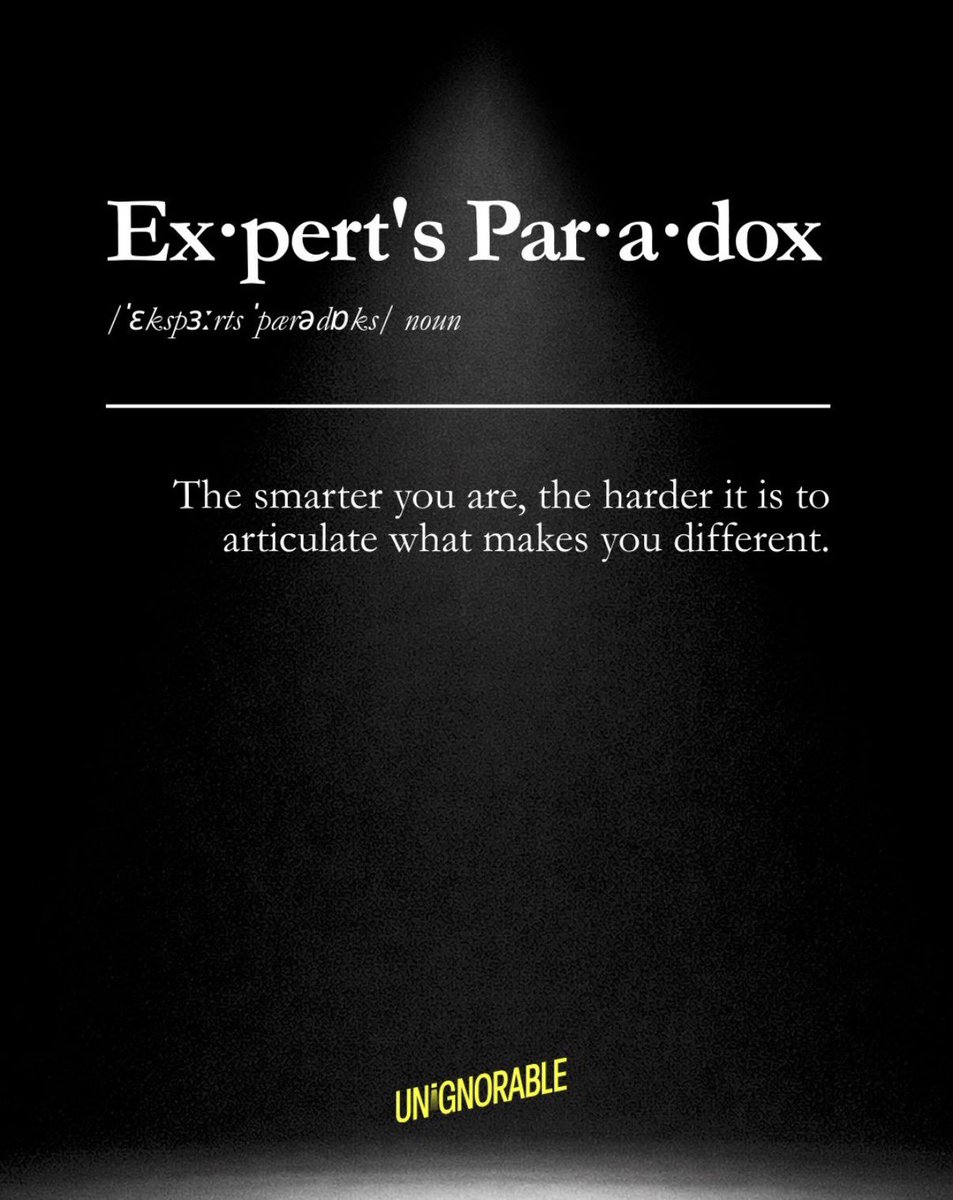
The deeper your expertise, the harder it is to see what makes you different. This is the Expert’s Paradox. And it’s brutal.
Katelyn Bourgoin 🧠 tweet media
English
14
1
28
1.4K
Ed Alexander retweetledi
Glenn Greenwald
Glenn Greenwald@ggreenwald·
You won't hear a better 55-second description of MAGA and Trump than this: in terms of the perspective of any minimally honest MAGA supporter:
English
2.3K
12.7K
39.2K
2.1M