

Freddy
2K posts
Freddy
@fat_freddy1
building in web3 ⛓️ | biz dev & Co-Founder @talalabsio | prediction markets enjoyer | truth is bullish 🔮
Katılım Nisan 2021
3.5K Takip Edilen628 Takipçiler

Imagine you own 1% of WynnDEX
We generate billions in volume (easy), I myself through my own personal affiliate link generated BILLIONS in volume for HyperLiquid.
But instead of all of it going to the house.. you get a proportion of the profits.
This isn’t so much about money for me, although I do have dreams of owning a private jet, I still feel cheap when chartering a small jet.
But if WE THE PEOPLE own this DEX and own a share of its profits, think of the power of community meme coins, right narrative they can go to billions. I see this kind of power but bringing it into the perp trading world.
Wynn
English
English

@fat_freddy1 @vikrantnyc @shinohai2017 Motorola will support GrapheneOS natively and I want to support Motorola for doing so.
English

BlackBerry had it figured out with that little LED in the corner.
English
@Kushed_Crypto @vikrantnyc @shinohai2017 Why motorola though? Pixel are much better for graphene OS.
English
English
English
@vikrantnyc @shinohai2017 Missed it so much... the physical keyboard was unmatched.
English


funds haven't moved to tornado or swapped for XMR yet. sitting perfectly still on etherscan. maybe we're looking at a white hat who just wanted to teach thorchain a lesson about their tech debt.
etherscan.io/address/0xd477…
Vadim (AI, ⋈)@zacodil
Thorchain didn't lose $10.7M to a smart contract bug or a stolen key. The bug was in the cryptography itself - and Thorchain probably isn't the only chain running on it. A single attacker bonded RUNE and joined the validator set days before the incident, looking like any legitimate operator. From inside, they exploited what investigators currently believe was a flaw in GG20, the threshold signature library Thorchain uses to co-sign transactions. Each signing session leaked a fragment of private key material to the attacker's node. After enough sessions, they had collected enough leaked data to mathematically reconstruct the vault's full private key. Then they signed unauthorized outbound transactions as the vault. The smart contracts behaved correctly. No validator infrastructure was breached. Funds left through normal channels because the signatures were mathematically valid - just produced by an attacker who had silently rebuilt the key. Here's why this matters beyond Thorchain. GG20 was published in 2020 (Gennaro-Goldfeder). The Alpha-Rays attack (Verichains, 2023) and TSSHOCK at BlackHat 2023 documented practical weaknesses in tss-lib and related implementations. Some teams patched. Many didn't bother. Based on shared library lineage, protocols that should audit their TSS right now include Mayachain (direct THORChain fork), Sygma cross-chain bridge, Keep Network's tBTC v1, and any service still running on bnb-chain/tss-lib or ZenGo-X/multi-party-ecdsa. Major custody and MPC services that already migrated to newer threshold schemes (CGGMP21, DKLs): Fireblocks, Coinbase Custody, Taurus, Silence Laboratories. The industry has been quietly moving away from GG20 for two years. Thorchain just gave everyone still on it a reason to move faster.
English

Freddy retweetledi

Community alert
We are monitoring reports of a potential THORChain exploit across BTC, ETH, BSC, and Base for $10M+.
The protocol has paused trading as a result.
Reported theft addresses:
BTC:
bc1ql4u94klk265lnfur2ujk9p6uh52f2a8jhf6f37
EVM:
0x82fc0d5150f3548027e971ec04c065f3c93154eb
Please rely only on official THORChain channels for confirmed updates.
Avoid unofficial links and speculation.
Stay safe.
English


@Twinkyboikrish Even kerala dishes are not as masala dense, people prefer more chicken/meat flavour.
English

Problem with Indian meat eaters is that they eat meat like acchar and then brag muhh protein
Dawg you had 20 gms of chicken with 100ml oil 😭
Sayantika@SayantikaSays
My plate is free from tears, guilt and pain of innocent plants ☘️ 🙏
English

The Ethereum wave is hitting hard in India w/ @EFDevcon
The south has been watching. (Mainly Kerala). Not anymore.
Builders, assemble. Something is cooking.
More details soon.
cc - @Web3_kerala
English


Lmao dickhead here started posting about xmr. I liked a post. He followed me. I followed back. He unfollowed. I unfollowed back. Liked another post. He refollowed. I refollowed(maybe it was an accident). He unfollowed again. Okay I block the account. @0xturbo_
English


I’m not doing this X thing correctly. I’m the CFO of a company that just announced the largest crypto M&A deal in history, I posted about it, then reposted my own posts and somehow I only gained one follower this week…. Can someone tell me what I’m doing wrong?

English

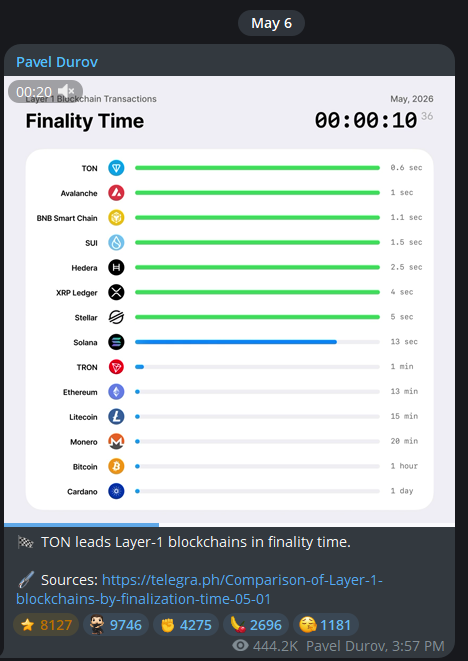
Pavel Durov, founder of Telegram, posted this video in regards to TON's finality time.
I'll take Monero at 20 minutes and beyond any day.
English

What would your advice be for someone who wants to invest in BTC?
English


For those who are sleeping under some Vishwaguru rock.
This technology is being used on you.
Wim den Oudsten@WimdenOudsten
IK PRESENTEER U, UW H.A.A.R.P.-KLIMAATSTOORNIS! De hoogfrequente HAARP-zender wordt gebruikt om extreem/zeer laagfrequente golven op te wekken door middel van gemoduleerde verwarming van de ionosfeer/magnetosfeer. De Universiteit van Maranhao in Brazilië heeft geconcludeerd dat dit aardbevingen, cyclonen en sterke plaatselijke verwarming kan veroorzaken.
English